The Industrial Disputes Act, 1947 (IDA) was India's principal legislation governing employer-employee relations, dispute resolution, and conditions of service in industrial establishments. Enacted on 11 March 1947, it remained in force for over seven decades. The Act has now been subsumed under the Industrial Relations Code, 2020, one of four new labour codes. For UPSC aspirants, understanding both the original Act and the reforms is essential for Polity (GS-II) and Economy (GS-III) papers.
Background and Objective
Before the IDA, industrial relations in India were governed by the Trade Disputes Act, 1929, which had limited scope. The IDA was enacted to:
- Provide a mechanism for investigation and settlement of industrial disputes
- Prevent illegal strikes and lockouts
- Provide security of tenure to workers against arbitrary retrenchment and closure
- Promote collective bargaining between employers and workers
Key Definitions Under the Act
| Term | Definition (Section) |
|---|---|
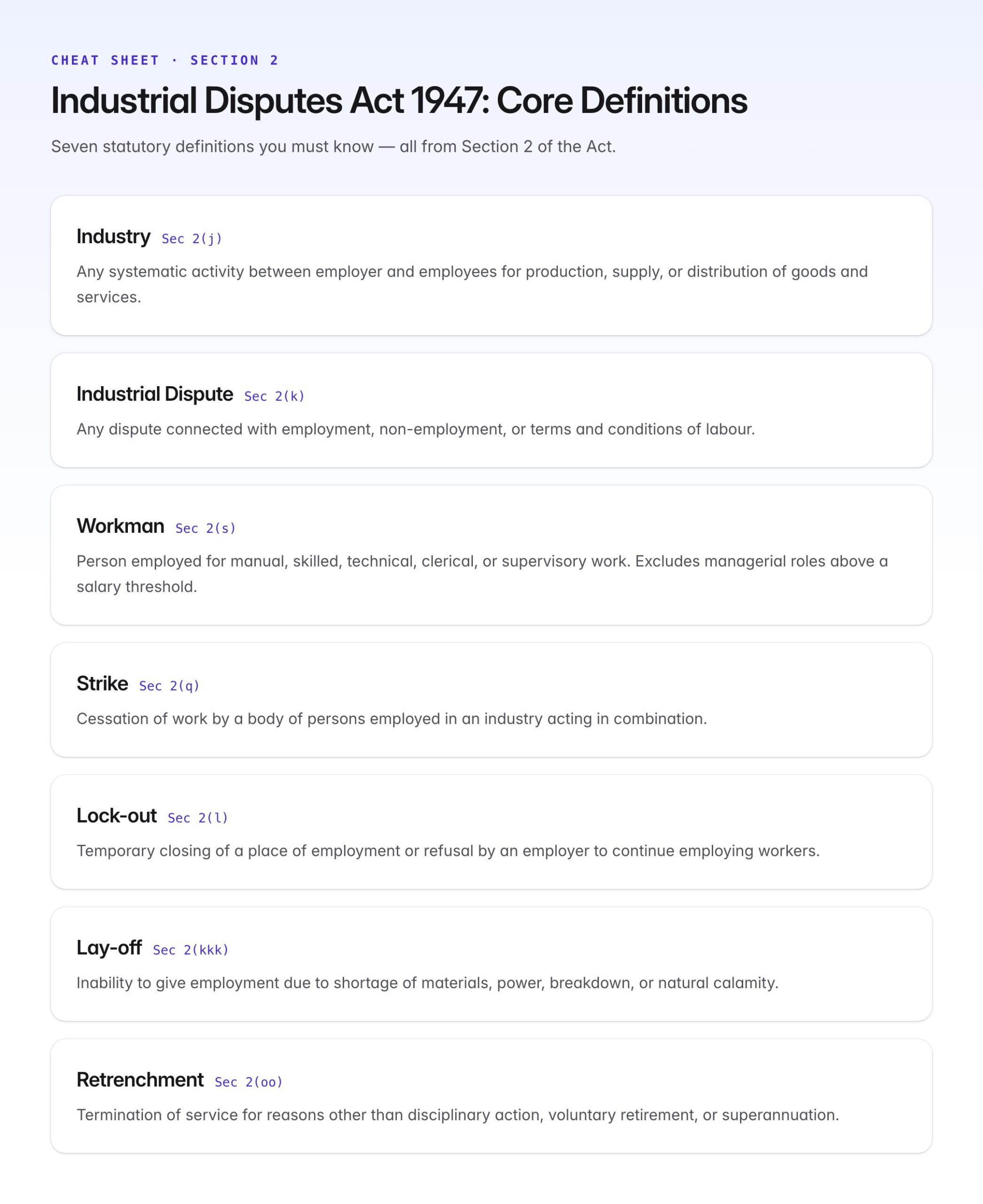
| Industry (Sec. 2(j)) | Any systematic activity carried on by co-operation between employer and employees for production, supply, or distribution of goods and services |
| Industrial Dispute (Sec. 2(k)) | Any dispute or difference between employers and employers, employers and workmen, or workmen and workmen, connected with employment, non-employment, terms, or conditions of labour |
| Workman (Sec. 2(s)) | Any person employed in an industry to do manual, unskilled, skilled, technical, operational, clerical, or supervisory work (excludes those in managerial/administrative capacity drawing above specified salary) |
| Strike (Sec. 2(q)) | Cessation of work by a body of persons employed in an industry acting in combination |
| Lock-out (Sec. 2(l)) | Temporary closing of a place of employment, suspension of work, or refusal by an employer to continue employing workers |
| Lay-off (Sec. 2(kkk)) | Failure, refusal, or inability of an employer to give employment due to shortage of materials, power, breakdown of machinery, or natural calamity |
| Retrenchment (Sec. 2(oo)) | Termination of service of a workman by the employer for any reason other than disciplinary action (excludes voluntary retirement, retirement on superannuation, non-renewal of contract) |
Dispute Resolution Machinery
The IDA established a multi-tier system for dispute resolution.
Conciliation
| Authority | Appointed By | Function |
|---|---|---|
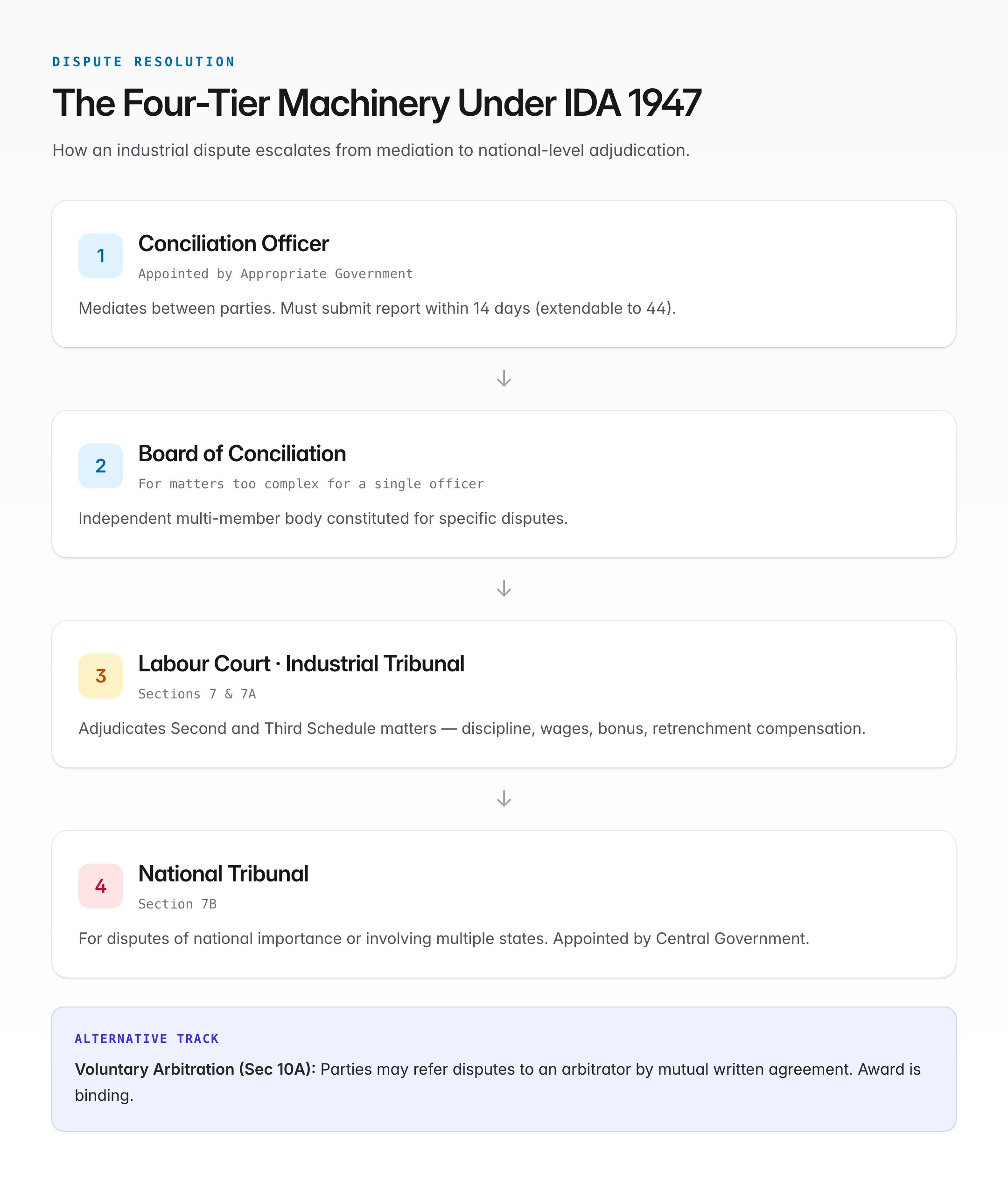
| Conciliation Officer | Appropriate Government | Mediates disputes; promotes settlement between parties |
| Board of Conciliation | Appropriate Government | Independent body for disputes that conciliation officers cannot resolve |
A conciliation officer must submit a report within 14 days (extendable to 44 days) of receiving notice of a dispute.
Adjudication
| Authority | Jurisdiction | Composition |
|---|---|---|
| Labour Court (Sec. 7) | Matters in Second Schedule (discharge, disciplinary action, withdrawal of concessions, legality of strikes/lockouts) | One presiding officer (district judge-level) |
| Industrial Tribunal (Sec. 7A) | Matters in Second and Third Schedule (wages, bonus, working hours, retrenchment compensation, rationalisation) | One presiding officer; may have assessors |
| National Tribunal (Sec. 7B) | Disputes of national importance or involving multiple states | Appointed by Central Government |
Voluntary Arbitration
Under Section 10A, parties may refer a dispute to an arbitrator by written agreement. The award is binding and enforceable like a tribunal award.
Strikes and Lockouts: Legal Framework
When Strikes Are Illegal
| Condition | Section |
|---|---|
| Without giving 14 days' notice in a public utility service | Sec. 22(1) |
| Within 14 days of giving such notice | Sec. 22(1) |
| During the pendency of conciliation proceedings and 7 days after conclusion | Sec. 22(1) |
| During pendency of proceedings before a Labour Court, Tribunal, or National Tribunal | Sec. 22(1) read with Sec. 23 |
| Contrary to any award or settlement in force | Sec. 23 |
When Lockouts Are Illegal
The same conditions apply symmetrically to employers declaring lockouts. Additionally, an employer in a public utility service cannot declare a lockout without 14 days' notice.
Penalties
- Illegal strike: Imprisonment up to 1 month or fine up to Rs 50, or both (Sec. 26)
- Illegal lockout: Imprisonment up to 1 month or fine up to Rs 1,000, or both (Sec. 26)
- Instigation of illegal strike/lockout: Imprisonment up to 6 months or fine up to Rs 1,000, or both (Sec. 27)
Retrenchment and Closure Provisions
Chapter VA (Establishments with 50-99 workers)
- Retrenchment: Employer must give one month's notice (or pay in lieu) and retrenchment compensation of 15 days' average pay for every completed year of service.
- Last in, first out (LIFO) principle applies unless otherwise justified.
Chapter VB (Establishments with 100+ workers)
- Employer must seek prior permission of the Appropriate Government before retrenchment, lay-off, or closure.
- This provision was a major source of criticism from employers who argued it discouraged hiring and formalisation.
Landmark Amendments
| Year | Amendment | Significance |
|---|---|---|
| 1976 | Chapter VB inserted | Prior government permission required for closure/retrenchment in units with 300+ workers |
| 1982 | Threshold reduced to 100 | Extended protection to smaller units |
| 1984 | Unfair labour practices defined (Schedule V) | Listed specific unfair practices by employers and workers |
| 2010 | Amendment Bill introduced (lapsed) | Attempted to raise Chapter VB threshold back to 300 |
The New Labour Codes: Replacing the IDA
The Industrial Relations Code, 2020 (IRC) replaces three Acts: the IDA 1947, the Trade Unions Act 1926, and the Industrial Employment (Standing Orders) Act 1946.
Key Changes Under the Industrial Relations Code, 2020
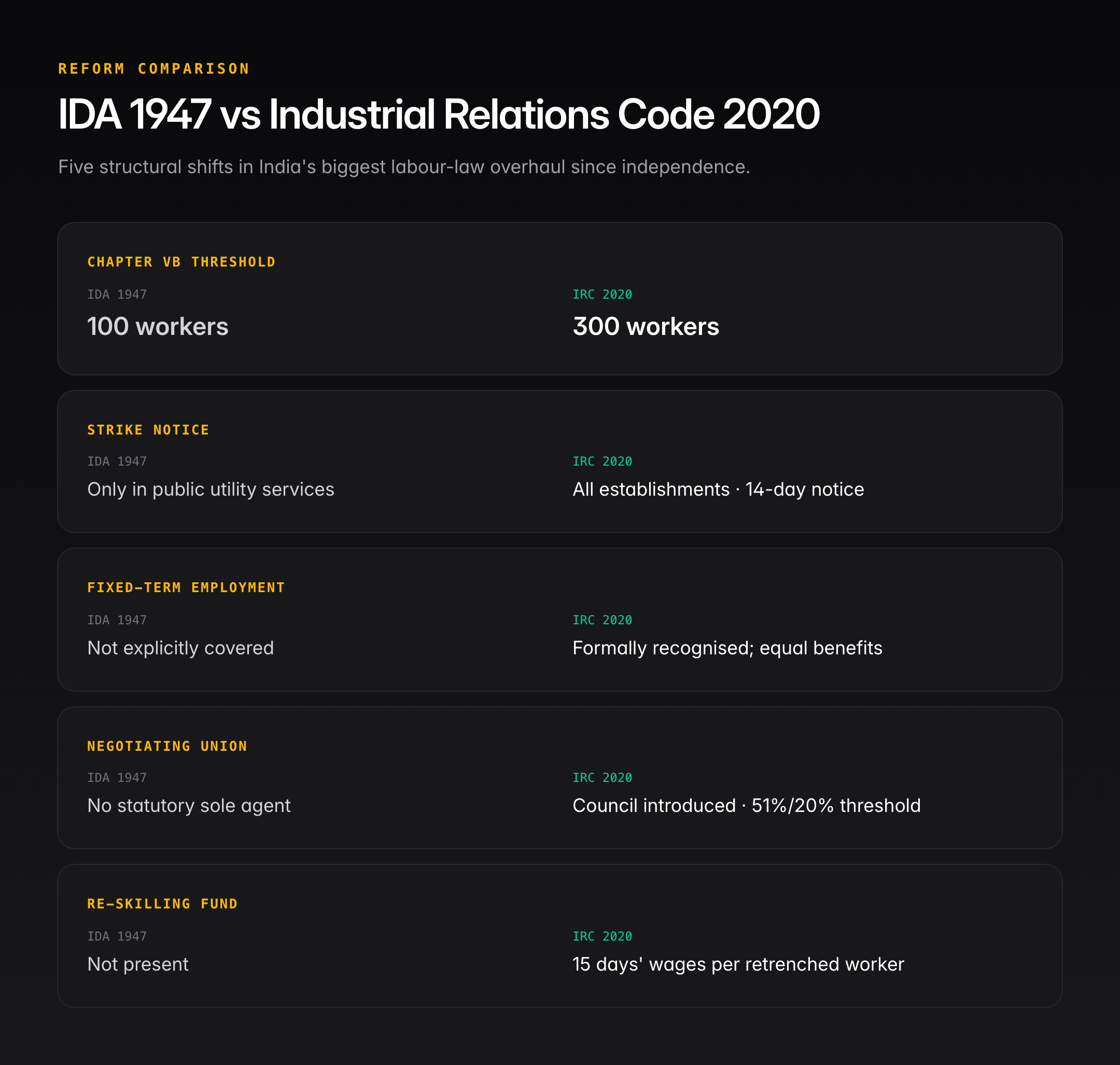
| Feature | IDA 1947 | Industrial Relations Code 2020 |
|---|---|---|
| Chapter VB threshold | 100 workers | 300 workers (government can raise further by notification) |
| Strike notice | Only in public utility services | All industrial establishments must give 14 days' notice |
| Definition of worker | "Workman" (excludes supervisory staff above Rs 10,000) | "Worker" — updated salary threshold |
| Fixed-term employment | Not explicitly covered | Formally recognised; fixed-term workers get same benefits as permanent workers |
| Recognition of trade unions | No statutory provision for sole negotiating agent | Negotiating Union/Council concept introduced (51% or 20% threshold) |
| Re-skilling fund | Not present | Employer must contribute 15 days' wages to a re-skilling fund for retrenched workers |
| Dispute resolution | Conciliation officer, Labour Court, Tribunal | Two-member Industrial Tribunal replaces Labour Courts; Grievance Redressal Committee mandatory in units with 20+ workers |
Status of Implementation
As of 2026, the four Labour Codes (Wages, Social Security, Industrial Relations, and Occupational Safety) have been passed by Parliament but their implementation depends on states framing rules. Several states have notified draft rules, but nationwide implementation remains a work in progress.
Important Case Law
| Case | Significance |
|---|---|
| Bangalore Water Supply v. A. Rajappa (1978) | Supreme Court widened the definition of "industry" using the triple test: systematic activity, organised by co-operation, for production/distribution of goods and services |
| Workmen of Dimakuchi Tea Estate v. Management (1958) | Clarified principles of bonus as a deferred wage |
| Excel Wear v. Union of India (1978) | Upheld the constitutional validity of Chapter VB (prior permission for closure) |
UPSC Relevance
| Paper | How It Appears |
|---|---|
| Prelims (GS) | Definitions (strike, lockout, retrenchment), difference between lay-off and retrenchment, new Labour Codes |
| Mains GS-II (Polity/Governance) | Labour reforms, ease of doing business, rights of workers |
| Mains GS-III (Economy) | Labour market flexibility, formalisation, industrial growth |
| Essay | Workers' rights vs economic liberalisation; India's manufacturing ambitions |
Key terms to remember: Industrial Disputes Act 1947, Industrial Relations Code 2020, conciliation, adjudication, workman, retrenchment, Chapter VB, prior permission, fixed-term employment, negotiating union, re-skilling fund.
The transition from the IDA to the new Labour Codes represents India's most significant labour law reform since independence, attempting to balance worker protection with employer flexibility and ease of doing business.
Tell Google you want more of this.
Add Anantam IAS as a preferred sourceOne tap, and this site shows up more often in your own Top Stories, AI Overviews and AI Mode. Remove it any time.