The Industrial Disputes Act 1947 is the spine of post-independence labour law in India. For seventy-eight years it set the rules for how a quarrel between an employer and a workman gets named, escalated, and finally settled. It told a factory owner what counts as a strike and what counts as a lockout. It told a workman when retrenchment compensation kicks in and when a closure needs government permission. It built a five-step adjudication ladder that begins inside the workplace and ends at a national tribunal in Delhi.
The Industrial Disputes Act 1947 has now been formally subsumed into the Industrial Relations Code 2020, which the central government notified into force on 21 November 2025. The Code consolidates three older statutes: the Trade Unions Act 1926, the Industrial Employment (Standing Orders) Act 1946, and the Industrial Disputes Act 1947. But the Code carries forward most of the architecture of the 1947 Act, so understanding the parent law is still the only way to read the Code intelligently.
This explainer walks through the machinery the Industrial Disputes Act 1947 created, the definitions of strike, lockout, layoff, retrenchment, and closure, the leading judgments, and the points the IR Code changes. It’s written for UPSC mains GS-II and GS-III, prelims polity, and the labour-law section of the optional sociology and political science syllabi.
Quick Facts on the Industrial Disputes Act 1947
- Enacted. 11 March 1947, came into force 1 April 1947.
- Total sections. 40 sections in seven chapters plus five schedules.
- Goal. Investigation and settlement of industrial disputes, and prevention of unfair labour practices.
- Authorities created. Works committee, conciliation officer, board of conciliation, court of inquiry, labour court, industrial tribunal, national tribunal.
- Key concepts. Industrial dispute, strike, lockout, layoff, retrenchment, closure, workman, wages.
- Replaced by. Industrial Relations Code 2020, notified into force on 21 November 2025.
- Applies to. Workmen in industries as defined in Section 2(j), now read with the Bangalore Water Supply test (1978).
- Compensation. 15 days’ average pay per completed year for retrenchment; one month’s notice or pay in lieu (Section 25F).
What the Industrial Disputes Act 1947 Was Designed To Do
The Industrial Disputes Act 1947 grew out of two earlier statutes, the Trade Disputes Act 1929 and the Defence of India Rules notifications of the Second World War. Both had failed to give Indian industry a settled dispute-resolution system. The 1947 Act tried to fix that by creating a layered set of forums and by attaching legal force to settlements reached in conciliation or imposed by adjudication.
The statute pursues four objectives. First, it provides machinery for the investigation and settlement of industrial disputes. Second, it promotes amicable relations between employer and workman through internal works committees. Third, it prevents illegal strikes and lockouts by imposing notice and cooling-off requirements. Fourth, it secures relief for workmen affected by layoff, retrenchment, and closure through a defined compensation regime.
The Industrial Disputes Act 1947 was a response to the wave of post-war industrial unrest that hit Bombay, Calcutta, and Kanpur in 1946. Parliament chose to put dispute settlement on a statutory footing rather than leave it to ad-hoc tribunals, and that choice has shaped Indian labour jurisprudence ever since.
The Five-Tier Dispute Resolution Machinery
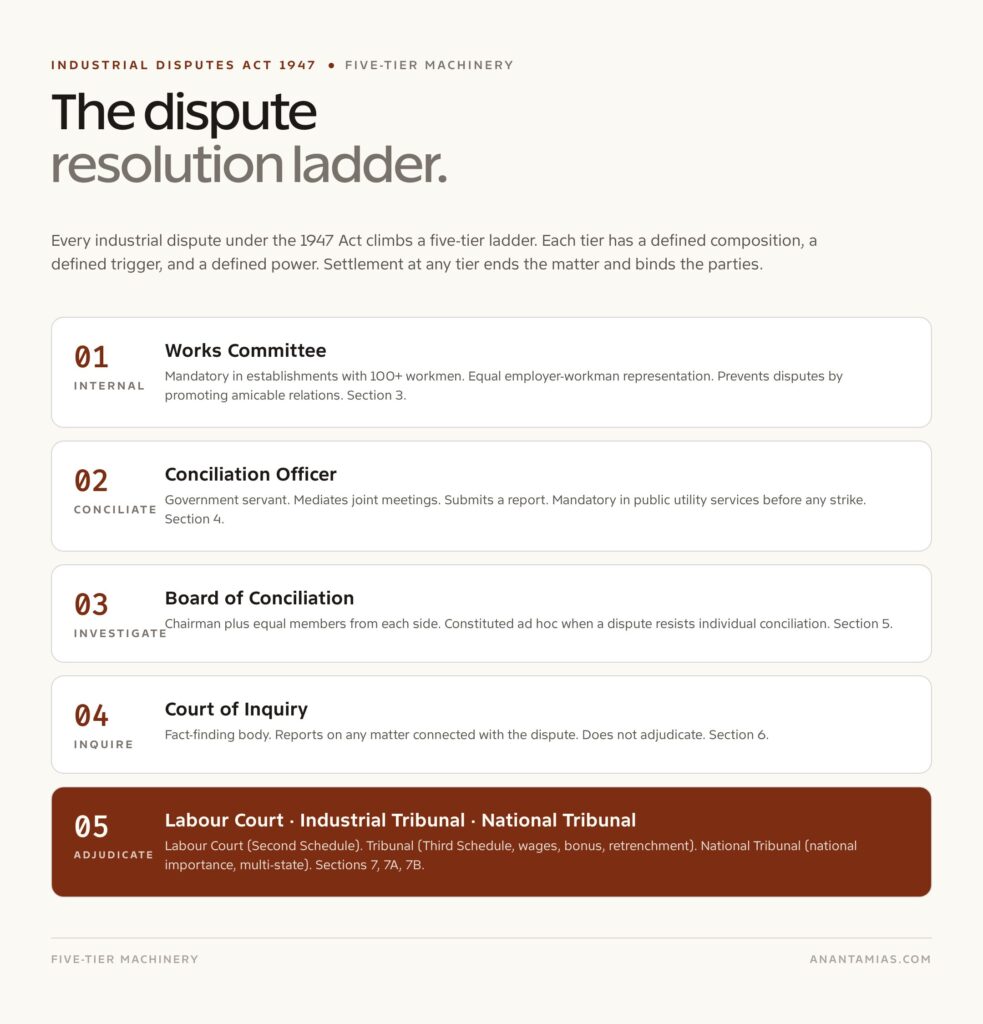
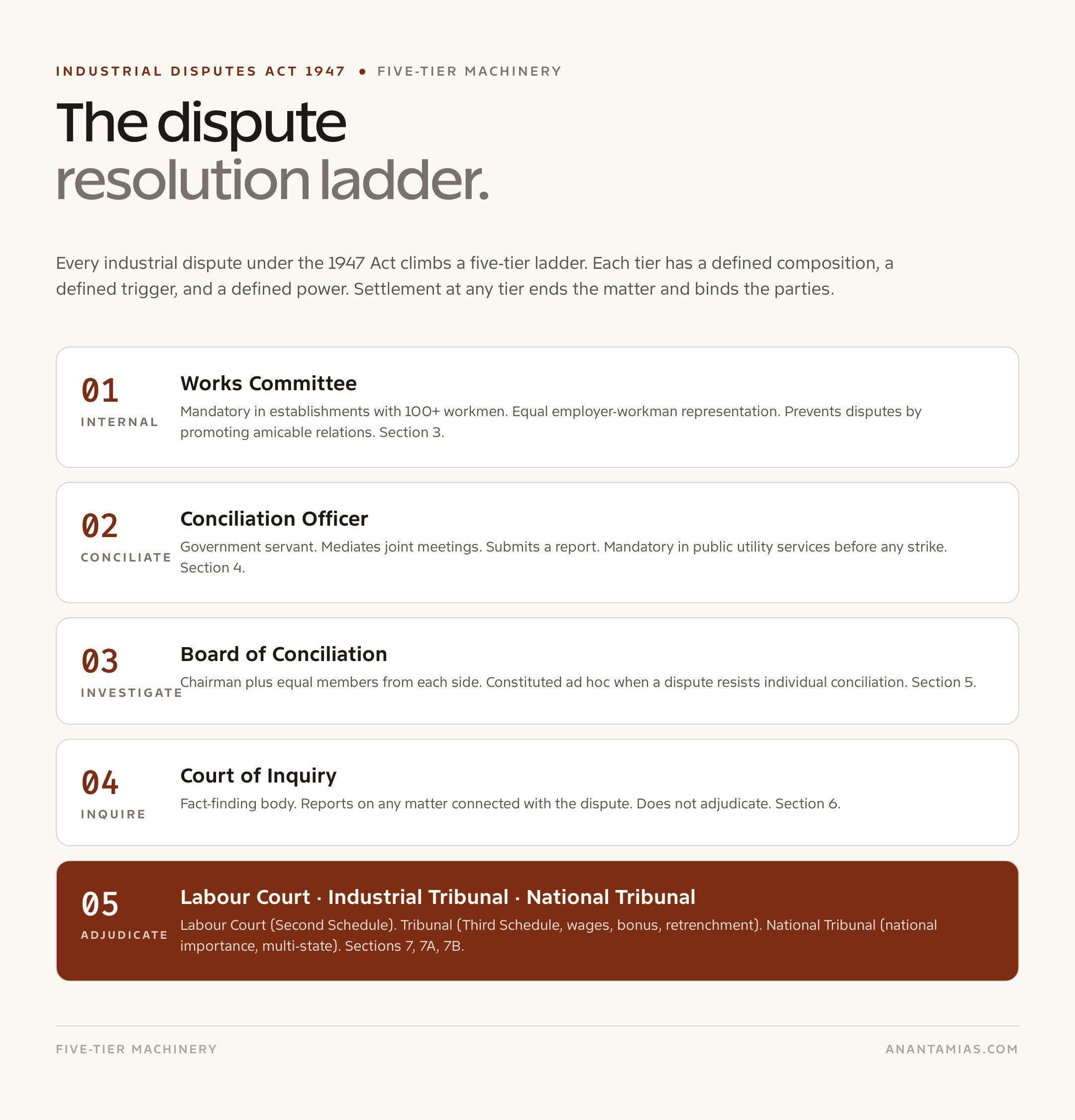
The most distinctive contribution of the Industrial Disputes Act 1947 is its layered dispute-resolution machinery. Each tier has a specific role, a specific composition, and a specific stage at which it can be invoked.
Works committee (Section 3). Mandatory in every establishment employing 100 or more workmen. Equal representation of workmen and employer. Its job is to promote good relations and resolve differences before they harden into a dispute. It is the only internal forum in the Act.
Conciliation officer (Section 4). A government servant appointed to mediate disputes. The officer holds joint meetings, encourages settlement, and submits a report. Conciliation is mandatory in public utility services before a strike or lockout can be called.
Board of conciliation (Section 5). A larger body, with a chairman and two or four members in equal numbers from each side, constituted ad hoc when a dispute resists individual conciliation. It investigates and reports to the government.
Court of inquiry (Section 6). A fact-finding body that reports on any matter connected with an industrial dispute. It does not adjudicate. Its report is published and used by government to decide whether to refer the dispute for compulsory adjudication.
Labour court, industrial tribunal, national tribunal (Sections 7, 7A, 7B). These are the adjudicatory tiers. The labour court hears matters in the Second Schedule, such as legality of an order under standing orders or discharge of a workman. The industrial tribunal hears Third Schedule matters, including wages, bonus, hours of work, and retrenchment. The national tribunal handles disputes of national importance or those affecting establishments in more than one state.
Definition of “Industrial Dispute” Under Section 2(k)
Section 2(k) defines an industrial dispute as “any dispute or difference between employers and employers, or between employers and workmen, or between workmen and workmen, which is connected with the employment or non-employment or the terms of employment or with the conditions of labour of any person.”
The wording matters because every forum under the Industrial Disputes Act 1947 only acquires jurisdiction once a matter qualifies as an industrial dispute. A purely individual grievance was historically excluded, but Section 2A, inserted in 1965, brought disputes over discharge, dismissal, retrenchment, or termination of a single workman within the statute, even without union espousal.
The Supreme Court in Workmen of Dimakuchi Tea Estate v. Management (1958) read three requirements into Section 2(k): the dispute must be real and substantial, it must be between defined parties, and it must concern a person in whose employment the parties have a direct and substantial interest. That test still governs.
Strikes and Lockouts: The Right and Its Limits
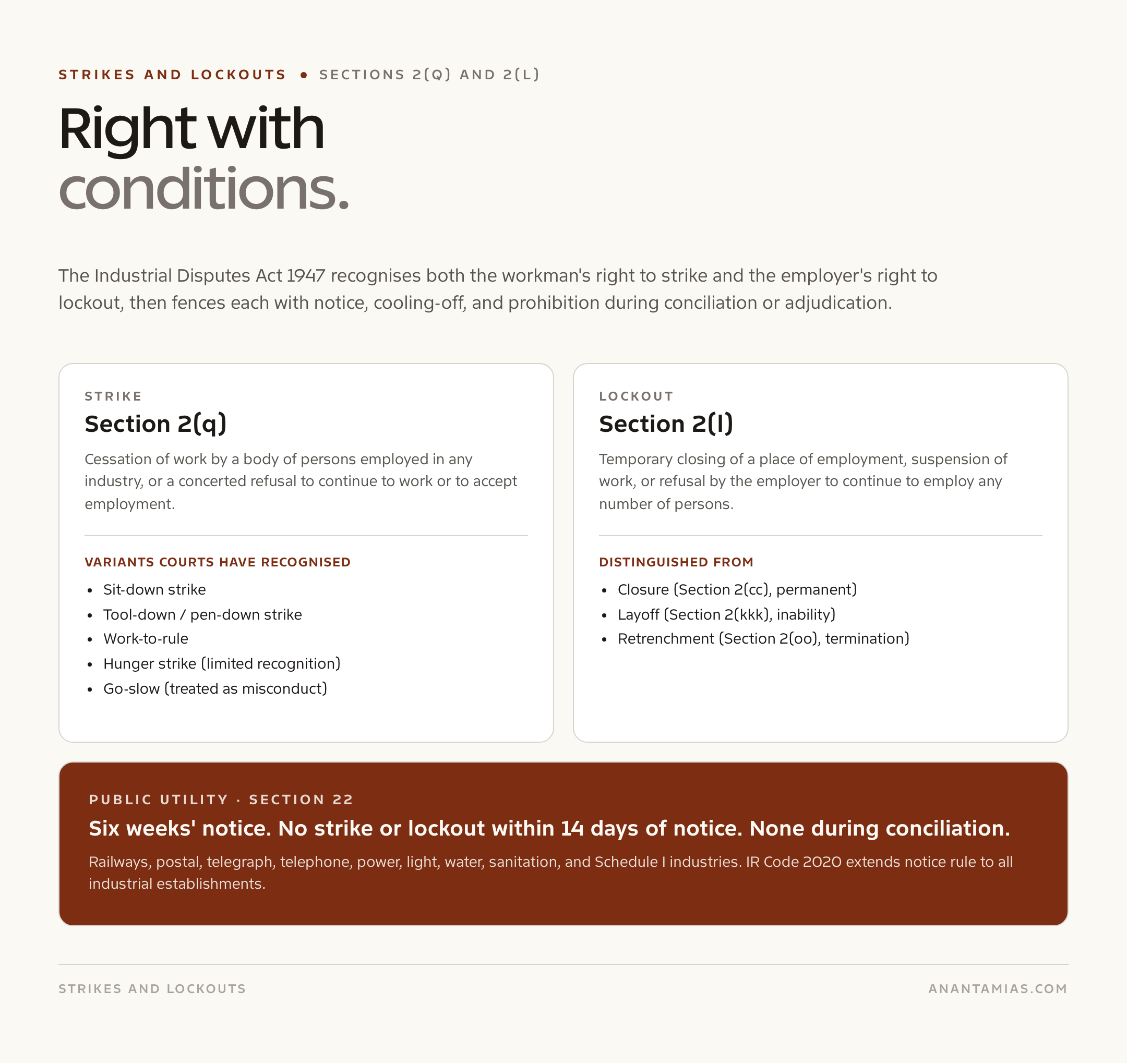
The Industrial Disputes Act 1947 recognises both the workman’s right to strike and the employer’s right to lockout. It also fences both rights with conditions.
A strike under Section 2(q) is a cessation of work by a body of persons employed in any industry acting in combination, or a concerted refusal to continue to work or to accept employment. Variants the courts have read in include the sit-down strike, the tool-down strike, the work-to-rule, and the go-slow, though go-slow is treated as misconduct rather than a true strike.
A lockout under Section 2(l) is the temporary closing of a place of employment, or the suspension of work, or the refusal by an employer to continue to employ any number of persons employed by him.
The statute restricts both. In a public utility service under Section 22, no strike or lockout is permitted without six weeks’ notice, within fourteen days of giving notice, before the expiry of the notice date, or during the pendency of conciliation. In a non-public-utility undertaking, strikes and lockouts are illegal during the pendency of conciliation, adjudication, or settlement, and for two months thereafter. The Industrial Relations Code 2020 has extended the public-utility notice regime to all industrial establishments.
Layoff: Section 2(kkk) and Sections 25A to 25E
Layoff is the failure, refusal, or inability of an employer to give employment to a workman on the muster roll due to shortage of coal, power, raw material, accumulation of stocks, machinery breakdown, natural calamity, or any other connected reason. The workman remains on the roll but is not given work.
Sections 25A to 25E set out the compensation regime. Any workman with at least one year of continuous service, in an establishment employing 50 or more workmen, is entitled to laid-off compensation equal to 50 percent of basic wages plus dearness allowance for every day of layoff, capped at 45 days in a year. Beyond 45 days, the employer may retrench under Section 25F instead of continuing to pay layoff compensation.
The Industrial Disputes Act 1947 makes layoff a defined event with a defined cost, which prevents an employer from sending workmen home indefinitely on no pay while claiming the establishment is still in operation.
Retrenchment: Section 25F and the “Last Come, First Go” Rule
Retrenchment under Section 2(oo) is the termination of a workman’s service for any reason other than disciplinary action, voluntary retirement, retirement on reaching superannuation, continued ill-health, or termination on the basis of non-renewal of a contract.
Section 25F lays down three conditions for a valid retrenchment: one month’s written notice or wages in lieu, fifteen days’ average pay for every completed year of continuous service as retrenchment compensation, and a copy of the retrenchment notice to the appropriate government.
Section 25G prescribes the order of retrenchment: the workman who came last must go first, subject to written reasons for any departure. Section 25H gives retrenched workmen a preferential right of re-employment if the employer later proposes to take on workmen again.
In State Bank of India v. N. Sundara Money (1976) the Supreme Court held that non-renewal of a fixed-term contract amounts to retrenchment unless expressly excluded, a position later partly reversed by the 1984 amendment that added the contract non-renewal exception in Section 2(oo)(bb).
Closure: Section 25-O and Government Permission
Closure under Section 2(cc) is the permanent closing down of a place of employment or part of it. Section 25-O, inserted by the 1976 amendment, requires an employer of an industrial establishment with 100 or more workmen to seek prior government permission to close, giving 90 days’ notice.
The Supreme Court in Excel Wear v. Union of India (1978) struck down the original Section 25-O as an unreasonable restriction on the fundamental right under Article 19(1)(g), and the provision was redrafted. Closure without permission, if the establishment exceeds the threshold, is illegal and the workmen are deemed to be in service.
The IR Code 2020 retains the closure-permission regime but raises the threshold from 100 to 300 workmen, which is one of its most criticised changes.
Landmark Judgments Under the Industrial Disputes Act 1947
The case law on the Industrial Disputes Act 1947 fills several volumes, and the constitutional backdrop for many decisions ties back to Article 20 of the Indian Constitution and the broader fundamental-rights framework. Five judgments cover the conceptual ground.
Bangalore Water Supply v. A. Rajappa (1978). A seven-judge bench redefined “industry” under Section 2(j) to include almost every systematic activity carried on by cooperation between employer and employee for the production or distribution of goods and services. The triple test of systematic activity, cooperation, and production of goods or services is still cited, though the legislature has tried to override parts of it.
Workmen of Dimakuchi Tea Estate v. Management (1958). Set the test for whether a dispute is an industrial dispute, requiring direct and substantial interest of the parties.
Excel Wear v. Union of India (1978). Held that the right to close a business is part of Article 19(1)(g) and that unreasonable restrictions on closure violate the fundamental right.
Punjab National Bank v. All India PNB Employees’ Federation (1960). Laid down that participation in an illegal strike is misconduct, but the punishment must be proportionate.
Steel Authority of India v. National Union Waterfront Workers (2001). Settled that abolition of contract labour does not automatically absorb the contract workers as direct employees.
Unfair Labour Practices and the Fifth Schedule
The Fifth Schedule, inserted in 1982, lists unfair labour practices for both employers and workmen. Employer practices include interference with union activities, victimisation of office-bearers, refusal to bargain collectively in good faith, and engaging contract labour to defeat the statute. Workman practices include indulging in coercive activities, gheraos, willful slowdown, and refusal to bargain in good faith.
Commission of a listed unfair labour practice is a punishable offence under Section 25U, with imprisonment up to six months or fine up to one thousand rupees, or both. The Industrial Relations Code 2020 retains the list and the penalty framework.
Transition to the Industrial Relations Code 2020
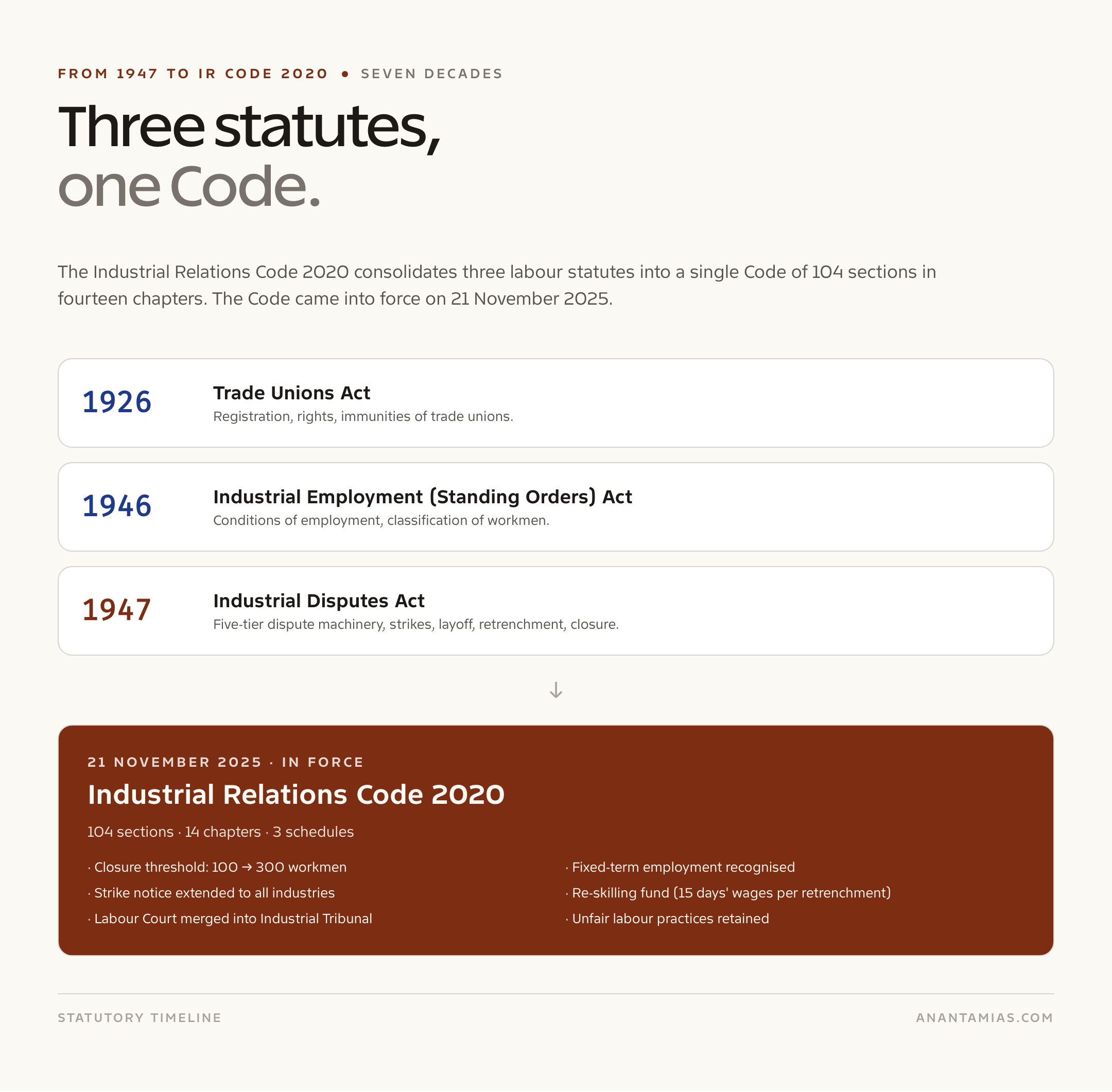
The Industrial Relations Code 2020 consolidates the Trade Unions Act 1926, the Industrial Employment (Standing Orders) Act 1946, and the Industrial Disputes Act 1947 into a single Code of 104 sections in fourteen chapters. The Code came into force on 21 November 2025. The macroeconomic context for this reform, including the fiscal deficit of India and the productivity push, is part of the standard mains framing.
Key changes from the Industrial Disputes Act 1947 in the Code are visible in five areas. The threshold for prior government permission for layoff, retrenchment, and closure rises from 100 to 300 workmen. Fixed-term employment is formally recognised and the Code grants such workers the same statutory benefits as permanent workmen on a pro-rata basis. The strike-notice requirement that earlier applied only to public utility services is extended to all industrial establishments, requiring 14 days’ notice in a window of 60 days. A re-skilling fund is created, funded by employer contributions equal to 15 days’ wages for each retrenched workman. Labour courts as a distinct tier are merged into a single industrial tribunal that hears all matters earlier divided between the labour court and the industrial tribunal.
The conciliation officer, the board of conciliation, the court of inquiry, the national tribunal, and the works committee survive in the Code in substantially the same form. The definitions of strike, lockout, layoff, retrenchment, and closure are carried over with minor drafting refinements.
UPSC Angles on the Industrial Disputes Act 1947
For prelims, the Industrial Disputes Act 1947 has been asked on the composition of the works committee, the number of authorities created under the Act, the threshold for retrenchment compensation, and the Second versus Third Schedule allocation between labour court and industrial tribunal. UPSC has also paired the Act with macroeconomic indicators like India unemployment data in matching-type questions.
For mains GS-II, the Act and its successor Code are tested through the lens of welfare state obligations, the constitutionality of restrictions on closure under Article 19(1)(g), the comparative position with ILO conventions on freedom of association and collective bargaining, and the parliamentary process that put the three codes on the statute book through the Rajya Sabha and Lok Sabha. GS-III brings in the productivity argument, the ease-of-doing-business critique of pre-2020 labour law, and the gig and platform economy that sits outside the Industrial Disputes Act 1947 entirely. A standard answer juxtaposes the protective architecture of the 1947 statute with the flexibility orientation of the 2020 Code, and asks whether the new threshold of 300 workmen for closure permission strikes the right balance.
For optional sociology, the questions track labour as a site of class conflict, with the Industrial Disputes Act 1947 read as a state instrument of accommodation between capital and organised labour.
Frequently Asked Questions
What is the Industrial Disputes Act 1947?
The Industrial Disputes Act 1947 is a central legislation that creates the machinery for investigation and settlement of industrial disputes in India and defines strike, lockout, layoff, retrenchment, and closure. It came into force on 1 April 1947 and has been subsumed into the Industrial Relations Code 2020 from 21 November 2025.
Which authorities does the Industrial Disputes Act 1947 set up?
The statute creates seven authorities: the works committee, the conciliation officer, the board of conciliation, the court of inquiry, the labour court, the industrial tribunal, and the national tribunal. Each has a defined role at a different stage of dispute resolution.
What is the difference between layoff and retrenchment under the Act?
Layoff is a temporary inability to provide work due to specified reasons, and the workman stays on the roll with 50 percent compensation. Retrenchment is termination of service for any reason other than disciplinary action, with one month’s notice and 15 days’ pay per completed year as compensation.
What is Section 25F of the Industrial Disputes Act 1947?
Section 25F lays down three mandatory conditions for valid retrenchment: one month’s written notice or wages in lieu, fifteen days’ average pay per completed year as retrenchment compensation, and notice to the appropriate government. Non-compliance renders the retrenchment void.
How does the Industrial Relations Code 2020 change the Industrial Disputes Act 1947?
The Code consolidates three labour statutes including the 1947 Act, raises the closure-permission threshold from 100 to 300 workmen, formally recognises fixed-term employment, extends strike notice to all industries, creates a re-skilling fund, and merges the labour court and industrial tribunal into a single industrial tribunal.
Is the right to strike a fundamental right in India?
No. The Supreme Court in TK Rangarajan v. Government of Tamil Nadu (2003) held that government employees have no fundamental, statutory, or moral right to strike. For other workmen the right is statutory, available under the Industrial Disputes Act 1947 and now the IR Code 2020, subject to notice and conciliation requirements.
What is a public utility service under the Industrial Disputes Act 1947?
Section 2(n) lists services such as railways, postal, telegraph, telephone, industries supplying power, light, or water, public conservancy or sanitation, and any industry specified in the First Schedule. Strikes and lockouts in these services require six weeks’ notice under Section 22.
Tell Google you want more of this.
Add Anantam IAS as a preferred sourceOne tap, and this site shows up more often in your own Top Stories, AI Overviews and AI Mode. Remove it any time.