
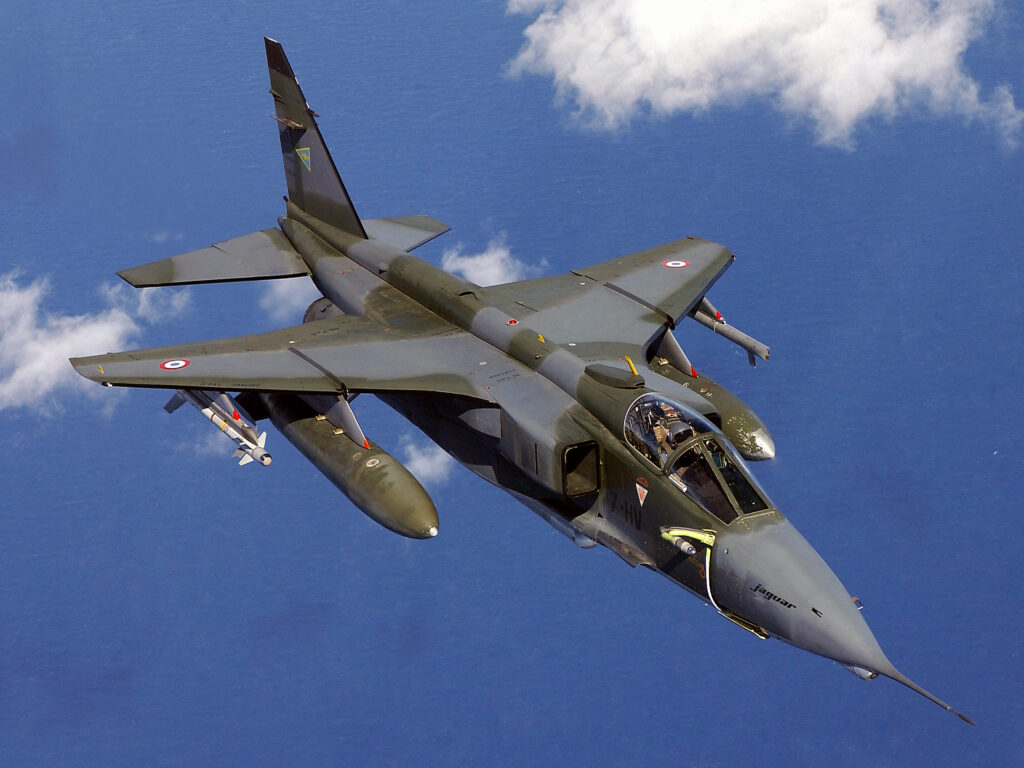
The SEPECAT Jaguar is a twin-engine ground-attack fighter jet operated by the Indian Air Force (IAF) since the early 1980s. Designed jointly by the United Kingdom and France in the 1960s (SEPECAT = Société Européenne de Production de l'Avion École de Combat et d'Appui Tactique), the Jaguar has been the backbone of India's deep-penetration strike capability — able to fly low and fast into enemy territory to hit key targets. India remains the only country still operating Jaguars in significant numbers, even as the UK and France retired theirs years ago.
For UPSC, the Jaguar is a frequently tested Defence topic — particularly around India's strike capabilities and ongoing retirement/replacement discussions.
Overview
| Attribute | Detail |
|---|---|
| Designation | SEPECAT Jaguar |
| Origin | UK-France joint development (1960s) |
| First flight | 1968 |
| In IAF service | Since 1979 (trainers); combat squadrons from 1981 |
| IAF fleet | ~120 aircraft currently (reducing due to age) |
| Squadrons | ~6 squadrons |
| Speed | Up to 1,700 km/h (Mach 1.6 with clean configuration) |
| Combat radius | ~910 km (typical strike mission) |
| Weapons payload | ~4,760 kg of bombs and missiles |
| Crew | 1 (single-seat variants) / 2 (trainers) |
| Manufacturer | HAL (license production in India) |
Acquisition
In the late 1970s, India needed a replacement for the ageing Canberra bombers and to develop a credible deep-strike capability. India evaluated:
- Jaguar (UK-France)
- Mirage 5 (France)
- Viggen (Sweden)
- MiG-23 (USSR)
In 1978, India selected the Jaguar primarily for its:
- Low-level penetration capability
- Range and payload
- NATO-class electronics
- Availability of license production
License Production
| Stage | Detail |
|---|---|
| Initial batch | 40 aircraft purchased from UK |
| License production | By HAL from 1982 |
| Total produced | ~160 aircraft in India |
| HAL facility | Bengaluru |
Variants in IAF Service
The IAF operates multiple Jaguar variants:
Primary Variants
| Variant | Role | Features |
|---|---|---|
| Jaguar IS (Shamsher) | Strike (single-seat) | Main combat variant |
| Jaguar IB (Shamsher) | Strike variant with navigation | |
| Jaguar IT (Trainer) | Dual-seat trainer | |
| Jaguar IM (Maritime) | Maritime strike | Anti-ship missile capable |
| Jaguar 'Darin' I, II, III | Upgraded versions | Improved electronics |
Nomenclature
Indian Jaguars carry the "Shamsher" designation (meaning "Sword of Justice" in Persian — a name chosen by IAF).
DARIN Upgrades
The Jaguar has undergone successive DARIN (Display Attack Ranging Inertial Navigation) upgrades:
DARIN-I
- Original IAF electronics suite
- Improved navigation and attack systems
DARIN-II (mid-1990s)
- Upgraded weapon delivery systems
- Improved targeting
- Better integration with Indian weapons
DARIN-III (from 2010s)
- Major avionics overhaul
- New mission computer
- Glass cockpit (modern multi-function displays)
- Advanced radar capabilities
- Precision-guided munition integration
- Electronic warfare capabilities
- Cost: Significant per-aircraft upgrade
The DARIN-III upgrades are intended to extend the Jaguar's service life.
Operational Roles
Deep-Penetration Strike
The Jaguar was specifically designed for low-level, high-speed penetration into enemy airspace:
- Flying below enemy radar
- Hitting high-value targets deep behind enemy lines
- Role previously performed by Canberras
Nuclear Delivery
The Jaguar is reportedly certified as a nuclear delivery platform for India:
- Can carry India's air-dropped nuclear weapons
- Low-altitude penetration makes it suitable for this role
- Part of India's nuclear triad (along with land-based missiles and submarine-launched)
Maritime Strike
Jaguar IM variants are specifically designed for maritime operations:
- Based at Jamnagar (Gujarat) and Goa
- Armed with Sea Eagle anti-ship missiles
- Role: Ship-killing in Arabian Sea and Indian Ocean
Close Air Support
Can provide close air support to ground forces when called.
Combat Record
The Jaguar has seen operational service:
- 1984: Photo-reconnaissance in Sri Lanka
- 1987-89: IPKF operations in Sri Lanka
- 1999 Kargil War: Limited role due to terrain; mostly reconnaissance
- Various operations along the Pakistan border
Weapons Capability
The Jaguar can carry:
| Weapon Type | Examples |
|---|---|
| Air-to-surface bombs | General purpose bombs, cluster bombs, laser-guided bombs |
| Anti-ship missiles | AGM-65 Maverick, Sea Eagle |
| Air-to-air missiles | Matra Magic, AIM-9L Sidewinder |
| Rockets | 68mm rockets |
| Guns | 2 x 30mm ADEN cannons (internal) |
| Nuclear weapons | Reportedly certified |
Retirement and Replacement
Current Status
The Jaguar fleet is showing its age:
- Oldest Jaguars are over 40 years old
- Engine reliability issues — the Rolls-Royce-Turbomeca Adour engines are difficult to maintain as global support diminishes
- Obsolescent compared to modern fighters
Retirement Plans
The IAF has announced plans to retire the Jaguar in phases:
- Older squadrons to be retired first
- DARIN-III upgraded aircraft to serve until ~2030
- Final retirement expected in mid-2030s
Replacement
The Jaguar is to be replaced by:
- Tejas LCA Mark-1A (for some squadrons)
- Rafale (limited role)
- AMCA (Advanced Medium Combat Aircraft — under development) in the long term
- Possibly more MRFA (Multi-Role Fighter Aircraft) procurement
Unique Status: India the Last Jaguar Operator
India is now the only country still operating Jaguars in significant numbers:
- UK: Retired all Jaguars in 2007
- France: Retired in 2005
- Oman: Retired 2014
- Ecuador: Retired 2004
This creates challenges:
- Spare parts scarcity
- Engine overhaul complexity
- No collaborative maintenance with other operators
- Full responsibility for keeping them airworthy falls on HAL and IAF
On the positive side, India has become the global expert on Jaguar operations — which could create opportunities for consulting services or repurposing.
Strategic Significance
Nuclear Triad Dimension
The Jaguar's nuclear delivery role is strategically significant:
- India's nuclear strike aircraft would launch from air bases rather than carriers
- Deep-penetration capability is essential for second-strike doctrine
- As Jaguar retires, the Rafale and later AMCA will assume this role
Regional Implications
- Pakistan and China track India's Jaguar fleet status
- Retirement of Jaguars without adequate replacement creates a capability gap
- India's procurement decisions on replacements are geostrategically significant
Famous Jaguar Squadrons
| Squadron | Base |
|---|---|
| 5 Squadron "Tuskers" | Ambala |
| 6 Squadron "Dragons" | Jamnagar (maritime) |
| 14 Squadron "Bulls" | Ambala |
| 16 Squadron "Black Cobras" | Gorakhpur |
| 27 Squadron "Flaming Arrows" | Gorakhpur |
| 224 Squadron "Warlords" | Jamnagar (maritime) |
Notable Incidents
- Multiple crashes over the years — the Jaguar has a relatively high accident rate by IAF standards (partially due to age and low-altitude mission profile)
- Engine flame-outs — a recurring concern with the Adour engines
- Lethal accidents — several pilots have lost their lives in Jaguar crashes
UPSC Relevance
GS3 (Science & Technology/Defence): IAF inventory, India’s nuclear triad, strategic capabilities.
GS2 (IR): Defence procurement, strategic partnerships (UK, France).
Key Prelims facts:
- Full name: SEPECAT Jaguar
- Origin: UK-France joint development
- IAF service: Since 1981 (combat); 1979 (trainers)
- Indian name: Shamsher
- Role: Deep-penetration strike aircraft
- Manufactured in India by: HAL (license production)
- IAF fleet: ~120 aircraft
- Engine: Rolls-Royce-Turbomeca Adour
- Variants: IS, IB, IT, IM (maritime), DARIN I/II/III
- Speed: Mach 1.6 (clean)
- Combat radius: ~910 km
- Payload: ~4,760 kg
- Notable role: Nuclear delivery (certified)
- Maritime variant: Jaguar IM (Jamnagar, Goa)
- Status: India is the only major Jaguar operator globally
- Retirement: Phased, expected completion by mid-2030s
- Likely replacements: Tejas LCA Mark-1A, Rafale, future AMCA
Tell Google you want more of this.
Add Anantam IAS as a preferred sourceOne tap, and this site shows up more often in your own Top Stories, AI Overviews and AI Mode. Remove it any time.





