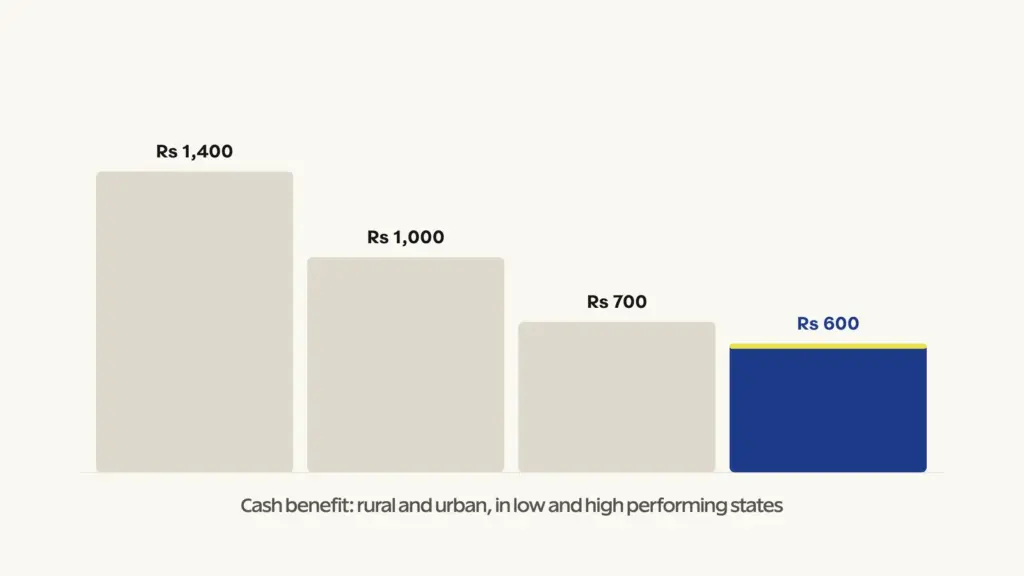
Janani Suraksha Yojana (JSY) is a central government scheme under the National Health Mission that pays pregnant women a cash benefit for delivering in a health facility — ₹1,400 in rural and ₹1,000 in urban areas of low-performing states, and ₹700 rural / ₹600 urban in the rest of the country. The ASHA worker in your village or ward is the scheme’s contact point: she helps you register the pregnancy, accompanies you for delivery, and gets the claim processed at the facility. There is no online application; the benefit is claimed through the health system itself.
What is Janani Suraksha Yojana?
JSY was launched on 12 April 2005 with one clear objective: reduce maternal and newborn deaths by getting more poor women to deliver in institutions — sub-centres, primary and community health centres, first referral units, and the general wards of district and state hospitals — instead of at home. It is a centrally sponsored scheme that combines cash assistance with delivery and post-delivery care, and it runs in every state and union territory.
The scheme deliberately spends more where institutional delivery rates are lowest. Ten states — Uttar Pradesh, Uttarakhand, Bihar, Jharkhand, Madhya Pradesh, Chhattisgarh, Assam, Rajasthan, Odisha and Jammu & Kashmir — are classified as Low Performing States (LPS). All the remaining states and UTs are High Performing States (HPS).
Cash Assistance: LPS vs HPS Amounts
The entitlements, as published on the official NHM page:
| Category | Area | Mother’s package | ASHA’s package | Total |
|---|---|---|---|---|
| LPS | Rural | ₹1,400 | ₹600 | ₹2,000 |
| LPS | Urban | ₹1,000 | ₹400 | ₹1,400 |
| HPS | Rural | ₹700 | ₹600 | ₹1,300 |
| HPS | Urban | ₹600 | ₹400 | ₹1,000 |
The ASHA package is not deducted from the mother’s money — it is a separate incentive paid to the ASHA. In rural areas her ₹600 covers ₹300 for antenatal care support and ₹300 for facilitating the institutional delivery; in urban areas the split is ₹200 + ₹200.
Who is Eligible?
Eligibility differs by state category:
- In LPS states: all pregnant women delivering in government health centres — sub-centre, PHC, CHC, FRU, or the general ward of a district or state hospital — are eligible, without income or caste conditions.
- In HPS states: the benefit is restricted to BPL, Scheduled Caste and Scheduled Tribe women delivering in government health centres.
- Accredited private institutions: in both LPS and HPS states, BPL/SC/ST women delivering in private hospitals accredited under JSY are covered.
Keep the relevant proof handy in HPS states — BPL ration card or caste certificate — along with an ID and your antenatal registration record.
ASHA’s Role: Your Single Point of Contact
JSY formally designates the Accredited Social Health Activist (ASHA) as the link between the government and the pregnant woman. In practice, this is how she helps:
- Registers the pregnancy early and gets you the Mother and Child Protection (MCP) card at the anganwadi/sub-centre.
- Ensures antenatal check-ups, tetanus injections and iron-folic acid tablets are done on schedule.
- Identifies the government facility, arranges or accompanies you to the facility for delivery (ambulance/referral transport under NHM can be called through 102/108 in most states).
- Helps complete the JSY paperwork at the facility so the payment is processed.
- Follows up with postnatal visits and newborn immunisation.
How to Claim the JSY Benefit
There is no portal or form you fill yourself; the claim flows through the facility where you deliver:
- Register your pregnancy with the local ASHA or ANM and get your MCP card.
- Carry your documents at the time of delivery: MCP card, ID/Aadhaar, bank passbook, and BPL/caste certificate where applicable (HPS states).
- Deliver at a government facility or a JSY-accredited private hospital.
- The facility verifies eligibility and processes the payment — now generally by direct benefit transfer to the mother’s bank account, ideally sanctioned around discharge.
- If the payment has not arrived within a few weeks, follow up through the ASHA, the ANM, or the block medical officer’s office with your MCP card and discharge slip.
A practical tip: open a bank account in the mother’s own name during pregnancy if she does not have one — payments cannot be credited to someone else’s account.
Scheme at a Glance
| Item | Detail |
|---|---|
| Launched | 12 April 2005, under the National Health Mission |
| Ministry | Health and Family Welfare (centrally sponsored) |
| Mother’s benefit | ₹1,400/₹1,000 (LPS rural/urban); ₹700/₹600 (HPS rural/urban) |
| ASHA’s incentive | ₹600 rural / ₹400 urban (separate from the mother’s amount) |
| LPS states | UP, Uttarakhand, Bihar, Jharkhand, MP, Chhattisgarh, Assam, Rajasthan, Odisha, J&K |
| Where to claim | Government facility or JSY-accredited private hospital — no online application |
| Fee | Nil at every step |
JSY vs PMMVY: Two Different Benefits
JSY is often confused with the PM Matru Vandana Yojana (PMMVY). They are separate schemes, and an eligible woman can receive both.
| Point | JSY | PMMVY |
|---|---|---|
| What it is | Cash incentive for institutional delivery | Maternity benefit compensating wage loss |
| Amount | ₹600–₹1,400 depending on state and area | ₹5,000 for the first child; ₹6,000 for the second if a girl, per the official PMMVY portal |
| When paid | Around the delivery, at the facility | In instalments linked to registration, check-ups and birth |
| How to apply | Through ASHA/ANM and the facility; no self-application | Application via anganwadi/ASHA on the PMMVY portal ([pmmvy.wcd.gov.in](https://pmmvy.wcd.gov.in/)) |
| Ministry | Health & Family Welfare (NHM) | Women & Child Development |
For a wider view of family-facing transfer schemes, see this sarkari yojana list.
Frequently Asked Questions
How much money is given under Janani Suraksha Yojana?
Mothers get ₹1,400 (rural) or ₹1,000 (urban) in the ten Low Performing States, and ₹700 (rural) or ₹600 (urban) in High Performing States, for delivering in a government or accredited facility.
Who is eligible for JSY?
In LPS states (UP, Uttarakhand, Bihar, Jharkhand, MP, Chhattisgarh, Assam, Rajasthan, Odisha, J&K), all women delivering in government facilities. In other states, BPL, SC and ST women. BPL/SC/ST women delivering in JSY-accredited private hospitals are covered everywhere.
How do I apply for Janani Suraksha Yojana online?
You don’t — there is no online application. Register your pregnancy with your ASHA or ANM, deliver at a government or accredited facility, and the facility processes the payment to the mother’s bank account.
Does the ASHA worker take a share of the mother’s money?
No. The ASHA’s incentive (₹600 rural / ₹400 urban) is a separate package paid by the scheme for her antenatal and delivery-facilitation work. The mother’s amount is hers in full.
Can I get both JSY and PMMVY?
Yes. JSY is a delivery incentive under the health ministry; PMMVY is a maternity benefit under the WCD ministry. An eligible woman can receive both for the same pregnancy.
Is JSY available for a third child?
In LPS states the benefit has no birth-order cap for deliveries in government institutions. Conditions historically applied in HPS states; confirm your state’s current practice with the ANM or block health office, since implementation details are state-administered.
What documents are needed for JSY?
The MCP (mother and child protection) card from antenatal registration, an ID such as Aadhaar, the mother’s bank passbook, and — in High Performing States — BPL or SC/ST proof.
Tell Google you want more of this.
Add Anantam IAS as a preferred sourceOne tap, and this site shows up more often in your own Top Stories, AI Overviews and AI Mode. Remove it any time.