Disclosure: this guide contains Amazon affiliate links. As an Amazon Associate, Anantam IAS earns from qualifying purchases — at no extra cost to you.
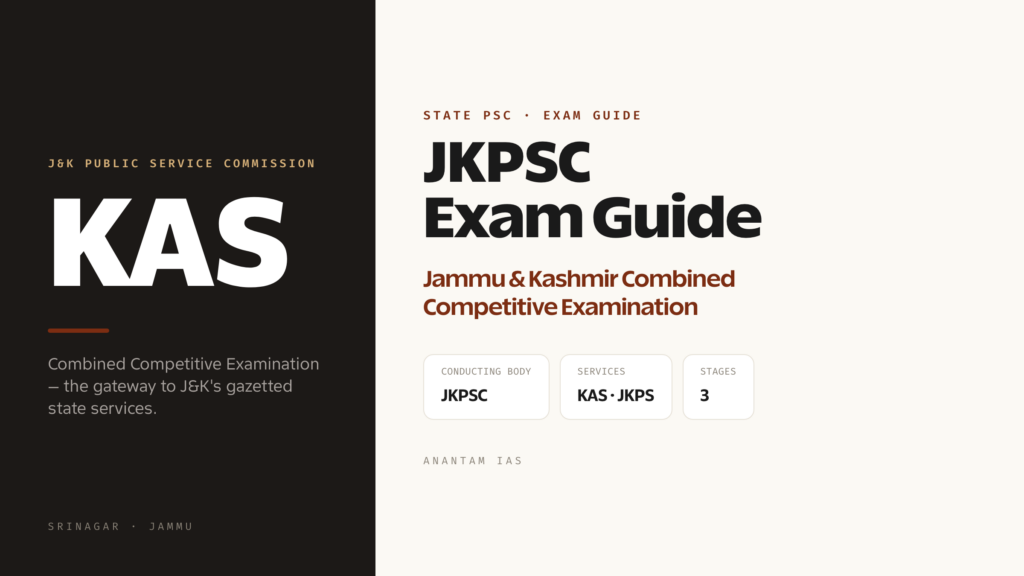
JKPSC stands for the Jammu and Kashmir Public Service Commission — the public service commission that recruits officers for the civil services of the Union Territory of Jammu & Kashmir, chiefly through its Combined Competitive Examination (CCE), whose selected officers form the KAS (J&K Administrative Service) cadre.
The Jammu and Kashmir Public Service Commission (JKPSC) is the constitutional body that recruits officers for the civil services of the Union Territory of Jammu & Kashmir. For an aspirant in the Valley, in Jammu, or anywhere in the country who holds a J&K domicile, JKPSC’s flagship exam is the most direct route into the administrative machinery that runs one of India’s most strategically important regions.
That flagship exam is the Combined Competitive Examination (CCE), and the officers it selects are widely known as KAS officers — the Kashmir Administrative Service / J&K Administrative Service cadre that anchors district administration, policing, and accounts across the UT. This guide walks through what JKPSC recruits for, the three-stage pattern, who’s eligible under the current domicile framework, the syllabus with its strong J&K focus, and a realistic preparation strategy.
What Is JKPSC?
JKPSC is the public service commission for the Union Territory of Jammu & Kashmir, headquartered in Srinagar with a wing in Jammu. It conducts recruitment and advisory functions for the J&K government, and its single most important recruitment is the Combined Competitive Examination — the gateway to the gazetted state services.
The CCE is “combined” because one notification and one selection process fill several services at once. In a recent cycle, JKPSC advertised the Junior Scale of the J&K Administrative Service, the J&K Police (Gazetted) Service, and the J&K Accounts (Gazetted) Service through a single combined exam. A KAS officer typically starts as a Deputy Collector or in an equivalent gazetted post and moves up to Sub-Divisional Magistrate, Additional Deputy Commissioner, and senior secretariat roles — the state-cadre counterpart to an IAS officer’s early career.
Key Facts
- Conducting authority: Jammu & Kashmir Public Service Commission (JKPSC).
- Exam: Combined Competitive Examination (CCE), recruiting the KAS / J&K Administrative Service and allied services.
- Services filled: Junior Scale of J&K Administrative Service, J&K Police (G) Service, J&K Accounts (G) Service.
- Stages: Three — Preliminary (objective), Mains (descriptive), and Personality Test (interview).
- Frequency: Notified as vacancies arise; aspirants should treat it as a roughly annual planning cycle and watch the official JKPSC site for each notification.
- Scale: Vacancies are modest and competition is sharp — a recent notification carried around 80 combined posts, so cut-offs run high.
JKPSC Exam Pattern
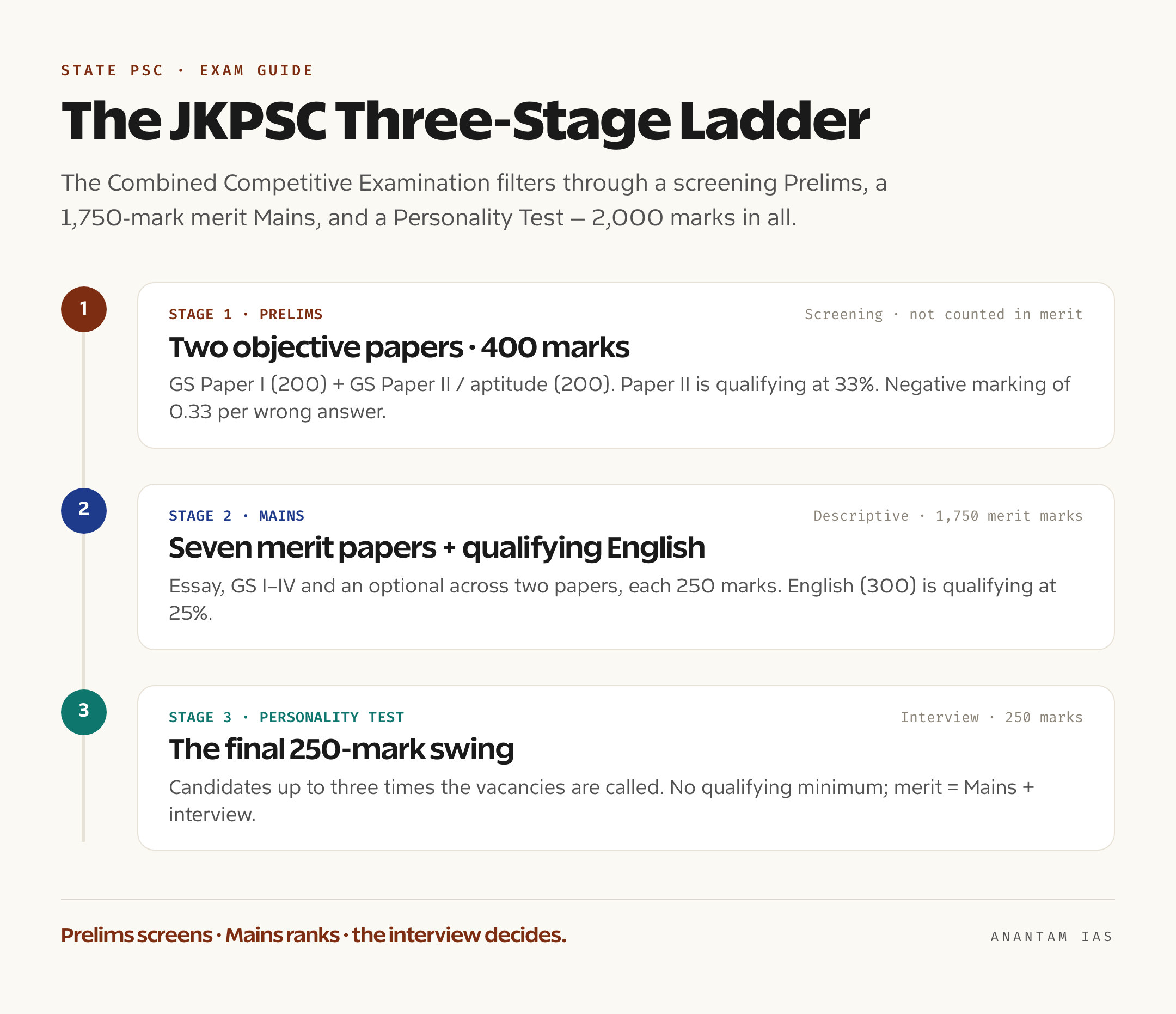
The Combined Competitive Examination runs in three stages. The structure closely tracks the UPSC Civil Services template, which is good news: most UPSC-oriented study material transfers directly, and you layer J&K-specific content on top.
Prelims
The Preliminary Examination is a screening test of two objective (MCQ) papers.
| Feature | Details |
|---|---|
| Papers | 2 (General Studies Paper I and Paper II) |
| Marks | 200 each (400 total) |
| Type | Objective, multiple-choice |
| Negative marking | 0.33 mark deducted per wrong answer |
| Paper II status | Qualifying only — minimum 33% required |
| Purpose | Screening; marks don’t carry to the final merit |
Paper II is the aptitude (CSAT-style) paper and is purely qualifying — clear 33% and your merit rank rests on Paper I, exactly as in UPSC. So concentrate your Prelims energy on General Studies Paper I, where the J&K-specific weighting matters most.
Mains
The Mains is a descriptive (conventional, essay-type) examination. As laid out by exam-pattern references such as Drishti IAS, it comprises eight papers: an English language paper that is qualifying, plus seven papers that count toward the final merit.
| Paper | Subject | Marks | Counts for merit? |
|---|---|---|---|
| English | Language paper (25% qualifying) | 300 | Qualifying only |
| Paper I | Essay | 250 | Yes |
| Paper II | General Studies I | 250 | Yes |
| Paper III | General Studies II | 250 | Yes |
| Paper IV | General Studies III | 250 | Yes |
| Paper V | General Studies IV (Ethics) | 250 | Yes |
| Paper VI | Optional Subject — Paper 1 | 250 | Yes |
| Paper VII | Optional Subject — Paper 2 | 250 | Yes |
| Written total (merit) | 1,750 |
Unlike many state PSCs that have dropped the optional subject, JKPSC retains it — candidates pick one optional that runs across two papers. The English paper carries a 25% qualifying threshold and doesn’t add to merit. Exact paper counts and weightings have shifted across cycles, so confirm the breakdown in the notification you’re applying against.
Personality Test
Candidates who clear the Mains cut-off are called for the Personality Test (interview), typically up to three times the number of vacancies.
| Feature | Details |
|---|---|
| Marks | 250 |
| Qualifying minimum | None |
| Grand total | 2,000 (1,750 written + 250 interview) |
The interview probes your awareness of J&K’s administration, contemporary issues, and your suitability for a public-facing officer’s role. Final merit combines the seven merit Mains papers with the Personality Test across 2,000 marks, and the interview swing can decide service allocation.
JKPSC Eligibility
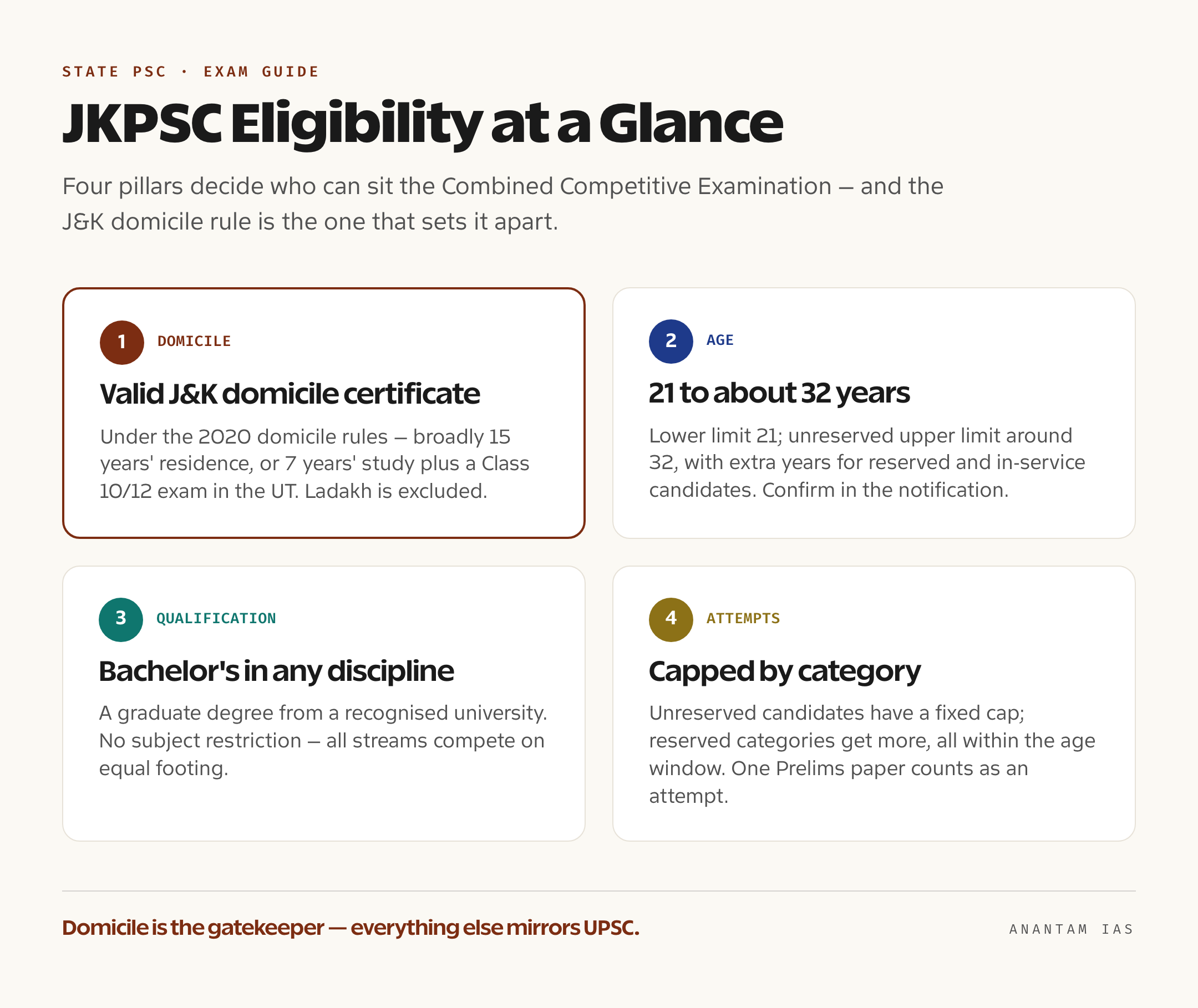
Eligibility for the Combined Competitive Examination turns on four pillars — domicile, age, educational qualification, and attempts. The domicile requirement is the defining feature of this exam and is what separates JKPSC from a pan-India exam like the UPSC Civil Services.
Domicile (the post-2019 framework). After the Jammu and Kashmir Reorganisation Act, 2019 reorganised the former state into the Union Territories of Jammu & Kashmir and Ladakh, the older permanent-resident system was replaced. The Jammu and Kashmir Grant of Domicile Certificate (Procedure) Rules, 2020 now govern who qualifies. Broadly, a person who has resided in J&K for 15 years, or has studied for seven years and sat the Class 10 or 12 examination in the UT, is eligible for a domicile certificate, along with several specified categories. To apply for the CCE you must hold a valid J&K domicile certificate. (Ladakh, now a separate UT, falls outside this framework.)
Age. The lower age limit is generally 21 years. The upper limit for the unreserved category is typically around 32 years, with category-based relaxations that extend it further — reserved categories (SC/ST, RBA, ALC/IB, and others) and in-service candidates get additional years as fixed in each notification. Because the exact upper limit and relaxations are revised periodically, always check the figures in the live notification rather than assuming last year’s band.
Educational qualification. A Bachelor’s degree in any discipline from a recognised university is the baseline. There’s no subject restriction for the general administrative services, so engineering, arts, commerce, science, and law graduates compete on the same footing.
Attempts. The number of permitted attempts depends on category — unreserved candidates have a capped number of attempts while reserved categories get more, all within the prescribed age window. Appearing in even one Prelims paper counts as an attempt. Treat the attempt limit and age ceiling as a single planning constraint and read both from the notification.
JKPSC Syllabus
The JKPSC syllabus has two layers: a national GS layer that overlaps heavily with the UPSC syllabus, and a J&K state-specific layer that is the real differentiator. Master the first with standard material; win the exam on the second.
Prelims Syllabus
General Studies Paper I covers Indian history and the freedom struggle, the geography of India and the world, the Indian Constitution and polity, governance, the Indian economy, environment and ecology, general science and technology, and current events of national and international importance. Woven through it is dedicated Jammu & Kashmir general knowledge — the region’s history, geography, culture, and current affairs.
General Studies Paper II is the aptitude paper — comprehension, interpersonal and communication skills, logical reasoning and analytical ability, decision-making and problem-solving, basic numeracy, and data interpretation. It’s qualifying at 33%, so you need competence, not perfection.
Mains Syllabus
The Mains General Studies papers mirror the UPSC GS structure:
- GS I: Indian heritage and culture, history (modern India, post-independence, world history), Indian society and social diversity, and geography — with J&K’s own history, art, and physical geography embedded.
- GS II: the Constitution, polity, governance, the Parliament and judiciary, social justice, welfare schemes, and India’s international relations.
- GS III: the economy, agriculture and horticulture, science and technology, environment and disaster management, and internal security.
- GS IV: ethics, integrity, and aptitude, including case studies on administrative integrity.
Alongside GS, you write an Essay paper and a qualifying English paper, plus an Optional Subject across two papers. The optional list spans humanities, sciences, law, and regional and other literatures including Kashmiri, Dogri, and Urdu.
State-Specific Focus
This is where JKPSC is won or lost. Across both Prelims and Mains, expect concentrated J&K and Ladakh content:
- History & culture: the region’s dynasties and rulers, the Dogra period, the accession of 1947, and J&K’s distinctive art, crafts, festivals, and languages.
- Geography: the Himalayan and Pir Panjal ranges, the Kashmir Valley and Jammu plains, rivers (Jhelum, Chenab, Tawi), lakes, glaciers, and the agro-climatic zones that shape farming.
- Polity & administration (post-2019). Handle this factually. The Jammu and Kashmir Reorganisation Act, 2019 reorganised the former state of Jammu & Kashmir into two Union Territories — Jammu & Kashmir (with a legislature) and Ladakh (without one) — and the special provisions formerly applied under Article 370 of the Constitution were rendered inoperative. Know the current administrative structure of the UT, the role of the Lieutenant Governor, and the present legal and governance framework.
- Economy: horticulture (the apple, saffron, and walnut economy), handicrafts (Pashmina, carpets, papier-mâché), tourism as a growth driver, hydropower potential, and the UT’s development schemes.
- Schemes & current affairs: central and UT-level welfare and development programmes, recent policy moves, and ongoing administrative reforms.
Build a separate J&K notes file from day one. The national GS you’ll share with every UPSC aspirant; the J&K layer is your edge.
JKPSC Preparation Strategy
A focused 10-14 month plan, layered correctly, is enough to be competitive. Here’s the sequence that works.
Build the GS foundation with NCERTs
Because the JKPSC syllabus tracks UPSC so closely, start where UPSC aspirants start — NCERTs for history, geography, polity, economy, and science (Classes 6-12), then standard reference books. Everything you read here serves both Prelims and Mains. If you’re already preparing for the Civil Services, you’re most of the way there; see our UPSC syllabus 2026 breakdown to map the overlap.
Add the J&K state-specific layer
Once the national base is firm, build the J&K module: state history and culture, the geography of the UT, the post-2019 administrative framework, the horticulture-and-tourism economy, and J&K schemes. Use J&K Economic Survey data, government portals, and a good state-GK compilation. This is the highest-return study time you’ll invest, because few candidates do it well.
Run current affairs in two tracks
Follow national current affairs through a daily newspaper and a monthly compilation, and keep a parallel J&K log — UT policy decisions, development projects, and administrative news. Six to eight months of consistent notes covers the window the exam draws from.
Mine PYQs, then practise
Analyse JKPSC previous-year papers by theme — they reveal how heavily J&K GK is weighted and what depth Mains answers need. Mains is descriptive, so write timed GS answers and essays and get them reviewed. For Prelims, take full-length mocks with negative marking on, since the 0.33 penalty rewards disciplined guessing. Pick your optional early, and plan three revision cycles before Prelims with a focused Mains revision after you clear it.
Posts, Salary & Career
The Combined Competitive Examination fills gazetted posts across three services. In a recent cycle these were the Junior Scale of the J&K Administrative Service (the KAS administrative cadre), the J&K Police (Gazetted) Service, and the J&K Accounts (Gazetted) Service.
These services sit at Pay Level 8 (roughly ₹47,600-₹1,51,100 in the pay matrix), in line with the entry grade for gazetted state officers. Beyond pay, the draw is the role: a KAS officer runs revenue and magistracy work as a Deputy Collector / SDM, manages district-level administration, and is in line — via promotion and the IAS state-cadre quota — for elevation to the IAS over a career. The J&K Police (G) and Accounts (G) services offer parallel growth tracks in policing and financial administration.
Vacancies are limited and the combined post count per cycle is modest, which keeps cut-offs high — so a strong, J&K-aware preparation matters more here than in larger-intake exams. Treat the small intake as a reason to prepare deeply, not a reason to hesitate.
Books for the JKPSC CCE
Most of what you read for UPSC transfers to the JKPSC CCE: polity, economy, modern history and the NCERT base. What does not transfer is the Jammu, Kashmir and Ladakh section, and that is where the selection is decided. One state book, read three times, beats five read once.

Know Your State: Jammu & Kashmir and Ladakh 2026-27 — Arihant
- 336 pages, Arihant, 2026-27 edition
- History, geography, economy and administration of both UTs after reorganisation
- Coloured maps and chapter-end MCQs

Lucent's General Knowledge 2026 — English (15th revised edition)
- 460 pages, Lucent Publications
- Static GK in the compressed, list-heavy format state PSC prelims reward
- Overrated for UPSC, right for this exam
- Indian Polity, M. Laxmikanth (Amazon.in). The polity questions are the same exam everywhere.
- Lucent’s General Knowledge (Amazon.in). Overrated for UPSC, right for the static questions here.
- Indian Economy, Ramesh Singh (Amazon.in). Read the concept chapters; the state budget goes on top.
- A Brief History of Modern India, Spectrum (Amazon.in). The freedom-struggle questions come straight from here.
- Know Your State: Jammu & Kashmir and Ladakh 2026-27 — Arihant (Amazon.in): the UT-specific half of the paper, with the post-2019 reorganisation covered.
- NCERTs, Classes 6 to 12, for history, geography and science. Free from NCERT; nothing to buy.
Skip the coaching compilations until you have finished these. They summarise books you have not read yet.
Frequently Asked Questions
What is the JKPSC KAS exam and who conducts it?
The KAS exam is the Combined Competitive Examination conducted by the Jammu & Kashmir Public Service Commission. It recruits officers for the J&K Administrative Service (KAS), the J&K Police (Gazetted) Service, and the J&K Accounts (Gazetted) Service through a single three-stage process — Prelims, Mains, and a Personality Test.
Who is eligible to apply for the JKPSC Combined Competitive Examination?
You need a valid Jammu & Kashmir domicile certificate under the 2020 domicile rules, a Bachelor’s degree in any discipline from a recognised university, and you must fall within the prescribed age band — generally 21 to around 32 years for the unreserved category, with relaxations for reserved and in-service candidates. Check the exact age limit and attempt cap in the live notification.
How is the JKPSC exam pattern different from UPSC?
The structure is similar — two objective Prelims papers (Paper II qualifying), a descriptive Mains, and an interview. The big difference is content: JKPSC carries heavy Jammu & Kashmir-specific weighting in history, geography, polity, and current affairs, and the final merit is built on a 2,000-mark scale (1,750 written plus 250 interview). The CSAT-style aptitude paper is qualifying in both exams.
Does JKPSC have an optional subject like UPSC?
Yes. Unlike several state PSCs that have moved to an all-GS Mains, JKPSC retains an optional subject that runs across two papers in the Mains. Candidates choose one optional from a list spanning humanities, sciences, law, and regional literatures such as Kashmiri, Dogri, and Urdu. Confirm the current paper structure in the notification you apply against.
Tell Google you want more of this.
Add Anantam IAS as a preferred sourceOne tap, and this site shows up more often in your own Top Stories, AI Overviews and AI Mode. Remove it any time.