Knowing the june special days list from 1 to 30 is a non-negotiable for UPSC, SSC, banking and state PSC aspirants. The month is loaded with national observances, international UN days, state foundation anniversaries, and birth or death anniversaries that surface in current-affairs MCQs across every Indian competitive exam. This guide covers every named day in June, organised by date, with the historical context, the body that declared it, and the UPSC-relevant angle for each entry.
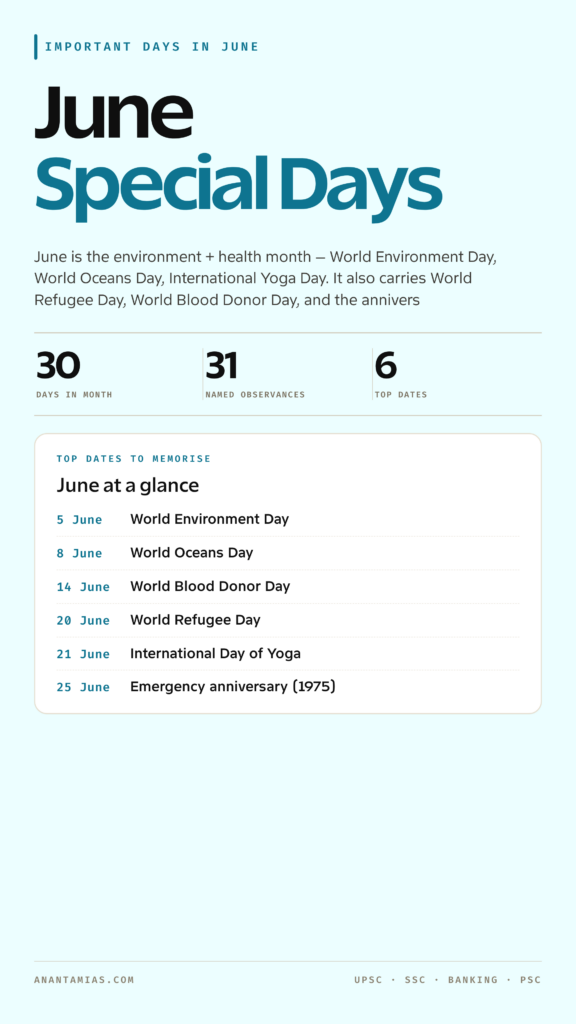
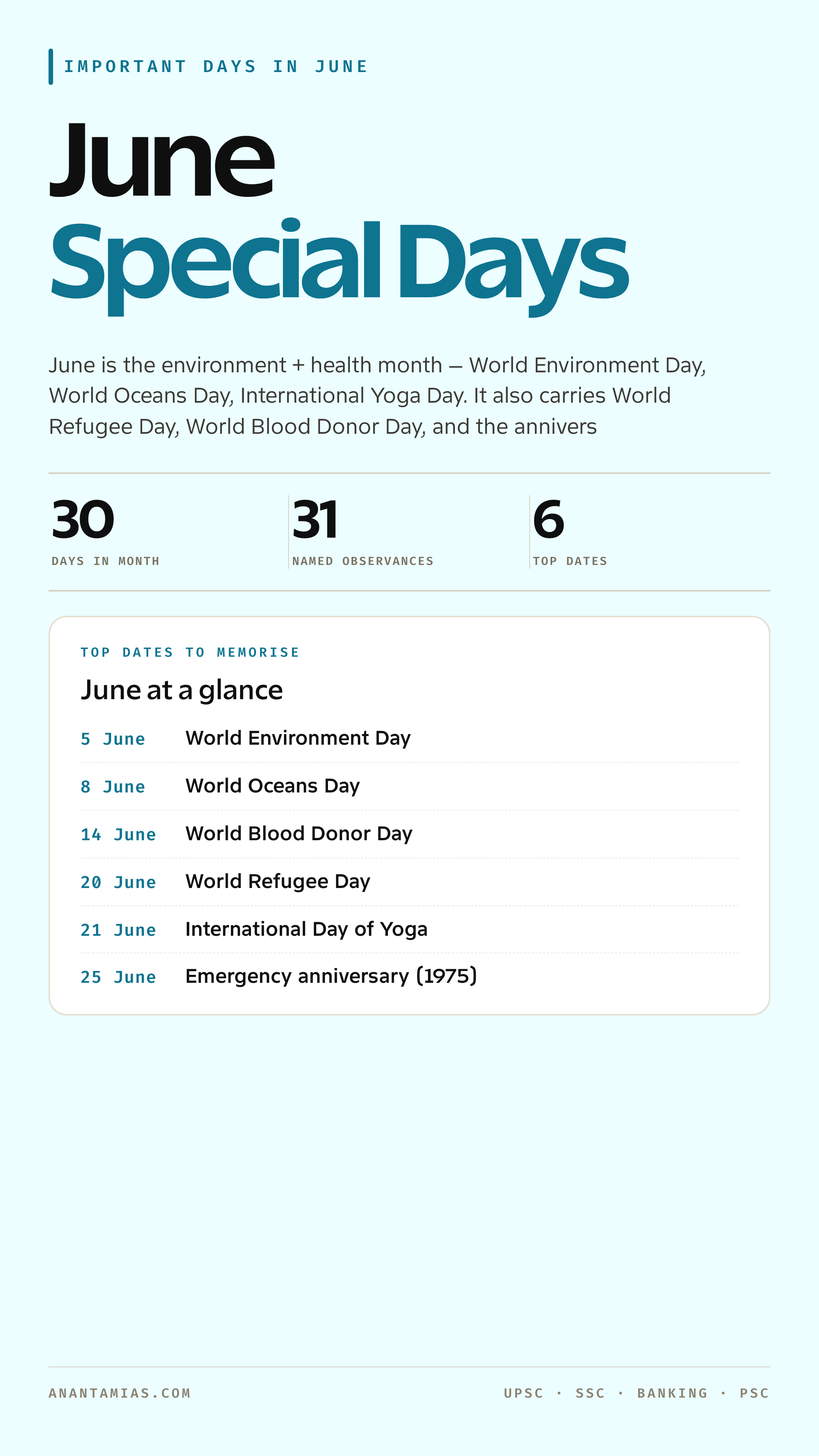
At a glance: June is the environment + health month — World Environment Day, World Oceans Day, International Yoga Day. It also carries World Refugee Day, World Blood Donor Day, and the anniversary of the Emergency.
Quick Facts at a Glance
- Month: June
- Total days: 30
- Named days covered in this guide: 31
- Type: mix of national, international, statehood, religious and birth/death anniversaries
- UPSC relevance: Prelims (current-affairs MCQs) + Mains GS I, II, III (depending on theme) + Essay
Background and Historical Context
India’s calendar of observances has three layers. The first is national days set by the Government of India through ministries — Republic Day (26 January), Independence Day (15 August), Constitution Day (26 November), Sardar Patel’s Rashtriya Ekta Diwas (31 October), and so on. The second is international days set by the United Nations and its agencies (WHO, UNESCO, FAO, UNHCR, ILO) — typically commemorating a founding anniversary or a treaty. The third is cultural, religious and birth/death anniversaries that have evolved organically through community observance, later picked up by government for institutional backing.
For June, the most testable categories are: (a) UN-designated days because their dates trace to specific founding treaties (always a fact-MCQ candidate); (b) birth/death anniversaries of constitutional figures (Ambedkar, Nehru, Patel, Gandhi, Bose) because they tie directly to GS I and II syllabi; (c) state foundation days because UPSC asks at least one state-formation question every year.
Top Highlights in June
Before the day-by-day breakdown, here are the June dates you absolutely cannot miss for the exam:
- 5 June — World Environment Day
- 8 June — World Oceans Day
- 14 June — World Blood Donor Day
- 20 June — World Refugee Day
- 21 June — International Day of Yoga
- 25 June — Emergency anniversary (1975)
June Day by Day — Every Named Date
Below is the comprehensive day-by-day list of important june dates and observances. Multiple entries on the same date are grouped together. Each entry includes the declaring body or origin, the historical event commemorated, and where applicable the UPSC angle.
Early June (1-10)
| Date | Day / Observance | What it commemorates |
|---|---|---|
| 1 Jun | World Milk Day | FAO day since 2001 to recognise importance of milk as a global food. |
| 1 Jun | Global Day of Parents | UN day since 2012. |
| 2 Jun | Telangana Formation Day | Marks formation of Telangana state in 2014, India’s 29th state. |
| 3 Jun | World Bicycle Day | UN day since 2018. |
| 4 Jun | International Day of Innocent Children Victims of Aggression | UN day since 1982. |
| 5 Jun | World Environment Day | UN day since 1974 marking 1972 Stockholm Conference. |
| 7 Jun | World Food Safety Day | WHO + FAO day since 2018. |
| 8 Jun | World Oceans Day | UN-designated since 2008. |
| 8 Jun | World Brain Tumour Day | Awareness day initiated 2000 by German Brain Tumour Association. |
| 10 Jun | World Eye Donation Day | Awareness on corneal donation. |
Mid June (11-20)
| Date | Day / Observance | What it commemorates |
|---|---|---|
| 12 Jun | World Day Against Child Labour | ILO day since 2002. |
| 13 Jun | International Albinism Awareness Day | UN day since 2014. |
| 14 Jun | World Blood Donor Day | Marks birth of Karl Landsteiner (1868), discoverer of ABO blood-group system. |
| 15 Jun | World Elder Abuse Awareness Day | UN day since 2011. |
| 17 Jun | World Day to Combat Desertification and Drought | UN day; marks 1994 UNCCD adoption. |
| 18 Jun | Autistic Pride Day | Annual day for autism rights movement since 2005. |
| 19 Jun | World Sickle Cell Day | UN day since 2009; particularly relevant to Indian tribal populations. |
| 20 Jun | World Refugee Day | UN-designated 2001 marking 50 years of 1951 Refugee Convention. |
Late June (21-30)
| Date | Day / Observance | What it commemorates |
|---|---|---|
| 21 Jun | International Day of Yoga | UN-declared in 2014 on PM Modi’s proposal; first observed 2015. |
| 21 Jun | World Music Day (Fête de la Musique) | Initiated 1982 in France. |
| 21 Jun | World Hydrography Day | Anniversary of IHO founding in 1921. |
| 23 Jun | International Olympic Day | Marks 1894 founding of International Olympic Committee. |
| 23 Jun | United Nations Public Service Day | UN day since 2002. |
| 23 Jun | International Widows Day | UN day since 2010. |
| 25 Jun | Day of the Seafarer | IMO day since 2011. |
| 25 Jun | Emergency Day (India remembrance) | Anniversary of imposition of Emergency in 1975 by PM Indira Gandhi. |
| 26 Jun | International Day Against Drug Abuse and Illicit Trafficking | UN day since 1987. |
| 26 Jun | International Day in Support of Victims of Torture | UN day since 1998. |
| 28 Jun | International Day of the Tropics | UN day since 2016. |
| 29 Jun | National Statistics Day (India) | Birth anniversary of P. C. Mahalanobis (1893), father of Indian statistics. |
| 30 Jun | World Asteroid Day | Marks 1908 Tunguska event; UN-recognised since 2016. |
Significance for UPSC and General Knowledge
In the last seven UPSC Prelims, current-affairs questions tied to important days have appeared every year — typically 1 to 3 questions per paper across history, environment, governance and IR. For June specifically, the high-probability MCQ areas are:
- UN-day declaration years: ‘Which year did the UN declare X?’ — straight fact-MCQ.
- Convention/treaty linkages: ‘World Wetlands Day commemorates which convention?’ — Ramsar (1971).
- State foundation dates and the reorganisation Act: ‘Which state was formed on date X under Act Y?’
- Birth/death anniversaries of constitutional figures: Tested via direct fact and via thematic essays.
- Major operational anniversaries (Vijay Diwas, Kargil Diwas): tested in defence + IR papers.
Detailed Analysis: Thematic Clusters in June
Beyond date-by-date memorisation, June’s observances fall into thematic clusters that often appear together in essay and GS questions. Group your revision around these clusters rather than memorising loose dates:
- Public health: WHO-aligned awareness days for specific diseases and health systems.
- Environment and ecology: UN Environment, biodiversity and disaster-related days.
- Freedom struggle and constitution-makers: birth/death anniversaries of national leaders + constitutional milestones.
- State foundation: anniversaries of states reorganised or carved out under specific Acts.
- Education and youth: teacher’s day, literacy, child rights and youth empowerment.
Comparative Perspective: How India’s Day Calendar Differs
Compared with the United States’ federal-holiday-heavy calendar or Japan’s emperor-tied observances, India’s calendar is unusually balanced — federal national holidays remain few, but the layer of state foundation days, thematic awareness days, and UN-aligned observances is dense. This reflects three structural choices: a federalist constitution that gives states their own foundation rituals; a Nehruvian internationalism that embraced UN observances early; and a post-2014 push to convert birth anniversaries of national figures into thematic observance days (Parakram Diwas, Janjatiya Gaurav Diwas, Veer Bal Diwas, Rashtriya Ekta Diwas).
For aspirants, this means you cannot rely on a single source. You need (a) Ministry of Home Affairs notifications for new national observance days, (b) UN website for international days, (c) state-government gazettes for statehood days, and (d) cultural-ministry releases for revived anniversaries. This guide consolidates all four.
Challenges and Criticisms
Three structural challenges with India’s observance calendar are worth flagging in Mains-essay or interview contexts. First, observation inflation: the number of declared observance days has grown faster than the average citizen’s awareness — over 1,200 international days are now tracked globally, of which India observes perhaps 200. Second, political contestation: new national days declared after 2014 (Parakram Diwas, Veer Bal Diwas, Rashtriya Ekta Diwas, Janjatiya Gaurav Diwas) have been criticised as ideological re-packaging by opposition voices, even as government argues they correct earlier omissions. Third, implementation gaps: many UN-aligned observances such as World Wetlands Day or International Day of Forests get government press releases but no ground-level outreach in states.
Prelims Pointers
- Memorise the top 10 dates from this June list — they have the highest hit rate in past papers.
- Always note the declaring body (UN agency, ministry, organisation) — it’s a common MCQ stem.
- For UN days, the date usually commemorates a founding treaty — note the year.
- For statehood days, note the Act under which the state was formed (States Reorganisation Act 1956, Madhya Pradesh Reorganisation Act 2000, etc.).
- For birth anniversaries, link the figure to their main contribution — Dr. Ambedkar to Constitution, Patel to integration, Vivekananda to revivalism.
Mains Practice Questions on June
- Critically examine the role that June‘s national observance days play in shaping the public memory of India’s freedom struggle. (15 marks)
- India observes several international days declared by the UN system in June. Evaluate whether these observances translate into measurable policy outcomes at the central and state levels. (15 marks)
- Discuss the politics of declaring new national observance days. Use examples from June to argue both sides. (10 marks)
Conclusion
The june special days list is much more than a memorisation drill. It is a structured map of how the Indian state, the international community and civil society have chosen to commemorate the people, events and themes considered worth remembering. For UPSC and other competitive exams, the dates are the hook — but the stories behind them are the actual answer to MCQs and essay prompts. Use this list as a reference, not a cram sheet.
Frequently Asked Questions
What is the full june special days list from 1 to 30?
The june special days list from 1 to 30 covers all named national, international, statehood and cultural observances in June, including World Environment Day, World Oceans Day, World Blood Donor Day among many others. The complete day-by-day breakdown is in the body of this guide.
Why is the list of important days in June important for UPSC?
UPSC Prelims has asked at least one current-affairs MCQ tied to June’s observances in every paper since 2018 — typically about the declaring UN agency, the historical event, or the constitutional figure whose anniversary it is. Mains GS papers and Essay also draw on themes from June’s observance clusters.
How many named days fall in June on this list?
This guide covers 31 named observances across June’s 30 days. Some dates carry multiple observances (for example, several state foundation days overlap on 1 November).
What is the most important day in June for India?
For India specifically, the standout date in June is World Environment Day. It carries the highest national-significance weight and is typically the most-cited in interview and essay contexts.
Which UN-designated days fall in June?
UN-designated days in this month appear in the day-by-day table above with their declaring agency and year of designation noted. They typically commemorate the anniversary of a founding treaty or convention.
Which Indian state foundation days are observed in June?
State foundation days in this month are listed in the day-by-day table — covering both States Reorganisation Act 1956 anniversaries and post-2000 state carve-outs.
How do I revise the june special days list efficiently?
Group dates by theme rather than memorising them sequentially — public health (WHO-aligned), environment (UN/UNEP-aligned), freedom struggle (birth/death anniversaries), state foundation, defence anniversaries, and education. Themes stick better than isolated dates.
Are these observances same every year?
Most fixed-date observances (Republic Day, Independence Day, UN days) repeat every year on the same date. A handful are tied to lunar calendars (Diwali, Eid, Holi, Onam) and shift annually. This guide focuses on fixed-date observances; cross-check almanacs for moveable festivals.
Tell Google you want more of this.
Add Anantam IAS as a preferred sourceOne tap, and this site shows up more often in your own Top Stories, AI Overviews and AI Mode. Remove it any time.