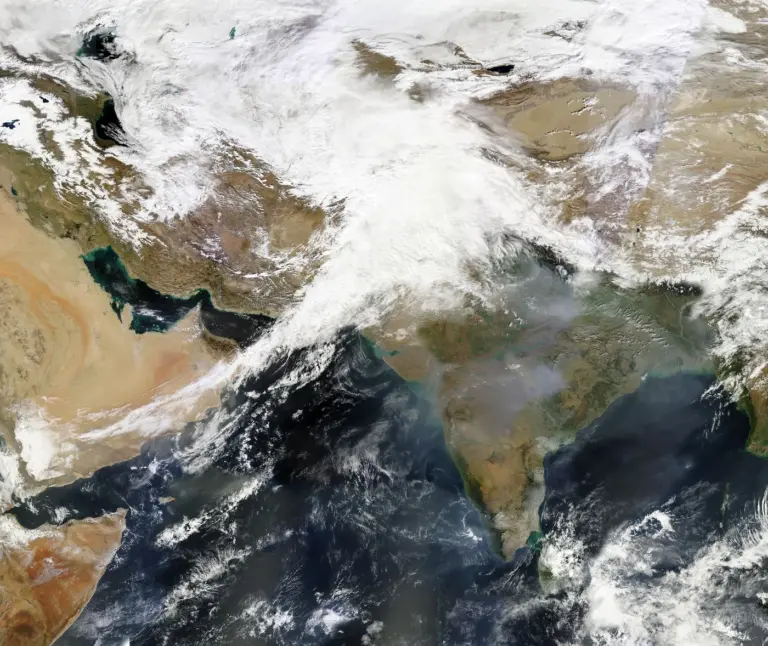
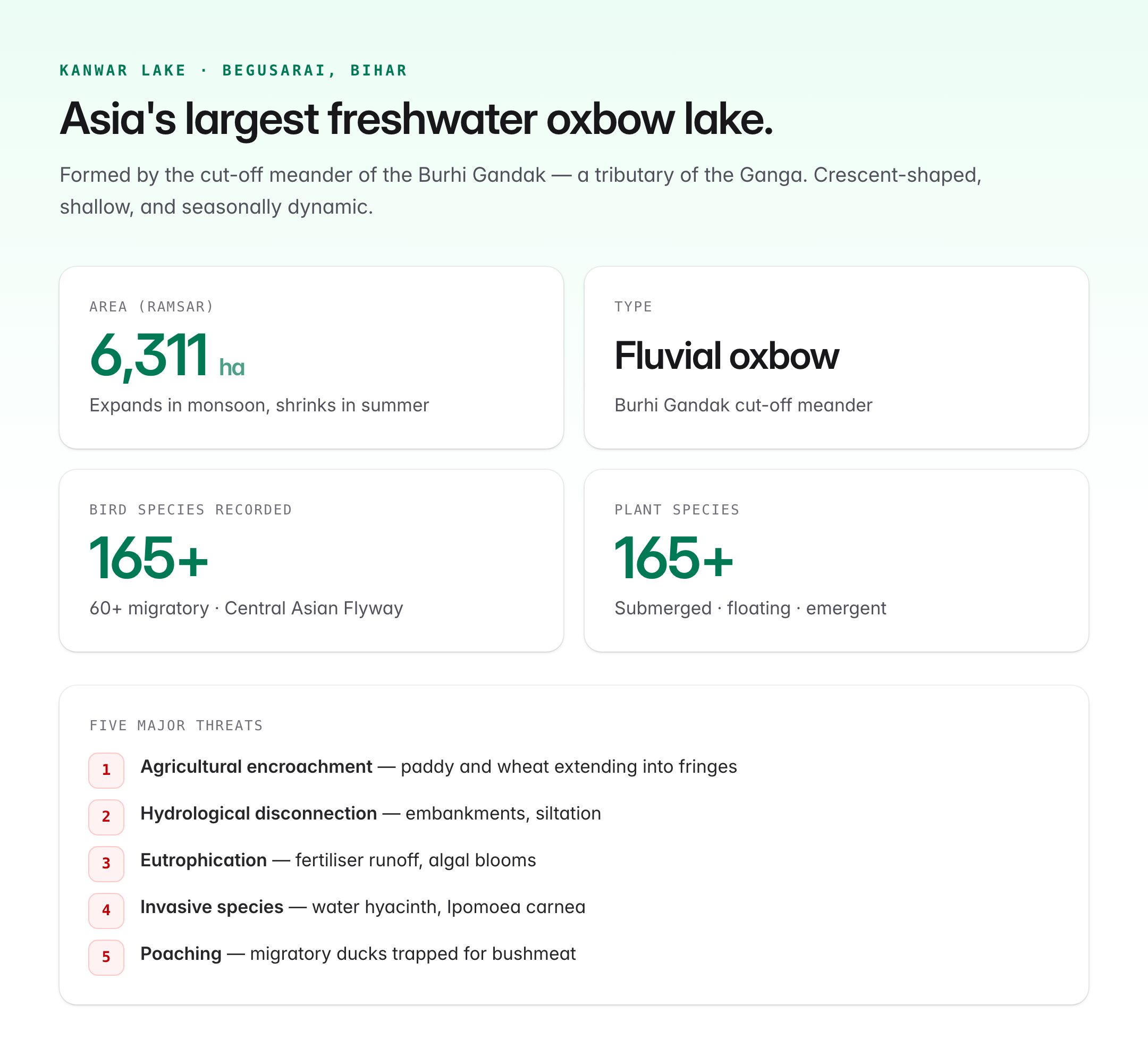
Kanwar Lake, officially known as Kabartal Wetland, is a freshwater lake in Begusarai district of Bihar and is widely described as Asia's largest freshwater oxbow lake. An oxbow lake is a crescent-shaped water body formed when a meander of a river is cut off from the main channel. Kanwar Jheel was formed by the meandering of the Burhi Gandak River, a tributary of the Ganga, and today covers approximately 6,311 hectares of the Indo-Gangetic floodplain. In 2020, Kabartal was designated as India's 41st Ramsar site and Bihar's first — a formal acknowledgement of its international ecological importance. For UPSC aspirants, Kanwar Lake represents a textbook case of wetland geomorphology, avian biodiversity, and conservation politics in North India.
Geography and Formation
Kanwar Lake is located in the Manjhaul area of Begusarai district, about 22 km northwest of Begusarai town and around 160 km from Patna. It lies on the northern floodplain of the Ganga, in the middle Ganga plain. The lake was created by the cut-off meander of the Burhi Gandak River, which migrated leaving behind this crescent-shaped residual water body — a classic oxbow.
| Feature | Detail |
|---|---|
| Location | Manjhaul, Begusarai district, Bihar |
| Coordinates | 25.6° N, 86.1° E (approx.) |
| Type | Freshwater oxbow lake |
| Area | 6,311 hectares (Ramsar notified) |
| Catchment river | Burhi Gandak (Ganga tributary) |
| Altitude | ~50 m above sea level |
| Shape | Crescent (oxbow) |
| Seasonal character | Expands during monsoon, shrinks in summer |
Kanwar is often called “Kanwar Jheel” in official Bihar documents and “Kabartal” in the Ramsar Convention notification. The water is alkaline to neutral, shallow (<2 m in most sections), and subject to rapid seasonal fluctuation — doubling during the monsoon and contracting to a few hundred hectares in peak summer.
Ecological Character
Kabartal is classified by Ramsar as a Wetland of International Importance under Criteria 2, 4, and 8 — species of conservation concern, critical habitat during life stages, and a major fish spawning ground.
Flora
The wetland supports over 165 plant species, including submerged aquatics (Hydrilla, Vallisneria), floating plants (Eichhornia, Pistia, Lemna), emergent macrophytes (Typha, Phragmites), and seasonal marsh grasses on the exposed fringes.
Fauna
- Fish: Over 50 species, including commercially important catla, rohu, mrigal, and the migratory hilsa during floods.
- Amphibians and reptiles: Frogs, Indian softshell turtle, snakes.
- Mammals: Smooth-coated otter (vulnerable), jackal, jungle cat.
- Birds: The lake's celebrity group.
Avian Diversity
Kabartal is on the Central Asian Flyway, hosting over 60 migratory bird species from Central Asia, Europe, and the Arctic during winter (October–March). Over 165 bird species in total have been recorded.
| Bird group | Examples |
|---|---|
| Migratory ducks | Northern pintail, gadwall, garganey, common teal, northern shoveler |
| Resident waterfowl | Lesser whistling duck, cotton pygmy goose |
| Waders | Black-tailed godwit, wood sandpiper, common snipe |
| Raptors | Greater spotted eagle (Vulnerable), Pallas's fish eagle (Endangered) |
| Storks and cranes | Black-necked stork, Sarus crane (Vulnerable) |
| Cormorants, egrets, herons | Little cormorant, cattle egret, purple heron |
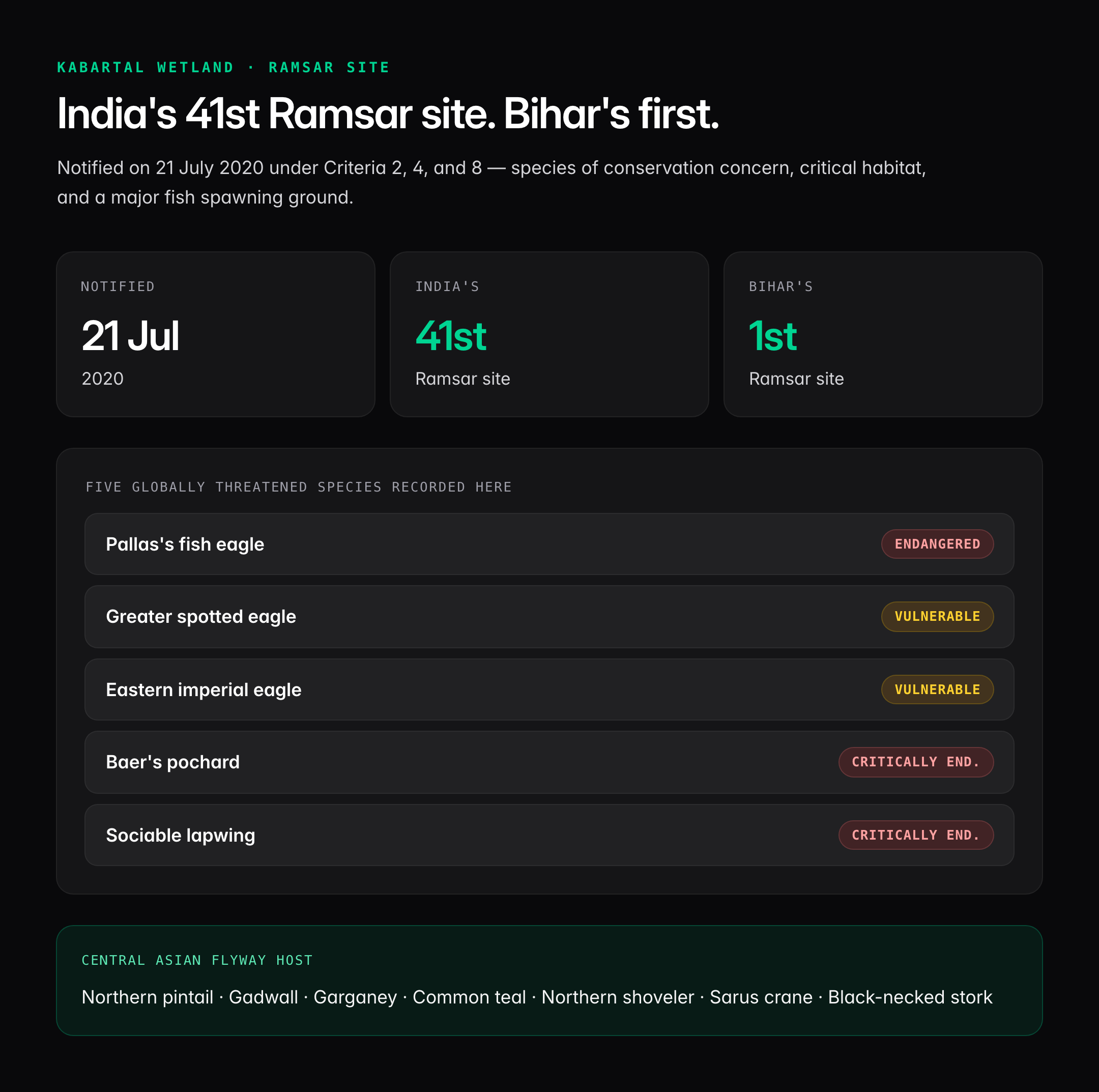
Kabartal is one of only a handful of Indian wetlands where five globally threatened species (Pallas's fish eagle, greater spotted eagle, eastern imperial eagle, baer's pochard, sociable lapwing) have been recorded.
Ramsar Site Status
Kabartal Wetland was notified as a Ramsar site on 21 July 2020, becoming:
- India's 41st Ramsar site
- Bihar's first Ramsar site
The designation was driven by its international avian importance and the threat of habitat loss from agricultural conversion. As of 2024, India has over 80 Ramsar sites, and Kabartal remains an emblematic representative of oxbow wetlands in North India — a category including Patna's Kanwar, Bihar's Gogabeel, Assam's Deepor Beel (also Ramsar).
Threats to Kanwar Lake
The Kabartal Wetland faces five major threats that have reduced its inundated area by nearly two-thirds over the past four decades.
- Agricultural encroachment: Farmers have extended paddy and wheat cultivation into the dry fringes of the wetland, effectively shrinking its active area.
- Hydrological disconnection: Embankments on the Burhi Gandak and siltation at inlet points reduce seasonal water exchange.
- Eutrophication: Fertiliser runoff and sewage from surrounding villages have triggered algal blooms.
- Invasive species: Water hyacinth (Eichhornia crassipes) and Ipomoea carnea choke open water and reduce bird habitat.
- Poaching: Despite legal protection, migratory ducks are trapped in nets and snares for bushmeat trade — a long-standing concern flagged by the Bombay Natural History Society (BNHS).
Conservation Status and Governance
- Legal protection: Declared Kabartal Bird Sanctuary in 1986 under the Wild Life (Protection) Act, 1972.
- Ramsar notification: 2020.
- State authority: Bihar's State Wetlands Authority under the Wetlands (Conservation and Management) Rules, 2017.
- Central funding: National Plan for Conservation of Aquatic Ecosystems (NPCA) of the Ministry of Environment, Forest and Climate Change.
- Stakeholders: Bihar forest department, Begusarai district administration, local panchayats, community fishers.
A Kabartal Conservation and Management Plan was developed post-Ramsar notification, covering hydrological restoration, anti-poaching surveillance, ecotourism, and community-based livelihood support.
Oxbow Lakes of India: A Wider Context
Oxbow lakes are scattered across the Indo-Gangetic and Brahmaputra plains. Notable examples:
| Lake | River (former meander) | State |
|---|---|---|
| Kanwar (Kabartal) | Burhi Gandak | Bihar |
| Gogabeel | Kankai / Mahananda | Bihar (Katihar) |
| Deepor Beel | Brahmaputra | Assam |
| Kaziranga beels | Brahmaputra | Assam |
| Samaspur Bird Sanctuary beels | Gomti | Uttar Pradesh |
| Manchar Lake (historical) | Indus | Now in Pakistan |
Oxbows are ecologically disproportionate to their size — they support higher biodiversity per hectare than large reservoirs because they retain natural floodplain dynamics.
Ecosystem Services of Kanwar Lake
- Flood moderation of the Burhi Gandak during the monsoon.
- Groundwater recharge for surrounding villages.
- Fisheries livelihood for nearly 5,000 people in Begusarai district.
- Carbon sequestration in wetland sediments.
- Cultural and religious significance — local festivals linked to the lake.
- Scientific value — long-term monitoring site for avian ecology.
UPSC Relevance
Kanwar Lake (Kabartal Wetland) is a frequent Prelims and environment Mains topic. For Prelims, memorise: Bihar's Begusarai district, formed by the Burhi Gandak meander, called Asia's largest freshwater oxbow lake, Ramsar site since 2020 — India's 41st and Bihar's first. A typical MCQ links Kanwar with the Central Asian Flyway or with Pallas's fish eagle. For GS Paper I (Geography), it is a type example of an oxbow lake formed by fluvial geomorphology — pair with Brahmaputra beels and deltaic dead rivers. For GS Paper III (Environment and Ecology), Kabartal is a case study of wetland degradation drivers (encroachment, eutrophication, invasive species) and of the Ramsar Convention 1971 implementation in India under the Wetlands (Conservation and Management) Rules, 2017. Link Kabartal with Montreux Record (degraded Ramsar sites), Sustainable Management of Wetlands programme, MoEFCC's NPCA, and the global World Wetland Day (2 February). In Essay, oxbow lakes like Kanwar illustrate how small, neglected habitats carry outsized ecological value — a framing examiners consistently reward. Avoid the common error of calling Kanwar a "tectonic lake" (it is fluvial, not tectonic) or confusing Kabartal with Chilika (brackish, Odisha) or Loktak (floating phumdi, Manipur).
Tell Google you want more of this.
Add Anantam IAS as a preferred sourceOne tap, and this site shows up more often in your own Top Stories, AI Overviews and AI Mode. Remove it any time.