Kathak dance belongs to the state of Uttar Pradesh in North India, and is one of the eight classical dance forms of India recognised by the Sangeet Natak Akademi. The answer to the popular UPSC question "Kathak dance which state" is most directly Uttar Pradesh — particularly the cultural centres of Lucknow, Varanasi, and nearby regions — with strong historical and contemporary roots also in Rajasthan (Jaipur) and Madhya Pradesh (Raigarh). Kathak traces its lineage to the ancient Kathakas — storytelling Brahmin bards who recited epics in temples, which later evolved into a sophisticated dance form combining rhythm, storytelling, and graceful movements. For UPSC aspirants, Kathak is an important Art & Culture topic (GS Paper I), featuring regularly in Prelims MCQs and Mains cultural heritage questions.
Which State Does Kathak Belong To?
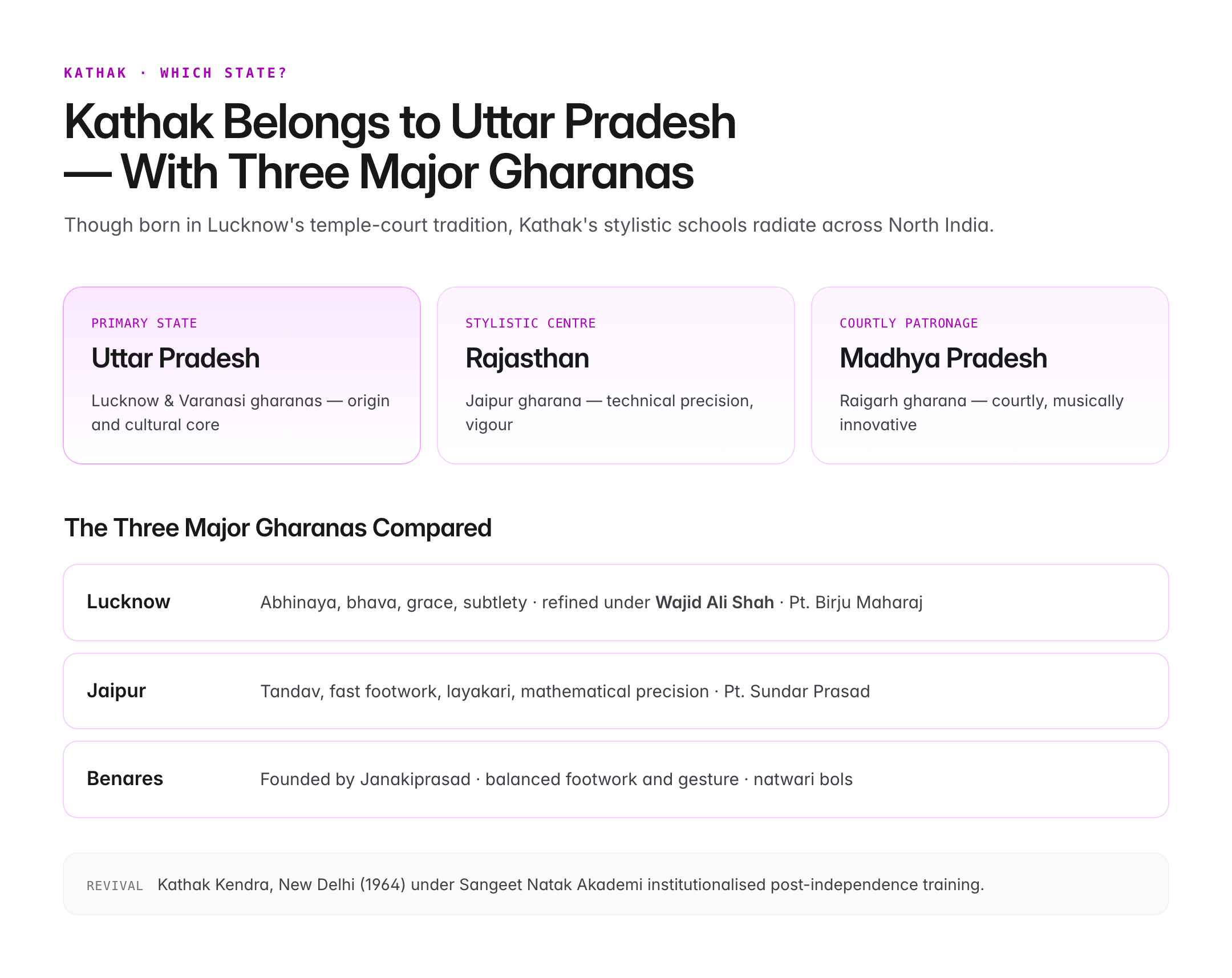
Though Kathak flourished across North India, its primary associations are:
| State | Role in Kathak |
|---|---|
| Uttar Pradesh | Origin; Lucknow and Varanasi gharanas |
| Rajasthan | Jaipur gharana — technical precision and vigour |
| Madhya Pradesh | Raigarh gharana — courtly patronage |
In the strictest UPSC answer context, Kathak is the classical dance of Uttar Pradesh.
Etymology and Meaning
The word "Kathak" comes from the Sanskrit "Katha" meaning story, and "Kathakar" meaning storyteller. The Kathakas were communities of wandering bards who narrated episodes from the Ramayana and Mahabharata in temples through recitation, music, gestures, and mime — the seed of today's Kathak.
Historical Evolution
Ancient Period
- Roots in Vedic and post-Vedic temple recitations.
- References in Natya Shastra of Bharata Muni (approximately 200 BCE–200 CE).
- Temple-based devotional storytelling.
Medieval/Mughal Period
- Transitioned from temple to court.
- Under Mughal patronage (16th–19th century), Kathak absorbed Persian costumes, Urdu poetry, and ghazal elements.
- Emphasis shifted from devotion (bhakti) to aesthetics, romance, and abhinaya (expression).
- Wajid Ali Shah, the last Nawab of Awadh, was a key patron who refined the Lucknow gharana.
Colonial Decline and Revival
- British colonial stigma pushed Kathak into decline.
- Post-independence, revived through institutions like Kathak Kendra (New Delhi, 1964) under Sangeet Natak Akademi.
Gharanas of Kathak
A gharana is a stylistic school. The three major Kathak gharanas are:
1. Lucknow Gharana
- Origin: Courts of Awadh, under Wajid Ali Shah.
- Focus: Abhinaya (expression), bhava (emotion), grace, and subtlety.
- Founders/Exponents: Ishwari Prasad, Thakur Prasad, Pt. Birju Maharaj, Shambhu Maharaj, Lachhu Maharaj.
2. Jaipur Gharana
- Origin: Rajput courts of Jaipur.
- Focus: Tandav (vigorous), fast footwork, technical layakari, mathematical precision.
- Exponents: Bhanuji, Durga Prasad, Pt. Sundar Prasad, Kundan Lal Gangani.
3. Benares/Varanasi Gharana
- Founded by Janakiprasad.
- Focus: Balanced footwork and gesture; natwari bols, use of symmetrical patterns.
- Strong connection to religious themes.
4. Raigarh Gharana (newer)
- Developed in Chhattisgarh/Madhya Pradesh under Raja Chakradhar Singh of Raigarh.
- Blends elements of Lucknow and Jaipur with musical innovation.
Technical Elements of Kathak
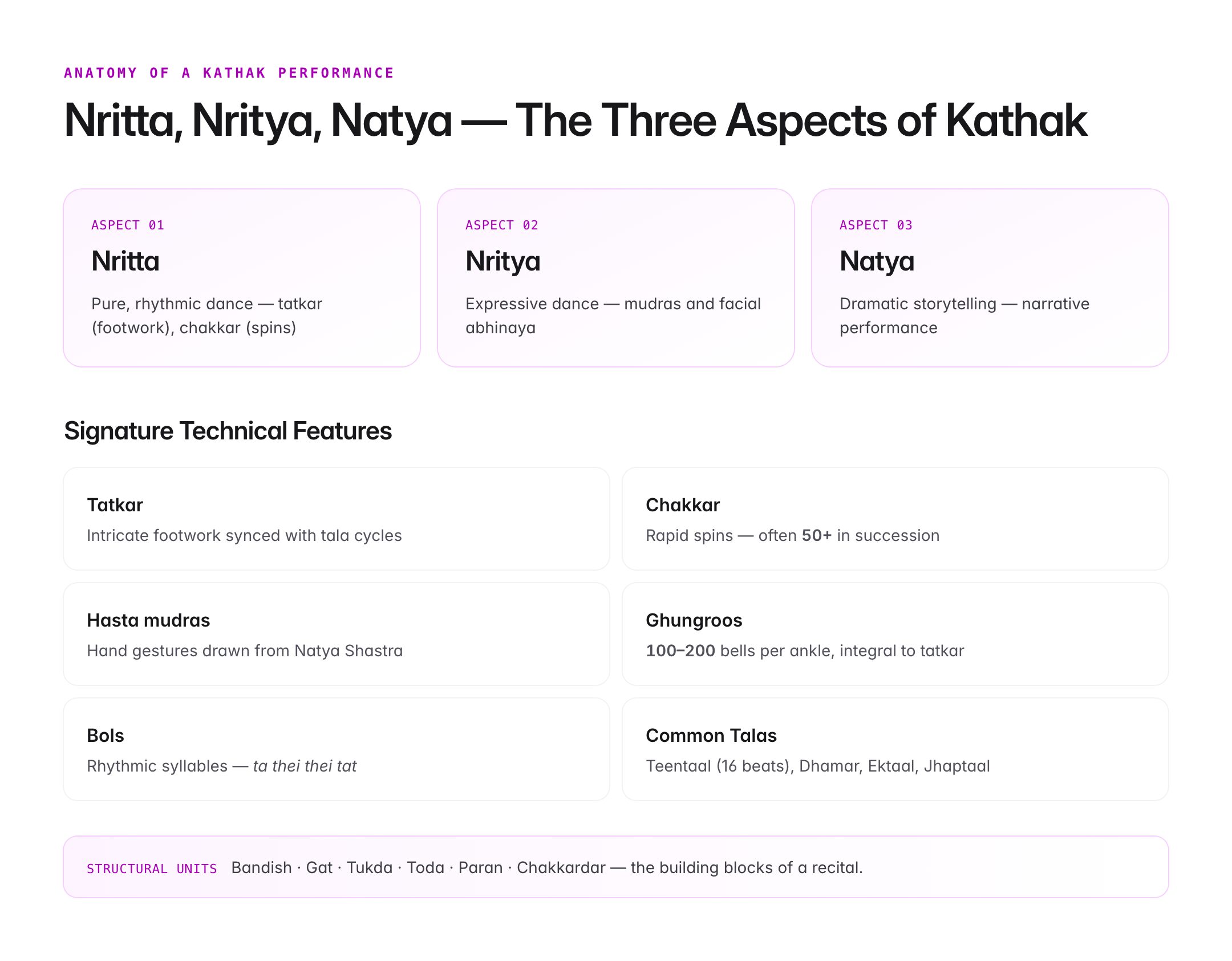
Kathak performances combine three core aspects:
| Element | Description |
|---|---|
| Nritta | Pure, rhythmic dance — footwork (tatkar), spins (chakkar) |
| Nritya | Expressive dance — storytelling via mudras, facial expressions |
| Natya | Dramatic element — narrative performance |
Key Features
- Tatkar — intricate footwork synchronised with rhythm cycles (talas).
- Chakkar — characteristic rapid spins (often 50+ in succession).
- Hasta mudras — hand gestures.
- Abhinaya — facial and body expressions.
- Bol — rhythmic syllables like ta thei thei tat.
- Bandish, gat, tukda, toda, paran, chakkardar — structural compositions.
- Common talas: Teentaal (16 beats), Dhamar, Ektaal, Jhaptaal.
Costume and Music
Costume
- Female (Hindu style): Lehenga-choli with dupatta.
- Female (Mughal style): Angarkha (long flared kurta), churidar, odhani.
- Male: Kurta-churidar or dhoti-kurta with cap.
- Ghungroos (ankle bells): 100–200 on each ankle, integral to tatkar rhythm.
- Heavy jewellery, bindi, maang-tikka.
Music
- Hindustani classical music tradition (see Raga Bilawal).
- Instruments: Tabla, Pakhawaj, Sarangi, Sitar, Harmonium, Flute.
- Vocal forms: Thumri, Dadra, Ghazal, Bhajan.
Famous Kathak Exponents
- Pandit Birju Maharaj — Lucknow gharana doyen; Padma Vibhushan.
- Sitara Devi — "Kathak Queen," praised by Rabindranath Tagore.
- Shovana Narayan — Padma Shri awardee.
- Kumudini Lakhia — modernised Kathak with ensemble choreography.
- Pandit Durgalal, Roshan Kumari, Rajendra Gangani, Aditi Mangaldas.
Significance and UPSC Context
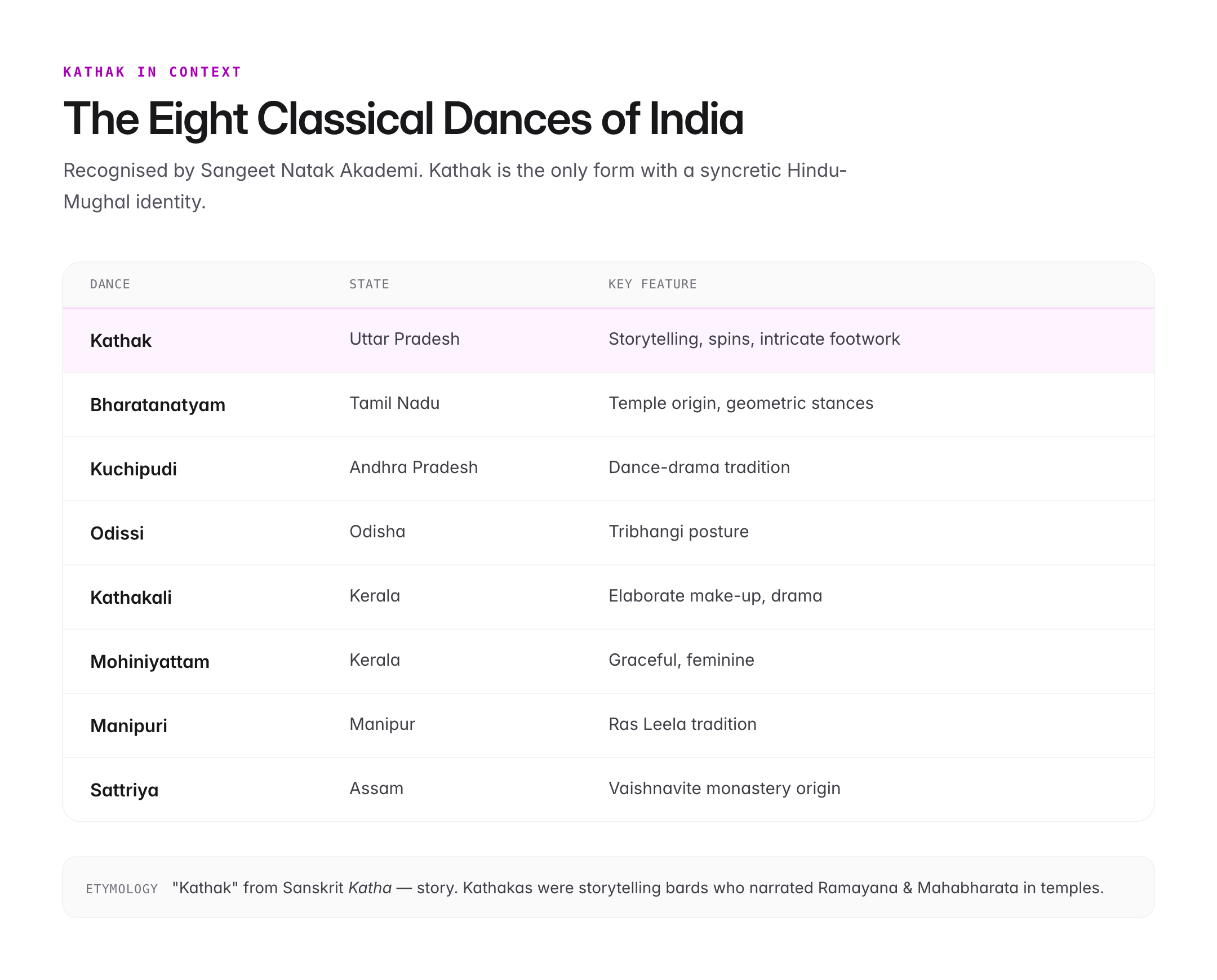
- One of the eight classical dances along with Bharatanatyam (TN), Kuchipudi (AP), Odissi (Odisha), Kathakali (Kerala), Mohiniyattam (Kerala), Manipuri (Manipur), Sattriya (Assam).
- Only classical dance with strong syncretic Hindu-Mughal identity.
- Showcases Ganga-Jamuni tehzeeb — composite culture.
- Recognized in UNESCO cultural heritage discourses and promoted via ICCR.
Quick Comparison: Kathak vs Other Classical Dances
| Dance | State | Key Feature |
|---|---|---|
| Kathak | Uttar Pradesh | Storytelling, spins, footwork |
| Bharatanatyam | Tamil Nadu | Temple origin, geometric stances |
| Kuchipudi | Andhra Pradesh | Dance-drama tradition |
| Odissi | Odisha | Tribhangi posture |
| Kathakali | Kerala | Elaborate make-up, drama |
| Mohiniyattam | Kerala | Graceful, feminine |
| Manipuri | Manipur | Ras Leela tradition |
| Sattriya | Assam | Vaishnavite monastery origin |
UPSC Relevance
- Prelims focus: Kathak → Uttar Pradesh; three main gharanas (Lucknow, Jaipur, Benares); Wajid Ali Shah patronage; origin from Kathakas; Birju Maharaj's gharana; key features (tatkar, chakkar, abhinaya).
- Mains GS-I angle: Evolution of Indian classical dance; impact of Mughal patronage on Indian performing arts; role of court culture in preserving classical art forms; composite Ganga-Jamuni culture.
- Sample PYQ angle: "Indian classical dances reflect the amalgamation of religious devotion and royal patronage. Discuss with reference to Kathak." — structure with temple origins, Mughal courtly transformation, gharana system, and modern revival via Kathak Kendra and Sangeet Natak Akademi.
Tell Google you want more of this.
Add Anantam IAS as a preferred sourceOne tap, and this site shows up more often in your own Top Stories, AI Overviews and AI Mode. Remove it any time.