Disclosure: this guide contains Amazon affiliate links. As an Amazon Associate, Anantam IAS earns from qualifying purchases — at no extra cost to you.
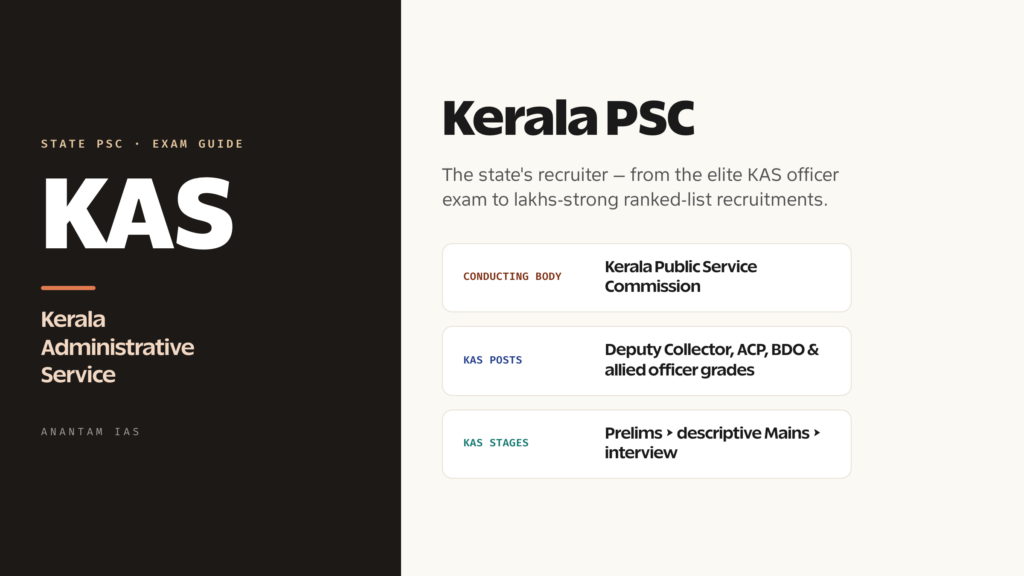
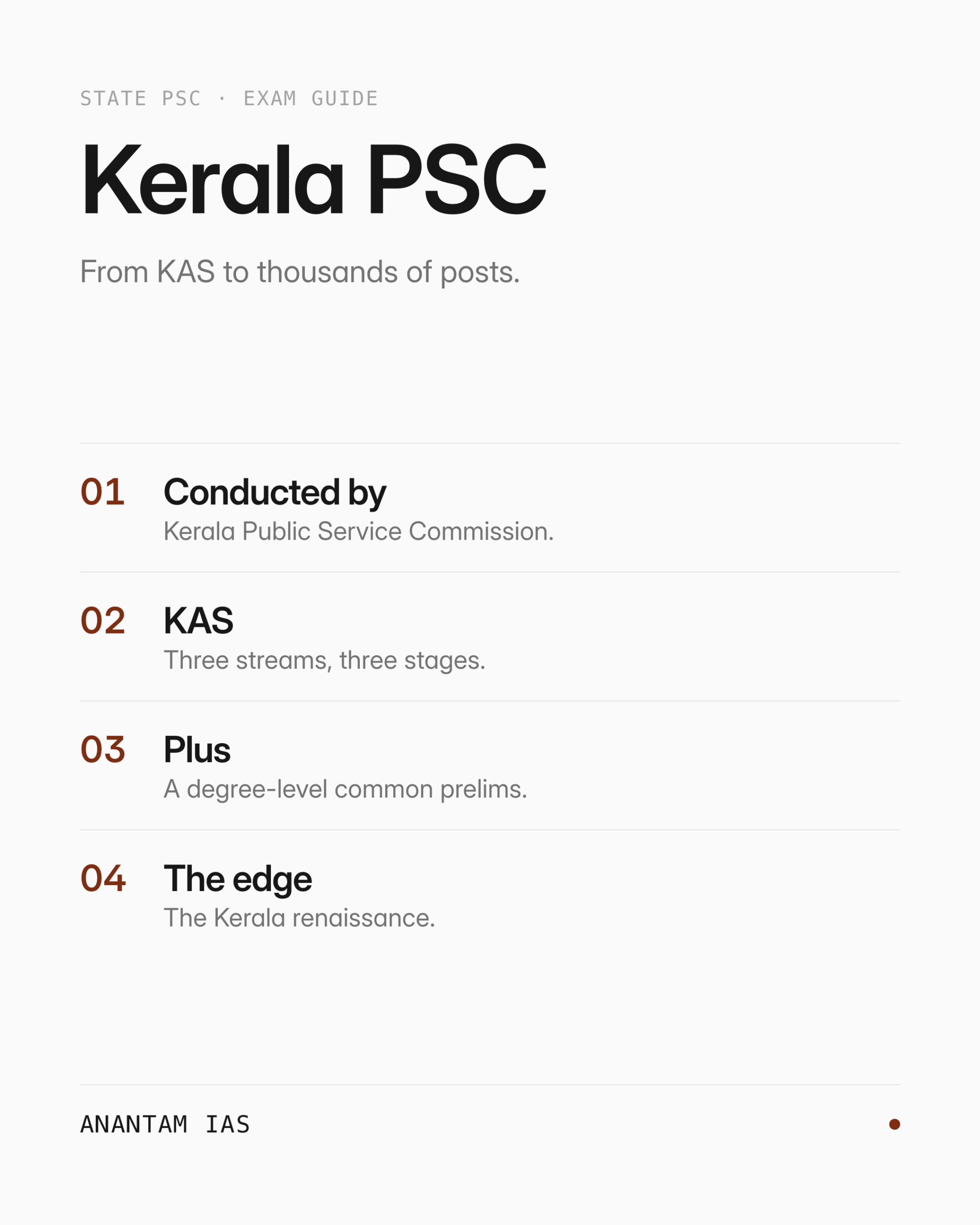
KAS stands for the Kerala Administrative Service — Kerala's flagship officer cadre, recruited by the Kerala Public Service Commission (Kerala PSC) through a UPSC-style Prelims–Mains–Interview examination. Kerala PSC also recruits for almost every other state government post — from Sub Inspector and University Assistant down to clerical and last-grade roles — through common screening tests and the ranked-list system.
| Item | Detail |
|---|---|
| KAS full form | Kerala Administrative Service |
| Conducting body | Kerala Public Service Commission (Kerala PSC) |
| Headquarters | Thiruvananthapuram |
| KAS stages | Prelims (200) → descriptive Mains (300) → Interview (50) |
| KAS entry streams | Stream I (open, ~21–32 yrs), II (departmental), III (promotion) |
| Eligibility | Bachelor's degree; Thulasi one-time registration; working Malayalam |
| Other posts | Sub Inspector, Excise Inspector, University Assistant, LDC, LGS |
The Kerala Public Service Commission (Kerala PSC) is the constitutional body that recruits for almost every state government job in Kerala — from the elite officer-grade Kerala Administrative Service down to clerical and last-grade posts. For lakhs of graduates and school-leavers across the state, “writing PSC” is less a single exam and more a way of life, with study circles, coaching, and a famously competitive ranked-list culture built around it.
What makes Kerala PSC unusual is its two very different faces. One is the Kerala Administrative Service (KAS), a UPSC-style three-stage exam with a descriptive Mains that produces the state’s senior administrators. The other is a vast machinery of recruitments — clerks, assistants, sub-inspectors, university staff — increasingly funnelled through common preliminary exams and the ranked-list system. This guide covers both, so you can decide which Kerala PSC pathway fits you.
What Is Kerala PSC?
Kerala PSC is the state’s recruiting authority under Articles 315-323 of the Constitution, responsible for selecting candidates for posts in state government departments, public sector undertakings, universities, local bodies, and Kerala-controlled boards and corporations. Where the Union Public Service Commission staffs the all-India services, Kerala PSC staffs the state’s own administrative spine.
Two recruitment models sit under that single roof. The Kerala Administrative Service is the prestige exam — a dedicated officer cadre created in 2018 to fast-track talent into senior posts such as Deputy Collector, Assistant Commissioner, and Block Development Officer, with a UPSC-style Prelims-Mains-Interview structure. Everything else — the degree-level and tenth-level recruitments — runs through a different machine, where a common Preliminary screening test now filters candidates before post-specific selection, and successful candidates are placed on a ranked list valid until it is exhausted or expires.
Key Facts
- Conducting authority: Kerala Public Service Commission, headquartered at Thiruvananthapuram, with district and taluk offices statewide.
- Flagship exam: Kerala Administrative Service (KAS) — three streams of entry into a single officer cadre.
- Posts covered: From KAS officer grades to Sub Inspector, Excise Inspector, University Assistant, Lower Division Clerk (LDC), and Last Grade Servant (LGS).
- Frequency: KAS is notified periodically (not strictly annual); the degree-level and tenth-level common prelims run on published annual calendars.
- Scale of competition: Popular posts like LDC and University Assistant routinely draw lakhs of applicants, making rank-list mathematics brutally tight.
Kerala PSC Exam Pattern
Because Kerala PSC runs two distinct systems, there are really two patterns to understand — the KAS ladder and the common degree-level model. Both use objective screening with negative marking; only KAS adds a full descriptive Mains.
Prelims
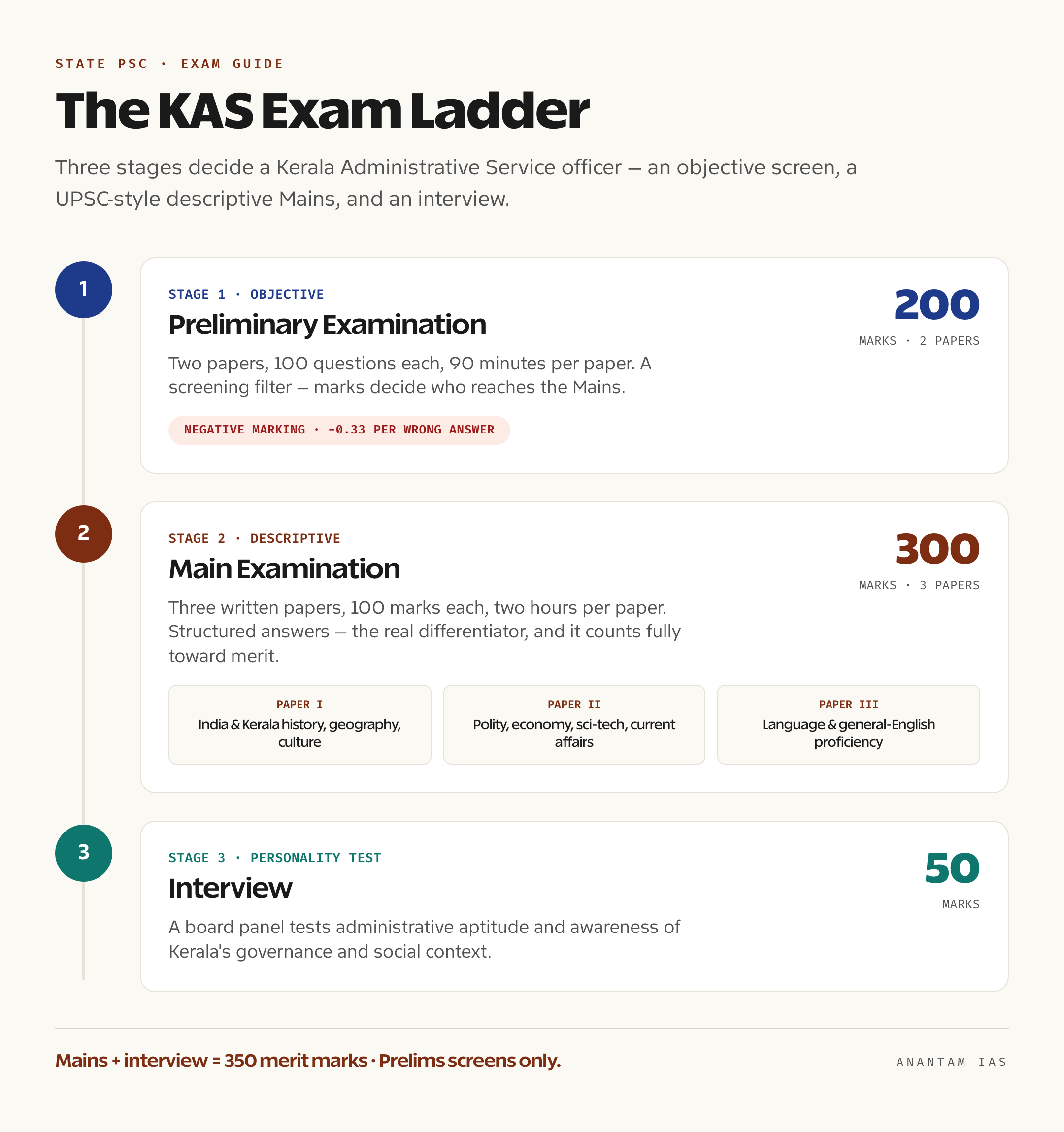
For KAS, the Preliminary stage is an objective screening test of two papers, each with 100 questions for 100 marks, written in a 90-minute slot per paper, for a Prelims total of 200 marks. Wrong answers carry negative marking — one-third (0.33) of a mark deducted per incorrect response — so blind guessing hurts. KAS Prelims is a screening filter that decides who reaches the Mains; it works like UPSC’s CSAT-plus-GS screen, but with a heavier Kerala focus.
For the degree-level recruitments, Kerala PSC now uses a common Preliminary Examination — a single OMR-based objective screen that several graduate posts share. It carries 100 questions for 100 marks, with the same 0.33 negative marking, and is split across General Knowledge (the largest block), simple arithmetic and mental ability, general English, and a regional-language section. Clearing this common prelims is what makes you eligible for the post-specific Mains. The same idea repeats at the tenth-level for posts like LDC and LGS through their own common screening tests.
Mains
The KAS Mains is the real differentiator. It is a fully descriptive exam — three papers, 100 marks each, two hours per paper, for 300 marks — that tests structured writing, analysis, and Kerala-specific depth rather than recognition memory. Broadly, the three papers cover General Studies and Indian/Kerala history-geography-culture; polity, governance, economy, science-and-technology and current affairs; and language and general-English proficiency. This descriptive stage is what makes KAS feel like a state-level UPSC: marks here count fully toward the final merit list.
For the degree-level common-prelims posts, the “Mains” is post-specific. Once you clear the shared screening test, you sit a Mains tailored to the post you applied for (Sub Inspector, University Assistant, and so on), and that paper — combined with verification and, where applicable, physical or interview stages — decides your final rank.
Interview/Personality Test
KAS adds a Personality Test of 50 marks after the Mains, assessed by a Kerala PSC board panel. It probes administrative aptitude, awareness of Kerala’s governance and social context, and the candidate’s clarity under questioning. For many degree-level and tenth-level posts there is no separate interview at all — selection is decided largely on written marks plus document verification — which is one reason the ranked-list cut-offs are so finely contested.
Kerala PSC Eligibility
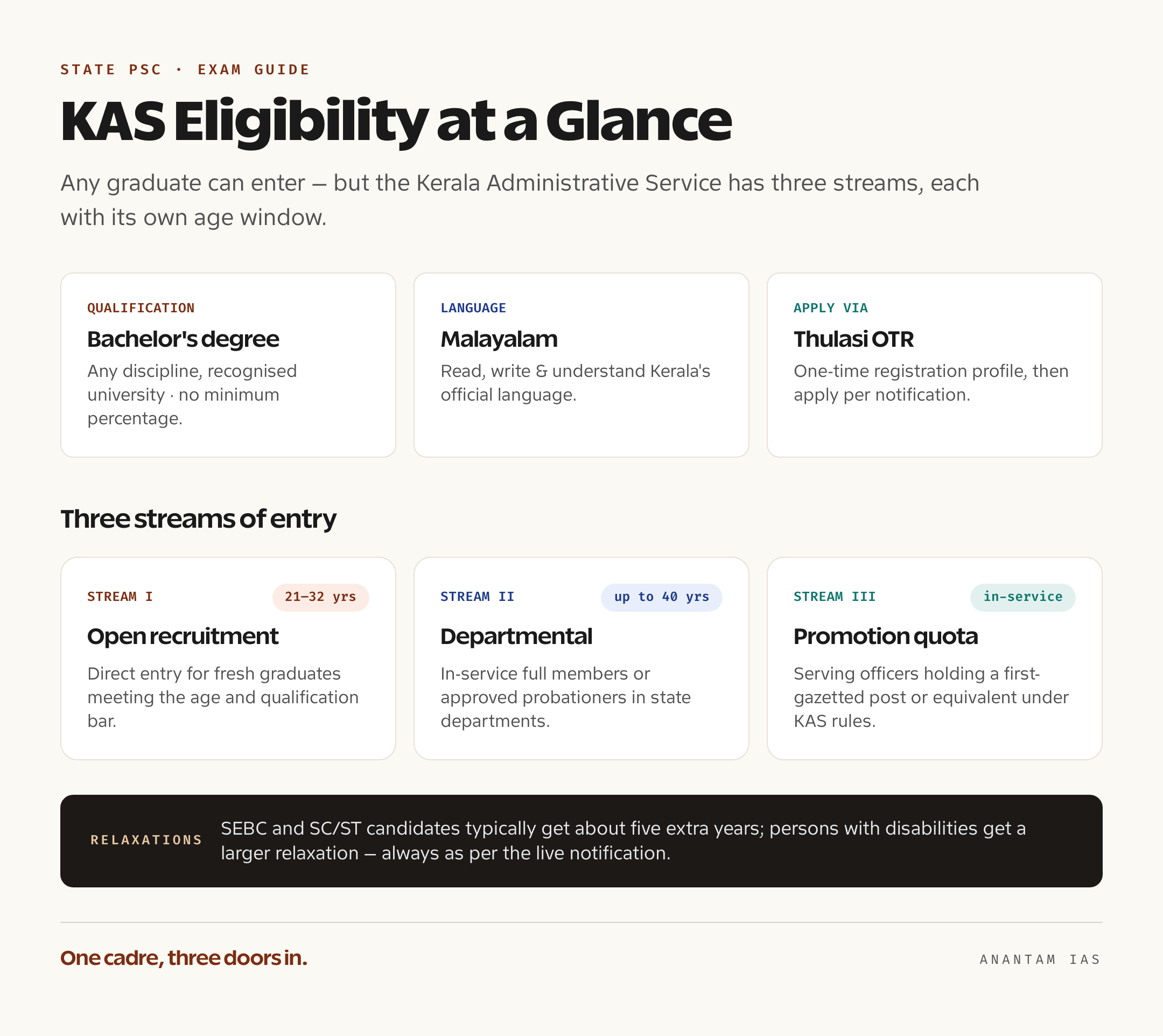
Eligibility splits by which Kerala PSC pathway you choose, but a few rules are common to almost all of it: Indian citizenship, registration through the Commission’s Thulasi one-time-registration portal, and a working knowledge of Malayalam, the language of Kerala’s administration. You register once on Thulasi, build a profile with your qualifications and language details, and then apply to individual notifications from that profile.
For the Kerala Administrative Service, the headline feature is three streams of entry into the same cadre. Stream I is open recruitment for fresh graduates meeting the age and qualification bar. Stream II is direct recruitment from in-service candidates who are full members or approved probationers in state departments. Stream III is a promotion route for serving officers already holding a first-gazetted post or equivalent under the KAS rules. The educational qualification across streams is a bachelor’s degree in any discipline from a recognised university, with no minimum-percentage requirement.
Age limits follow the stream. For Stream I open recruitment the general band is typically 21-32 years, with the usual Kerala relaxations layered on top — generally about five extra years for SEBC/OBC and SC/ST candidates, and a larger relaxation for persons with disabilities, subject to the prevailing notification. Stream II departmental candidates have a higher upper age (around 40), and Stream III promotion candidates work to an in-service ceiling rather than an entry-age band. For the degree-level and tenth-level recruitments, age limits, reservation, and relaxations are set post-by-post in each notification, so the rule is always to read the specific advertisement rather than assume.
Kerala PSC Syllabus
The syllabus is where Kerala PSC stops resembling a generic government exam and becomes unmistakably about Kerala. Across both the KAS and the common-prelims streams, a large and reliably tested chunk of every paper is Kerala history, geography, polity, economy, schemes, and — above all — the Kerala renaissance.
Prelims Syllabus
KAS Prelims spans general studies of national and international importance, the humanities (history, polity, geography, economy), general science and technology, environment and ecology, and mental ability — with Kerala-specific content woven through every section. The degree-level common prelims is broader and shallower: a dominant General Knowledge block (Indian and Kerala history, geography, the Constitution, culture, basic science and computer awareness, current affairs), plus arithmetic and reasoning, general English, and a regional-language section. The unifying thread is that Kerala GK is never optional.
Mains Syllabus
The KAS Mains demands descriptive, well-structured answers across its three papers: India-and-Kerala history, geography and culture; polity, governance, the economy, science-and-technology, and current affairs; and language-and-English proficiency. Unlike UPSC, KAS has no separate optional subject — the entire descriptive load is general-studies and Kerala-focused, so there is no 500-mark optional to build a whole strategy around. For the degree-level posts, the post-specific Mains adds domain content relevant to that role on top of the same Kerala-GK base.
State-Specific Focus
This is the part that wins or loses Kerala PSC. The Kerala renaissance and social-reform movement is tested more heavily, and more precisely, than almost any other single topic. Expect detailed, date-and-name questions on Sree Narayana Guru and the SNDP Yogam (1903), Ayyankali and the Sadhu Jana Paripalana Yogam (1907), Chattampi Swamikal, and the great agitations — the Vaikom Satyagraha (1924-25), the Guruvayur Satyagraha (1931), and the Channar and Kallumala struggles. Around that core sit Kerala’s modern political history and the formation of the state, its geography (backwaters, monsoon, the Western Ghats, plantation belts), the Kerala model of human development, state government schemes and welfare boards, and Malayalam language and literature. Treat Kerala GK as the spine of preparation, not a top-up.
Kerala PSC Preparation Strategy
A good Kerala PSC plan is built in layers — a national-GK foundation, a thick Kerala-specific core, disciplined current affairs, and relentless practice against the ranked-list reality.
Build the General Foundation
Start with the same backbone that serves any Indian competitive exam: NCERT-grade history, geography, polity, economics, basic science, and environment. If you are also eyeing the civil services, the overlap is real — much of the UPSC-style general-studies base transfers directly to KAS Prelims and Mains. Our UPSC syllabus 2026 guide is a useful map of that shared GS terrain, and our explainer on what PCS means and how state services work puts Kerala PSC in the wider state-services picture.
Master the Kerala-Specific Core
This is non-negotiable. Give a dedicated, sustained block to Kerala history, the renaissance and social reformers, Kerala geography, the state’s economy and schemes, and Malayalam-medium GK. Build a one-page sheet of renaissance figures — reformer, organisation, year, key contribution — because that exact mapping is asked again and again. A strong Kerala core is what separates rank-holders from the crowd, since national GS is broadly equal across serious candidates.
Get Current Affairs Right
Blend national current affairs with Kerala-focused coverage — state budget highlights, new welfare schemes, awards and appointments, and Kerala-relevant developments. Maintain short, dated notes you can revise quickly, and tie each item back to the syllabus head it serves rather than collecting trivia.
Practice PYQs and Answer Writing
Solve previous-year Kerala PSC papers ruthlessly — they reveal exactly which renaissance names, schemes, and Kerala facts recur. For the degree-level and tenth-level posts, that pattern-spotting plus speed-and-accuracy under negative marking is most of the battle. For KAS, add structured answer-writing practice for the descriptive Mains; our UPSC vs SSC comparison is a helpful reference point for understanding how a descriptive officer-grade exam differs from a purely objective recruitment.
Drill Mocks and Revise
Take timed full-length mocks, review every wrong answer, and rebuild weak Kerala-GK areas. Because rank lists turn on fractions of a mark, your management of negative marking — knowing when to attempt and when to leave — is itself a skill to train. Revise the Kerala core on a fixed cycle so it stays sharp right up to the exam.
Posts, Salary and the Ranked-List System
Kerala PSC’s reach is the widest of any single state authority. At the top sit KAS officer-grade posts — Deputy Collector, Assistant Commissioner, Block Development Officer and equivalents — drawing officer-grade pay under the Kerala pay revision, with strong administrative growth. Below that, degree-level recruitments fill posts like Sub Inspector of Police, Excise Inspector, Assistant Jailor, University Assistant, and Junior Assistant, while tenth-level recruitments fill Lower Division Clerk, Last Grade Servant, and similar roles across departments and PSUs.
What ties it all together is the ranked list. For most non-KAS posts, Kerala PSC publishes a district-wise or department-wise ranked list of qualified candidates, and appointments are made from that list as vacancies arise until the list is exhausted or its validity lapses. This is why aspirants track their rank obsessively and why cut-offs are decided by tiny margins: a slightly higher rank can mean an advice memo within months, while a marginally lower one may wait out the entire list’s life. Understanding the ranked-list mechanics — list validity, district categories, and how vacancies are reported — is as important as the syllabus itself.
Books for Kerala PSC
Most of what you read for UPSC transfers to Kerala PSC: polity, economy, modern history and the NCERT base. What does not transfer is the Kerala section, and that is where the selection is decided. There is no single Kerala GK book worth recommending on Amazon.in right now; the Kerala PSC Bulletin and the state’s own publications do that job.

Lucent's General Knowledge 2026 — English (15th revised edition)
- 460 pages, Lucent Publications
- Static GK in the compressed, list-heavy format state PSC prelims reward
- Overrated for UPSC, right for this exam
- Indian Polity, M. Laxmikanth (Amazon.in). The polity questions are the same exam everywhere.
- Lucent’s General Knowledge (Amazon.in). Overrated for UPSC, right for the static questions here.
- Indian Economy, Ramesh Singh (Amazon.in). Read the concept chapters; the state budget goes on top.
- A Brief History of Modern India, Spectrum (Amazon.in). The freedom-struggle questions come straight from here.
- NCERTs, Classes 6 to 12, for history, geography and science. Free from NCERT; nothing to buy.
Skip the coaching compilations until you have finished these. They summarise books you have not read yet.
Frequently Asked Questions
What is the difference between KAS and the other Kerala PSC exams?
KAS is Kerala PSC’s flagship officer-cadre exam, with a UPSC-style three-stage structure — an objective Prelims of two 100-mark papers, a descriptive Mains of three 100-mark papers, and a 50-mark interview — for senior posts like Deputy Collector. Most other Kerala PSC recruitments run through common objective screening tests, post-specific Mains, and the ranked-list system, and many have no interview at all.
Is Malayalam compulsory for Kerala PSC?
In practice, yes for most posts. Malayalam is the language of Kerala’s administration, so candidates are generally expected to read, write, and understand it, and many notifications include a regional-language component. You register once on the Commission’s Thulasi one-time-registration portal, where you record your language and qualification details before applying to any post.
What is the age limit for the KAS exam?
It depends on the stream. Stream I open recruitment is typically 21-32 years, with the usual Kerala relaxations — around five extra years for SEBC and SC/ST candidates and a larger relaxation for persons with disabilities — applied as per the live notification. Stream II departmental candidates have a higher upper age (around 40), and Stream III is a promotion route governed by an in-service ceiling rather than an entry-age band.
How important is the Kerala renaissance for Kerala PSC?
Extremely. The Kerala renaissance and social-reform movement is one of the most heavily and precisely tested areas across KAS and the common prelims, with frequent date-and-name questions on Sree Narayana Guru, Ayyankali, Chattampi Swamikal, the SNDP Yogam, and agitations like the Vaikom Satyagraha. A reformer-organisation-year-contribution mapping should be a core part of every Kerala PSC revision sheet.
Tell Google you want more of this.
Add Anantam IAS as a preferred sourceOne tap, and this site shows up more often in your own Top Stories, AI Overviews and AI Mode. Remove it any time.