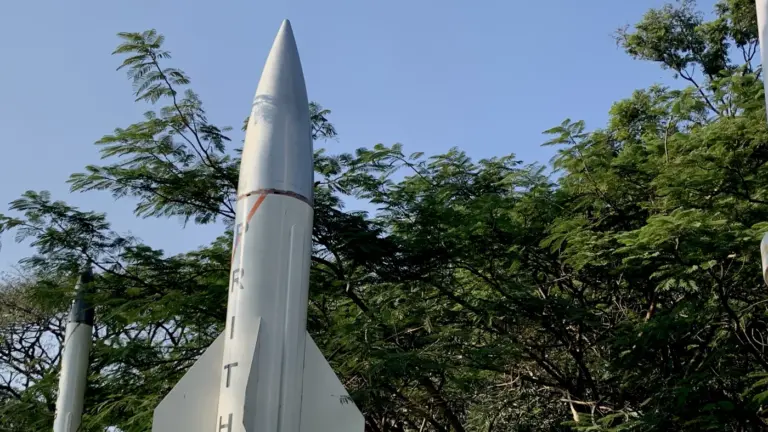
The launch industry has been about expendable rockets for almost its entire history. A first stage burned, separated, and fell into the ocean. An upper stage delivered the payload and was either deorbited or left in space as debris. The hardware that took thousands of engineers years to design was used once. The economics of spaceflight grew out of that fact, and almost every launch programme in the world, from the Soviet R-7 family to India’s Polar Satellite Launch Vehicle, is built around it.
SpaceX began breaking that pattern with the Falcon 9 booster, which since 2015 has landed back on a drone ship or a coastal pad and flown again, sometimes more than twenty times. Starship is the next step. It is designed to be fully reusable, both stages, with rapid turnaround, dry-mass amortisation, and a launch cadence measured in days rather than years. If the architecture works, it will compress the cost of reaching orbit by an order of magnitude and reset the constraints under which every space agency in the world plans missions.
For UPSC purposes, Starship intersects space technology, the Artemis Accords, the global launch market, NASA’s lunar programme, and the wider question of how India’s space sector should respond. This article explains the vehicle, the engines, the catch architecture, the missions it is meant to serve, and what the system means for the next phase of human spaceflight.
Quick Facts on the Starship System
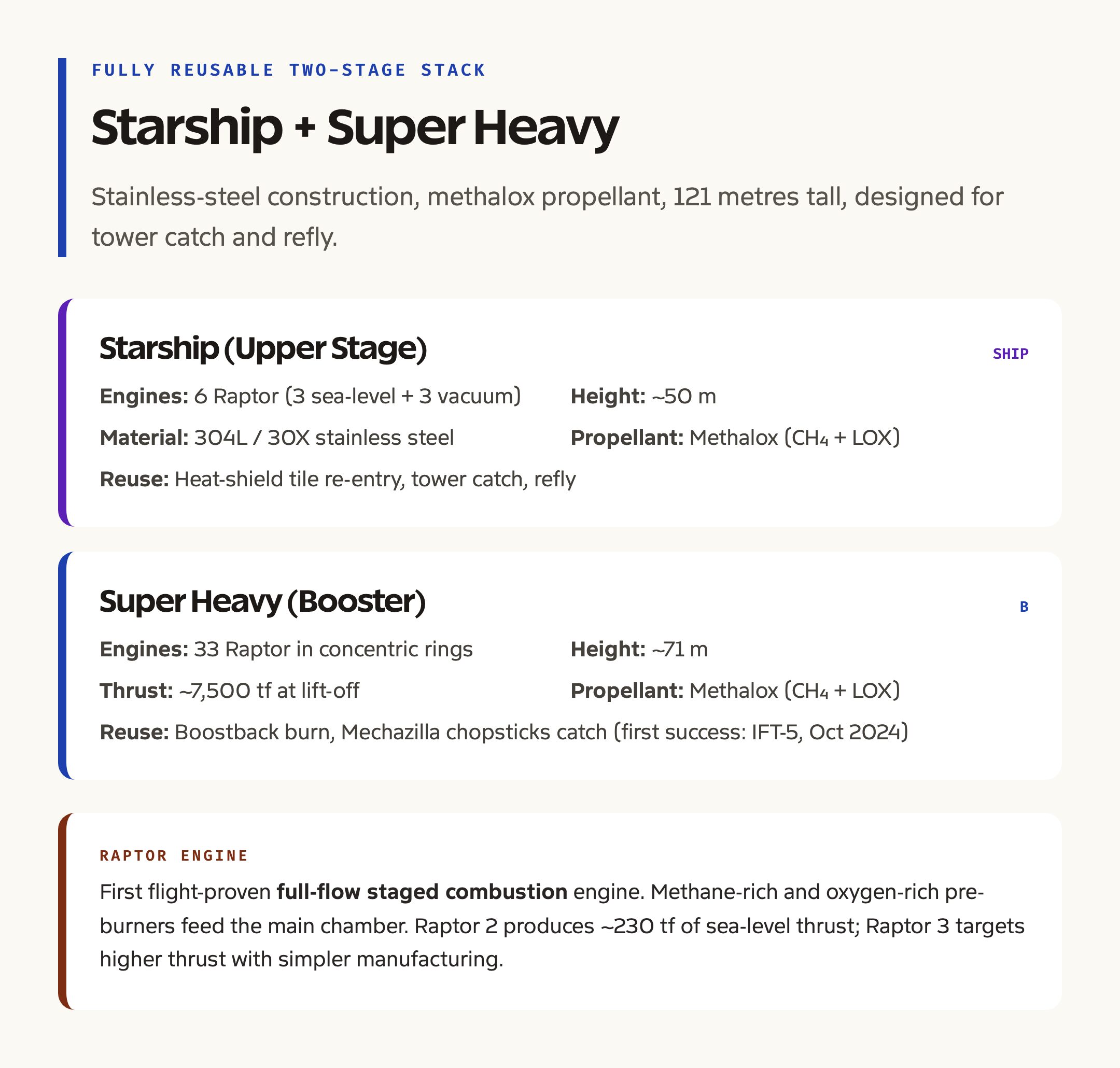
Starship is a two-stage, fully reusable, super heavy-lift launch vehicle developed by SpaceX. The first stage is called Super Heavy. The upper stage is called Starship. Both stages are constructed from stainless steel, an unusual choice in modern aerospace, where aluminium alloys and carbon-fibre composites are the norm. Stainless steel is heavier per cubic centimetre but is cheap, easy to weld in large structures, and resistant to the high temperatures of atmospheric re-entry without elaborate insulation.
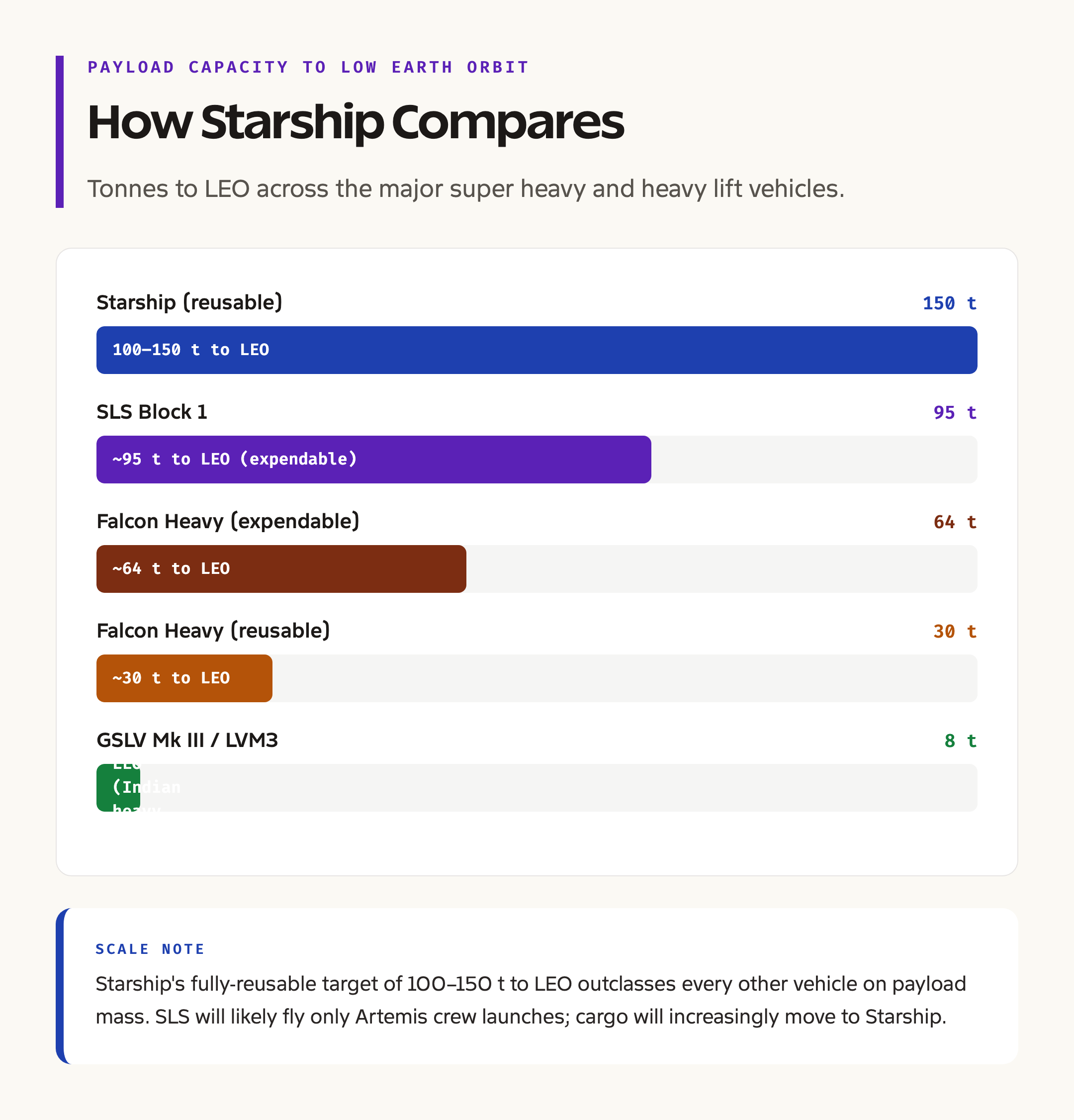
The combined stack stands about 121 metres tall, taller than the Saturn V that flew Apollo astronauts to the Moon. Lift-off thrust at full configuration approaches 7,500 tonnes-force, almost twice that of Saturn V. Designed payload to low Earth orbit in fully reusable mode is in the 100 to 150 tonne class, with potentially higher capacity in expendable or partial-reuse modes.
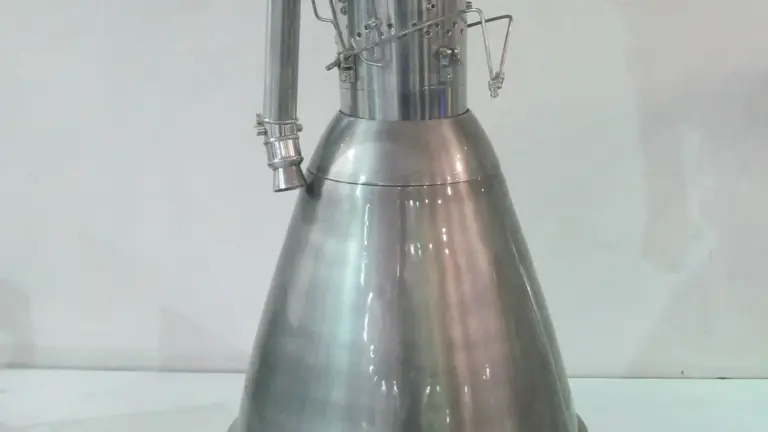
The propellant on both stages is methalox, a mixture of liquid methane and liquid oxygen. The engines are Raptor units developed by SpaceX, the first flight-proven full-flow staged combustion engines in the world. Super Heavy uses 33 Raptor engines arranged in concentric rings. Starship uses six Raptor engines, three optimised for atmospheric flight and three for the vacuum of space.
The architecture envisions a tower catch on return. Both Super Heavy and Starship are designed to fly themselves back to the launch tower, where two giant robotic arms, nicknamed the chopsticks, intercept the stage in mid-air. The launch tower system is referred to as Mechazilla. The first successful tower catch of Super Heavy occurred in October 2024 on the IFT-5 flight.
What Starship Actually Is
Starship is a vehicle designed to be the workhorse of the next phase of human spaceflight. NASA selected the Starship Human Landing System variant in April 2021 as the lander that will return astronauts to the lunar surface for Artemis III, the first crewed lunar landing since 1972, and Artemis IV. The choice forced SpaceX to develop the in-space refuelling capability needed to send a fully fuelled lander to the Moon, since a single Starship cannot carry enough propellant to reach the lunar surface and return.
Beyond Artemis, Starship is intended to serve commercial and military payloads to low Earth orbit, geostationary transfer orbit, and beyond. SpaceX has signed launch contracts for Starlink V2 satellites, several commercial communication payloads, and a private circumlunar mission called dearMoon, although the latter was reorganised in 2024.
The longer-term ambition is Mars. Elon Musk has publicly stated that Starship is designed to support the eventual transport of cargo and crew to Mars, with the aim of establishing a permanent human presence. Whether or when that happens depends on policy, biology, and capital, but the vehicle architecture is shaped by it.
A subsidiary application is point-to-point transport on Earth. A Starship that can reach low Earth orbit can also fly a sub-orbital trajectory between any two points on Earth in under an hour. Whether this becomes a practical service for cargo or passengers is a separate question of regulation, noise, and economics, but the capability is intrinsic to the design.
Background and Historical Context
SpaceX was founded by Elon Musk in 2002 with the stated long-term aim of enabling human settlement of Mars. The company’s first orbital vehicle, Falcon 1, reached orbit in 2008. Falcon 9 followed in 2010, and the company’s first crewed flight, Demo-2 to the International Space Station, lifted off in May 2020. Falcon 9 booster reuse, demonstrated through hundreds of recoveries, drove launch costs to roughly half of the comparable expendable competition.
The Starship architecture began under the name Mars Colonial Transporter in 2012, evolved through the Interplanetary Transport System concept of 2016, and was renamed Starship and Super Heavy in 2018. Construction shifted from carbon-fibre composites to stainless steel in 2019, on the argument that stainless was cheaper and more thermally robust at the scale required.
Sub-orbital prototype testing took place at the Boca Chica facility in South Texas, now branded Starbase. A series of single-stage Starship prototypes, beginning with the Starhopper in 2019 and progressing through SN5, SN8, SN10, SN11, SN15, made short hops and ten-kilometre belly-flop tests through 2021. The first integrated flight test of Starship plus Super Heavy occurred on 20 April 2023, ending in a deliberate self-destruct over the Gulf of Mexico after stage-separation failure.
Through 2023 and 2024, SpaceX worked through a sequence of integrated flight tests. IFT-2 in November 2023 achieved hot staging, where Starship’s engines fired before separation from Super Heavy. IFT-3 in March 2024 reached orbital velocity. IFT-4 in June 2024 achieved a controlled splashdown of both stages. IFT-5 in October 2024 made the first successful tower catch of Super Heavy. IFT-6 and subsequent flights through 2025 progressed toward routine catch and refly.
Key Features of the Starship System
The Raptor engine is the heart of the vehicle. It is the first full-flow staged combustion engine to fly. In a full-flow staged combustion cycle, both the methane and oxygen are partially burned in two separate pre-burners, and the entire output of each pre-burner is fed into the main combustion chamber. The result is high specific impulse, lower thermal stress on individual components, and the ability to reuse engines many times. Raptor 2 produces about 230 tonnes-force of sea-level thrust at full power, and Raptor 3, in development, targets even higher thrust with lower part counts.
The 33-engine arrangement on Super Heavy is the largest cluster of liquid-propellant engines ever flown. The Soviet N-1 Moon rocket of the 1970s used 30 engines and never succeeded in flight. SpaceX’s approach to engine-out tolerance, fault management, and gimbal control is one of the system’s signature engineering achievements.
Mechazilla is the tower-and-chopsticks catch system. The arms hold the booster on the way up, release it at lift-off, and catch it by mounting points on its forward section as it descends through hover. Catching the booster rather than landing it on legs reduces the dry mass of the vehicle and accelerates turnaround. The same architecture is intended for Starship itself, although Starship currently splashes down in the Indian Ocean while the catch profile is qualified.
In-space refuelling is the enabling capability for lunar and interplanetary missions. A full Starship lacks the propellant to fly from low Earth orbit to the Moon and return. The Artemis architecture therefore launches a depot Starship to orbit, follows it with a series of tanker launches to fill the depot, and finally launches the crew lander to the depot for refuelling. The first orbital ship-to-ship transfer test is one of the milestones SpaceX must demonstrate before the Artemis crewed flight.
Stainless steel construction is unusual but practical. The 304L and 30X stainless alloys retain strength at cryogenic temperatures, resist heat at re-entry, and can be welded in atmosphere using techniques familiar from the petrochemical industry. The trade-off is mass; a stainless Starship is heavier than an aluminium counterpart of equal volume, but cheaper to fabricate and easier to repair.
Why Starship Matters
The most direct effect, if the architecture works, is on launch cost. Falcon 9 reuse compressed cost-per-kilogram to low Earth orbit by a factor of two to three relative to expendable competition. Full reuse on Starship, with a stainless body and a high-flight-rate Raptor production line, is targeted at a further factor of ten. The economics depend on flight cadence, refurbishment time, and the loss rate of stages, but the goal is cost-per-kilogram in the low hundreds of dollars rather than the thousands.
A second effect is on payload mass. A 100 to 150 tonne class lifter changes the design constraints for orbital infrastructure. Large modular space stations, big-aperture telescopes such as a possible LUVOIR-class successor to the James Webb Space Telescope, and constellations of large communication satellites all become viable. Spacecraft that previously had to be folded, deployed, and validated in orbit can be launched as monolithic structures.
A third effect is on lunar and Mars missions. The Artemis HLS architecture commits NASA to operating Starship as a lunar lander. If the system works, future cargo deliveries to the lunar surface can use the same vehicle. The cost of supporting an outpost on the Moon, in the gateway station and on the surface, falls accordingly.
A fourth effect is on competitive pressure. China’s Long March 9 super heavy-lift programme, Blue Origin’s New Glenn, Rocket Lab’s Neutron, and ISRO’s Next Generation Launch Vehicle have all been shaped by the assumption that Falcon 9 and now Starship define the cost benchmarks they must meet or beat. India’s GSLV vs NGLV vs Falcon Heavy framework reflects this directly.
Detailed Analysis: How a Mission Works
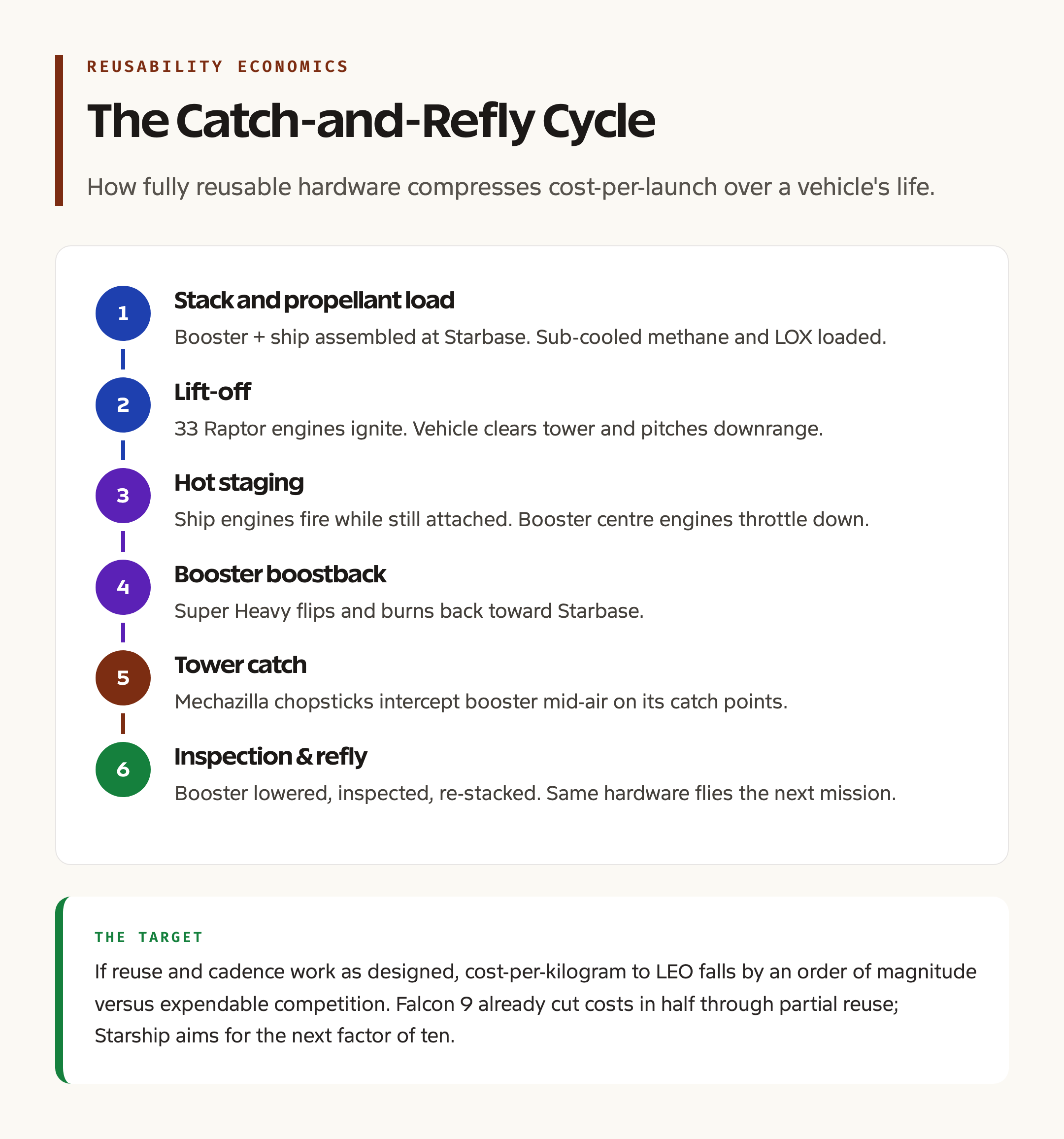
A typical Starship mission begins with stack assembly at Starbase. The Super Heavy booster is rolled to the orbital launch mount and placed on the chopsticks. Starship is stacked on top. Propellant loading begins about an hour before lift-off, with sub-cooled liquid methane and liquid oxygen flowing from the tank farm through the tower’s quick-disconnects into both stages.
At lift-off, all 33 Raptor engines on Super Heavy ignite. The vehicle clears the tower and pitches downrange. About two and a half minutes into flight, hot staging begins. The Starship upper stage ignites its engines while still attached, and the booster’s centre engines throttle down. Stage separation occurs while the booster’s hot exhaust pushes the upper stage clear.
Super Heavy then performs a boostback burn, returning to the launch site. As it approaches the tower, it performs a final landing burn using a subset of its engines, slowing to a hover. The chopsticks close around the booster’s catch points, taking its full weight. Starship continues to orbit on its own engines, completes its mission, performs a deorbit burn, and either splashes down in the Indian Ocean or, in the mature architecture, executes its own tower catch back at Starbase or at a Florida pad.
For an Artemis lunar mission, the sequence becomes more elaborate. A Starship depot launches first to a parking orbit. A series of tanker Starships launches over the following days or weeks, transferring methane and oxygen to the depot. Once the depot is full, a crew Starship launches, docks with the depot, and refuels. A separate Orion capsule launched on the SLS rocket carries the astronauts to lunar orbit, where they board the now-fuelled Starship lander. The lander descends to the lunar surface, supports a multi-day mission, and ascends to lunar orbit for the Orion handoff and Earth return.
Comparative View: Starship vs SLS vs Falcon Heavy
NASA’s Space Launch System, SLS, is an expendable super heavy-lift vehicle developed for the Artemis programme. It uses a hydrogen-oxygen core stage with four RS-25 engines repurposed from the Space Shuttle, supplemented by two solid rocket boosters. The vehicle is launched from Kennedy Space Center, lands nothing, and is discarded after each flight. Per-launch cost has been estimated by NASA’s inspector general at over two billion dollars.
Falcon Heavy is SpaceX’s earlier heavy-lift vehicle, with a Falcon 9 core flanked by two Falcon 9 first stages used as boosters. It is partially reusable, with the boosters and core capable of returning to land or drone-ship pads. Lift-off thrust is about half of Super Heavy’s. Payload to low Earth orbit in expendable mode is around 64 tonnes; in fully reusable mode, less than half of that.
Starship outclasses both on payload mass, cost target, and reuse. SLS will likely fly only the Artemis crew launches; cargo will increasingly move to Starship. Falcon Heavy continues for missions where Starship is overkill or where the integration timing favours an existing vehicle.
China’s Long March 9 is in early development with a comparable payload target but no public reuse architecture. Blue Origin’s New Glenn is a partially reusable heavy-lift vehicle that competes with Falcon Heavy and the lower end of the Starship envelope. Rocket Lab’s Neutron and Stoke Space’s Nova target the medium-lift segment with full reuse.
Challenges and Risks
The biggest open question is reliability at scale. Starship has demonstrated successful flights but has also lost vehicles. A vehicle catalogued for human spaceflight must reach a flight-success rate consistent with NASA’s loss-of-crew thresholds. The path requires many cargo flights, stage catches, and re-flights before crew can fly safely.
In-space refuelling has been demonstrated in small scale on prior missions but never with cryogenic methalox at the scale Starship requires. Boil-off losses, fluid transfer dynamics in microgravity, and quick-disconnect reliability are all open engineering problems.
Production and infrastructure are the second class of challenges. Starbase’s Texas and Florida pads must support the high cadence the architecture assumes. Raptor production has scaled but must continue to scale, and Raptor 3 must qualify into routine flight. Weather, regulatory approvals, and environmental review of high-cadence operations are the third class.
A fourth issue is sustainability. Methalox emissions at high cadence, the use of stainless steel from a globally limited steel-grade supply, and the cumulative environmental impact of routine super heavy-lift launches need to be tracked and managed.
Prelims Pointers
Starship is a two-stage, fully reusable super heavy-lift launch vehicle. Stage 1 is Super Heavy with 33 Raptor engines. Stage 2 is Starship itself with 6 Raptor engines. Construction is from stainless steel. Propellant is methalox, methane plus oxygen. Mechazilla is the launch tower with chopsticks arms that catch the booster. The first successful tower catch was on IFT-5 in October 2024. NASA selected Starship as the Human Landing System for Artemis III in April 2021. In-space refuelling is required for the lunar mission profile. Raptor is the first full-flow staged combustion engine to fly.
Mains Practice Questions
- The full reusability of the SpaceX Starship system has the potential to reset launch economics globally. Discuss the technical innovations that make this possible and the implications for India’s space sector. (250 words)
- Examine the role of Starship in the Artemis programme and assess what the choice of a commercial vehicle as the lunar lander signals for international space cooperation. (250 words)
- Compare the Starship system with GSLV-Mk III, NGLV, and Falcon Heavy. What lessons can ISRO draw for the design of India’s next-generation heavy-lift launcher? (250 words)
Way Forward
For India, Starship is both an opportunity and a competitive pressure. It offers cheap launch capacity that Indian commercial-satellite operators and even research missions can buy on the open market. It also pushes ISRO to accelerate the Next Generation Launch Vehicle programme, which incorporates partial reuse and methalox propulsion targets aligned with the post-Falcon-9 era.
The Indian space ecosystem can learn three lessons. The first is the value of vertical integration; SpaceX builds its own engines, structures, avionics, and software, which compresses iteration cycles. The second is the value of stainless-steel airframes and high-flight-rate test campaigns; ISRO’s traditional cost-conservative test pace is a poor fit for the next era. The third is the strategic importance of human spaceflight and lunar mission architecture; Gaganyaan and the Bharatiya Antariksh Station programme are critical.
Globally, the diplomatic implications are significant. A single commercial company supplying the heaviest lift capacity in the world creates dependencies that space agencies must manage. The Artemis Accords, signed by India in 2023, give a framework for cooperation but leave open the question of how non-US countries access Starship-class capacity if SpaceX’s priorities shift. India’s interest is in maintaining sovereign access to heavy-lift capability while also being able to use Starship-class commercial services where they offer the best fit.
Whether Starship lives up to its specification is still to be seen. The flights through 2025 have made progress but have not yet demonstrated the full operational tempo. The system is on a path that, if it works, will define the next thirty years of spaceflight. India should plan for that world while continuing to build its own capabilities.
Frequently Asked Questions
What is SpaceX Starship?
SpaceX Starship is a two-stage, fully reusable, super heavy-lift launch vehicle being developed by SpaceX. The first stage is called Super Heavy and uses 33 Raptor engines. The second stage is called Starship and uses 6 Raptor engines. Both stages are designed to return to the launch site for catch and reuse.
Why is Starship made of stainless steel?
Stainless steel is cheaper than aerospace aluminium and carbon-fibre composites, easier to weld at large scale, retains strength at cryogenic temperatures, and resists the heat of atmospheric re-entry without elaborate thermal-protection systems. The trade-off is higher mass, which is offset by the system’s overall reusability.
What is methalox?
Methalox is the propellant combination of liquid methane and liquid oxygen used by the Raptor engine. It offers higher specific impulse than the kerosene-oxygen used in earlier rockets, is cleaner-burning, and can in principle be manufactured on Mars from atmospheric carbon dioxide and Martian water, supporting the Mars-mission architecture.
What is Mechazilla and the chopsticks catch?
Mechazilla is the SpaceX nickname for the integrated launch tower at Starbase that holds the vehicle, supports propellant loading, releases it at lift-off, and catches the returning booster using two giant robotic arms called the chopsticks. The first successful chopsticks catch of a returning Super Heavy booster occurred in October 2024.
What is the Raptor engine?
The Raptor is a methalox engine developed by SpaceX. It is the first full-flow staged combustion engine to fly, a propulsion cycle that runs both the methane-rich and oxygen-rich pre-burners at full propellant flow. Raptor 2 produces about 230 tonnes-force of sea-level thrust; Raptor 3 targets higher thrust with simpler manufacturing.
Why does Starship need in-space refuelling?
A single Starship cannot carry enough propellant to fly from Earth’s surface to the Moon and return. The Artemis architecture therefore launches a propellant depot to low Earth orbit, fills it with multiple tanker Starship flights, and refuels the crew Starship at the depot before sending it to the Moon.
What is the role of Starship in Artemis?
NASA selected Starship in April 2021 as the Human Landing System for the Artemis III crewed lunar landing and the follow-up Artemis IV mission. Astronauts will travel to lunar orbit on the Orion capsule launched by SLS, board the refuelled Starship lander, descend to the lunar surface, and return to lunar orbit for the trip home.
How does Starship compare to NASA’s SLS?
NASA’s Space Launch System is expendable and uses hydrogen-oxygen propellant with solid rocket boosters. Per-launch cost is over two billion dollars. Starship is fully reusable, uses methalox, has higher payload to low Earth orbit, and targets a per-launch cost orders of magnitude lower if the reuse architecture works as planned.
Has Starship reached orbit?
Starship reached orbital velocity for the first time on the third integrated flight test in March 2024, although the upper stage was lost during re-entry. Subsequent flights have demonstrated controlled splashdowns, the first successful tower catch of Super Heavy, and progressive validation of the catch architecture.
What does Starship mean for India?
Starship lowers the cost of orbital and beyond-Earth-orbit access globally. Indian commercial-satellite operators gain a cheaper launch option. ISRO faces competitive pressure to accelerate the Next Generation Launch Vehicle programme, which targets partial reuse and methalox propulsion. The strategic value of sovereign launch capability remains, but the calculus around cost-per-kilogram shifts.
Tell Google you want more of this.
Add Anantam IAS as a preferred sourceOne tap, and this site shows up more often in your own Top Stories, AI Overviews and AI Mode. Remove it any time.