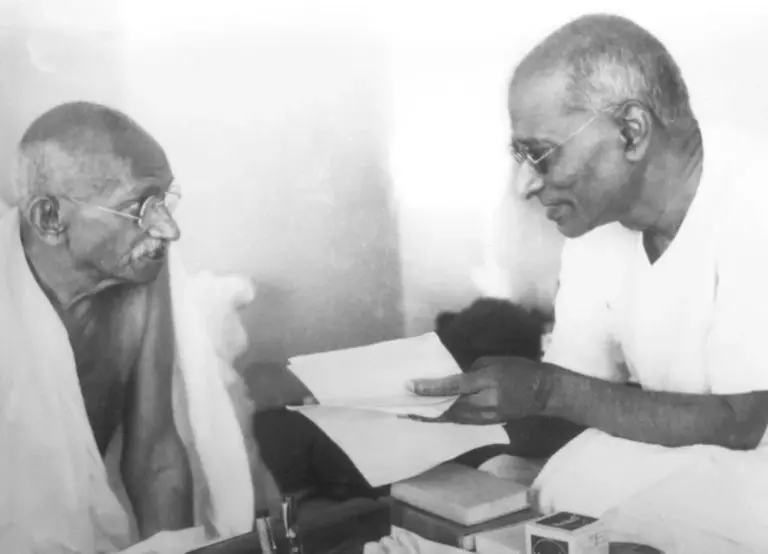
The Kheda Satyagraha of March–June 1918 was Mohandas Karamchand Gandhi's second Satyagraha on Indian soil, fought in the Kheda (Kaira) district of Gujarat against the British colonial government's refusal to suspend land revenue during a year of crop failure and famine. It followed the Champaran Satyagraha of 1917 and preceded the Ahmedabad Mill Strike of 1918, together forming the three "local Satyagrahas" that established Gandhi as a mass leader in Indian politics.
Kheda is historically significant for two reasons. It introduced the no-tax campaign as a weapon of the Indian national movement. And it brought Vallabhbhai Patel — later the "Iron Man of India" — into Gandhi's inner circle.
Kheda Satyagraha: Quick Facts
| Year | March–June 1918 |
| Place | Kheda (Kaira) district, Gujarat |
| Leaders | Mohandas Karamchand Gandhi and Vallabhbhai Patel |
| Cause | Government’s refusal to suspend land revenue after the 1917 crop failure and famine |
| Method | No-tax Satyagraha — civil disobedience plus social boycott of those who paid |
| Local organisers | Mohanlal Pandya and Shankarlal Parikh |
| Outcome | Revenue collected only from those who could pay; confiscated property returned (a partial victory) |
| Significance | India’s first no-tax campaign; Sardar Patel’s political emergence |
Location and Context
- Kheda district (spelt Kaira under the British) lies in central Gujarat, between Ahmedabad and Vadodara
- Agrarian economy dominated by the Patidar (Kanbi-Patel) landholding community
- Principal crops — tobacco, cotton, millets
The Immediate Trigger — Crop Failure of 1917
- The monsoon of 1917 failed across Kheda
- Crop output collapsed — below 25% of a normal year in many villages
- Simultaneously, there was an outbreak of plague and cholera
- Prices of food grains rose sharply due to World War I conditions
- Under the Land Revenue Code of Bombay Presidency, full revenue remission was due if the yield was less than 25% of normal — but the Bombay government refused to suspend or reduce revenue
- Officials insisted on full collection and threatened confiscation of land for default
The Peasants Approach Gandhi
Local leaders Mohanlal Pandya and Shankarlal Parikh — both from Kheda district — had been campaigning for revenue relief. They approached Gandhi, who had recently concluded the successful Champaran Satyagraha.
Gandhi, accompanied by Vallabhbhai Patel, Indulal Yagnik, Anasuyaben Sarabhai, and others, toured Kheda villages, documented crop failures, and independently verified that the statutory condition for revenue remission was met.
When the Bombay government continued to refuse, Gandhi launched a Satyagraha in March 1918.
The No-Tax Campaign — Strategy and Methods
| Tactic | Purpose |
|---|---|
| Refusal to pay land revenue | Direct civil disobedience against the state's core fiscal claim |
| Pledge of non-violence | Gandhian discipline; no attack on officials or property |
| Acceptance of confiscation | Peasants pledged to let the government seize their land, crops, and cattle rather than pay |
| Social boycott of collaborators | Villagers who paid were socially ostracised to maintain unity |
| Voluntary restraint on wealthy peasants | Gandhi asked better-off farmers who could pay to refuse on principle — so the movement was not merely about capacity to pay |
| Mass mobilisation | Public meetings, padayatras (village marches), and written pledges |
Role of Vallabhbhai Patel
- This was Patel's first major political campaign under Gandhi
- A barrister-at-law from Karamsad (within Kheda district), Patel gave up his European-style legal career to organise villages
- Moved from village to village recruiting volunteers, collecting evidence, and disciplining protestors
- Established the direct rapport with the Patidar peasantry that later powered the Bardoli Satyagraha (1928) and the Congress mass movements
Outcome
The Satyagraha lasted approximately four months (March–June 1918). The government did not formally concede. Instead, it issued secret instructions that revenue be collected only from farmers who could pay, and that poorer farmers be exempted.
- The immediate pressure on poor cultivators was lifted
- Confiscated property was returned to many peasants
- Gandhi called off the Satyagraha while publicly acknowledging it was a partial victory, not a total one
- In written reflection later, he noted that the movement had strengthened peasant morale and demonstrated the viability of mass non-violent resistance
Comparison — Champaran (1917), Kheda (1918), Ahmedabad (1918)
| Feature | Champaran (1917) | Kheda (1918) | Ahmedabad (1918) |
|---|---|---|---|
| Region | Bihar | Gujarat | Gujarat |
| Issue | Forced indigo cultivation (Tinkathia system) | Full land revenue despite crop failure | Wage dispute — cancellation of plague bonus in textile mills |
| Opponent | European indigo planters + colonial govt | Bombay Presidency government | Ahmedabad mill-owners |
| Method | Inquiry + civil resistance | No-tax Satyagraha | Hunger strike by Gandhi + strike |
| Gandhi's associate | Rajendra Prasad, Brajkishore Prasad, J.B. Kripalani | Vallabhbhai Patel, Indulal Yagnik | Anasuyaben Sarabhai |
| Outcome | Tinkathia abolished; Champaran Agrarian Act 1918 | Revenue relief for poor peasants; confiscated property returned | 35% wage increase for mill workers |
| Significance | Gandhi's entry into Indian politics | First no-tax campaign; Patel's emergence | First labour Satyagraha |
Associated Figures
- Anasuyaben Sarabhai — social reformer from the Sarabhai industrial family of Ahmedabad; supported Kheda while simultaneously leading the Ahmedabad mill workers
- Indulal Yagnik — journalist and lawyer, later founder of the Mahagujarat movement
- Mohanlal Pandya — local organiser, known as the "Onion Thief of Kheda" after he publicly led peasants to dig up onion crops confiscated by the government
- Shankarlal Parikh — landowner of Kathlal, early supporter and organiser
Significance in the National Movement
1. First No-Tax Satyagraha
Kheda established refusal to pay tax as a legitimate weapon of the Indian national movement. It later informed the Bardoli Satyagraha (1928) and revenue-refusal components of Civil Disobedience (1930–34).
2. Peasant Mobilisation
Kheda demonstrated that Indian peasants — long considered politically passive — could be organised into disciplined mass action. This insight shaped Gandhi’s subsequent strategy of building the Indian National Congress on a rural peasant base.
3. Emergence of Sardar Patel
Patel's political rise began at Kheda. From here, he went on to lead:
- Borsad Satyagraha (1923) — against punitive tax
- Bardoli Satyagraha (1928) — his greatest Satyagraha; earned him the title "Sardar"
- Integration of princely states (1947–49) as Deputy Prime Minister
4. Refinement of Gandhian Method
Kheda allowed Gandhi to test and refine Satyagraha as a political method in a purely Indian setting (Champaran had involved European planters; Kheda confronted the colonial state directly on its fiscal power).
5. Moral Basis of Tax Refusal
Gandhi's insistence that well-off farmers also refuse — even if they could pay — established the principle that Satyagraha is a stand of conscience, not merely a demand of the weak. This principle would run through all later Gandhian movements.
Limitations
- The movement was confined to Kheda district and did not spread
- It relied heavily on the Patidar caste community — the participation of lower-caste and landless labourers was limited
- The government's concession was administrative, not statutory — no legal right to remission was won
- Gandhi himself acknowledged that discipline among some villagers had lapsed in places
UPSC Relevance
GS1 (Modern Indian History): Gandhian phase of the freedom struggle; peasant movements; emergence of leadership.
Key Prelims facts:
- Kheda Satyagraha: March to June 1918
- Location: Kheda (Kaira) district, Gujarat
- Trigger: failure of 1917 monsoon + government refusal to suspend revenue
- Method: No-tax campaign + social boycott of those who paid
- Local leaders who approached Gandhi: Mohanlal Pandya and Shankarlal Parikh
- Gandhi's key lieutenant at Kheda: Vallabhbhai Patel (his first major Gandhian campaign)
- Other associates: Anasuyaben Sarabhai, Indulal Yagnik
- Sequence of local Satyagrahas: Champaran 1917 → Kheda 1918 → Ahmedabad Mill Strike 1918
- Outcome: revenue collected only from those who could pay; confiscated property returned
Mains pointers: Kheda is a case study in localised Satyagraha, the economic dimensions of colonial rule, and the organisational chemistry between Gandhi and Patel that would shape Congress politics for the next three decades.
Tell Google you want more of this.
Add Anantam IAS as a preferred sourceOne tap, and this site shows up more often in your own Top Stories, AI Overviews and AI Mode. Remove it any time.