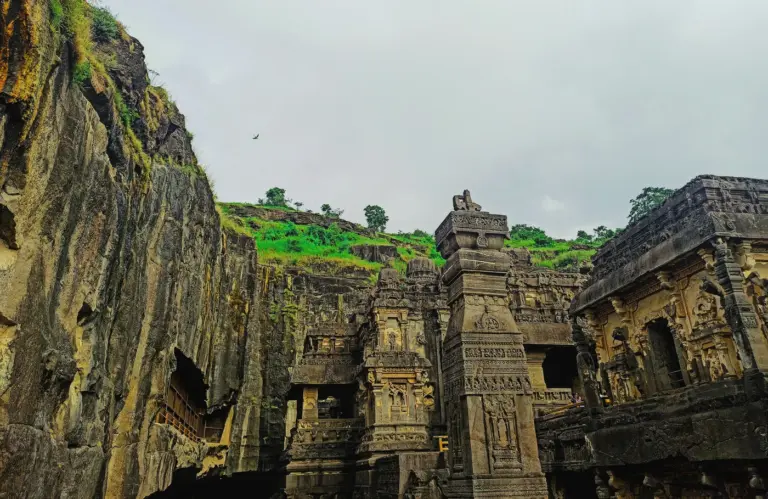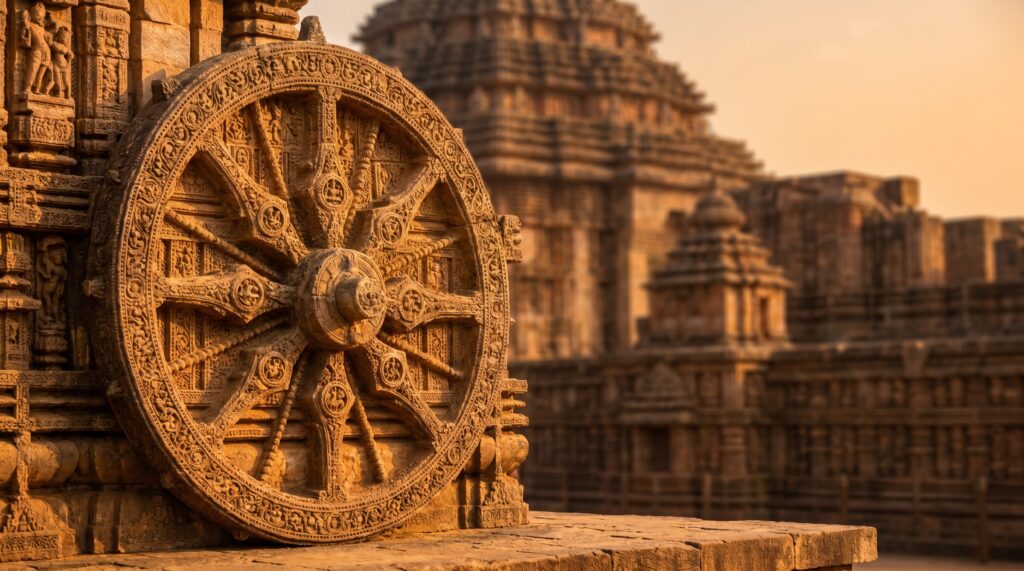
Stand in front of the Konark Sun Temple and the first thing that fails you is the word “temple.” What you are looking at is a stone chariot, roughly the size of a small hill, carved with twenty-four wheels and meant to be pulled by seven straining horses across the sky. The builders were not decorating a shrine with chariot motifs. They conceived the entire monument as the vehicle of Surya, the Sun God, frozen mid-journey on the Odisha coast. Miss that, and the wheels look like ornament. Get it, and every stone falls into place.
The confusion runs deeper than most guidebooks admit. The soaring tower you expect over the sanctum is gone, collapsed centuries ago, so the building you photograph today is actually the assembly hall, not the temple’s holiest part. The wheels you admire are working sundials. And the “Black Pagoda” it was nicknamed was a navigation mark for European sailors, not a Buddhist stupa. Konark is a monument that keeps being mistaken for something simpler than it is.
Who built Konark, and when
The Konark Sun Temple was built in the 13th century, around 1250 CE, by King Narasimhadeva I of the Eastern Ganga dynasty, the same royal line that raised the great Jagannath Temple at Puri a century earlier. Narasimhadeva I, who ruled from about 1238 to 1264, commissioned it near the mouth of the Chandrabhaga river on Odisha’s Bay of Bengal coast, in the town now called Konark in Puri district.
The dedication is unambiguous: the temple honours Surya, the Sun God, whose worship had a long, prosperous history in this stretch of coastal India. Konark, in fact, means “corner of the Sun,” from *kona* (corner) and *arka* (Sun).
Fix the dynasty and it stops being an isolated marvel. The Eastern Gangas were prolific temple builders, and Konark is the high point of their patronage, the most ambitious thing they ever attempted in stone. If your notes on the Eastern Ganga dynasty already carry the Puri Jagannath Temple, Konark belongs on the same page, built by the same house a hundred years on and pushed to a far riskier scale.
| Attribute | Detail |
|---|---|
| Location | Konark, Puri district, Odisha (Bay of Bengal coast) |
| Built | c. 1250 CE (13th century) |
| Builder | King Narasimhadeva I, Eastern Ganga dynasty |
| Deity | Surya, the Sun God |
| Conceived as | A colossal chariot with 24 wheels and 7 horses |
| Architecture | Kalinga school (Odishan Nagara style) |
| Main materials | Khondalite, laterite, and chlorite stone |
| Nickname | “Black Pagoda” |
| UNESCO World Heritage Site | Inscribed 1984 |
| On currency | Wheel featured on the reverse of the ₹10 note |
The Kalinga school of architecture, decoded
Konark is the finest surviving example of the Kalinga style, the regional temple tradition of Odisha that is treated as a distinctive branch of the broader Nagara (North Indian) style. Where the two-word label “Kalinga architecture” usually gets memorized without meaning, the actual grammar is simple once you name its parts.
A classic Odishan temple lines up as a sequence of halls on a single axis. The deul (also called the *rekha deul*) is the sanctuary tower, the tall curvilinear spire that rises directly over the deity in the sanctum. In front of it stands the jagamohana, the pyramidal-roofed assembly hall where worshippers gathered. At Konark, two more halls extend the axis: the natamandira, a dancing hall, and a *bhoga-mandapa*, a hall of offerings.
Here is the detail that reframes the whole visit. The great deul at Konark, the main tower, has collapsed. It is estimated to have risen around 70 metres (about 227 feet), which would have made it one of the tallest temple towers in India, but it fell centuries ago, and only its base survives. What still stands, and what every photograph of Konark actually shows, is the jagamohana, the assembly hall, roughly 30 metres tall with its stepped pyramidal roof intact. So the monument you walk up to is technically the porch, not the shrine. Keeping the Nagara, Dravida, and Vesara styles straight is much easier once you can point to a real building and name the deul and the jagamohana on it.
Reading the chariot: 24 wheels and 7 horses
The temple’s plinth is carved as a chariot with twelve pairs of wheels, twenty-four in all, drawn by seven horses, and every one of those numbers carries meaning rather than decoration. The 24 wheels are most often read as the 24 hours of the day or the 24 fortnights (pakshas) of the year, so the chariot is a calendar as much as a vehicle. The seven horses are read as the seven days of the week, and in the older mythology as the seven horses that pull Surya’s chariot across the heavens.
Each wheel is a serious object in its own right, close to 3 metres (about 9 to 10 feet) in diameter, carved with a hub, spokes, and an ornate rim covered in miniature scenes. The horses strain at the front of the southern side, sculpted mid-gallop, so the entire mass of stone reads as caught in motion, hauling the Sun up the sky.
The stone itself tells part of the story. The builders used khondalite for most of the structure, laterite in the foundations and hidden cores, and finer chlorite for door frames and some sculpture, hauling much of it from quarries well inland because the coastal site had no good building stone of its own. That logistics fact, moving thousands of tonnes of rock to a beach, is a quiet measure of how much the Eastern Gangas were willing to spend on a single act of devotion.
The wheels that tell time
The most repeated claim about Konark, that its wheels function as sundials, is true and worth stating precisely because it usually gets waved away as legend. Several of the carved wheels act as working sundials: the shadow cast by the central hub or an axle pin falls across the spokes and rim, and the position of that shadow can be read to tell the time of day, reportedly to a fine accuracy.
The mechanism is more elegant than a novelty suggests. A wheel has eight major spokes dividing it into eight segments, with minor spokes and beaded markings between them, so the rim works like a graduated dial. Local guides still demonstrate reading the hour from the shadow, and the general principle, a fixed pointer casting a shadow on a marked face, is exactly how any sundial works.
This is where Konark stops being only an art-history entry and becomes a genuine piece of applied astronomy. A temple to the Sun that also measures the Sun’s daily arc is not a coincidence; it is the whole idea made functional. That crossover, sacred art doubling as an instrument, is what lifts Konark above a merely beautiful ruin.
Why it was called the Black Pagoda
European sailors named it the “Black Pagoda,” and the name stuck for a practical reason: the dark, towering temple was a prominent landmark visible from the sea and used as a navigation mark as ships moved along the Odisha coast. The contrast was deliberate in their usage. The Jagannath Temple at Puri, lime-plastered and pale, was their “White Pagoda,” and Konark, darker in stone and silhouette, became its black counterpart.
There is a sailors’ legend attached, that the temple once carried a great lodestone or magnet at its crown that pulled ships off course, and that mariners eventually removed it. It is almost certainly folklore rather than fact, but it survives because it fits the temple’s reputation as a hazard-cum-beacon on a dangerous coast.
The nickname matters for one reason worth flagging: “Black Pagoda” says nothing about Buddhism. “Pagoda” was simply the catch-all European word for an Indian temple, and Konark is a Hindu Sun temple through and through. Confusing the two is a common slip.
From ruin to World Heritage Site
The Konark Sun Temple was inscribed as a UNESCO World Heritage Site in 1984, recognized as a masterpiece of the Kalinga school and one of the great sun temples of the world. By then it had already spent centuries as a ruin, its main tower down and its interior at risk of following.
The single most important conservation act came in 1903, when the British administration, through what became the Archaeological Survey of India, filled the interior of the surviving jagamohana with sand and sealed it to stop the hall from collapsing under its own weight. That decision is why the assembly hall still stands today, even though it also means you cannot enter it. The Archaeological Survey of India continues to maintain the site, battling salt-laden coastal air and weathering that steadily eat at the carvings. You can find the official listing at the UNESCO World Heritage Centre, and the Archaeological Survey of India manages the monument on the ground.
Two more anchors make Konark stick. Its erotic sculptures, carved openly on the walls, put it in the same conversation as the Khajuraho temples of Madhya Pradesh, another site where temple architecture and frank human sculpture sit together. And the temple’s chariot wheel is stamped on the reverse of the Indian ₹10 note, which is the everyday reason so many people recognize the design without knowing its name.
How to study Konark without drowning in detail
The efficient way to hold Konark is to build it around three questions, then let every fact answer one of them: what it is, how it is built, and why it matters. Almost nothing you need to know about the temple falls outside those three.
For “what it is,” lock the core sentence: a 13th-century Sun temple in Odisha, built by Narasimhadeva I of the Eastern Ganga dynasty, conceived as Surya’s chariot with 24 wheels and 7 horses. That one line answers most factual questions before they are finished.
For “how it is built,” learn the Kalinga vocabulary as a pair: the deul (the collapsed main tower over the sanctum) and the jagamohana (the surviving assembly hall you actually see). If you can label those two on a photograph, you understand the layout better than most, and it slots straight into your broader notes on temple architecture of India. Add the sundial wheels here, because they are a “how it works” fact, not just a “what it looks like” one.
For “why it matters,” group the three big markers: UNESCO World Heritage Site (1984), the “Black Pagoda” navigation name, and the ₹10 note. Those are the connectors that link Konark to the wider World Heritage sites in India list and to everyday recognition. Study it as three answers to three questions and the temple stops being a pile of impressive but loose facts.
Frequently Asked Questions
Who built the Konark Sun Temple?
King Narasimhadeva I of the Eastern Ganga dynasty, around 1250 CE. The same dynasty had built the Jagannath Temple at Puri roughly a century earlier.
Which god is the Konark temple dedicated to?
Surya, the Sun God. The whole monument is designed as Surya’s chariot, and the name Konark itself means “corner of the Sun.”
Why is Konark shaped like a chariot?
Because it was conceived as the vehicle of the Sun God crossing the sky. It has 24 carved wheels, usually read as the hours of the day or fortnights of the year, and 7 horses read as the days of the week.
Do the wheels really work as sundials?
Yes. Several of the wheels act as sundials: the shadow of the central hub or axle pin falls across the graduated spokes and rim, and the time of day can be read from its position.
Why is it called the Black Pagoda?
European sailors used the dark, tall temple as a navigation landmark from the sea and called it the “Black Pagoda,” in contrast to the pale “White Pagoda,” the Jagannath Temple at Puri. It has nothing to do with Buddhism.
Why can’t you see the main tower today?
The main sanctuary tower, the deul, collapsed centuries ago. What stands and what visitors photograph is the jagamohana, the assembly hall, which the Archaeological Survey of India stabilized by filling with sand in 1903.
When did Konark become a UNESCO World Heritage Site?
It was inscribed in 1984 as a masterpiece of the Kalinga school of temple architecture.
What is the Konark temple made of?
Mainly khondalite stone, with laterite in the foundations and finer chlorite for door frames and some sculpture, much of it quarried inland and hauled to the coast.
Practice Questions
1. The Konark Sun Temple was built by which ruler?
a) Rajaraja Chola I
b) Narasimhadeva I of the Eastern Ganga dynasty
c) Krishnadevaraya
d) Mahendravarman I
Answer: b
2. The Konark Sun Temple is designed in the form of a chariot with:
a) 12 wheels and 4 horses
b) 24 wheels and 7 horses
c) 8 wheels and 2 horses
d) 16 wheels and 9 horses
Answer: b
3. To which broad temple-architecture style does the Kalinga school belong?
a) Dravida
b) Vesara
c) Nagara
d) None of the above
Answer: c
4. The Konark temple is popularly known by which name?
a) White Pagoda
b) Black Pagoda
c) Golden Temple
d) Red Fort
Answer: b
5. In which year was the Konark Sun Temple inscribed as a UNESCO World Heritage Site?
a) 1972
b) 1984
c) 1993
d) 2004
Answer: b
Mains-style questions
1. “The Konark Sun Temple is architecture, astronomy, and art fused into one monument.” Discuss with reference to its chariot design and sundial wheels. 2. Explain the key features of the Kalinga school of temple architecture, using Konark to illustrate the deul and the jagamohana. 3. Assess the conservation challenges faced by coastal monuments in India, taking the Konark Sun Temple as a case study. 4. Situate the patronage of the Konark Sun Temple within the temple-building tradition of the Eastern Ganga dynasty. 5. Compare the treatment of sculpture at Konark with that at Khajuraho, and comment on what it reveals about temple art of the period.
Konark deserves a place in your preparation not because it is old or famous, but because it refuses to be filed under a single heading. It is a lesson in Kalinga architecture, a working astronomical instrument, a chapter in Eastern Ganga history, and a live conservation problem on a salt-battered coast, all in one collapsed and half-standing structure. Learn it as that convergence, keep the deul and the jagamohana straight, and remember that the “temple” you are looking at is really the chariot hall of the Sun, still frozen mid-journey after eight hundred years.
Tell Google you want more of this.
Add Anantam IAS as a preferred sourceOne tap, and this site shows up more often in your own Top Stories, AI Overviews and AI Mode. Remove it any time.