The Khajuraho Temples are the most complete surviving expression of mature Nagara temple architecture in central India. The Chandela dynasty built them between roughly 950 and 1050 CE in the small town of Khajuraho in the modern Chhatarpur district of Madhya Pradesh, on the dry forested plateau of Bundelkhand. The original complex contained about 85 temples; today about 25 survive, divided into three groups, with the western group containing the largest and most elaborate shrines. The Khajuraho Temples are best known popularly for the erotic mithuna sculptures on their exterior walls, but those panels are a small fraction of an enormously diverse sculptural programme that also includes deities, attendant figures, dancers, musicians, animals, and scenes of daily life. UNESCO inscribed the Khajuraho group of monuments on the World Heritage List in 1986.
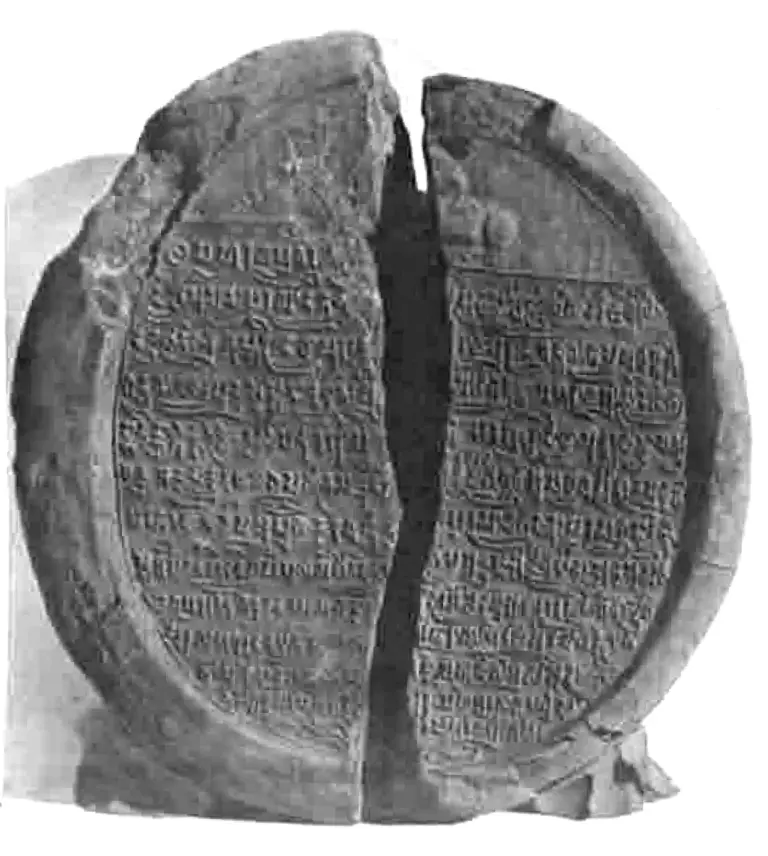
The Khajuraho Temples matter for three reasons. They preserve a hundred-year span of Nagara temple architecture in its most refined form. They include both Hindu and Jain temples in adjacent sites, allowing comparative study of the two traditions under a single patronage system. And they record the cultural ambition of a regional dynasty that briefly rose to the front rank of north Indian polities and used the temple as the principal vehicle of self-representation. The Chandela inscriptions name their kings, identify the patrons of individual temples, and date the construction of most of the principal structures, giving the site an unusually solid historical anchor.
The Chandelas: Patrons of Khajuraho
The Chandela dynasty rose to power in the ninth century in the Jejakabhukti region of central India, the historical name for the area around modern Bundelkhand. They began as feudatories of the Pratiharas, became independent in the early tenth century, and rose to peak influence under Yashovarman in the mid tenth century and his successor Dhanga in the late tenth and early eleventh. Yashovarman built the Lakshmana temple, the earliest of the great Khajuraho shrines, in 954. Dhanga built the Vishvanatha and the Parshvanatha. Vidyadhara, who reigned in the early eleventh century, built the Kandariya Mahadeo, the largest and most elaborate of all.
The Chandelas were defeated by Mahmud of Ghazni in 1019 and again in 1022, though they survived as a regional power for another century and a half. The wave of temple construction at Khajuraho effectively ended with Vidyadhara’s reign, and the temples of the second half of the eleventh century are smaller, less ambitious, and increasingly conservative in style. By the thirteenth century the Chandelas had been displaced by the Delhi Sultanate, and Khajuraho lost its political function. The temples were never destroyed by invasion, in part because the site was remote, and the surrounding forest gradually overgrew them.
The Rediscovery
The Khajuraho Temples passed out of the wider historical record after the thirteenth century. They were never wholly abandoned: local pilgrims continued to visit the larger shrines and the Jain temples remained in worship throughout. But the site was not known to the Islamic and later imperial authorities, and the colonial-era rediscovery is dated to 1838, when Captain T. S. Burt of the Bengal Engineers came across the temples while on tour and reported them to the Asiatic Society of Bengal. Alexander Cunningham, the founder of the Archaeological Survey of India, surveyed the site in detail in 1852 and again in the 1860s, and his survey is still the basis for the chronological framework of the site.
Nagara Architecture at Khajuraho
The Khajuraho Temples are textbook examples of mature Nagara architecture, the northern Indian temple style that developed between the seventh and eleventh centuries. The Nagara temple is built on a high platform, the jagati, raised above the surrounding ground. The temple itself has a sequence of axial chambers: a porch, the ardha-mandapa; an antechamber, the mandapa; an interior pillared hall, the maha-mandapa; a short passage, the antarala; and the sanctum, the garbha-griha, housing the principal image. Above each chamber rises a tower, the shikhara, with the principal tower over the garbha-griha rising highest.
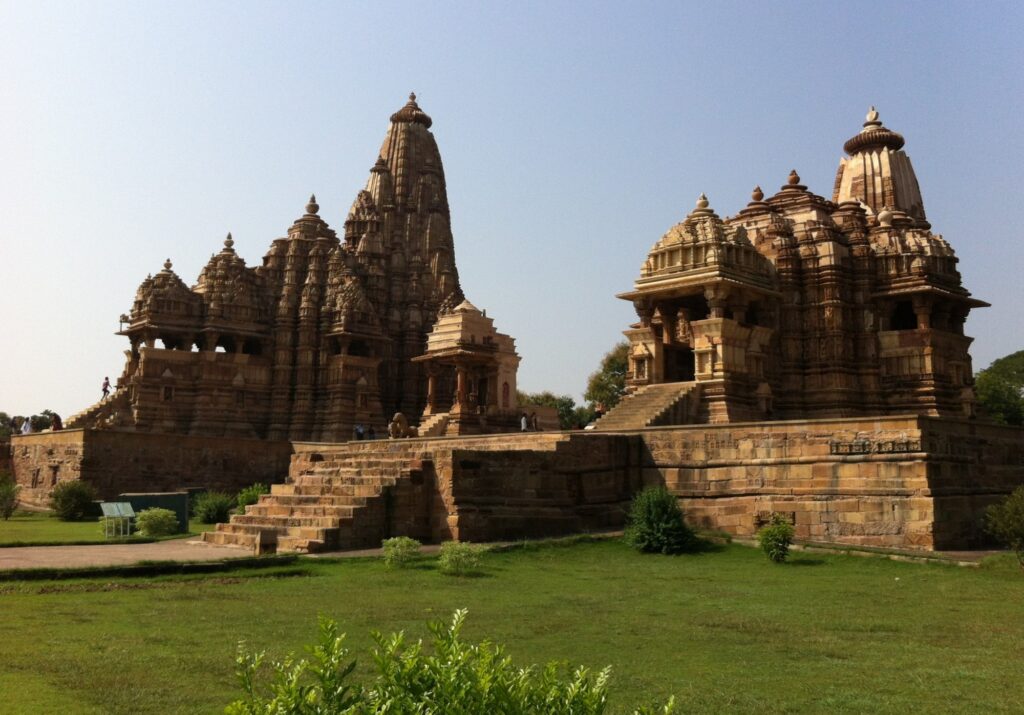
The signature feature of the Khajuraho style is the clustered shikhara. The principal tower is surrounded by progressively smaller turrets, the urusringas, that climb the slopes of the main tower in a rising and receding pattern. The effect is of a central mountain peak ringed by smaller summits, and the architectural metaphor is explicit: the temple is Mount Meru, the cosmic axis around which the universe is organised. The Kandariya Mahadeo has 84 such subsidiary shikharas around its central tower, the most elaborate count at any Khajuraho temple.
The Three Groups
The Khajuraho Temples divide into three geographic groups. The western group, north-west of the modern village, contains the largest and finest temples, including the Kandariya Mahadeo, the Lakshmana, the Vishvanatha, the Chitragupta, the Devi Jagadambi, the Matangeshvara, and others. All are Hindu shrines dedicated to Shiva, Vishnu, or the goddess. The eastern group, on the east side of the village, contains the principal Jain temples, including the Parshvanatha, the Adinatha, and the Ghantai. The southern group, the smallest of the three, contains the Duladeo and the Chaturbhuja temples on the south of the village.
The clustering reflects probable original patronage and sectarian preferences. The Chandelas were Hindu by personal religion, but they patronised Jain temples within their territory, and the proximity of the Jain group to the Hindu groups at Khajuraho is a useful piece of evidence for the tolerant cultic landscape of the central Indian dynasties.
The Kandariya Mahadeo: The Largest Shrine
The Kandariya Mahadeo, built around 1030 by Vidyadhara, is the largest and most elaborate of the Khajuraho Temples. It is dedicated to Shiva, with a marble lingam in the sanctum. The temple stands on a high terrace shared with two adjacent shrines, the Devi Jagadambi and the Mahadeva, and the three together form a unified architectural composition. The Kandariya is about thirty metres long, twenty metres wide, and thirty metres high to the top of the central shikhara.
The exterior walls of the Kandariya carry three superimposed bands of sculpture. The lower band shows secular life, with scenes of musicians, dancers, attendants, and women in various poses. The middle and upper bands are dominated by deities: Shiva and Vishnu in their various avatars, the goddess in her forms, attendant deities of the directions, celestial musicians and apsaras. The mithuna sculptures for which Khajuraho is popularly known appear principally in the junction bands between the major friezes, and they constitute perhaps ten percent of the total figural sculpture of the temple.
Lakshmana and Vishvanatha
The Lakshmana temple, built by Yashovarman in 954, is the oldest of the great western group temples and the only one whose dedication is unambiguous from its surviving foundation inscription. It is dedicated to Vaikuntha Vishnu, a four-headed form of Vishnu, and the cult image installed by Yashovarman, a green stone, was originally a Pratihara image taken from Tibet via the court of the Shahi king of Kabul. The Lakshmana is smaller than the Kandariya but more complete; it preserves the four subsidiary shrines at the corners of the platform, the only Khajuraho temple to retain a complete panchayatana, five-shrine, arrangement.
The Vishvanatha, built by Dhanga in 999, is a Shiva temple with a layout very similar to the Lakshmana. It also preserves a partial panchayatana, with two of the four corner shrines still standing. The exterior sculpture of the Vishvanatha is particularly fine, and the temple is conventionally regarded as the bridge between the early Khajuraho style of the Lakshmana and the mature complexity of the Kandariya.
The Jain Group: Parshvanatha and Adinatha
The eastern group is dominated by the Parshvanatha temple, the largest and finest of the Khajuraho Jain shrines. It was built in the second half of the tenth century and is dedicated to Parshvanatha, the twenty-third Tirthankara. Architecturally the Parshvanatha follows the same Nagara conventions as the Hindu temples of the western group, with a clustered shikhara, a sequence of axial chambers, and three bands of exterior sculpture. The figural programme differs in iconography but not in style: the deities are Jain rather than Hindu, but the sculptors and the workshop tradition are clearly the same.
The Adinatha temple, also in the eastern group, is dedicated to the first Tirthankara and is later than the Parshvanatha. The Ghantai temple, also Jain, is now mostly ruined and preserves only its central pavilion, named for the bell-and-chain motif carved on its pillars. The presence of three sizeable Jain temples at Khajuraho, all funded under or alongside Chandela patronage, indicates a substantial Jain merchant community in the region during the tenth and eleventh centuries.
Why the Mithuna Sculptures?
The mithuna, sculptural couples in erotic embrace, are the popularly famous feature of the Khajuraho Temples. They appear principally on the junction walls between the major exterior friezes, and they constitute a small minority of the total sculpture. The scholarly literature has offered several explanations. One school sees them as illustrations of the Kama Shastra, a celebration of the role of desire as one of the four ends of human life. Another school connects them to the Tantric traditions of late first-millennium India, in which the union of male and female principles was treated as an analogue of the cosmic union of consciousness and energy. A third reading sees them as auspicious figures intended to ward off misfortune at the architecturally vulnerable junction points of the wall.
Whatever the doctrinal explanation, the mithuna sculptures are executed with the same anatomical precision and rhythmic sense of movement as the rest of the Khajuraho figural programme. They are not formally distinct from the surrounding figures, and the popular focus on them as a separate category is largely a feature of modern reception rather than an internal feature of the temple programme.
UNESCO Inscription and Conservation
UNESCO inscribed the Khajuraho Group of Monuments on the World Heritage List in 1986 under criteria recognising the artistic creation of a unique style and the masterpiece of human creative genius represented by the temples. The Archaeological Survey of India manages the site, with conservation work distributed across the three groups. The temples are dressed in fine sandstone from local quarries, and the principal conservation challenges are weathering of the stone, biological colonisation, and pressure from a steadily growing tourist circuit.
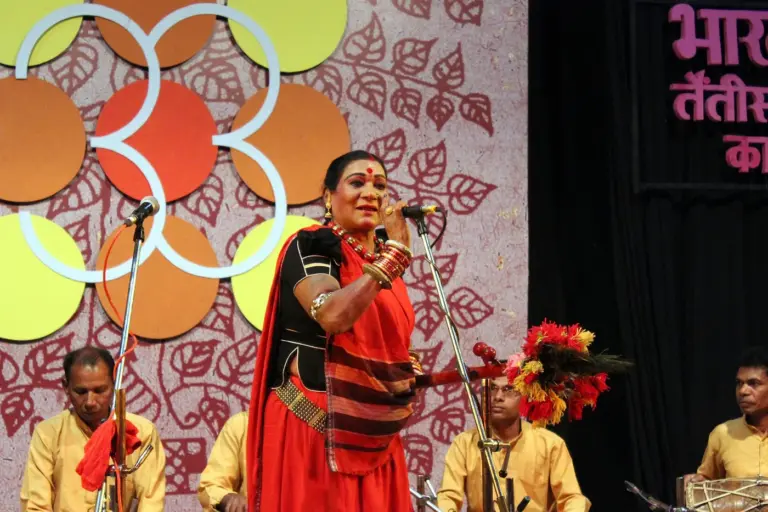
The annual Khajuraho Dance Festival, held in February or March against the backdrop of the western group temples, has become the principal cultural event linking the site to contemporary Indian classical dance traditions. The festival presents Bharatanatyam, Kathak, Odissi, and other forms on a stage in front of the Kandariya Mahadeo and the Vishvanatha, with the temple sculpture of dancers visible behind the live performers. The Khajuraho Temples form a useful comparison with the Konark Sun Temple of Odisha and the Ajanta Caves for understanding the range of medieval Indian temple and rock-cut architecture, and they sit alongside the Red Fort, Delhi and the Qutub Minar in the broader catalogue of north Indian UNESCO sites.
Frequently Asked Questions
Who built the Khajuraho Temples and when?
The Chandela dynasty built the Khajuraho Temples between roughly 950 and 1050 CE in the Bundelkhand region of central India. Yashovarman built the Lakshmana temple in 954, Dhanga built the Vishvanatha in 999, and Vidyadhara built the Kandariya Mahadeo around 1030. The major phase of construction ended in the mid-eleventh century after the Chandelas were defeated by Mahmud of Ghazni.
How many Khajuraho temples survive today?
About twenty-five of an original eighty-five Khajuraho Temples survive. They are divided into three groups: the western group, which contains the largest Hindu temples; the eastern group, which contains the principal Jain temples; and the southern group, which contains the Duladeo and the Chaturbhuja.
What is the largest temple at Khajuraho?
The Kandariya Mahadeo, built by Vidyadhara around 1030, is the largest and most elaborate of the Khajuraho Temples. It is about thirty metres long, twenty metres wide, and thirty metres high to the top of the central shikhara. It is dedicated to Shiva and stands on a shared terrace with the Devi Jagadambi and the Mahadeva.
What architectural style are the Khajuraho Temples?
The Khajuraho Temples are mature Nagara style, the northern Indian temple tradition. They have a clustered shikhara, with the principal tower surrounded by smaller turrets that climb the slopes of the main tower. The sequence of axial chambers, the porch, the mandapa, the maha-mandapa, the antarala, and the garbha-griha, follows the standard Nagara plan.
Why are the Khajuraho Temples known for erotic sculpture?
The mithuna sculptures, erotic couples on the junction walls between the major friezes, have become the popularly famous feature of the temples. They constitute a small minority of the overall sculpture, perhaps ten percent of the total. Scholarly interpretations link them to the Kama Shastra, to Tantric ritual, and to the auspicious function of figures at architectural junction points.
Are there Jain temples at Khajuraho?
Yes. The eastern group of Khajuraho contains three principal Jain temples: the Parshvanatha, the Adinatha, and the partially preserved Ghantai. The Parshvanatha is the largest and finest, built in the second half of the tenth century, and architecturally it is indistinguishable in workshop style from the Hindu temples of the western group.
When was Khajuraho rediscovered?
Khajuraho was rediscovered by the colonial authorities in 1838, when Captain T. S. Burt of the Bengal Engineers came across the temples on tour and reported them to the Asiatic Society of Bengal. Alexander Cunningham, the founder of the Archaeological Survey of India, conducted detailed surveys in 1852 and the 1860s. Local pilgrims and the Jain community had continued to visit the site throughout.
When were the Khajuraho Temples designated a UNESCO World Heritage Site?
UNESCO inscribed the Khajuraho Group of Monuments on the World Heritage List in 1986. The listing covers the western, eastern, and southern groups, and recognises both the artistic and architectural importance of the temples as a complete surviving expression of mature Nagara style.
Tell Google you want more of this.
Add Anantam IAS as a preferred sourceOne tap, and this site shows up more often in your own Top Stories, AI Overviews and AI Mode. Remove it any time.