Disclosure: this guide contains Amazon affiliate links. As an Amazon Associate, Anantam IAS earns from qualifying purchases — at no extra cost to you.
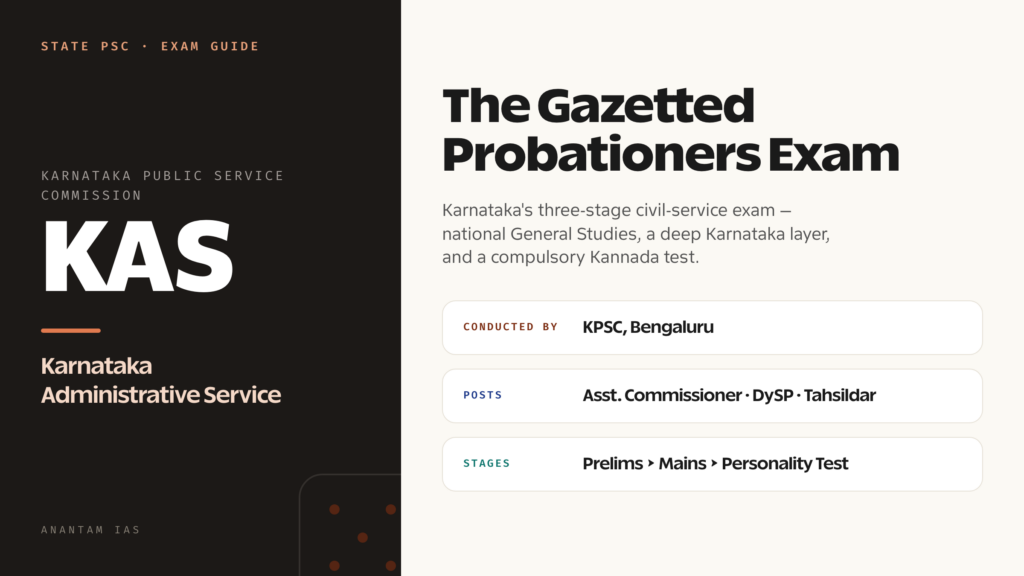
The Karnataka Public Service Commission (KPSC) is the constitutional body that recruits officers for the state civil services in Karnataka — the home of Bengaluru, India’s technology capital, and a state with one of the largest and fastest-growing economies in the country. Its flagship recruitment is the Gazetted Probationers exam, the gateway to the Karnataka Administrative Service, the cadre most aspirants simply call the KAS.
If the IAS is the all-India dream, the KAS is the Karnataka dream — an Assistant Commissioner, a Deputy Superintendent of Police, a Tahsildar who runs a taluk’s revenue administration. The exam mirrors the UPSC three-stage design but layers on a heavy dose of Karnataka-specific history, geography, polity, and a hard Kannada-language requirement that no amount of UPSC coaching prepares you for. This guide walks through what the exam is, how it’s structured, who can sit for it, what the syllabus demands, and how to build a plan that actually works.
What Is KPSC KAS?
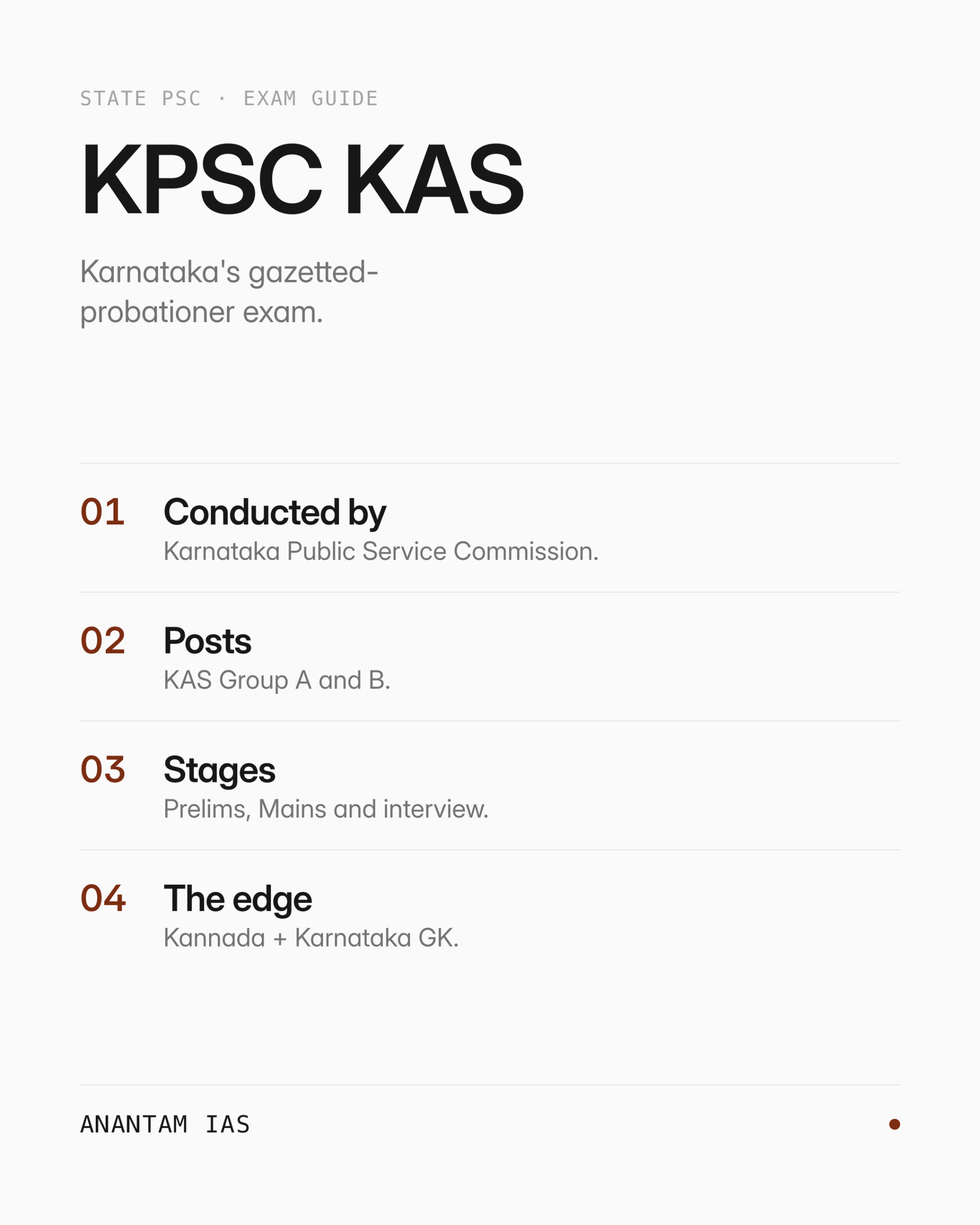
The KPSC KAS exam — formally the Gazetted Probationers (Group A and Group B) Competitive Examination — is the Karnataka Public Service Commission’s main recruitment for state-cadre officers. It is the state-level equivalent of the UPSC Civil Services Examination, selecting officers who will run districts, taluks, police sub-divisions, and revenue and tax offices across Karnataka.
The Karnataka Administrative Service is to Karnataka what the IAS is to the Union: the senior generalist administrative cadre of the state. KAS officers start in roles such as Assistant Commissioner (a sub-divisional revenue head), and over a career can rise to district-level postings and eventually be promoted into the IAS itself. For a graduate who wants a high-impact career rooted in Karnataka rather than an all-India transferable posting, the KAS is the obvious target. To see how state services like this fit into the wider civil-service landscape, our guide on the PCS full form maps out the provincial civil services across states.
Key Facts
- Conducting authority: Karnataka Public Service Commission (KPSC), Bengaluru.
- Exam name: Gazetted Probationers Competitive Examination (Group A and Group B).
- Services recruited: Karnataka Administrative Service and allied Group A/B posts — Assistant Commissioner, Deputy Superintendent of Police (DySP), Tahsildar, Commercial Tax Officer, Assistant Commissioner of Commercial Taxes, Assistant Labour Commissioner, and similar gazetted positions.
- Stages: Three — Preliminary (objective), Mains (descriptive), and Personality Test (interview).
- Frequency: Notified by KPSC as vacancies arise; recent cycles have carried a few hundred posts in a single notification.
- Scale of competition: Lakhs of applicants for a few hundred vacancies, making it one of the most competitive state exams in South India.
KPSC KAS Exam Pattern
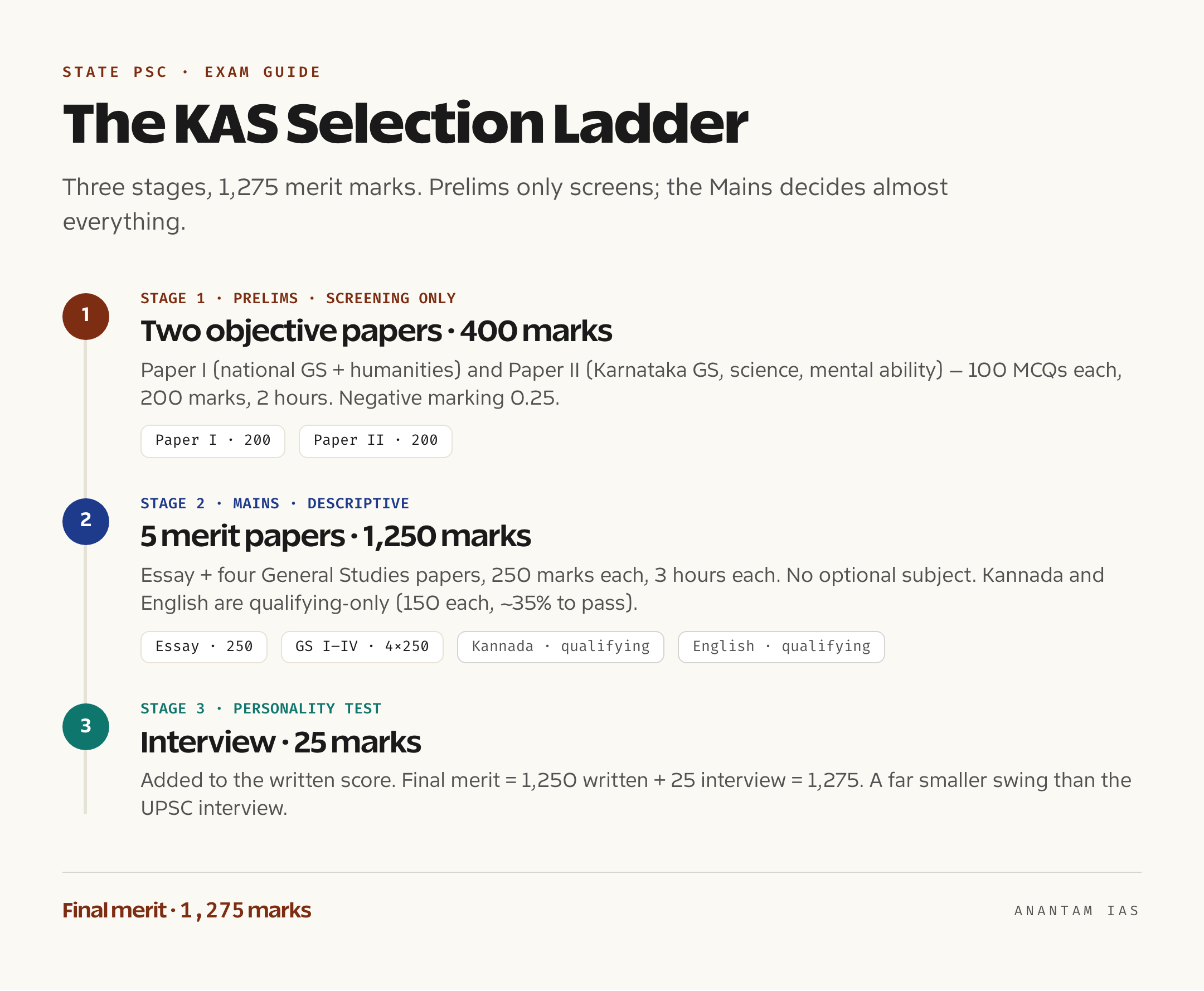
The KAS selection runs across three stages, and the structure deliberately echoes the UPSC model so that serious aspirants can prepare for both with a shared foundation. The big difference sits in the Mains, where KPSC has revised the design in recent cycles toward an all-General-Studies format with language papers that only qualify.
Prelims
The Preliminary examination is a screening test of two objective papers, each worth 200 marks with 100 multiple-choice questions and a two-hour duration.
| Feature | Details |
|---|---|
| Papers | 2 (Paper I and Paper II) |
| Marks | 200 each, 400 total |
| Questions | 100 per paper |
| Duration | 2 hours per paper |
| Type | Objective (MCQ) |
| Negative marking | 0.25 mark per wrong answer |
| Role | Qualifying/screening only — marks don’t carry to the final merit |
Paper I leans on national and international General Studies plus humanities (history, geography, polity), while Paper II carries Karnataka-specific General Studies, general science and technology, environment and ecology, and general mental ability. Like the UPSC CSAT, Prelims marks screen you for the Mains but don’t count toward your final rank.
Mains
The Mains is a written, descriptive examination. In the revised pattern, two language papers are purely qualifying and five papers count for merit.
| Paper | Subject | Marks | Counts for merit? |
|---|---|---|---|
| Qualifying | Kannada | 150 | No (need ~35%) |
| Qualifying | English | 150 | No (need ~35%) |
| Essay | Essay | 250 | Yes |
| GS Paper I | History, Society, Economy | 250 | Yes |
| GS Paper II | Geography, Constitution, Administration | 250 | Yes |
| GS Paper III | Science, Technology, Ecology | 250 | Yes |
| GS Paper IV | Ethics, Integrity, Aptitude | 250 | Yes |
That puts the merit-counting Mains total at 1,250 marks across five papers, each three hours long. Two structural points stand out. First, there is no optional subject — KPSC dropped it, so your entire Mains rests on General Studies and the essay, much like the MPPSC model. Second, the Kannada and English papers are qualifying-only: you must clear roughly 35% in each, but those marks don’t add to your rank. Papers are set in both Kannada and English, and you may answer in either medium.
Personality Test
Candidates who clear the Mains are called for the Personality Test, an interview carrying 25 marks that is added to the written score. The final merit is built on 1,275 marks — the 1,250 written plus the 25-mark interview. Because the interview is a small fraction of the total, the Mains essay and GS papers decide your fate far more than the board conversation does. This is a sharper contrast than UPSC, where the interview’s 275 marks can swing rankings substantially.
KPSC KAS Eligibility
Eligibility for the Gazetted Probationers exam blends standard civil-service rules with a Karnataka-specific language condition that trips up many outsiders.
- Nationality: Indian citizen.
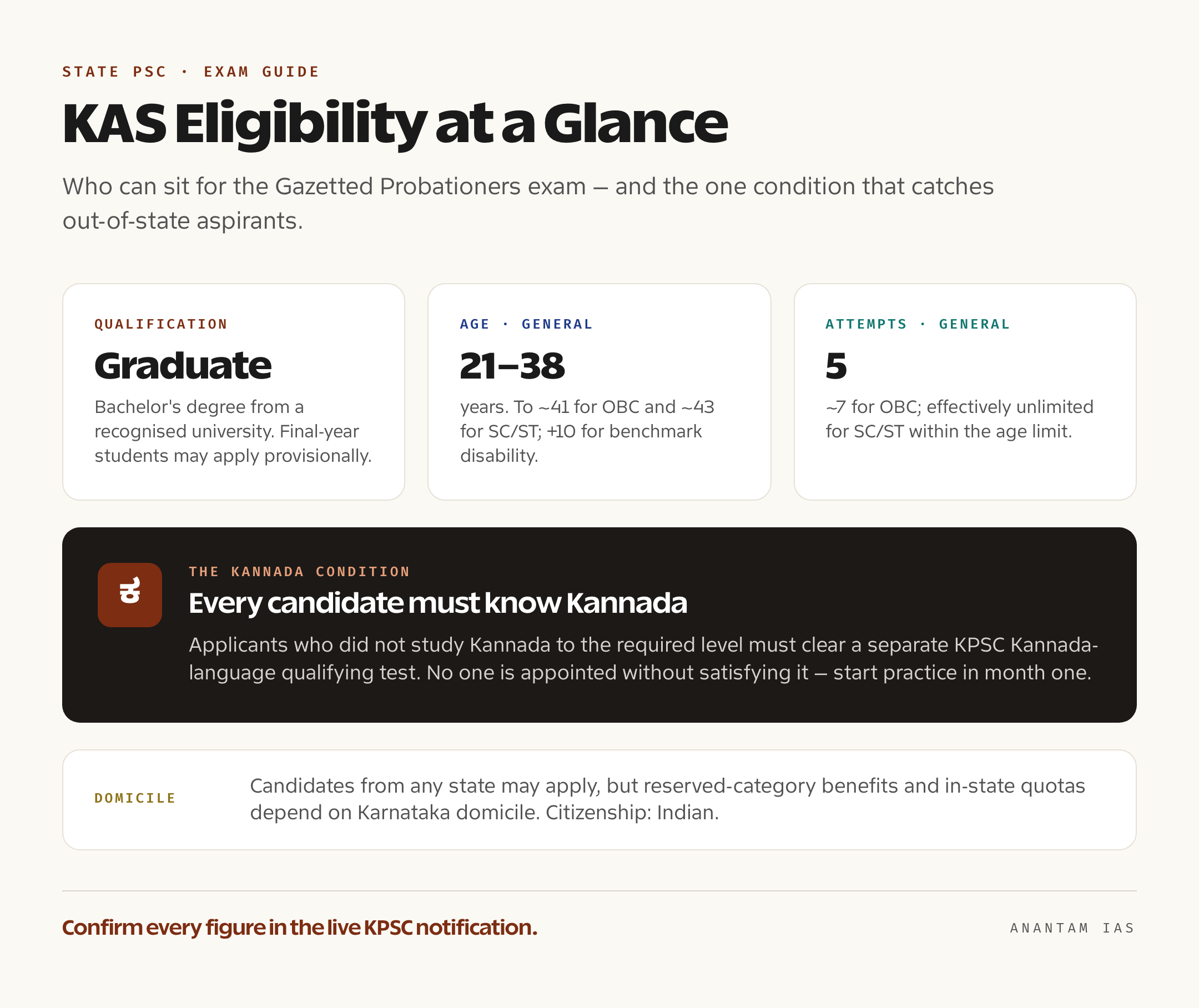
- Educational qualification: A bachelor’s degree (or equivalent) from a recognised university. Final-year students can typically apply provisionally and must produce the degree before appointment.
- Age limits: Generally 21 to 38 years for the General category, with relaxations to about 41 years for OBC (categories 2A, 2B, 3A, 3B) and around 43 years for SC, ST, and Category-1 candidates. Persons with benchmark disabilities get a further extension of up to 10 years. Exact upper limits are fixed in each notification, so confirm the cut-off date there.
- Number of attempts: Roughly five attempts for General candidates, around seven for OBC, and effectively unlimited for SC and ST candidates within the age ceiling.
- Kannada-language requirement: Every candidate must know Kannada. Applicants who did not study Kannada as a language up to a certain level must clear a separate Kannada-language qualifying test conducted by KPSC. This is the single biggest hurdle for aspirants from outside Karnataka.
- Domicile: Candidates from any state may apply, but reserved-category benefits and the in-state quotas hinge on Karnataka domicile, and the Kannada test applies to non-Kannada speakers regardless of where they live.
Because the age, attempt, and relaxation figures are revised periodically, always cross-check the live KPSC notification before you bank on a number. The Kannada condition, in particular, is non-negotiable — no candidate is appointed without satisfying it.
KPSC KAS Syllabus
The syllabus is where KAS earns its reputation as a Karnataka exam rather than a UPSC clone. The national-level General Studies overlaps heavily with UPSC, but a thick layer of Karnataka history, geography, polity, economy, and current affairs runs through every stage.
Prelims Syllabus
Paper I (General Studies — national and international): Current events of state, national, and international importance; the history of India and the Indian national movement with special emphasis on Karnataka; Indian and world geography; Indian polity and governance; and broad humanities coverage across history, geography, and political science.
Paper II (Karnataka and aptitude): General Studies relating to Karnataka — the state’s history, geography, polity, economy, and schemes; general science, technology, environment, and ecology; and general mental ability covering comprehension, reasoning, and basic numeracy. Unlike the UPSC CSAT, this aptitude content sits inside a Prelims paper that screens candidates rather than as a stand-alone qualifying test.
Mains Syllabus
The four merit GS papers spread the load across the familiar civil-service domains, each carrying a strong Karnataka thread:
- GS Paper I — History, Society, Economy: Indian and Karnataka history (social, cultural, economic, political), the freedom movement with Karnataka emphasis, social issues, and the basics of the Indian and state economy.
- GS Paper II — Geography, Constitution, Administration: Physical, human, and economic geography of India and Karnataka; the Constitution; governance and public administration; and the structure of Karnataka’s administrative machinery.
- GS Paper III — Science, Technology, Ecology: Developments in science and technology, environmental issues and climate change, biodiversity and conservation, with Karnataka-specific ecology where relevant.
- GS Paper IV — Ethics, Integrity, Aptitude: Ethics and the human interface, moral thinkers, emotional intelligence, civil-service values, and case-study-based questions on administrative dilemmas — closely modelled on the UPSC ethics paper.
The Essay paper (250 marks) asks for two or three essays on social, economic, political, and cultural themes, and rewards structure and Karnataka-aware examples. The Kannada and English qualifying papers (150 marks each) test grammar, comprehension, précis, and translation; they only need a pass mark but cannot be skipped.
State-Specific Focus
This is the real differentiator, and where dedicated study pays the highest dividends.
- Karnataka history: The dynastic sweep from the Kadambas and Gangas through the Badami Chalukyas, the Rashtrakutas, the Hoysalas (and their temple architecture at Belur and Halebidu), to the Vijayanagara Empire — Harihara and Bukka, Krishnadevaraya, and the Battle of Talikota of 1565. Then the Keladi Nayakas, the Wodeyars of Mysore, Hyder Ali and Tipu Sultan, and freedom-movement figures such as Rani Chennamma and Sangolli Rayanna of Kittur.
- Karnataka geography: Physical divisions (the coastal Karavali, the Malnad of the Western Ghats, and the Maidan plateau), major rivers (Kaveri, Krishna, Tungabhadra, Sharavathi), minerals, the iron-ore belt, and the state’s biodiversity hotspots.
- Karnataka polity and economy: State administrative structure, Panchayati Raj (Karnataka was a pioneer), the IT and biotech economy centred on Bengaluru, agriculture, and irrigation projects.
- Karnataka schemes and current affairs: Flagship state welfare and development programmes, plus the steady diet of Karnataka-focused current events that fills a large share of Prelims questions.
KPSC KAS Preparation Strategy
A KAS plan succeeds when it treats the national General Studies and the Karnataka layer as two parallel tracks, then welds the Kannada requirement on top.
Build the General Studies Foundation
Start with the NCERT-and-standard-reference base that any UPSC aspirant uses — history, geography, polity, economy, environment, and science. The overlap between KAS GS and the UPSC syllabus is large, so this foundation does double duty if you’re keeping the UPSC option open. Anyone weighing the two routes will find our UPSC vs State PCS comparison useful for deciding where to put their years.
Add the Karnataka Layer
Carve out a dedicated block of six to eight weeks for Karnataka-specific content: state history (master the Hoysala, Vijayanagara, and Wodeyar material), Karnataka geography, the state economy, administration, and government schemes. A Karnataka State Gazetteer, state-board history texts, and a reliable KAS-focused current-affairs compilation are worth more here than any number of national magazines.
Handle Kannada Early
If Kannada isn’t your first language, do not leave it for the end. Begin reading and writing practice from month one so the qualifying paper — and the separate language test, if you need it — never becomes the thing that ends your candidature. For candidates who studied in Kannada medium, this is a strength to lean into.
Work the Current Affairs and PYQs
Build a current-affairs habit that weights Karnataka heavily: a Kannada or English daily with strong state coverage, plus government scheme notifications. Then analyse KPSC’s previous-year papers to see how the commission frames questions — recent cycles show high-frequency Karnataka topics on history, geography, and schemes recurring almost every year.
Practise Answer Writing and Mocks
With five merit papers and an essay, the Mains rewards structured, time-bound writing. Write full-length GS answers and essays weekly, take full mock tests across all papers, and revise on a tight loop in the final stretch. The same answer-writing discipline that lifts UPSC scores lifts KAS scores. If you’re comparing exam routes more broadly, our UPSC vs SSC breakdown helps you see where administrative-cadre exams like KAS sit against clerical and technical alternatives.
Posts, Salary & Career
The Gazetted Probationers exam fills both Group A and Group B gazetted vacancies. Group A roles include the Assistant Commissioner of a sub-division, Deputy Superintendent of Police, and the Assistant Commissioner of Commercial Taxes; Group B roles include Tahsildar, Commercial Tax Officer, Assistant Labour Commissioner, and similar posts. The Tahsildar runs a taluk’s revenue administration and land records, while the Assistant Commissioner is the senior sub-divisional officer and the most coveted catch of the exam.
On pay, Group A KAS officers begin in the higher reaches of the Karnataka state pay matrix under the 7th Pay Commission, with a starting basic pay around Rs. 56,100 per month rising through the matrix; with Dearness Allowance, House Rent Allowance, and other benefits, the in-hand figure typically lands in the rough range of Rs. 75,000 to Rs. 1,20,000 per month, depending on posting. For a fuller picture of what a sub-divisional officer’s role and pay look like, our note on SDM salary covers the comparable revenue-line post in other states.
Career growth is the real draw. A KAS officer can move up to district-level responsibilities and, through promotion quotas, can eventually be inducted into the IAS — a path that gives the KAS the prestige and reach that pulls lakhs of Karnataka graduates to the exam each cycle.
Books for KPSC KAS
Most of what you read for UPSC transfers to KPSC KAS: polity, economy, modern history and the NCERT base. What does not transfer is the Karnataka section, and that is where the selection is decided. One state book, read three times, beats five read once.

Nutan GK 2026, 11th revised edition (Kannada)
- 792 pages, 11th revised edition for 2026, in Kannada
- Karnataka history, geography, economy and polity alongside general GK
- Written for KAS, PSI, FDA and the other Karnataka exams

Lucent's General Knowledge 2026 — English (15th revised edition)
- 460 pages, Lucent Publications
- Static GK in the compressed, list-heavy format state PSC prelims reward
- Overrated for UPSC, right for this exam
- Indian Polity, M. Laxmikanth (Amazon.in). The polity questions are the same exam everywhere.
- Lucent’s General Knowledge (Amazon.in). Overrated for UPSC, right for the static questions here.
- Indian Economy, Ramesh Singh (Amazon.in). Read the concept chapters; the state budget goes on top.
- A Brief History of Modern India, Spectrum (Amazon.in). The freedom-struggle questions come straight from here.
- Nutan GK 2026, 11th revised edition (Kannada) (Amazon.in): the Karnataka-specific guide most KAS candidates carry; in Kannada.
- NCERTs, Classes 6 to 12, for history, geography and science. Free from NCERT; nothing to buy.
Skip the coaching compilations until you have finished these. They summarise books you have not read yet.
Frequently Asked Questions
What is the selection process for the KPSC KAS exam?
The KAS Gazetted Probationers selection has three stages. The Preliminary exam has two objective papers of 200 marks each (400 total) and only screens candidates. The Mains has seven papers — Kannada and English qualifying papers of 150 marks each, plus an Essay and four GS papers of 250 marks each that count for merit (1,250 marks). The Personality Test adds 25 marks, for a final merit of 1,275.
What is the eligibility for KPSC KAS?
You need a bachelor’s degree from a recognised university and must be roughly 21 to 38 years old for the General category, with relaxations to about 41 years for OBC and around 43 years for SC and ST candidates. General candidates get about five attempts, OBC about seven, and SC/ST effectively unlimited within the age limit. Every candidate must know Kannada, and out-of-state candidates must clear a separate Kannada-language test.
Is there an optional subject in the KAS Mains?
No. KPSC removed the optional subject, so the merit-counting Mains is built entirely on the Essay and four General Studies papers, with Kannada and English as qualifying-only papers. Your whole Mains preparation is GS- and essay-focused, which is similar to the MPPSC structure and unlike the optional-heavy UPSC design.
How much Karnataka-specific content does the KAS exam have?
A great deal — it’s the defining feature. Karnataka history (Kadambas to Hoysalas, the Vijayanagara Empire, the Wodeyars, Hyder Ali and Tipu Sultan), Karnataka geography, state polity, economy, schemes, and Karnataka current affairs run through both Prelims papers and all four GS Mains papers. Aspirants who master this state layer, on top of the UPSC-style General Studies base, hold a clear edge.
Start Your KAS Preparation
The KAS rewards candidates who respect both halves of the exam — the national General Studies foundation and the deep Karnataka layer — and who treat the Kannada requirement as a first-month priority rather than a last-minute scramble. If you’re still choosing between an all-India and a state career, read our UPSC vs State PCS comparison, then map your timeline around the next KPSC notification. Build the foundation, layer the state, and write often — that’s the formula that turns a Karnataka graduate into a Gazetted Probationer.
Tell Google you want more of this.
Add Anantam IAS as a preferred sourceOne tap, and this site shows up more often in your own Top Stories, AI Overviews and AI Mode. Remove it any time.