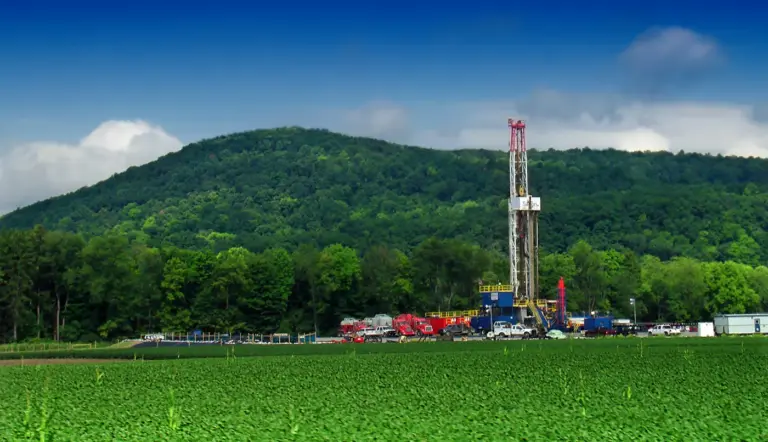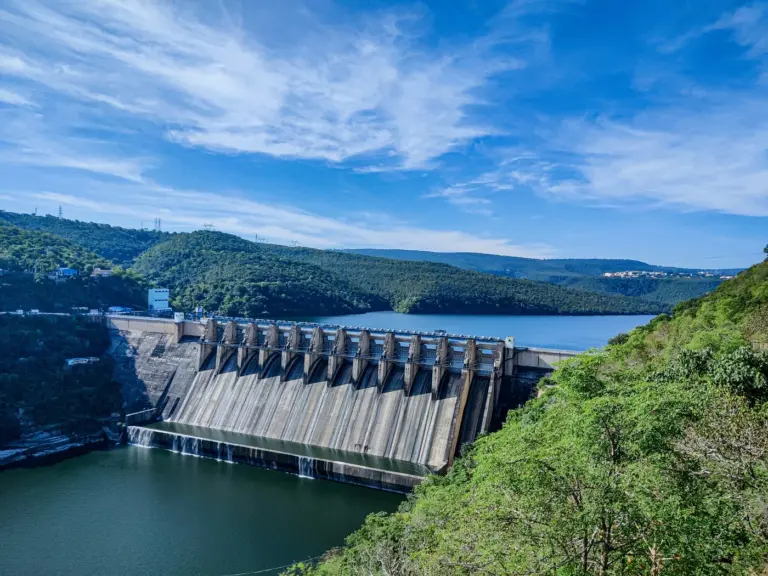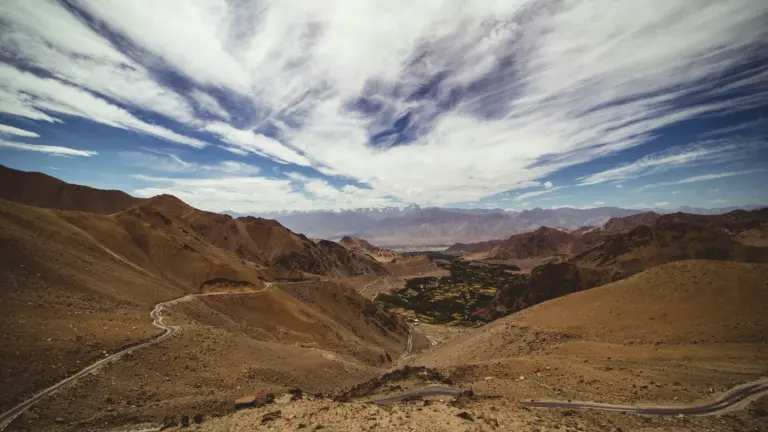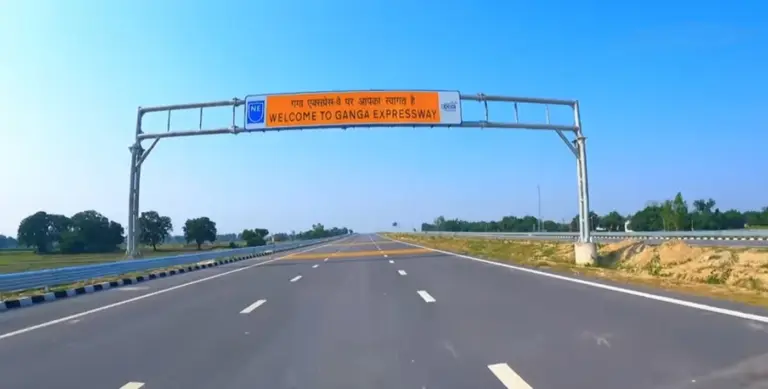
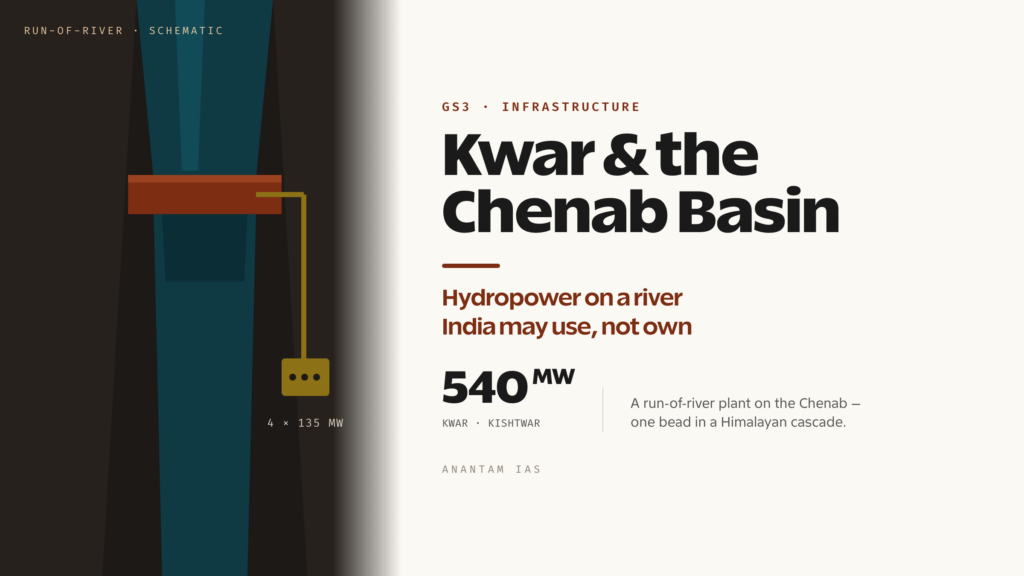
Drive up the gorge of the Chenab in Kishtwar district of Jammu and Kashmir and you pass one construction camp after another, each clinging to a sheer Himalayan slope above a river the colour of jade. One of them belongs to the Kwar Hydroelectric Project, a 540 MW plant that the Union Cabinet cleared in April 2022 at a cost of about Rs 4,526 crore, and where the Chenab’s flow was diverted into a tunnel in January 2024 so the dam wall could rise on dry ground. On its own, Kwar is a mid-sized power station. But it is rarely talked about on its own, and that is the point worth grasping. Kwar is one bead on a string — a cascade of dams India is racing to finish along a single Himalayan river that the country is allowed to use, but does not strictly own.
And that mix of engineering and law is exactly why this topic earns a place in your preparation. The Chenab is a “Western River” under the Indus Waters Treaty of 1960, a river whose waters were allotted to Pakistan even though it runs through Indian territory first. So every dam India builds here — Kwar, Pakal Dul, Kiru, Ratle and the rest — has to thread a needle: generate power without storing or diverting the water in ways the treaty forbids. The recent strain on that treaty, after India placed it “in abeyance” in 2025, has only sharpened the spotlight on these projects. For a UPSC aspirant, the Chenab cascade is a near-perfect GS3 case study because it braids together infrastructure, energy security, a transboundary treaty and the environmental fragility of the Himalaya in one place.
What the Kwar Project Is and How a Run-of-River Plant Works
Start with the plant itself, because the design tells you almost everything about why these projects look the way they do. Kwar is a run-of-river hydroelectric scheme on the Chenab in Kishtwar, built around a concrete gravity dam roughly 109 metres high. Its powerhouse holds four turbines of 135 MW each, adding up to the headline figure of 540 MW, and the project is expected to generate close to 1,975 million units of electricity in a normal year. As of early 2026, after the river diversion of January 2024, the developers were targeting completion around March 2028.
The phrase “run-of-river” is the one to define cleanly, because examiners and editorials lean on it constantly. A run-of-river plant generates electricity from the natural flow and fall of a river rather than from a large stored reservoir. It builds a relatively modest barrage to raise the water level, channels that water through a tunnel or penstock to a powerhouse set lower down, and lets the river continue on its way. The energy comes from “head” — the vertical drop between the intake and the turbines — and from the volume passing through, not from hoarding months of water behind a giant wall. Kwar’s net head is around 103 metres. So a run-of-river plant produces more in the high-flow summer months, when Himalayan snow and glaciers melt, and less in the lean winter. It is the opposite of a classic storage dam like Bhakra, which impounds a huge lake and releases water on demand across the year.
That distinction is not just a textbook nicety here — it is the legal heart of the whole basin, and we’ll come back to it. The small pond a run-of-river plant keeps behind its barrage is called “pondage,” and it is deliberately kept tiny, enough to smooth out a day’s fluctuation in flow, not to bank water for a dry season. A storage dam, by contrast, can hold back a river for months and so can both withhold water from those downstream and release it in a controlled surge. Because the Chenab’s waters are promised onward to Pakistan, India’s plants here are built so that what flows in roughly equals what flows out — the river lends its energy on the way past, but is not detained. Kwar’s gravity dam, its short headrace tunnel and its four 135 MW units are all sized around that constraint.
Who is building it matters too, because the same name recurs across the whole basin. Kwar is being executed by Chenab Valley Power Projects, or CVPP — a joint venture set up specifically to develop hydropower on this river. The central public-sector giant NHPC holds 51 per cent of CVPP and the Jammu and Kashmir State Power Development Corporation, or JKSPDC, holds the remaining 49 per cent. That structure — central engineering muscle and finance paired with a state-government stake — is how India is unlocking the Chenab’s potential after decades in which much of it sat untouched. CVPP is not building Kwar alone; it is building a portfolio, and Kwar is one line in that portfolio.
The Chenab Cascade: A River Engineered Bead by Bead
Now zoom out from Kwar to the river, because the Chenab is being turned into one of India’s most concentrated hydropower corridors. The river rises in Himachal Pradesh as the Chandrabhaga — born where the Chandra and Bhaga streams meet near Tandi — then cuts a deep, steep valley through Kishtwar, Doda, Ramban and Reasi before entering the plains. That steepness is the whole attraction: a fast-falling river in a narrow gorge offers exactly the “head” a run-of-river plant needs, which is why engineers have mapped a chain of projects down its length.
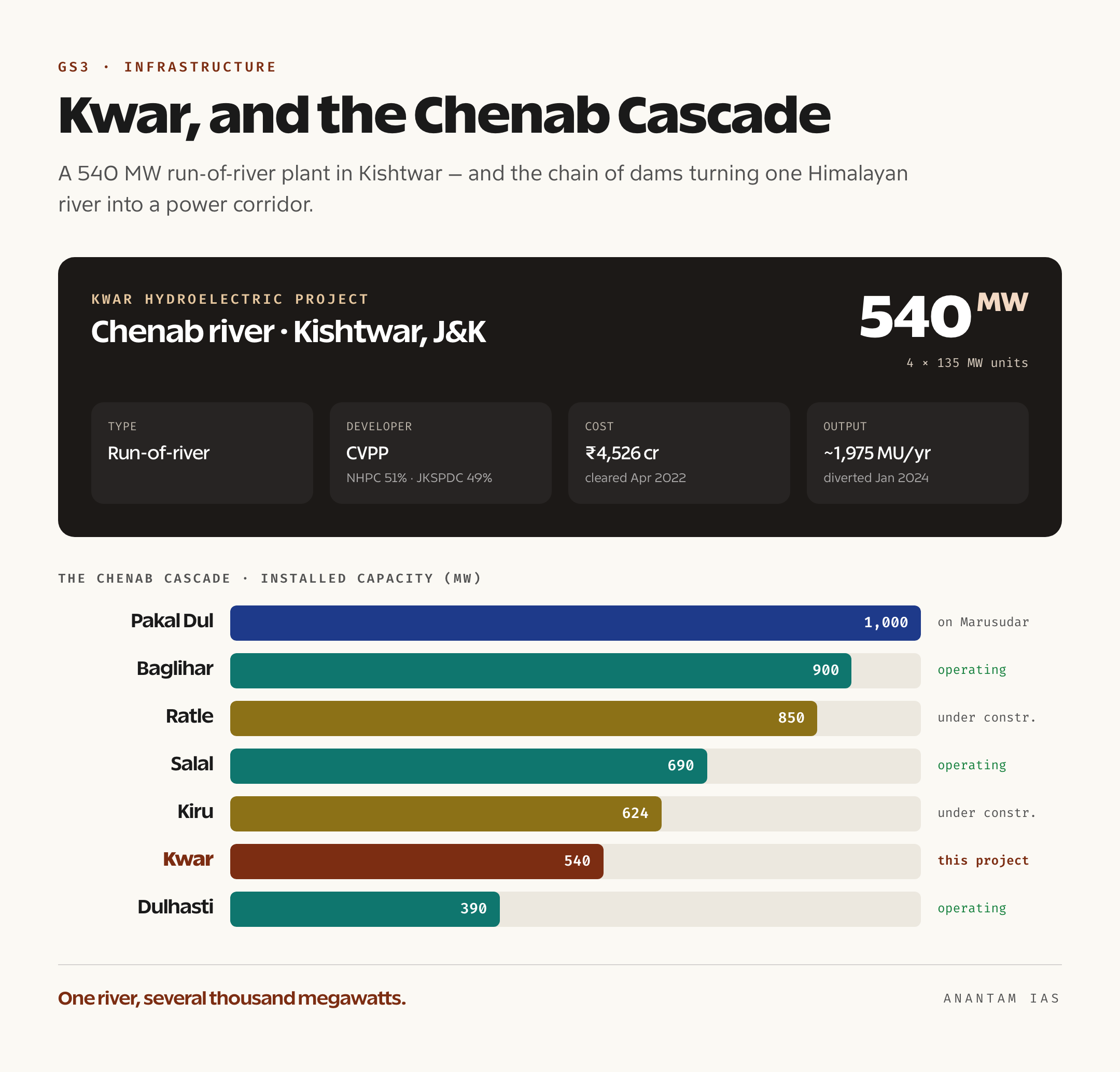
Read the cascade from the older, finished plants to the newest sites and the scale becomes clear. The Salal project in Reasi, commissioned from the late 1980s, is a run-of-river plant of about 690 MW — among the first big stations on the river. The 900 MW Baglihar plant in Ramban, built in two stages, followed and became famous for the dispute it triggered under the treaty. The 390 MW Dulhasti plant near Kishtwar was commissioned in 2007, and a Dulhasti Stage-II of around 260 MW is planned to draw more power from the same drop. Those are the operating anchors. Above them sits the new wave that CVPP and NHPC are racing to finish: the 1,000 MW Pakal Dul, the largest of the group, built not on the Chenab’s main stem but on the Marusudar, its biggest tributary; the 624 MW Kiru; the 540 MW Kwar; and, further along, the 850 MW Ratle. Add the cascade together and the Chenab corridor alone accounts for several thousand megawatts of capacity — a meaningful slice of India’s untapped Himalayan hydro potential, which runs into tens of thousands of megawatts across the country.
Pakal Dul deserves a special mention, because it is the one project that bends the run-of-river rule the furthest. It is a tall concrete-faced rockfill dam — around 167 metres — designed to create a genuine reservoir of roughly 108 million cubic metres on the Marusudar, which makes it effectively the first storage-capable project India has built in this part of the basin. Its four units of 250 MW each give it the cascade’s largest output, and the Marusudar was diverted some years ago to let the dam rise. So the cascade is not uniform. Most beads are pure run-of-river plants that take the flow as it comes; Pakal Dul adds a degree of storage that gives the system a little more control over timing.
It helps to see the cascade as a system rather than a list. The older plants downstream — Salal, Baglihar, Dulhasti — already convert the Chenab’s lower fall into power and have done so for years. The newer cluster upstream around Kishtwar — Pakal Dul, Kiru, Kwar — is where the unbuilt potential lay, and where CVPP and NHPC are now concentrated. Build them in sequence and a single drop of meltwater can spin turbines several times on its way down the valley, each plant harvesting a slice of the river’s total fall. That is the elegance of a cascade, and also its risk: the dams are physically and hydrologically linked, so a failure or a flood high in the chain can cascade downward too. And that single design choice that runs through it all — storage versus pure run-of-river — is precisely where the engineering meets the law, which is the next thing to understand.
The Indus Waters Treaty: The Rulebook Every Chenab Dam Must Obey
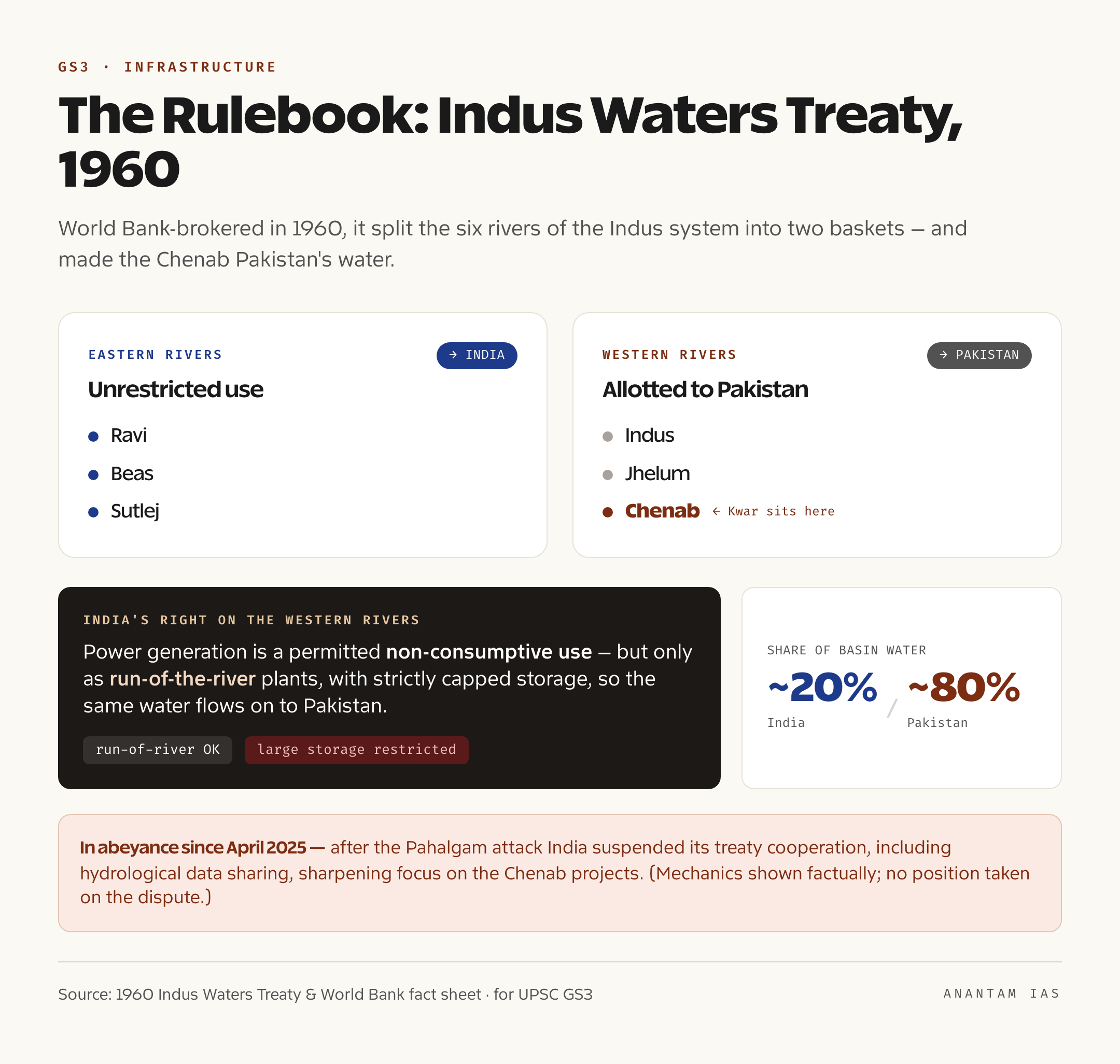
You cannot explain a single Chenab project without the Indus Waters Treaty, so learn its architecture cold. Signed in Karachi on 19 September 1960 by Jawaharlal Nehru and Pakistan’s Ayub Khan, and brokered by the World Bank, the treaty divided the six rivers of the Indus system between the two countries. The three Eastern Rivers — the Ravi, the Beas and the Sutlej — were given to India for unrestricted use. The three Western Rivers — the Indus, the Jhelum and the Chenab — were allotted to Pakistan. By volume the split is lopsided: the western rivers carry the bulk of the system’s flow, so the arrangement leaves India with roughly a fifth of the basin’s water and Pakistan with about four-fifths. As the World Bank’s own fact sheet on the treaty describes, this allocation was the price of a settlement that has, remarkably, survived three wars.
But “allotted to Pakistan” does not mean India gets nothing from the Chenab. The treaty lets India put the western rivers to limited use — some irrigation, and crucially, unlimited non-consumptive uses such as generating electricity. The catch is the design rules. Any hydro plant India builds on the Chenab must be run-of-the-river, with tightly capped “live” or pondage storage, gates set at specified levels, and spillways designed so that India cannot hold back or release large volumes at will. The idea is that India may borrow the river’s energy as it flows past, but must let essentially the same quantity of water continue downstream to Pakistan. That is why Kwar and Kiru are pure run-of-river, why their pondage is small, and why a storage element like Pakal Dul’s is the sensitive exception. Pakistan has repeatedly objected to the design of Indian projects — Baglihar went to a World Bank-appointed Neutral Expert, and Kishanganga on the Jhelum went to a Court of Arbitration — using the treaty’s own graded dispute mechanism, where a “question” goes to the Indus Commission, a “difference” to a Neutral Expert, and a “dispute” to a Court of Arbitration.
Then comes the recent twist that has put all of this in the news. After the Pahalgam terror attack of April 2025, India announced it was holding the Indus Waters Treaty “in abeyance” — a suspension of its cooperation under the treaty, including the routine sharing of hydrological data, pending what New Delhi described as Pakistan credibly ending cross-border terrorism. India has framed this as a sovereign response rather than a formal exit, and the legal status of “abeyance” — a term not found in the treaty text — is itself debated. What it has done in practice is loosen the perceived constraints on the Chenab projects: with the treaty’s day-to-day machinery paused, India has pressed ahead faster on the cascade and on works like reservoir flushing. This article does not take a side on the underlying India-Pakistan dispute; the point for your answer is to describe the treaty’s mechanics accurately and note that the projects sit inside a legal framework now under unusual strain.
Power, Promise and Peril: Why the Cascade Matters and What Could Go Wrong
So why pour thousands of crores into dams clinging to a Himalayan gorge? The case for the Chenab cascade is genuinely strong. Hydropower is clean, renewable and dispatchable — it can be ramped up within minutes to meet evening demand peaks in a way that solar and wind cannot, which makes it the natural partner for India’s fast-growing renewable fleet and its net-zero-by-2070 pledge. The projects feed power-hungry northern India, generate revenue and royalty-free power for Jammu and Kashmir, and create thousands of construction and operation jobs in a region that badly needs them — Kwar alone is projected to support around 2,500 jobs. Building out the cascade also lets India use its rightful share of the western rivers’ energy that, for decades, simply ran past unused.
But the perils are just as real, and a balanced answer names them squarely. The Himalaya is young, rising and seismically violent — these dams sit in one of the most earthquake-prone belts on earth, where a major quake or a landslide-triggered flood could be catastrophic. The region is also exposed to glacial lake outburst floods and to the kind of sudden cloudburst-and-debris disaster seen in the wider Himalaya in recent years, risks that climate change is intensifying as glaciers retreat and weather grows more erratic. Large run-of-river projects still fragment river ecology, trap sediment, alter the flow regime that downstream life depends on, and submerge forest and farmland; tunnelling and blasting through fragile slopes can destabilise hillsides and villages. And there is the human cost — land acquisition and the displacement of local communities, whose rehabilitation and share of the benefits are a recurring source of grievance. The way forward most experts urge is not to stop building but to build smarter: rigorous cumulative environmental-impact assessment of the whole cascade rather than one dam at a time, robust seismic and flood design, genuine benefit-sharing with affected communities, and the maintenance of ecological flows so the river survives between the dams. Get that balance right and the Chenab can be both a power corridor and a living river. Get it wrong and it becomes a line of fragile concrete in a danger zone.
For Your Mains Answer
This is a high-value topic for GS Paper 3, which covers infrastructure (energy and ports), environment and disaster management, and India’s economic development. It also touches GS Paper 2 on India’s relations with its neighbourhood, since the Indus Waters Treaty frames the whole story. The skill examiners reward here is integration: link the engineering (run-of-river design) to the law (the treaty) to the geography (the fragile Himalaya), and never write about the dam in isolation from the river basin and the treaty that governs it.
How to Build the Answer
Move in a clear chain. Open with what Kwar is and where it sits — 540 MW, run-of-river, on the Chenab in Kishtwar, built by CVPP. Define run-of-river versus storage so the design logic is explicit. Then zoom out to the cascade — name the big projects and their megawatts to show command of the landscape. Bring in the Indus Waters Treaty as the rulebook — Eastern versus Western rivers, India’s non-consumptive hydro rights, the design constraints, and the 2025 abeyance as live context. Close with a balanced evaluation: clean dispatchable power and regional development on one side, seismicity, ecology and displacement on the other, with a “build smarter” way forward. That arc — project, design, cascade, treaty, evaluation — fits almost any question on Himalayan hydropower or the Chenab.
Common Mistakes to Avoid
Don’t confuse a run-of-river plant with a large storage dam — the whole treaty logic rests on that distinction. Don’t say the Chenab “belongs” to India or that the treaty bans Indian dams; India has clear, if constrained, rights to generate power on it. Don’t take a political position on the India-Pakistan dispute; present the treaty’s mechanics factually. Don’t muddle the cascade figures — keep Pakal Dul (1,000 MW) and Kwar (540 MW) straight, and remember Pakal Dul is on the Marusudar tributary, not the main stem. And don’t ignore the environment — an answer that only celebrates capacity, with no word on seismicity or displacement, will read as unbalanced.
A Compact Answer Spine
Kwar = 540 MW run-of-river on the Chenab, Kishtwar, by CVPP (NHPC 51% + JKSPDC 49%), ~Rs 4,526 cr → run-of-river uses flow and head, not storage → part of the Chenab cascade: Salal (~690 MW), Baglihar (900 MW), Dulhasti (390 MW), Pakal Dul (1,000 MW, on Marusudar, storage), Kiru (624 MW), Ratle (850 MW) → governed by the Indus Waters Treaty 1960: Eastern rivers (Ravi, Beas, Sutlej) to India, Western rivers (Indus, Jhelum, Chenab) to Pakistan, India allowed non-consumptive run-of-river hydro under design limits → treaty “in abeyance” since April 2025 → verdict: clean dispatchable power and regional development versus Himalayan seismicity, ecology and displacement; build smarter with cumulative impact assessment.
Diagram or Flowchart Idea
Sketch a simple vertical river line for the Chenab from Himachal down to the plains, with labelled nodes for each project and its megawatts stacked along it — a “cascade ladder.” Beside it, a small two-column box: Eastern Rivers (to India) versus Western Rivers (to Pakistan), with an arrow showing India’s run-of-river hydro right on the western side. The two together carry the engineering and the law at a glance.
A Balanced-Conclusion Line
A line that lands the marks: “The Chenab cascade lets India draw clean, dispatchable power from a river it may use but does not own — a legitimate exercise of its treaty rights, whose real test lies not in the megawatts but in whether the dams can be built safely in a fragile Himalaya without breaking either the river’s ecology or its downstream commitments.”
How to Use Data Without Cramming
You need only a handful of anchors, not the whole portfolio: 540 MW (Kwar), 4 × 135 MW (its turbines), 1,000 MW (Pakal Dul, the cascade’s biggest), the treaty year 1960, and the roughly 20:80 water split between India and Pakistan. Attribute plainly — “under the 1960 Indus Waters Treaty,” “as the World Bank’s fact sheet notes” — rather than scattering figures loose. Two or three exact numbers placed well beat a dozen recited from memory.
FAQ
What is the Kwar Hydroelectric Project and where is it located? The Kwar Hydroelectric Project is a 540 MW run-of-river power station being built on the Chenab river in Kishtwar district of Jammu and Kashmir. Cleared by the Union Cabinet in April 2022 at a cost of about Rs 4,526 crore, it has a roughly 109-metre concrete gravity dam and four turbines of 135 MW each, and is expected to generate close to 1,975 million units of electricity a year. It is being executed by Chenab Valley Power Projects, a joint venture in which NHPC holds 51 per cent and the J&K State Power Development Corporation holds 49 per cent.
What is a run-of-river hydropower project? A run-of-river plant generates electricity from the natural flow and fall of a river rather than from a large stored reservoir. It uses a modest barrage to raise the water level and channels the flow through a tunnel to a powerhouse lower down, then returns the water to the river. The energy comes from the vertical drop, or “head,” and the volume passing through, so output is higher in the high-flow melt season and lower in winter. It is the type of project the Indus Waters Treaty permits India to build on the western rivers.
Which projects make up the Chenab cascade? The Chenab corridor hosts a chain of plants. The older operating ones include Salal (about 690 MW), Baglihar (900 MW) and Dulhasti (390 MW). The newer wave under construction includes Pakal Dul (1,000 MW, built on the Marusudar tributary and the largest of the group), Kiru (624 MW), Kwar (540 MW) and Ratle (850 MW). Together they make the Chenab one of India’s most concentrated hydropower corridors.
How does the Indus Waters Treaty affect these projects? Under the 1960 Indus Waters Treaty, the Chenab is a “Western River” whose waters were allotted to Pakistan, while India keeps the eastern rivers — Ravi, Beas and Sutlej. India may still use the Chenab for non-consumptive purposes such as power generation, but only through run-of-the-river designs with strictly limited storage, so the same water flows on to Pakistan. India placed the treaty “in abeyance” after the April 2025 Pahalgam attack, suspending its cooperation including hydrological data sharing, which has put fresh focus on the Chenab projects.
Practice Questions
Prelims MCQs
- The Kwar Hydroelectric Project is located on which river?
(a) The Jhelum
(b) The Chenab
(c) The Sutlej
(d) The Beas
Answer: (b) The 540 MW Kwar project is a run-of-river plant on the Chenab in Kishtwar district of Jammu and Kashmir. - Under the Indus Waters Treaty of 1960, which group of rivers was allotted to India for unrestricted use?
(a) Indus, Jhelum and Chenab
(b) Ravi, Beas and Sutlej
(c) Chenab, Ravi and Beas
(d) Indus, Sutlej and Jhelum
Answer: (b) The three Eastern Rivers — Ravi, Beas and Sutlej — went to India, while the Western Rivers (Indus, Jhelum, Chenab) were allotted to Pakistan. - With reference to a “run-of-river” hydroelectric project, which statement is correct?
(a) It relies on a very large reservoir to store months of water
(b) It generates power mainly from the natural flow and fall of the river with limited storage
(c) It is permitted only on the eastern rivers under the Indus Waters Treaty
(d) It cannot generate any electricity in the monsoon season
Answer: (b) A run-of-river plant uses the river’s flow and head rather than large storage; it is the design India is allowed to build on the western rivers. - The Chenab Valley Power Projects (CVPP), the developer of the Kwar project, is a joint venture between which entities?
(a) NTPC and NHPC
(b) NHPC and the J&K State Power Development Corporation
(c) NHPC and the World Bank
(d) JKSPDC and SJVN
Answer: (b) CVPP is a joint venture of NHPC (51 per cent) and the Jammu & Kashmir State Power Development Corporation (49 per cent). - Which of the following Chenab basin projects is built on the Marusudar river and has the largest installed capacity in the cascade?
(a) Kwar
(b) Kiru
(c) Pakal Dul
(d) Ratle
Answer: (c) The 1,000 MW Pakal Dul project, on the Marusudar tributary of the Chenab, is the largest in the cascade and includes a degree of storage.
Mains Practice Questions
- Explain the design of a run-of-river hydroelectric project and discuss why it is the dominant model for Indian hydropower on the western rivers of the Indus system. (15 marks, 250 words)
- “The Chenab is being engineered bead by bead into one of India’s most concentrated hydropower corridors.” Discuss the significance of the Chenab cascade for India’s energy security and for the development of Jammu and Kashmir. (15 marks, 250 words)
- Examine how the provisions of the Indus Waters Treaty, 1960 shape the design and operation of Indian hydroelectric projects on the western rivers. (15 marks, 250 words)
- Hydropower in the Himalaya carries both promise and peril. Critically analyse the environmental, seismic and social risks of building a cascade of dams on the Chenab, and suggest measures for sustainable development. (15 marks, 250 words)
- Distinguish between run-of-river and storage hydropower projects, and explain why the storage element of a project like Pakal Dul is more sensitive under the Indus Waters Treaty than a pure run-of-river plant. (10 marks, 150 words)
Tell Google you want more of this.
Add Anantam IAS as a preferred sourceOne tap, and this site shows up more often in your own Top Stories, AI Overviews and AI Mode. Remove it any time.