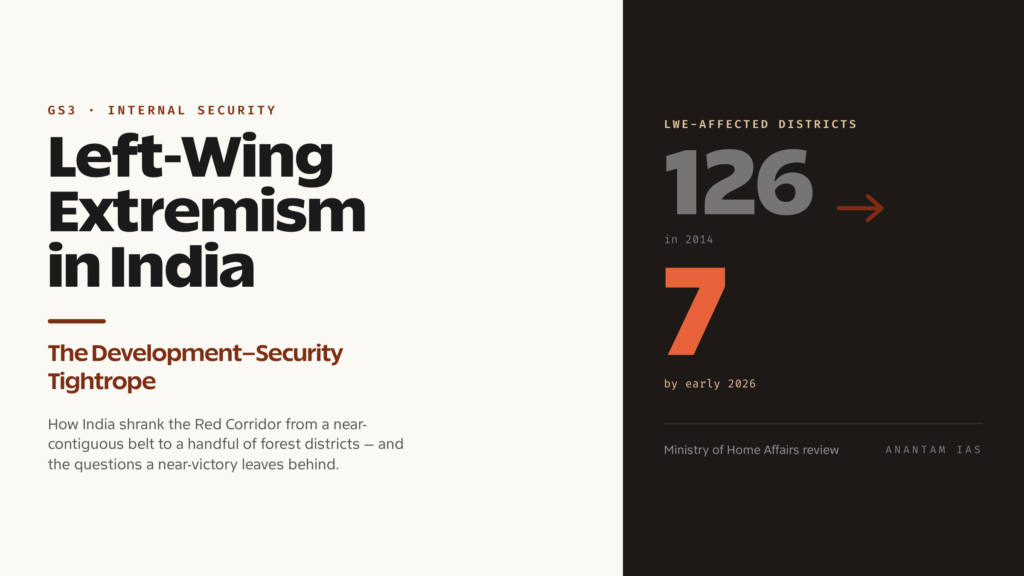
In April 2015, the Ministry of Home Affairs counted 126 districts touched by Left-Wing Extremism — a near-contiguous belt of forest and hill country running down the spine of the country, from the Jharkhand plateau through Chhattisgarh and into the edge of the Western Ghats. A decade earlier, a sitting Prime Minister had called this the single biggest internal-security threat the country faced. By the latest review in early 2026, that map had collapsed to seven districts, most of them clustered in one administrative pocket of southern Chhattisgarh called Bastar. The same government that once spoke of a strategic stalemate now talks about a finish line.
That is an extraordinary turnaround, and it deserves to be taken seriously on its own terms. But a counter-insurgency that is almost won is also the moment to ask the harder questions — about how it was won, about who paid for it, and about whether the development that was promised to follow the guns has actually arrived. Left-Wing Extremism in India is a story of the state regaining territory it had effectively ceded. It is also a story about tribal land, forest rights, and the thin line between restoring the rule of law and simply overwhelming a population. Both things are true at once, and an honest reading has to hold both.
The Challenge, Framed
Left-Wing Extremism — usually shortened to LWE, and known popularly as Naxalism — is an armed insurgency that wants to overthrow the Indian state through a protracted “people’s war” and replace it with a Maoist-style communist order. The name comes from Naxalbari, a village in West Bengal’s Darjeeling district where a peasant uprising erupted in May 1967 under communist leaders like Charu Mazumdar and Kanu Sanyal. That revolt fractured into dozens of factions over the following decades, but two of the largest — the People’s War Group, founded in Andhra Pradesh in 1980, and the Maoist Communist Centre — merged on 21 September 2004 to form the Communist Party of India (Maoist). That outfit, the CPI (Maoist), is banned as a terrorist organisation, and it has been the armed core of the movement ever since.
What makes LWE different from a purely ideological fringe is where it took root. The insurgency embedded itself in India’s poorest, most forested, most heavily tribal districts — places where the state’s writ was always thin, where land records were vague, and where the gap between a mining lease and an Adivasi’s customary forest was wide enough for an armed movement to live in. The Maoists offered a rough justice and a parallel administration in exactly the places where roads, schools, and courts had never quite reached. So the problem was never only a law-and-order problem. It was a governance vacuum that an armed ideology filled. That is why the official response, for the last decade, has rested on two legs at once — crush the armed apparatus, and close the development gap that gave it oxygen. Walking on both legs at the same time is the tightrope of the title.
The Red Corridor Today
The “Red Corridor” is the shorthand for the LWE belt, and for years it really did look like a corridor — an unbroken diagonal smear across the heart of India taking in Jharkhand, Bihar, Chhattisgarh, Odisha, Maharashtra, Telangana, Andhra Pradesh, Madhya Pradesh, and West Bengal. The defining feature of the last few years is that the corridor has stopped being a corridor. It has fragmented into islands, and the islands keep shrinking.
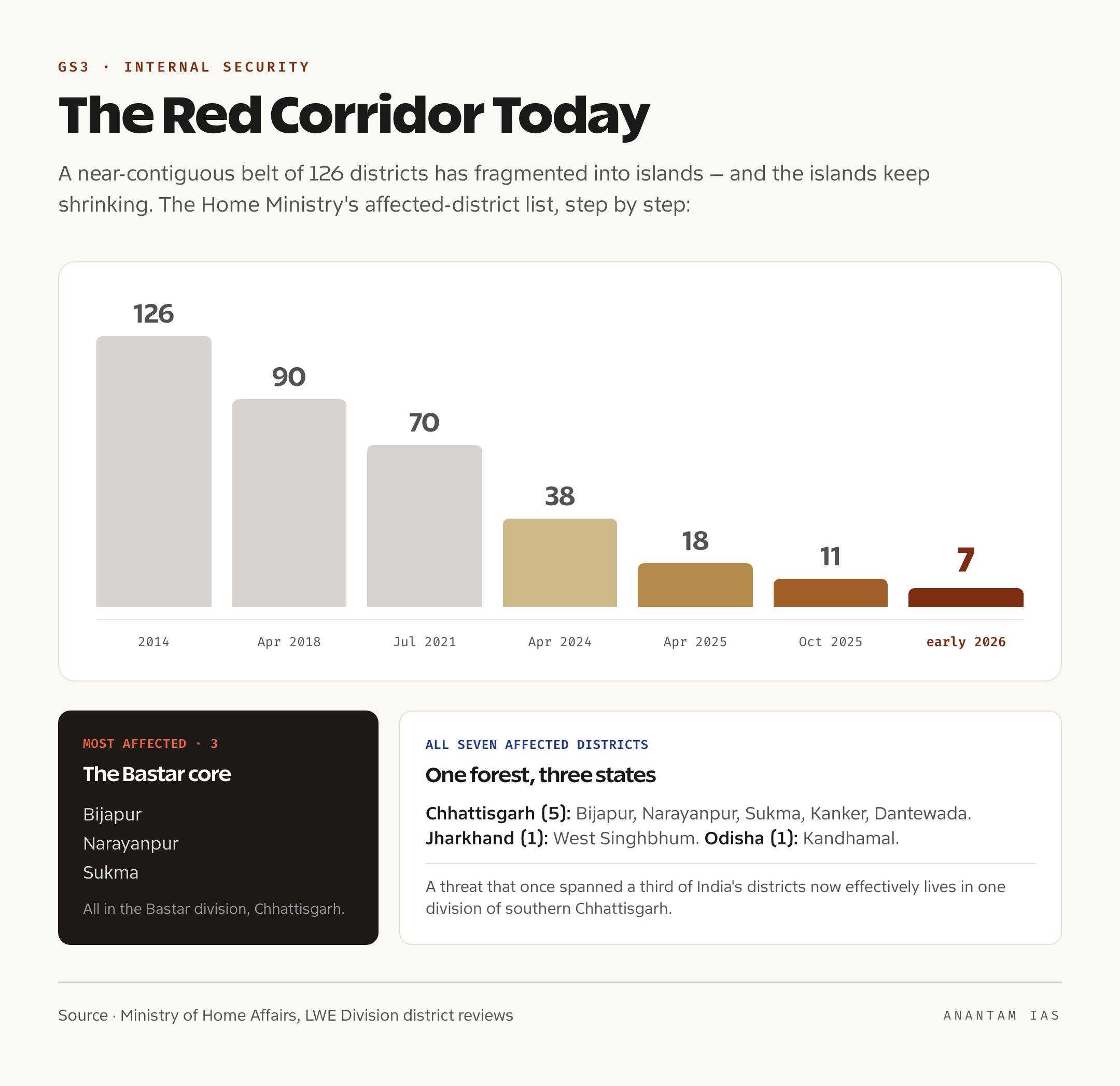
The numbers tell the story cleanly. The Ministry of Home Affairs classifies affected districts and revises the list periodically, and that list has fallen in steps: 126 districts in 2014, 90 by April 2018, 70 by July 2021, 38 by April 2024, 18 by April 2025, 11 by October 2025, and seven in the most recent review in early 2026. Of those seven, five sit in Chhattisgarh — Bijapur, Narayanpur, Sukma, Kanker, and Dantewada — with West Singhbhum in Jharkhand and Kandhamal in Odisha making up the rest. The category that the ministry calls “most affected” has narrowed to just three: Bijapur, Narayanpur, and Sukma, all in the Bastar division. A threat that once spanned a third of India’s districts now effectively lives in one forest.
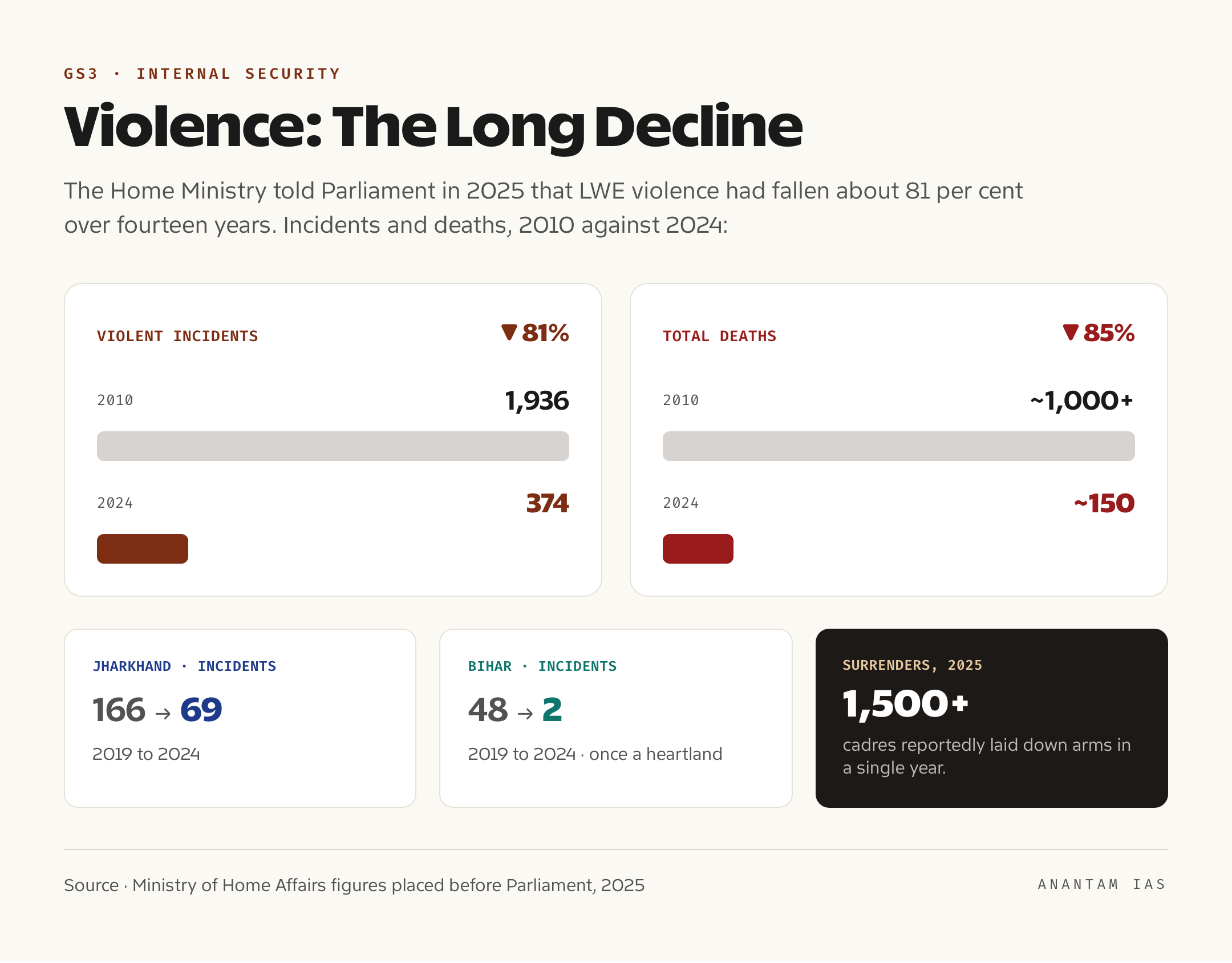
The violence data moves in the same direction. The Home Ministry told Parliament in 2025 that LWE violence had fallen by about 81 per cent over fourteen years — incidents dropping from 1,936 in 2010 to 374 in 2024 — while deaths fell roughly 85 per cent, from a little over a thousand in 2010 to around 150 in 2024. Take a shorter, more recent window and the trend holds: between 2019 and 2024, incidents fell about a quarter and total fatalities about a quarter too. State by state, the contraction is stark — Maoist violence in Jharkhand fell from 166 incidents in 2019 to 69 in 2024, and Bihar, once a heartland, dropped from 48 to just two. Alongside the decline in violence, surrenders have surged; more than 1,500 cadres reportedly laid down arms in 2025 alone, a sign that the movement’s own foot soldiers increasingly see no future in it.
And the leadership has been hollowed out. In May 2025, security forces killed Nambala Keshava Rao, known by his nom de guerre Basavaraj, the general secretary of the CPI (Maoist), in an encounter in the Abujhmarh forests of Narayanpur — the first time a serving general secretary of an Indian communist party has been killed by the state in the four-decade history of the insurgency. By early 2026 the Home Minister was telling the country that, barring one figure, the Maoist top leadership had effectively been wiped out. Whatever one makes of how that was achieved — and we will get to the how — the organisational decapitation is real.
India’s Institutional Response
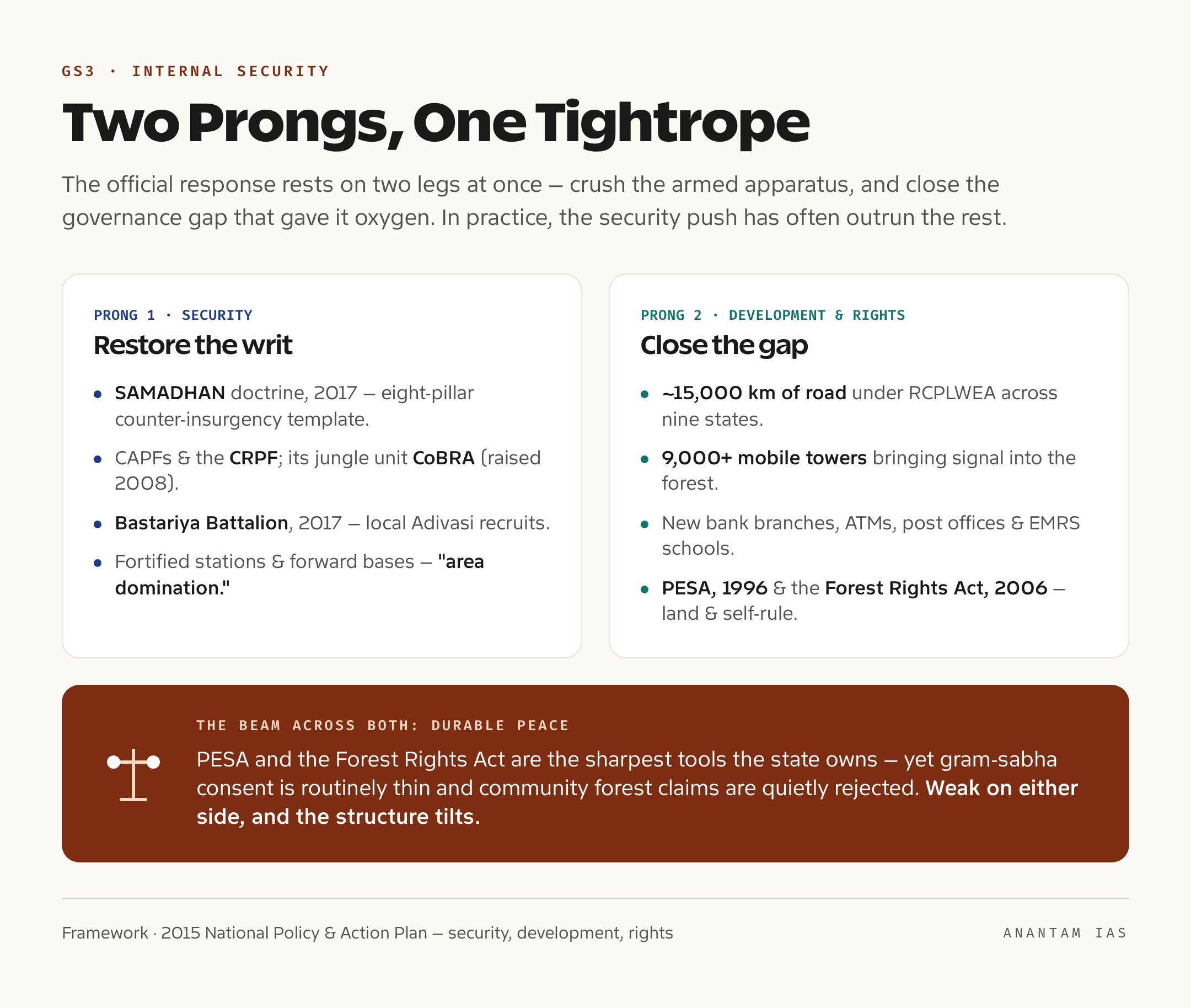
The architecture that produced these numbers runs through a dedicated Left-Wing Extremism Division inside the Ministry of Home Affairs, and it rests on a doctrine the ministry rolled out in 2017 with a deliberately memorable acronym: SAMADHAN. Each letter is a pillar — Smart leadership, Aggressive strategy, Motivation and training, Actionable intelligence, Dashboard-based key indicators, Harnessing technology, Action plan for each theatre, and No access to financing. Strip away the branding and it is a fairly orthodox counter-insurgency template: better-led and better-equipped forces, real-time intelligence, technology like drones and satellite imaging, and a financial squeeze to choke the movement’s money.
On the security side, the work is shared between state police forces and Central Armed Police Forces — the CAPFs, the umbrella term for the centre’s paramilitary like the Central Reserve Police Force. The CRPF carries the heaviest load, and its specialist jungle-warfare unit, CoBRA — the Commando Battalion for Resolute Action, raised in 2008 — does the deep-forest fighting. A telling refinement came in 2017 with the Bastariya Battalion, raised largely from local Adivasi youth in Bijapur, Dantewada, Narayanpur, and Sukma, on the logic that troops who know the terrain and speak the language fight a forest war better than outsiders. The state has also pushed physically into Maoist strongholds by building fortified police stations under the Special Infrastructure Scheme and planting dozens of new forward operating bases deep in Bastar — the strategy of “area domination,” where each new camp shrinks the space the insurgents can move in. The Security Related Expenditure scheme reimburses states for much of this cost.
But the doctrine’s real claim to coherence is the development leg, and the figures the government cites here are substantial. Roads have been the centrepiece, on the simple theory that an all-weather road is itself a form of security — it ends the isolation the Maoists fed on. Under the Road Requirement Plan and the Road Connectivity Project for LWE Affected Areas, or RCPLWEA, the centre says close to 15,000 kilometres of road have been built across the worst-hit districts in nine states. Connectivity of another kind has followed: more than 9,000 mobile towers commissioned to bring phone and data signals into the forest, with thousands more approved under a scheme tied to the Aspirational Districts Programme, the NITI Aayog initiative that targets India’s most-deprived districts and overlaps heavily with the LWE map. Financial inclusion has its own numbers — thousands of new bank branches, ATMs, and post offices offering banking in districts that had none — alongside Eklavya Model Residential Schools for tribal children, new Industrial Training Institutes, and skill centres. Underpinning all of it is the 2015 National Policy and Action Plan, which formally committed the state to a three-part approach: security, development, and ensuring the rights and entitlements of local communities.
That third commitment is where the law gets interesting, because two statutes are supposed to address the root grievance directly. The Panchayats (Extension to Scheduled Areas) Act of 1996 — PESA — gives the gram sabha, the village assembly, real authority in the Fifth Schedule tribal areas, including a say over land acquisition and the management of local resources. The Forest Rights Act of 2006 goes further, recognising the rights of forest-dwelling communities to the land they have lived on and farmed for generations, and even providing, in a specific clause, for the rehabilitation of those illegally evicted. On paper, PESA and the Forest Rights Act are the development prong’s sharpest tools — they hand power and title back to exactly the Adivasi communities whose alienation the Maoists exploited. The question, as always, is how fully they have been implemented.
Where the System Falls Short
Start with the implementation gap, because it is the honest place to begin. PESA and the Forest Rights Act are genuinely transformative laws, but in much of the Red Corridor they remain more promise than practice. Gram sabha consent is routinely thin or bypassed when a mining lease or an infrastructure project is at stake; individual forest-rights claims are approved while the community claims that matter most for self-governance are quietly rejected. The grievance that fed the insurgency — that the forest’s resources flow outward to the state and to industry while the Adivasi gets displacement and a daily-wage job, if that — has not been resolved by law. It has been managed.
Then there is the human-rights cost of the security push, which cannot be filed away as an unfortunate detail. The intensive offensive of the last two years — run under operations with names like Kagar, Sankalp, and Black Forest — has drawn serious and credible criticism. Civil-liberties bodies, including the People’s Union for Civil Liberties, have alleged that a number of “encounters” were in fact extrajudicial killings, that some of the dead were unarmed Adivasis rather than armed cadres, and that bodies were cremated without being returned to families in defiance of court directions. The killing of Basavaraj and more than two dozen others in May 2025 was condemned by such groups as an execution rather than a battlefield death — a contested account, but not one that can simply be waved away. When a state wins a war inside its own borders, against its own citizens, the manner of winning is itself part of the outcome. A peace built on unaccounted killings is brittle, and it leaves a grievance for the next generation to inherit.
The structural problems are quieter but just as real. Internal security is constitutionally a state subject, so the centre can fund, equip, and coordinate, but it cannot simply command — and the quality of the response has always varied with the capacity and political will of each state government. Intelligence-sharing across state lines, where Maoists have long exploited the seams, remains imperfect. There is also the risk that comes with near-victory itself: the temptation to declare the problem solved, withdraw attention and money, and let the development that was promised quietly lapse once the cameras leave. The history of insurgencies is full of movements that were declared finished and then regrouped, because the conditions that produced them were never actually fixed. A road and a mobile tower are necessary. They are not the same thing as justice over land.
The Way Forward
- Treat March 2026 as a milestone, not an exit. Even if the armed movement is effectively defeated, the underlying conditions — landlessness, displacement, weak governance in Fifth Schedule areas — will outlive it. Development spending and administrative attention should ramp up after the security victory, not wind down.
- Implement PESA and the Forest Rights Act in full, not selectively. Recognise community forest rights, route project consent genuinely through the gram sabha, and resettle the displaced. These laws are the most durable counter-insurgency tools the state owns, precisely because they remove the grievance rather than the grievants.
- Insist on accountability for the security operations. Independent, time-bound inquiries into contested encounters, and the return of bodies to families, are not concessions to the insurgency — they are what separates a constitutional state from the order it is fighting. Rights-respecting force is also more effective force, because it does not manufacture new recruits.
- Hold the surrender-and-rehabilitation promise. Surrenders only become permanent if former cadres find a livelihood and are not treated as suspects for life. The rehabilitation packages need to be honoured well past the headline.
- Build state capacity, not just central deployment. The eventual exit of central paramilitary forces should be matched by capable, accountable, locally-recruited state policing — and by a civil administration that actually shows up in the forest.
- Keep the data honest. Counting districts and incidents is useful, but the real test is whether tribal incomes, school enrolment, and land security improve. Measure the development prong as rigorously as the kill-and-capture numbers.
For Your Mains Answer
This topic sits squarely in GS Paper 3, under “linkages between development and spread of extremism” and the broader internal-security syllabus — it is one of the most reliably examined themes in the paper. It also feeds GS Paper 2 (governance, devolution, PESA and tribal welfare) and the Essay paper on development-versus-security or state-and-citizen themes. The examiner is testing whether you can hold two truths at once: that the state has a legitimate duty to restore its writ, and that how it does so, and what it leaves behind, matters just as much.
How to Build the Answer
Open with the scale of the turnaround — the fall from 126 districts to single digits — because it signals you know the current data. Then frame LWE as a development-security problem, not a pure law-and-order one: the insurgency lived in a governance vacuum, so the cure has to be governance, not only guns. Walk through the two-pronged response (SAMADHAN doctrine, CAPF and CoBRA on one side; roads, towers, PESA and the Forest Rights Act on the other), then pivot to the gaps — patchy implementation of tribal-rights laws and the human-rights questions around recent operations. Close with a balanced way forward. That arc — scale, framing, response, critique, balance — works for almost any LWE question.
Common Mistakes to Avoid
Don’t write it as a glorification of military success or as a one-sided indictment of the state; the marks are in the balance. Don’t reduce LWE to “poverty causes terrorism” — the link is real but the relationship is governance and dignity, not income alone. Don’t forget the federal dimension (police is a state subject). And don’t quote a single dramatic statistic without a year attached — an undated number reads as hearsay.
A Compact Answer Spine
Governance vacuum in tribal-forest belt → CPI (Maoist), 2004 merger, banned → two-pronged response: SAMADHAN doctrine, CAPF/CoBRA, area domination, plus roads (RCPLWEA), towers, financial inclusion, PESA and the Forest Rights Act → results: districts 126 to seven, violence down ~81% (2010-24) → gaps: thin PESA/FRA implementation, encounter and rights concerns, federal capacity → way forward: development must outlast the security win, accountability, full rights guarantees.
Diagram or Flowchart Idea
Draw a simple two-pillar diagram: a left pillar labelled “Security” (SAMADHAN, CAPF, CoBRA, fortified stations) and a right pillar labelled “Development and Rights” (roads, towers, PESA, Forest Rights Act). Rest a single beam across both labelled “durable peace,” and write underneath: “weak on either side and the structure tilts.” It captures the whole argument in one glance and is quick to sketch.
The Rights-and-Security Balance Angle
The sophisticated point, worth a line in the conclusion, is that the legitimacy of a counter-insurgency is part of its effectiveness, not a trade-off against it. A state that wins by extrajudicial means wins the territory but loses the consent — and consent is what keeps the territory afterwards. Naming both the security need and the civil-liberties concern in the same breath is exactly the maturity examiners reward.
How to Use Data Without Overclaiming
Attribute and date your figures: “The Home Ministry told Parliament in 2025 that LWE violence had fallen about 81 per cent since 2010” reads as scholarship; “Naxalism is over” reads as a slogan. Use the district count (126 to seven) and the violence trend as your anchors, hedge the contested numbers (the rights groups’ encounter figures are allegations, so say so), and you will sound like someone who has read the data rather than absorbed a headline.
FAQ
How many districts in India are affected by Left-Wing Extremism now? As of the latest Ministry of Home Affairs review in early 2026, the count had fallen to seven LWE-affected districts, down from 126 in 2014. Five are in Chhattisgarh — Bijapur, Narayanpur, Sukma, Kanker, and Dantewada — with West Singhbhum in Jharkhand and Kandhamal in Odisha. The three classified as “most affected” are Bijapur, Narayanpur, and Sukma, all in the Bastar division.
What is the SAMADHAN doctrine? SAMADHAN is the counter-LWE strategy the Home Ministry adopted in 2017. The acronym stands for Smart leadership, Aggressive strategy, Motivation and training, Actionable intelligence, Dashboard-based indicators, Harnessing technology, Action plan for each theatre, and No access to financing. It bundles the security, intelligence, technology, and financial-squeeze elements of the response into one framework.
How does development fit into the fight against Naxalism? The official view is that LWE grew in a governance vacuum, so closing that gap is part of the cure. The development prong includes nearly 15,000 km of roads under projects like RCPLWEA, thousands of mobile towers, new bank branches and post offices, and tribal-education schemes — backed in law by PESA, 1996, and the Forest Rights Act, 2006, which are meant to return self-governance and land rights to Adivasi communities.
What are the main criticisms of India’s anti-LWE operations? Two stand out. First, the tribal-rights laws meant to address the root cause — PESA and the Forest Rights Act — are unevenly implemented, so the underlying land and displacement grievances persist. Second, civil-liberties groups such as the People’s Union for Civil Liberties have alleged that some recent “encounters” in Bastar were extrajudicial killings of Adivasis rather than armed cadres, raising the question of whether the manner of the security victory undermines its legitimacy.
Tell Google you want more of this.
Add Anantam IAS as a preferred sourceOne tap, and this site shows up more often in your own Top Stories, AI Overviews and AI Mode. Remove it any time.