
The phrase blood money has a precise meaning in Islamic jurisprudence and a much looser meaning in everyday news coverage. When Indian newspapers report that the family of a murder victim in the Gulf has demanded several crore rupees as blood money, the underlying legal concept is Diyat, a centuries-old mechanism in Sharia law that allows the heirs of a victim to pardon the convict in exchange for compensation. The death sentence drops, the convict walks out, and the criminal case closes without retribution. This is a deeply unusual idea for anyone trained in the modern Indian criminal justice system, where murder is not a private dispute but a wrong against the State.
The Nimisha Priya case has pushed this question into mainstream policy debate. An Indian nurse on death row in Yemen, exhausted appeals, a desperate family, and a government that has told the Supreme Court that paying Diyat is the only realistic option left. The case has forced students, journalists, and policy commentators to grapple with a doctrine that Indian penal law does not recognise but Indian foreign policy occasionally cannot escape.
This article unpacks the legal standing of Diyat for the UPSC aspirant. It explains where the concept comes from, why Indian law rejects it for serious crimes, how the Supreme Court used Article 142 to allow a one-time exception in the Italian Marines case, and why the difference between Diyat and Indian plea bargaining matters more than it first appears. The framework is GS Paper 2, but the threads run into international law, criminal procedure, and the moral philosophy of punishment.
Quick Facts on Diyat and Blood Money
A short orientation set before the deeper analysis. These are the points an MCQ might isolate.
- Term: Diyat is the Arabic word for the financial compensation paid to the heirs of a victim under Islamic criminal law.
- Companion concept: Qisas refers to retributive punishment, typically a death sentence in murder cases, which Diyat can substitute when heirs pardon the offender.
- Indian status: Indian penal law does not recognise blood money as a way to settle a murder charge. Murder is a non-compoundable offence.
- Italian Marines exception: In 2021, the Supreme Court closed proceedings against two Italian marines after India received around 10 crore rupees as compensation, using Article 142 to do complete justice.
- Plea bargaining contrast: India introduced plea bargaining in 2005 through the Criminal Law Amendment Act, but it explicitly excludes offences punishable with death or life imprisonment.
- Foreign jurisdictions: Saudi Arabia, the United Arab Emirates, Qatar, Iran, Yemen, and Pakistan recognise Diyat to varying degrees.
- Constitutional anchor for the Indian position: Article 21 read with the Code of Criminal Procedure principle that the State is the prosecuting authority in cognisable offences.
What Diyat or Blood Money Actually Is
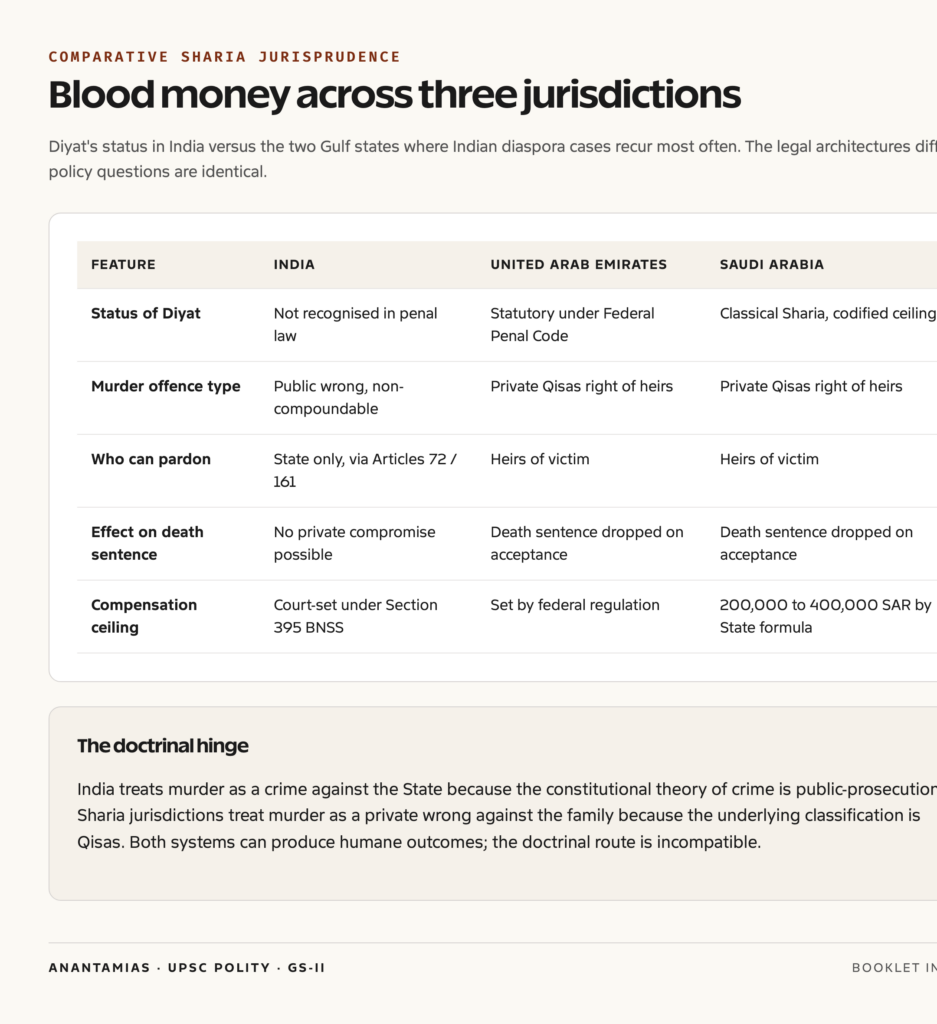
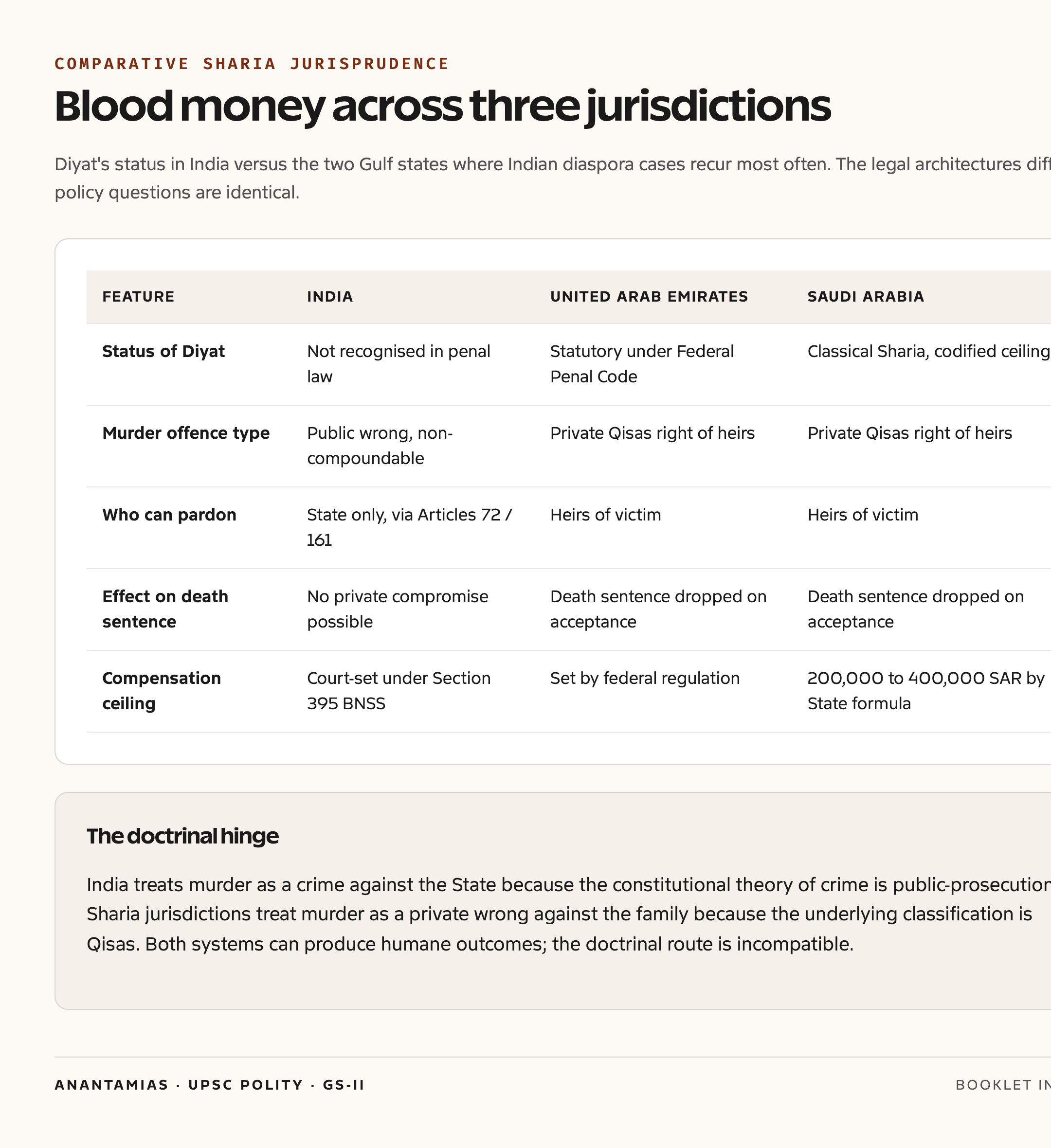
In classical Sharia jurisprudence, crimes against the person fall into three broad categories. Hudud offences are seen as crimes against God with fixed Quranic punishments. Tazir offences are matters of state discretion. Qisas offences are private wrongs against an individual or family, and murder sits in this third category. The framing is critical. Because murder is treated as a private wrong, the victim’s heirs are given the right to demand retribution, accept compensation, or grant unconditional pardon.
Diyat is the compensation route. The amount is not arbitrary in classical doctrine. Traditional jurisprudence pegs Diyat at a fixed measure, often described as a hundred camels or its monetary equivalent, with adjustments for the gender of the victim, the deliberate or accidental nature of the killing, and the religion of the parties. Modern legislation in jurisdictions such as Saudi Arabia and the UAE has updated these formulas into riyal or dirham figures that are revised periodically.
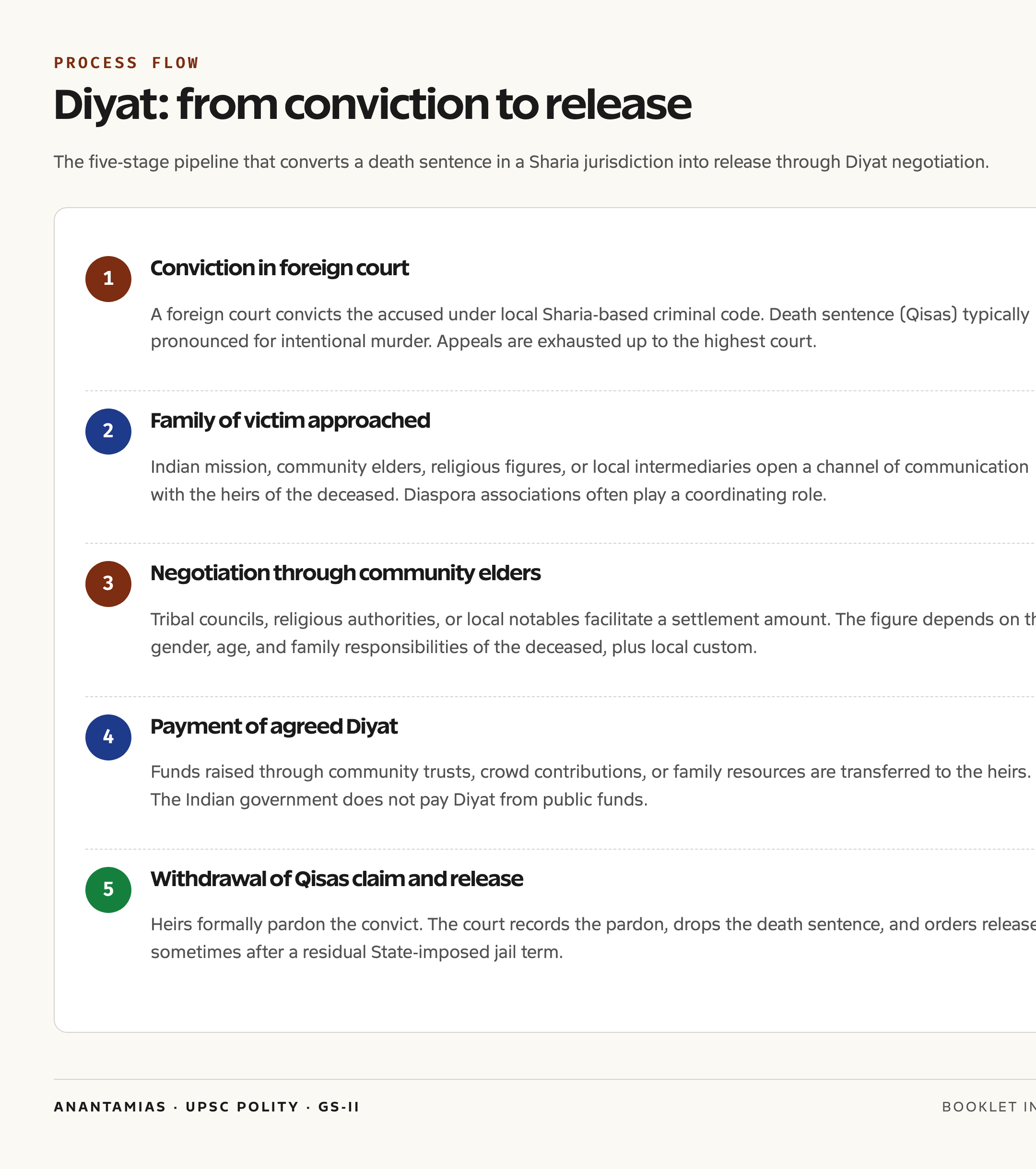
The mechanism functions as a privately negotiated settlement layered onto a public criminal process. The court convicts and may pronounce a death sentence. The victim’s family is then approached, usually through tribal elders, religious figures, or diplomatic intermediaries, to consider a pardon in exchange for Diyat. If the family accepts, the death sentence is set aside and the convict is released, sometimes after a residual jail term that the State retains the power to impose.
Background and Historical Context
The doctrine of blood money predates Islamic law by centuries. Pre-Islamic Arabian tribes already used compensation payments to prevent endless cycles of revenge between clans. Similar customs existed in Anglo-Saxon England, where the wergild system attached a price to every life depending on the social rank of the victim. Roman law, Germanic codes, and even early Indian customary practices in certain regions allowed for compounding of homicide through compensation paid to the bereaved family.
The Quran and the Hadith preserved the practice while reforming it. Verses in Surah al-Baqarah and Surah al-Maidah explicitly mention the option of forgiveness and the payment of Diyat as alternatives to retaliation. The shift was philosophical. Pre-Islamic blood money was a tribal mechanism to keep peace. The Quranic version layered an ethical recommendation of forgiveness on top, treating Diyat as a path that preserved life and rewarded mercy.
Modern codifications followed colonial encounters with Sharia. The Ottoman Mecelle codified Diyat in the nineteenth century. Saudi Arabia retains a more classical version. The UAE merged Sharia with civil-code structures in its Federal Penal Code. Pakistan, after the 1990 Qisas and Diyat Ordinance, introduced Diyat into its statutory landscape, a move that has been criticised for creating loopholes in honour killing prosecutions where families pardon the murderer of their own daughter.
India’s encounter with the doctrine has been almost entirely through the diaspora. Indian workers in the Gulf, Indian crew members on foreign ships, and Indian travellers who get caught in foreign criminal cases have repeatedly forced Indian missions to negotiate Diyat settlements. None of this has changed Indian domestic law, but it has built up a distinct body of foreign service practice.
Key Provisions and the Indian Legal Position
The Indian criminal code has never accepted blood money as a method of disposing of a murder charge. The architecture is built on three pillars.
Murder is a non-compoundable offence. Section 320 of the old Code of Criminal Procedure, now Section 359 of the Bharatiya Nagarik Suraksha Sanhita, lists the offences that can be compounded with the consent of the victim or victim’s family. Murder under Section 302 of the Indian Penal Code, now Section 103 of the Bharatiya Nyaya Sanhita, does not appear on that list. A private compromise between the accused and the victim’s family cannot quash a murder charge.
The State is the prosecuting authority in cognisable offences. Even if the family accepts compensation and refuses to depose, the prosecution proceeds because the wrong is conceptualised as one against society. This is the doctrinal opposite of Sharia’s classification of murder as a private Qisas offence.
Compounding rules apply to lesser offences. Hurt, theft, criminal breach of trust, and similar offences may be compounded under specific conditions, sometimes only with court permission. Section 359 of the BNSS retains this two-tier structure. Murder, attempt to murder, and offences punishable with death or life imprisonment remain firmly outside it.
The constitutional pardon power is a different track entirely. The President under Article 72 and Governors under Article 161 can grant pardon, remission, reprieve, or commutation. These are sovereign acts of grace exercised on the advice of the Council of Ministers, not private compromises. They do not require the victim’s family to accept anything.
Why the Diyat Question Matters for Public Policy
The legal answer is settled. The policy questions are not. Diyat surfaces repeatedly in three distinct contexts that students should distinguish.
Indian nationals abroad. The Ministry of External Affairs has handled multiple cases of Indians on death row in the Gulf, including domestic workers who killed employers, drivers in fatal accidents, and labourers caught in violent disputes. In several of these, community trusts and crowd-funded contributions have raised Diyat amounts to secure release. The Indian government generally facilitates negotiations but does not pay Diyat from public funds, holding to the principle that the State should not normalise the practice.
Foreign nationals in India. The State has sometimes accepted compensation payments from foreign governments to close criminal proceedings against their nationals. The Italian Marines case is the leading example. Such settlements are framed in international law and Article 142 terms, never as Diyat under Indian law, to preserve the doctrinal position.
Domestic reform debates. Some commentators have argued that India should consider expanded victim compensation as part of restorative justice, drawing inspiration from Diyat without adopting its specific religious framing. Others, especially women’s rights groups, point to the Pakistani experience to warn that any private settlement option in honour-related murders could become a loophole for family-sanctioned violence.
Detailed Analysis: The Italian Marines Exception
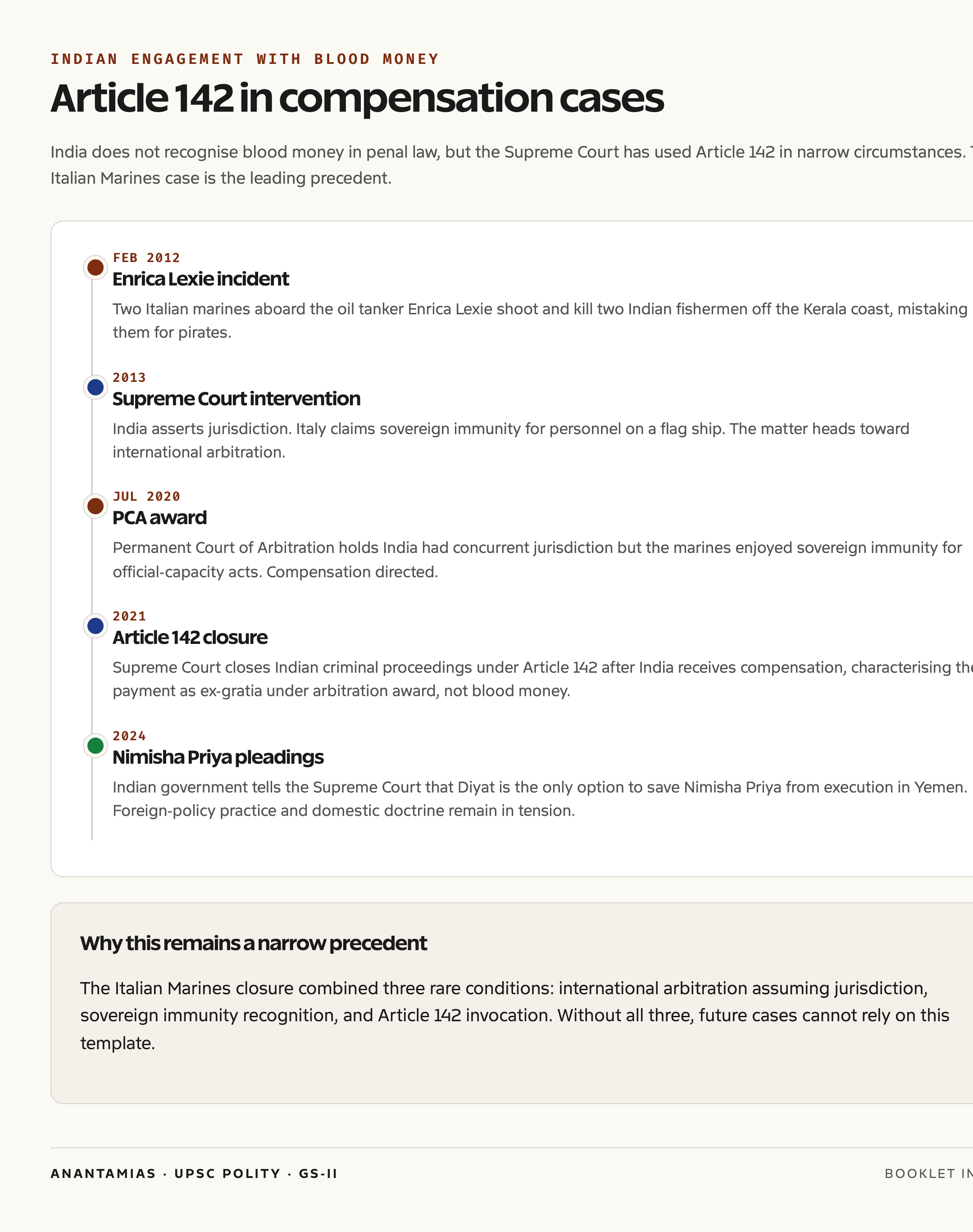
The Enrica Lexie case is the most important Indian engagement with the blood money idea. Two Italian marines aboard the oil tanker Enrica Lexie shot and killed two Indian fishermen off the Kerala coast in February 2012, mistaking them for pirates. The case triggered a long jurisdictional dispute. India tried to prosecute under its criminal law. Italy argued that the marines, as military personnel on a flag ship in international waters, enjoyed sovereign immunity. The dispute eventually went to a Permanent Court of Arbitration tribunal in The Hague.
The 2020 award held that India had concurrent jurisdiction but that the marines were entitled to sovereign immunity for acts performed in their official capacity. The tribunal directed Italy to compensate India for the loss of life, the loss of the fishing boat, and the period of detention. India received approximately 10 crore rupees, distributed to the families of the deceased and to the boat owner.
The Supreme Court of India then closed the criminal proceedings in 2021. The order invoked Article 142, the constitutional provision that empowers the Court to pass any order necessary for doing complete justice. The Court was careful to characterise the payment as compensation under an international arbitral award, not as blood money under Indian penal law. The conceptual difference matters. Blood money would imply that the State allowed a private compromise to extinguish a murder charge, which Indian law rejects. Compensation under an arbitral award implies that an external legal regime had assumed jurisdiction and that closure of the Indian proceedings was a matter of international comity.
The case is therefore not an opening of the door to Diyat. It is a narrow precedent that combined sovereign immunity, international arbitration, and Article 142 powers. Future cases that try to invoke this template would need to satisfy all three conditions, which is rare.
Comparative Frame: Diyat and Plea Bargaining in India
Aspirants frequently confuse Diyat with the Indian plea bargaining mechanism. The two have superficial resemblance and deep differences.
Plea bargaining was introduced into Indian criminal procedure through the Criminal Law Amendment Act of 2005, which inserted Chapter XXIA into the Code of Criminal Procedure. The provisions now appear as Chapter XXIII of the Bharatiya Nagarik Suraksha Sanhita. The accused can apply for plea bargaining only for offences punishable with imprisonment up to seven years. Offences against women, against children below fourteen, and offences affecting the socio-economic condition of the country are excluded. Murder, kidnapping, rape, and similar serious crimes lie outside the regime entirely.
| Feature | Blood Money (Diyat) | Plea Bargaining (India) |
|---|---|---|
| Applicability | Murder, manslaughter, bodily harm | Offences with maximum sentence of seven years or less |
| Crimes excluded | None in classical Sharia | Murder, rape, crimes against women and children, socio-economic offences |
| Initiator | Victim’s heirs | Accused person |
| Outcome | Full pardon, death sentence dropped | Reduced sentence, conviction recorded |
| Public or private | Private settlement validated by court | Court-supervised process under public law |
| Theoretical basis | Crime as private wrong against family | Crime as public wrong, but mitigated for efficiency |
The key intuition is that Indian plea bargaining never deletes guilt. It records conviction and reduces punishment. Diyat, by contrast, can produce full acquittal and release after Qisas is dropped. The two operate on opposite axes.
Challenges and Open Questions
The Diyat debate raises sharp challenges that any UPSC aspirant should be ready to engage with.
Compatibility with personal liberty. The Indian Constitution guarantees life and liberty under Article 21. A regime that allowed wealthy convicts to buy their way out of murder charges would violate the equality clause under Article 14. This is the strongest principled objection to importing Diyat into Indian law.
Risk to gender justice. Pakistani experience with Qisas and Diyat has shown that families can pardon murderers in honour killings, especially when the victim and the killer share the same household. The Anti-Honour Killing Law of 2016 in Pakistan partially closed this loophole by removing the family’s pardon right in honour-killing cases.
Diaspora protection vs domestic doctrine. Indian foreign policy has good reason to facilitate Diyat negotiations for nationals on death row in Sharia jurisdictions. Indian domestic policy has equally good reason to refuse to formalise blood money. Reconciling the two without contradiction is an exercise in keeping a doctrinal line firm while allowing humanitarian flexibility in foreign service practice.
Restorative justice frame. Some scholars argue that Indian victim compensation under the Probation of Offenders Act and Section 357 of the old Code, now Section 395 of the BNSS, is already a partial nod to restorative ideas. Whether this should expand toward more meaningful compensation regimes, without crossing into private compromise of serious crimes, is an open policy question.
Article 142 boundaries. The Italian Marines precedent has prompted concerns that Article 142 could be invoked too freely. The Court itself has signalled in subsequent rulings that Article 142 cannot override express statutory bars or constitutional principles. Whether future Diyat-style settlements could survive Supreme Court scrutiny is uncertain.
Prelims Pointers
A compact list of facts most likely to appear in objective questions on this topic.
- Diyat is a Sharia concept of compensation paid to the victim’s heirs in exchange for pardoning the convict.
- Qisas refers to retributive punishment, typically the death sentence, in Islamic criminal law.
- India’s penal law does not recognise blood money as a basis for closing a murder charge.
- Murder is a non-compoundable offence under Section 359 of the Bharatiya Nagarik Suraksha Sanhita and was likewise non-compoundable under the older Section 320 of the CrPC.
- Plea bargaining was introduced in 2005 and applies only to offences punishable with up to seven years’ imprisonment.
- The Italian Marines case was closed by the Supreme Court in 2021 using Article 142 of the Constitution.
- The compensation in the Italian Marines case was characterised as an ex-gratia payment under an international arbitration award, not as blood money.
- Article 72 vests pardoning power in the President; Article 161 vests it in the Governor.
- Saudi Arabia, the UAE, Qatar, Iran, Yemen, and Pakistan recognise Diyat to varying degrees.
- The Permanent Court of Arbitration award in the Italian Marines case was delivered in 2020 under the United Nations Convention on the Law of the Sea framework.
Mains Practice Questions
These are the kinds of analytical prompts the topic invites.
- The doctrine of blood money or Diyat is alien to Indian criminal jurisprudence. Examine the constitutional and statutory basis for this position. How did the Supreme Court navigate it in the Italian Marines case?
- Plea bargaining and Diyat are sometimes loosely compared in popular discourse. Critically analyse the differences in their conceptual basis, scope, and outcomes.
- Article 142 has been invoked to deliver complete justice in unusual cases. Discuss the boundaries of this power with reference to compensation-based closures of criminal proceedings.
- Discuss the policy dilemmas faced by the Indian government in cases where Indian nationals face Diyat-eligible death sentences in Sharia jurisdictions.
- Restorative justice is increasingly part of global criminal law reform conversations. Should India consider expanded victim compensation regimes, and what guardrails would be necessary to prevent the slide into private compromise of serious crimes?
Way Forward
A workable path for India does not require importing Diyat. It requires three calibrated moves.
Strengthen victim compensation under existing statutes. Section 395 of the BNSS already allows courts to direct payment of compensation. State victim compensation schemes funded by Legal Services Authorities can be expanded, especially for families of murder victims who often face economic ruin in addition to grief.
Build a clear consular protocol for Diyat cases abroad. The Ministry of External Affairs has handled enough cases to draft a public protocol that explains how missions will support negotiations, what the State will and will not pay, and how diaspora trusts can lawfully channel funds. Transparency would reduce the impression of arbitrary handling.
Hold the doctrinal line at home. The constitutional prohibition on private compromise of murder must remain firm. Article 142 powers should be invoked sparingly and only in cases that combine international jurisdictional complexity with sovereign immunity questions, as in the Italian Marines case. Anything more permissive risks creating a wealth-based escape route from Indian criminal law.
The Diyat question is ultimately about how a constitutional democracy that takes Article 14 and Article 21 seriously can engage with a doctrine rooted in a different theory of crime. The Indian answer has been to refuse the doctrine domestically while engaging pragmatically when its citizens fall under foreign jurisdictions that recognise it. That balance is uncomfortable but defensible.
Frequently Asked Questions
What is Diyat in simple terms?
Diyat is the Arabic word for blood money, the financial compensation paid by a convict or the convict’s family to the heirs of a murder victim under Sharia law. If the heirs accept the payment, they pardon the convict and the death sentence is dropped. The concept treats murder as a private wrong against the family rather than as a public wrong against the State, which is why heirs have the legal authority to forgive.
Does Indian law recognise blood money?
Indian law does not recognise blood money as a way to extinguish a murder charge. Murder is a non-compoundable offence under Section 359 of the Bharatiya Nagarik Suraksha Sanhita, which means a private compromise between the accused and the victim’s family cannot close the case. The State prosecutes the offence regardless of the family’s wishes, because the wrong is conceptualised as one against society as a whole.
Why was the Italian Marines case different?
The Supreme Court closed the criminal proceedings against two Italian marines in 2021 under Article 142, after an international arbitration tribunal awarded compensation to India and held that the marines enjoyed sovereign immunity. The Court was careful to call the payment an ex-gratia compensation under an international award, not blood money under Indian penal law. The combination of sovereign immunity, international arbitration, and Article 142 powers created a narrow precedent rather than a general rule.
What is the difference between Diyat and plea bargaining?
Plea bargaining is an Indian statutory mechanism introduced in 2005 that allows an accused person to plead guilty to a lesser charge or accept reduced punishment in exchange for waiving a full trial. It applies only to offences punishable with up to seven years’ imprisonment and excludes murder, rape, and crimes against women and children. Diyat applies to murder and similar serious crimes, is initiated by the victim’s family, and produces a full pardon rather than a reduced sentence.
Can the Indian government pay Diyat for citizens abroad?
The Indian government has consistently held that it does not pay Diyat from public funds, although it facilitates negotiations through diplomatic channels. Family members, community trusts, and crowd-funded contributions have raised Diyat amounts in past cases. The position protects the doctrinal stand that the Indian State does not endorse blood money while still allowing humanitarian assistance to citizens facing execution in jurisdictions that recognise the practice.
Which countries recognise Diyat today?
Saudi Arabia, the United Arab Emirates, Qatar, Iran, Yemen, and Pakistan recognise Diyat in varying forms. Saudi Arabia retains a relatively classical version with State-set ceiling figures. The UAE incorporates Diyat into its civil-and-criminal code structure. Pakistan adopted the Qisas and Diyat Ordinance in 1990 and incorporated its provisions into the Pakistan Penal Code, although it has since narrowed the family pardon route in honour-killing cases.
What is Article 142 of the Indian Constitution?
Article 142 empowers the Supreme Court to pass any decree or make any order necessary for doing complete justice in a case before it. The provision has been used to close cases that ordinary statutory remedies could not address adequately, including the Bhopal gas tragedy settlement, the Babri Masjid land dispute, and the Italian Marines case. The Court itself has clarified that Article 142 cannot override express statutory bars or constitutional principles.
Could India ever legalise Diyat-style settlements for murder?
A statutory regime allowing private compromise of murder charges would raise serious problems under Articles 14 and 21 of the Constitution. It would let wealthier convicts escape punishment in a way that poorer ones could not, violating the equality principle. It would also undermine the public-wrong theory that underpins Indian criminal law. Most legal scholars therefore recommend strengthening victim compensation regimes within the existing public-prosecution framework rather than importing the Diyat model.
What was the Nimisha Priya case about?
Nimisha Priya is an Indian nurse who has been on death row in Yemen for the alleged murder of a Yemeni national. After her appeals were exhausted, the Indian government informed the Supreme Court that paying Diyat to the victim’s family was the only remaining option to save her from execution. The case illustrates the structural difficulty for Indian missions handling capital cases in Sharia jurisdictions where domestic remedies have been exhausted and only the family’s pardon, secured through Diyat, can prevent the death sentence.
How does Diyat fit into restorative justice debates?
Restorative justice frames crime as a rupture in relationships that should be repaired through dialogue, accountability, and compensation rather than only through punishment. Diyat shares some features with this frame because it centres the victim’s family and offers a non-retributive resolution. The crucial difference is that Diyat operates as a private settlement that can fully extinguish a murder charge, which most modern restorative-justice scholars do not endorse for serious violent crime. The Indian path is more likely to involve expanded compensation within a public-prosecution framework rather than Diyat-style private resolution.
Tell Google you want more of this.
Add Anantam IAS as a preferred sourceOne tap, and this site shows up more often in your own Top Stories, AI Overviews and AI Mode. Remove it any time.