
Switch on a light bulb in your room. Now imagine that the same bulb is also a wireless internet router, transmitting data at gigabit speeds by flickering at frequencies far too fast for your eyes to detect. That is the concept behind Li-Fi, short for Light Fidelity, a wireless communication technology that uses light instead of radio waves to send and receive data. Li-Fi is not science fiction. The first working prototypes were demonstrated more than a decade ago, and commercial Li-Fi products are already being deployed in specialised settings.
For UPSC aspirants, Li-Fi matters for two reasons. The first is technical. The radio spectrum used by Wi-Fi, mobile networks, satellite communication, and a hundred other services is increasingly congested. Every new device that connects to the internet adds to the load. Li-Fi opens up an entirely new spectrum, the visible light spectrum, which is roughly 10,000 times wider than the radio spectrum. The second reason is strategic. Li-Fi works in environments where Wi-Fi cannot, including aircraft cabins, MRI rooms, and underwater. India’s research community, including IIT Madras and several private startups, has been active in Li-Fi development, and the technology is increasingly relevant to India’s broader push for indigenous wireless technologies.
This explainer walks through what Li-Fi is, how it works, where it beats Wi-Fi and where it loses, the use cases that make it valuable, and the practical limits that explain why it has not replaced Wi-Fi despite the hype.
Quick Facts: Li-Fi at a Glance
- Definition: Bidirectional, high-speed wireless communication that transmits data using light, primarily the visible light spectrum but also ultraviolet (UV) and infrared (IR)
- Core technology: Visible Light Communication (VLC) using LED bulbs as transmitters
- Inventor: Term coined by Professor Harald Haas at the University of Edinburgh, 2011 TED talk
- Theoretical speed: Up to 100 Gbps in laboratory settings, faster than current Wi-Fi 7
- Range: Approximately 10 metres, line of sight or via reflected light
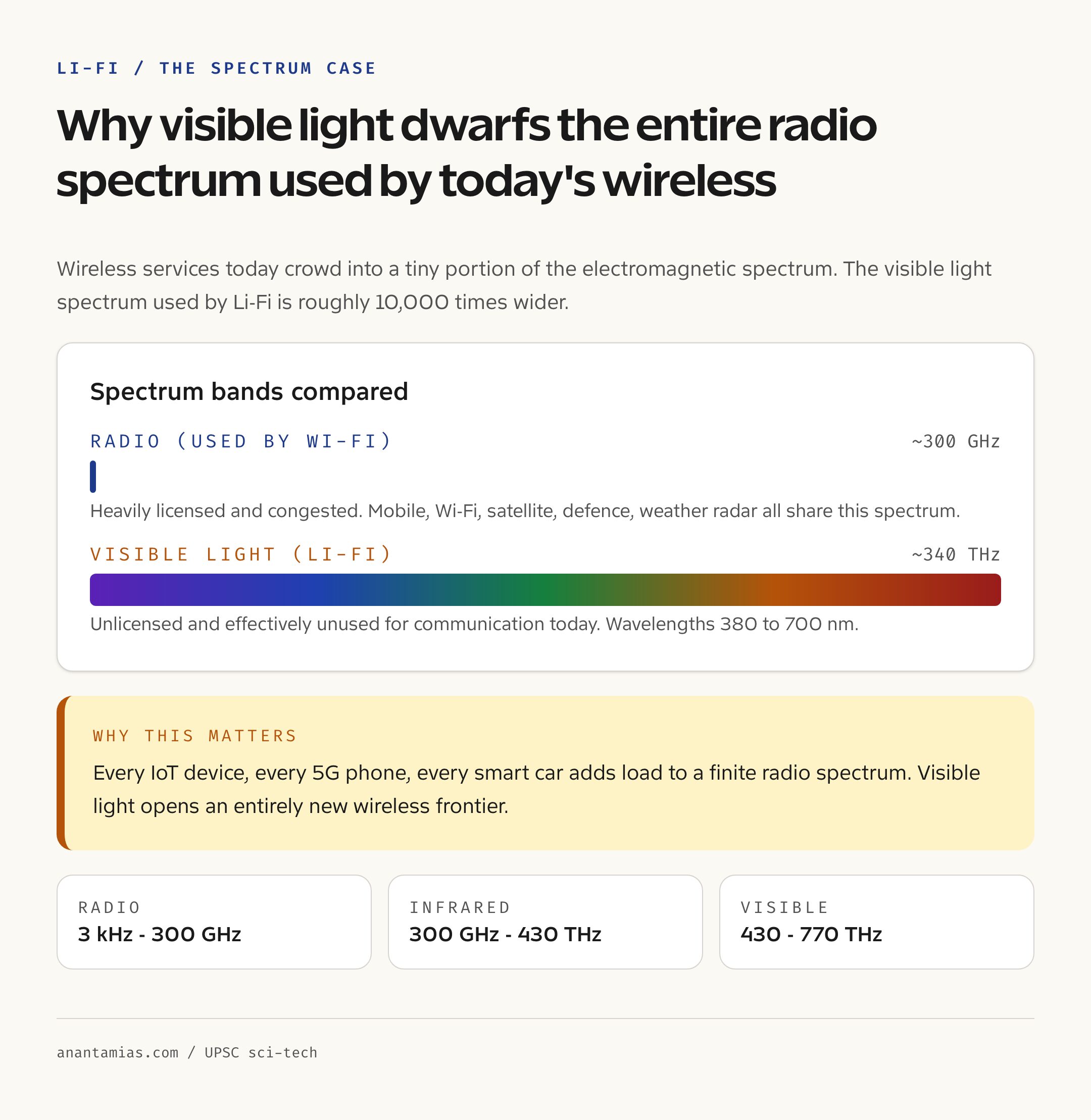
- Spectrum size: Visible light spectrum is roughly 10,000 times wider than the entire radio spectrum used for current wireless communication
- Wall penetration: None; light is blocked by opaque surfaces
- Standardisation: IEEE 802.11bb published in 2023 as the first global Li-Fi standard
- Indian research: IIT Madras, IIT Bombay, IIT Delhi all have active Li-Fi research programmes
What Is Li-Fi?
Li-Fi is a wireless communication technology that uses light waves rather than radio waves to transmit data. The principle is simple. An LED bulb fitted with a special driver chip can switch on and off at speeds far higher than the human eye can detect, on the order of millions of times per second. Each on-off cycle can encode binary data, with a brighter pulse representing a 1 and a dimmer pulse representing a 0. A photodetector at the receiving device, typically a small sensor on a phone, laptop, or USB dongle, picks up these pulses and converts them back into electrical signals that the device interprets as data.
The bulb’s flickering is invisible because human vision integrates light over windows of about 1/60th of a second. Anything faster appears to be steady illumination. Li-Fi systems modulate at megahertz rates, so the human eye sees a normal lit room while the device sees a stream of binary data flowing from the ceiling.
Li-Fi is bidirectional. The device sends data back to the network either through a separate uplink, often using infrared light to avoid visible flicker, or through other channels. In some implementations, the room contains both downlink LEDs (overhead lights) and uplink IR sensors, with each device having a small IR transmitter to send data back.
The term “Li-Fi” was coined by Professor Harald Haas of the University of Edinburgh in a 2011 TED talk where he demonstrated the technology with a desk lamp and an off-the-shelf solar cell. The talk popularised the concept and led to a wave of research and commercial development that continues today.
Background and Historical Context
The idea of using light to communicate is older than electronic communication itself. Smoke signals, signal fires, and ship-to-ship lamp signals are all forms of optical communication. In the late 1880s, Alexander Graham Bell patented the photophone, which used a beam of sunlight modulated by sound vibrations to transmit speech over a distance of 200 metres. Bell considered the photophone his greatest invention, ahead of the telephone, but the technology of the time could not deliver a practical product.
Modern fibre optic communication, which sends data through glass fibres using laser light, became the backbone of the internet from the 1980s onwards. Fibre is wired, not wireless, but it shares Li-Fi’s underlying principle of encoding data as light pulses. Fibre is now the dominant long-distance communication medium in the world.
Li-Fi as a wireless technology became practical only in the 2000s, when LED bulbs became efficient enough to replace incandescent and fluorescent lighting in most applications. LEDs can be switched on and off rapidly without wearing out, and they are already being installed in homes, offices, and street lighting at massive scale. The argument for Li-Fi is partly that the lighting infrastructure is already there. Adding a driver chip to existing LEDs is much cheaper than building a new wireless network.
The 2011 Harald Haas TED talk crystallised the concept into a single name and a single demonstration. Companies including PureLiFi (founded by Haas), Signify (formerly Philips Lighting), and Oledcomm have since brought Li-Fi products to market. The IEEE 802.11bb standard published in 2023 gave Li-Fi a formal place alongside Wi-Fi in the wireless networking ecosystem, making interoperability between Li-Fi devices from different manufacturers possible.
How Li-Fi Works: The VLC Principle
Visible Light Communication is the umbrella technology that includes Li-Fi. The basic system has three components. A modulating LED light source switches between brightness levels at high frequency. A free-space optical channel, which is the air between the bulb and the device, carries the modulated light. A photodetector receiver picks up the modulation and decodes the data.
Modulation schemes vary. The simplest is on-off keying, where a 1 is full brightness and a 0 is dim or off. More advanced schemes like orthogonal frequency-division multiplexing (OFDM) encode multiple bits per pulse and use multiple frequencies simultaneously, which is how Li-Fi achieves gigabit speeds. The same OFDM principle is used in modern Wi-Fi and 5G, but with radio waves instead of light.
The receiver is a photodetector, often a silicon photodiode, that converts incoming light into a varying electrical current. This current is amplified, filtered, and sampled to recover the original data stream. A modern smartphone can in principle act as a Li-Fi receiver if its camera or a dedicated photodetector is fast enough, though most current Li-Fi implementations use a separate USB or built-in dongle.
Li-Fi requires a direct line of sight between the bulb and the device, or a strong reflected light path. Light bouncing off walls and ceilings can carry data, though at reduced speed and reliability. This is fundamentally different from Wi-Fi, which uses radio waves that diffract around obstacles.
Li-Fi Versus Wi-Fi
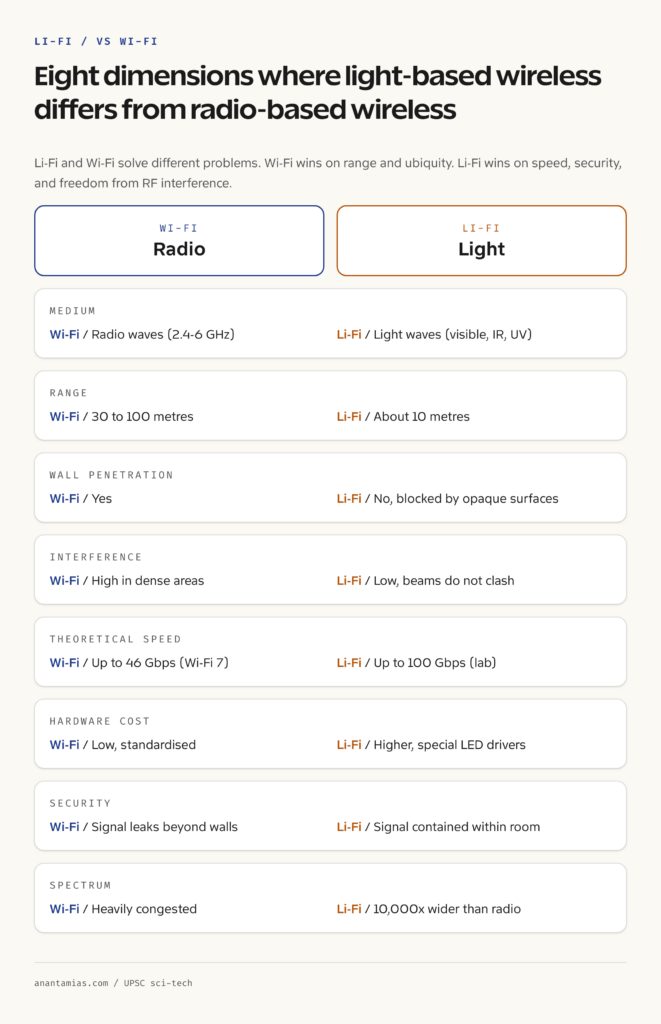
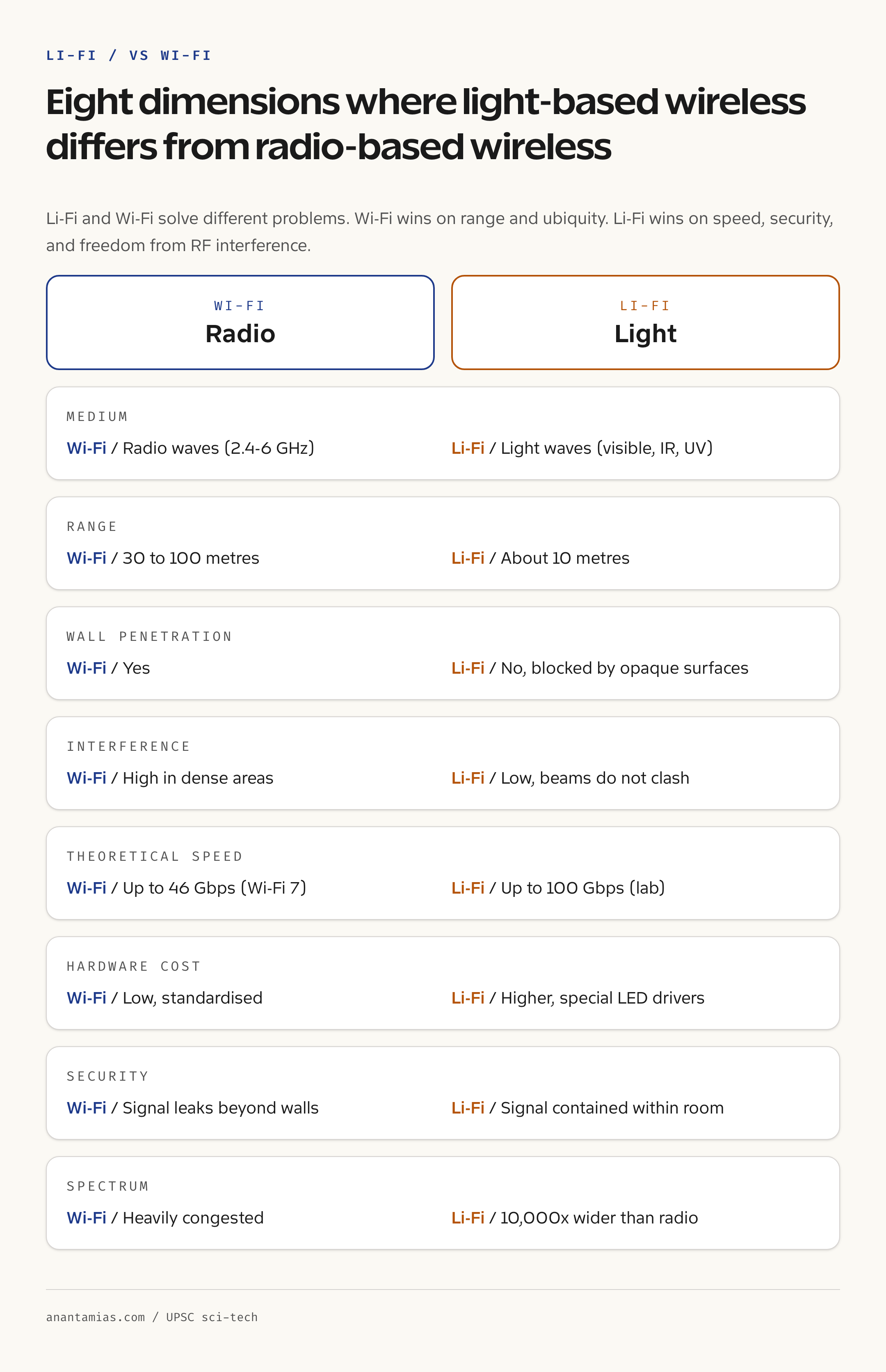
| Feature | Wi-Fi | Li-Fi |
|---|---|---|
| Medium | Radio waves (2.4, 5, 6 GHz) | Light waves (visible, IR, UV) |
| Range | High (30 to 100 metres typical) | Short (around 10 metres) |
| Wall penetration | Yes, passes through most walls | No, blocked by opaque surfaces |
| Interference | High in dense environments | Low, light beams do not interfere |
| Speed (theoretical) | Up to 46 Gbps (Wi-Fi 7) | Up to 100 Gbps (laboratory) |
| Hardware cost | Low, standardised globally | Higher, requires special LED drivers |
| Security | Signal leaks beyond walls | Signal contained within room |
| Energy efficiency | Separate radio infrastructure | Reuses lighting infrastructure |
| Health concerns | Concerns about RF exposure | Visible light is biologically safe |
| Regulation | Heavily licensed spectrum | Visible light is unlicensed |
The comparison shows that Li-Fi is not a replacement for Wi-Fi. It is a complement that wins in specific environments and loses in others. The two will coexist, with Wi-Fi remaining dominant for general-purpose connectivity and Li-Fi taking specialised niches.
Why It Matters
The deepest reason Li-Fi matters is the spectrum crunch. Modern wireless services rely on the radio spectrum from approximately 30 kHz to 300 GHz. Within that range, the most useful bands for high-bandwidth wireless are heavily allocated, with Wi-Fi sharing 2.4 GHz with Bluetooth and microwave ovens, and 5 GHz with weather radar and military systems. As more devices come online with the Internet of Things, the spectrum congestion is going to get worse, not better. Visible light occupies a frequency range from roughly 430 to 770 THz, which is approximately 10,000 times wider than the entire radio spectrum currently used for wireless. Tapping that spectrum, even partially, opens enormous bandwidth headroom.
Li-Fi also matters for security. Radio signals from a typical Wi-Fi router leak through walls and can be intercepted from outside the building. Light cannot. A Li-Fi network in a fourth-floor office is invisible to anyone in the parking lot. For corporate, government, and defence environments, this physical containment is a major security advantage. The technology of cyber security increasingly recognises that physical layer security through Li-Fi can complement encryption rather than replace it.
For India, Li-Fi connects to several technology priorities. It supports the broader push for indigenous wireless capability that runs through 5G, 6G, and the Bharat 6G Vision. It complements 5G technology rather than competing with it, with Li-Fi covering high-density indoor environments where 5G base stations are expensive to deploy. It opens niches in healthcare, aviation, and underwater communication where Indian industry can develop specialised products.
Detailed Analysis: Where Li-Fi Beats Wi-Fi
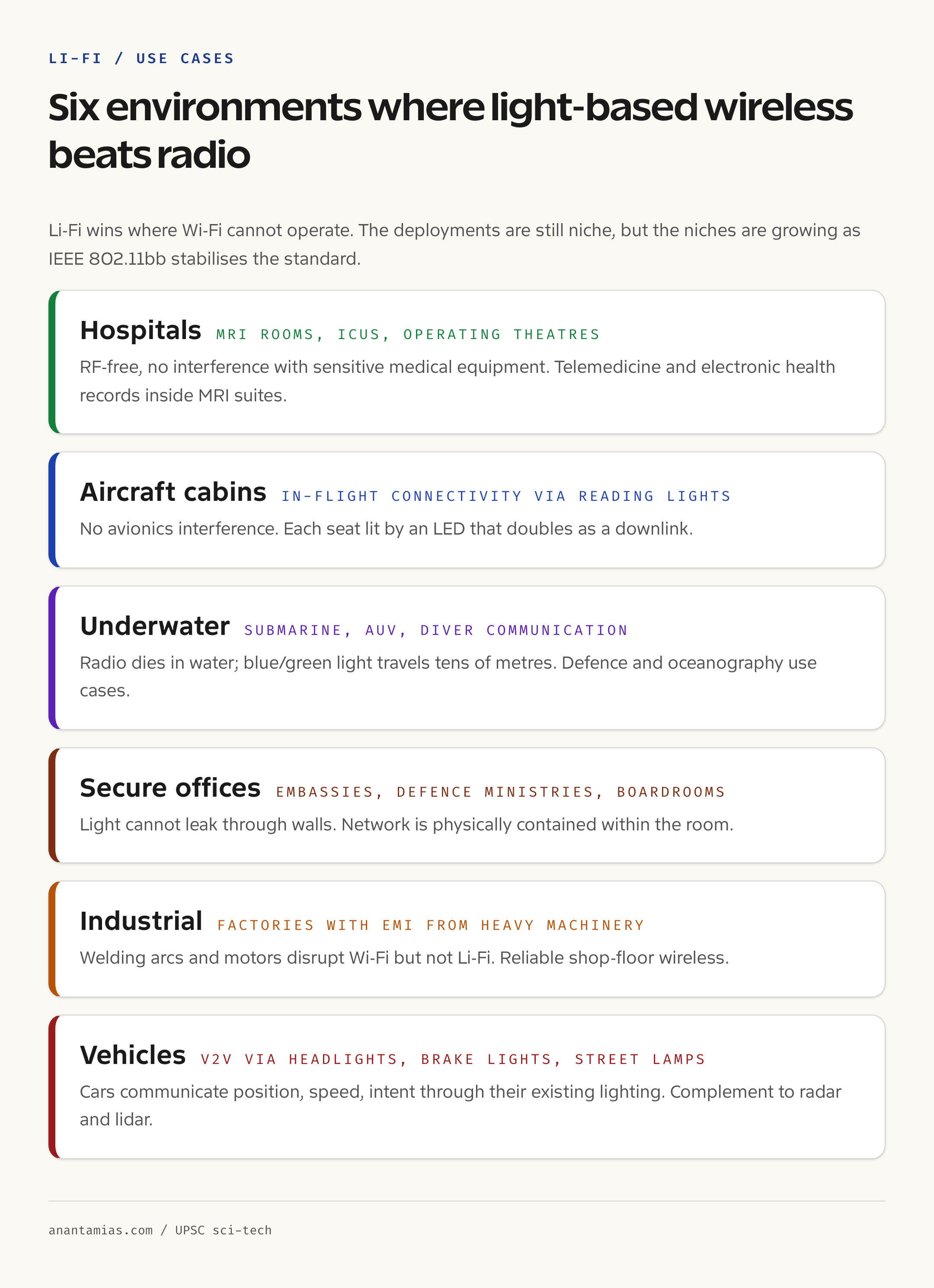
Hospitals. MRI machines and other sensitive medical equipment can be disrupted by radio frequency interference. Wi-Fi is often restricted in critical care areas. Li-Fi using LED ceiling lights provides high-bandwidth connectivity without RF interference. Hospitals can use Li-Fi for patient monitoring, telemedicine, and access to electronic health records inside MRI suites and intensive care units.
Aircraft cabins. Airlines have historically restricted Wi-Fi during certain phases of flight because of concerns about interference with avionics. Li-Fi works through the cabin’s reading lights and overhead lighting, providing in-flight connectivity without RF emissions. Several airlines and aircraft manufacturers have piloted Li-Fi systems, with adoption likely to grow as next-generation aircraft are designed.
Underwater communication. Radio waves are heavily attenuated in water. This is why submarines surface or use trailing antennas to communicate. Li-Fi using blue and green light, which are the wavelengths least absorbed by water, can carry data over tens to hundreds of metres underwater, depending on water clarity. Defence applications, including submarine-to-submarine and submarine-to-drone communication, are an active research area.
Secure offices and government facilities. Light cannot leak through walls. A Li-Fi network in a sensitive area can be physically contained within the room. This is valuable for embassies, defence ministries, intelligence agencies, and corporate boardrooms.
Industrial environments with EMI. Factories with heavy machinery, power lines, and welding equipment generate severe electromagnetic interference that disrupts Wi-Fi. Li-Fi is immune to EMI and can provide reliable wireless on the factory floor.
Vehicle-to-vehicle communication. Car headlights, brake lights, and street lamps can carry Li-Fi signals to communicate vehicle position, speed, and intent. This is being studied as a complement to radar and lidar in autonomous driving.
Comparative: Li-Fi Versus 5G and 6G
Li-Fi is sometimes positioned as competing with 5G and 6G, but the more accurate framing is complementary. 5G is designed for outdoor and wide-area connectivity, with cell sizes from a few hundred metres to several kilometres. Li-Fi is for indoor, room-scale connectivity. The two operate at different scales.
In a future smart city, a 5G network might handle the outdoor connectivity for autonomous vehicles, public Wi-Fi at parks, and machine-to-machine traffic for IoT sensors, while Li-Fi handles dense indoor environments like office buildings, shopping malls, and museums. The 6G research roadmap explicitly anticipates this hybrid model, with Li-Fi as one of several physical-layer technologies feeding into the 6G architecture.
The 6G research effort in India under the Bharat 6G Vision identifies visible light communication as one of the priority technologies for indigenous development. The linkage between national wireless strategy and Li-Fi research reflects the broader trend of treating wireless technology as a sovereignty issue rather than just a commercial product.
Challenges Limiting Li-Fi Adoption
Line of sight requirement. A Li-Fi connection drops if you put your hand over the receiver, walk into a corner, or move out of the room. Wi-Fi handles all these situations seamlessly. For general consumer use, this is a major usability problem.
Mobility. A Wi-Fi network handed off between access points is nearly seamless. Li-Fi handover between LED zones is harder because the signal drops abruptly when you cross a boundary. Research is underway on cell-edge handover techniques, but the user experience is not yet on par with Wi-Fi.
Daylight interference. Sunlight contains large amounts of light across all visible wavelengths, which can saturate Li-Fi photodetectors. Outdoor Li-Fi requires careful filtering and is much harder than indoor Li-Fi.
Cost of LED drivers. Li-Fi LEDs need a high-speed driver chip that ordinary LED bulbs do not have. This adds 20 to 50 per cent to the cost of each bulb, which is a significant deployment barrier.
Lack of installed base. Unlike Wi-Fi, where every laptop and phone has built-in support, Li-Fi requires specialised receivers. Adoption is constrained until smartphones include native Li-Fi support, which has not yet happened.
Bandwidth asymmetry. Most Li-Fi systems offer high downlink (to device) but lower uplink (from device) bandwidth, because the device’s transmitter has to be small and battery-friendly. This is fine for streaming but less ideal for video calls and uploads.
Prelims Pointers
- Li-Fi stands for Light Fidelity
- Operates on Visible Light Communication (VLC) technology
- Uses LED bulbs with high-speed driver chips
- Theoretical speeds up to 100 Gbps, faster than current Wi-Fi 7
- Range approximately 10 metres, requires line of sight or reflected light
- Cannot penetrate opaque walls, which is a security feature
- Does not interfere with sensitive radio equipment, safe for hospitals and aircraft
- Term coined by Professor Harald Haas, University of Edinburgh, 2011 TED talk
- IEEE 802.11bb, published 2023, is the first global Li-Fi standard
- Visible light spectrum is approximately 10,000 times wider than the radio spectrum
Mains Practice Questions
- “Li-Fi is not a replacement for Wi-Fi but a complement that wins in specific environments.” Discuss with reference to use cases and limitations. (15 marks, 250 words)
- Examine the role of Li-Fi in addressing spectrum congestion as wireless device counts grow. (10 marks, 150 words)
- India’s Bharat 6G Vision identifies visible light communication as a priority technology. Discuss the strategic and economic case for indigenous Li-Fi development in India. (15 marks, 250 words)
Way Forward
Li-Fi’s path to mainstream adoption depends on three things. The first is integration into smartphones and laptops as a built-in feature, similar to how Bluetooth or NFC became standard. Until that happens, Li-Fi will remain a niche specialist technology. The second is the deployment of Li-Fi-enabled lighting in commercial buildings, especially in offices, hospitals, and aircraft, which would create a network effect. The third is the maturity of cell-edge handover and outdoor Li-Fi, which will determine whether Li-Fi can move from single-room deployments to building-scale networks.
For India, Li-Fi sits at the intersection of telecommunications, lighting, and electronics manufacturing. The Bharat 6G Vision roadmap creates the policy framing, but commercial adoption will depend on the cost of indigenous LED drivers and the willingness of Indian buildings to install Li-Fi infrastructure. The most likely first markets are defence (submarines, secure facilities), healthcare (hospitals), and aviation (aircraft cabins), where the value proposition is highest and the cost premium is acceptable. Mass-market deployment in homes and consumer offices is at least a decade away.
Frequently Asked Questions
Is Li-Fi the same as fibre optics?
Both use light to carry data, but fibre optics is a wired technology that uses laser light inside glass fibres, while Li-Fi is a wireless technology that uses LED light through air. They share the underlying principle of encoding data as light pulses but are deployed in completely different settings.
Does Li-Fi work when the lights are off?
The LED has to be transmitting light, but it can be dimmed to very low intensity. Some Li-Fi systems can operate at brightness levels that look essentially dark to the human eye, by using infrared rather than visible light, or by dimming the visible LED enough that the room appears dark while the photodetector still receives signal.
Is Li-Fi faster than 5G?
In theoretical peak speeds, Li-Fi can match or exceed 5G in laboratory settings. In commercial deployment, current Li-Fi products offer hundreds of megabits per second, similar to mid-range 5G. Comparing the two on speed alone misses the point, since 5G is for outdoor wide-area coverage and Li-Fi is for indoor short-range coverage.
Can Li-Fi work outdoors?
Outdoor Li-Fi is challenging because sunlight saturates the photodetector. Specialised filters and modulation schemes can mitigate this, and applications like vehicle-to-vehicle communication using car headlights are an active research area, but outdoor Li-Fi is far less mature than indoor Li-Fi.
Is Li-Fi safer than Wi-Fi for health?
Visible light is biologically familiar and there are no known health concerns from the levels of light used in Li-Fi, which are the same levels as ordinary indoor lighting. Wi-Fi RF exposure has been studied extensively and is generally considered safe at consumer power levels, but some users prefer Li-Fi for non-RF environments. The health argument is more about preference than evidence.
Why are hospitals interested in Li-Fi?
MRI machines, EEG monitors, and other sensitive medical equipment can be disrupted by radio frequency interference. Li-Fi using ceiling LEDs provides high-bandwidth connectivity without RF emissions, making it suitable for MRI suites, intensive care units, and operating theatres.
Can my phone use Li-Fi?
Most smartphones do not have built-in Li-Fi support yet. Specialised dongles or attachments can add Li-Fi receivers. The expectation is that future smartphones may include native Li-Fi support as the technology matures and standards (like IEEE 802.11bb) gain industry adoption.
What is the IEEE 802.11bb standard?
IEEE 802.11bb is the first global standard for Li-Fi, published in 2023. It specifies how Li-Fi devices should communicate, ensuring interoperability between Li-Fi products from different manufacturers. The standard is to Li-Fi what 802.11n, 802.11ax, and 802.11be are to Wi-Fi.
Who is leading Li-Fi research and commercialisation?
Companies like PureLiFi (UK), Signify (Netherlands), Oledcomm (France), and several Asian firms lead commercial development. On the research side, the University of Edinburgh, IIT Madras, IIT Bombay, and several Chinese and German universities are active. India has both research strength and an emerging startup ecosystem in this space.
Will Li-Fi replace Wi-Fi?
No. Li-Fi and Wi-Fi solve different problems. Wi-Fi will remain dominant for general-purpose indoor and outdoor wireless connectivity. Li-Fi will take niches where its advantages, security through containment, immunity to RF interference, and high data density, outweigh its drawbacks. The future is hybrid, not winner-take-all.
Tell Google you want more of this.
Add Anantam IAS as a preferred sourceOne tap, and this site shows up more often in your own Top Stories, AI Overviews and AI Mode. Remove it any time.