Disclosure: this guide contains Amazon affiliate links. As an Amazon Associate, Anantam IAS earns from qualifying purchases — at no extra cost to you.
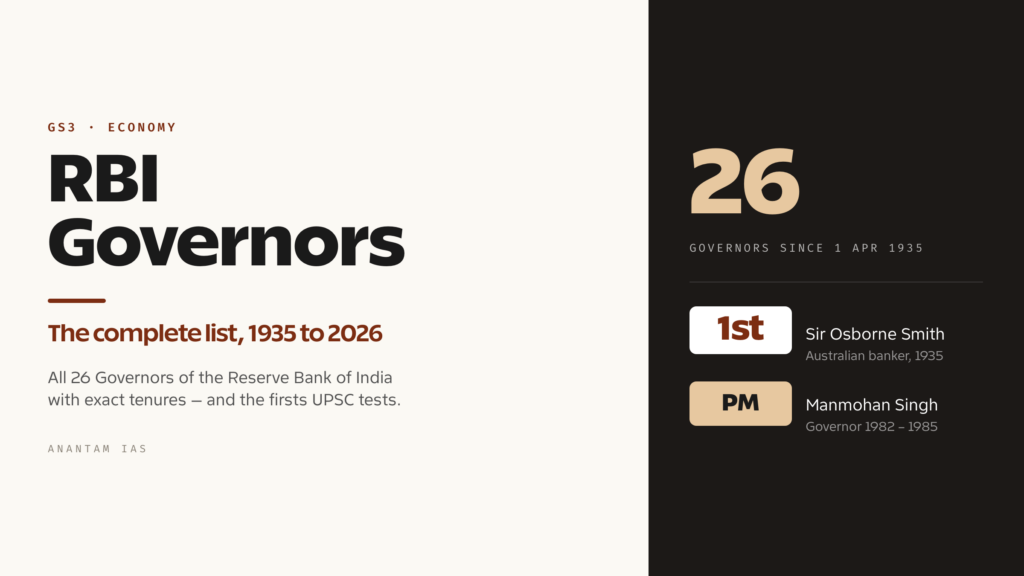
As of 2026, the Governor of the Reserve Bank of India is Sanjay Malhotra, the 26th Governor, who took charge on 11 December 2024. The RBI has had 26 Governors since it began operations on 1 April 1935: the first was Sir Osborne Smith (an Australian banker), the first Indian Governor was Sir C. D. Deshmukh, the longest-serving was Sir Benegal Rama Rau, and the only Governor who later became Prime Minister was Dr. Manmohan Singh.
Most aspirants can name Raghuram Rajan and maybe Shaktikanta Das, then go blank. But a Prelims question rarely asks who runs the Reserve Bank of India today. It asks who was the first Governor, who was the first Indian to hold the post, or which Governor later became Prime Minister. That is where a clean, memorised list earns you a mark while everyone else guesses.
This page is that list. The RBI has had 26 Governors since 1 April 1935, and you do not need to remember all 26 dates. You need the anchors: the firsts, the longest server, the famous names, and the current incumbent. Get those right and you have covered almost every way this topic has ever been tested in Prelims and Mains.
What the RBI Is and What Its Governor Does
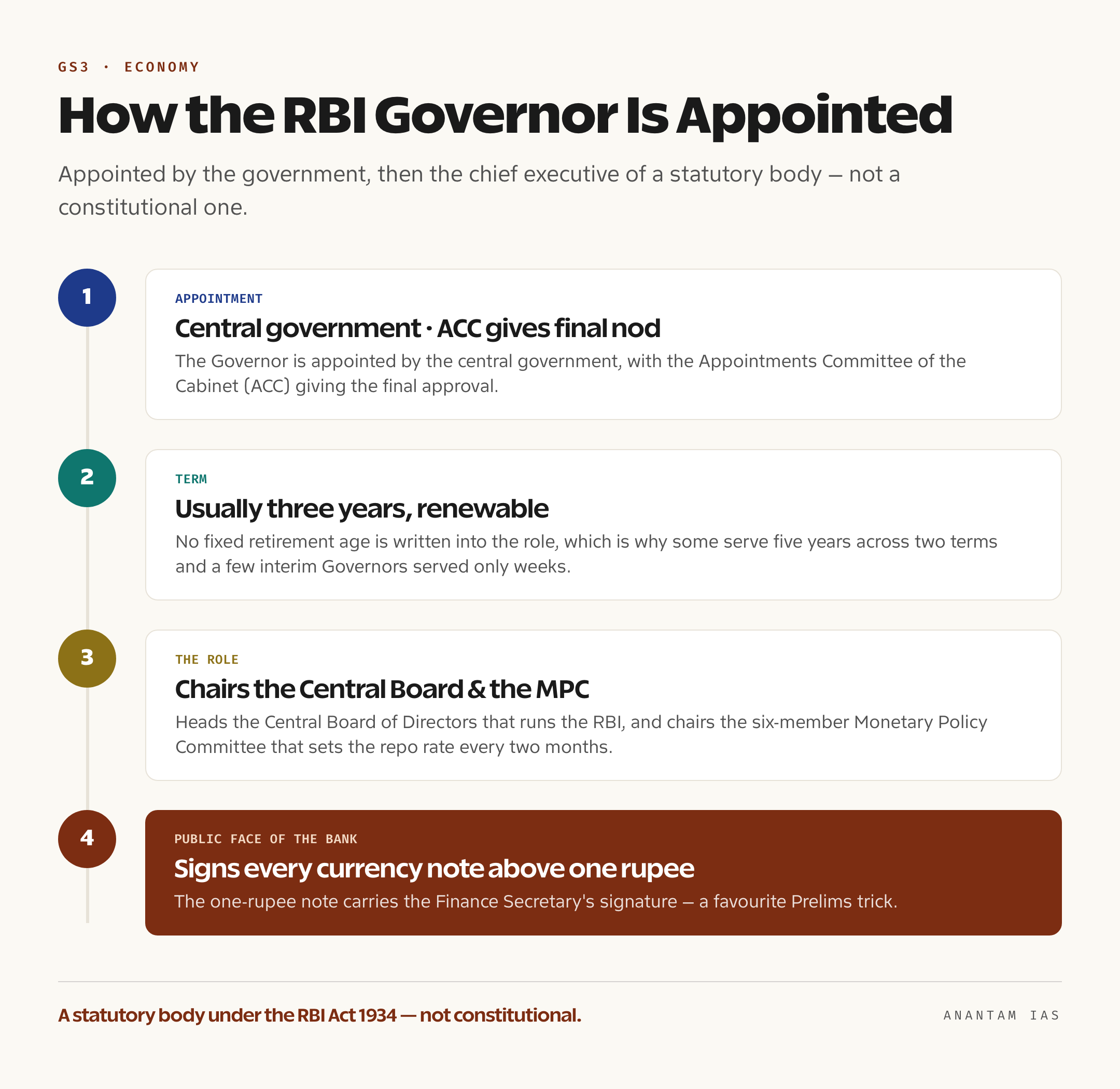
The Reserve Bank of India is the country’s central bank, and the Governor is its chief executive. The RBI was established on 1 April 1935 under the RBI Act, 1934, originally as a private shareholders’ bank, and was nationalised on 1 January 1949 so the government took full ownership. One detail trips up everyone: the RBI is a statutory body (created by an Act of Parliament), not a constitutional body. There is no Article of the Constitution that sets it up, so don’t look for one.
The Governor is the public face of the bank and signs every currency note above one rupee (the one-rupee note carries the Finance Secretary’s signature, a favourite Prelims trick). The Governor chairs the Central Board of Directors, which runs the RBI, and chairs the Monetary Policy Committee (MPC), the six-member body that sets the repo rate every two months. So when you read that the RBI “held rates steady,” it is the MPC under the Governor doing it. If you want the role itself in depth, read our explainer on the RBI Governor’s role and powers, and for the institution, our guide to the Reserve Bank of India.
On appointment: the Governor is appointed by the central government, with the Appointments Committee of the Cabinet (ACC) giving the final nod. The usual term is three years, and it is renewable, which is why some Governors serve five years across two terms and a few interim Governors served only weeks. There is no fixed retirement age written into the role, which is also why tenures vary so widely across the list below.
Complete List of RBI Governors (1935 to 2026)
Here is the full chronological list, from the first Governor in 1935 to the current one in 2026. There have been 26 Governors in all. Read the “Notable for” column carefully, because that is exactly what gets turned into a question. The interim Governors (numbers 5, 9, 11, and 16) served only weeks and are low-yield, so skim them and focus on the bold names.
| # | Governor | Tenure (from – to) | Notable for |
|---|---|---|---|
| 1 | Sir Osborne Smith | 1 Apr 1935 – 30 Jun 1937 | First Governor of RBI; an Australian banker; resigned before completing his term |
| 2 | Sir James Braid Taylor | 1 Jul 1937 – 17 Feb 1943 | Oversaw the shift from silver to fiat paper currency; died in office |
| 3 | Sir C. D. Deshmukh | 11 Aug 1943 – 30 Jun 1949 | First Indian Governor; later became Union Finance Minister |
| 4 | Sir Benegal Rama Rau | 1 Jul 1949 – 14 Jan 1957 | Longest-serving Governor (about 7.5 years); resigned after friction with the Finance Ministry |
| 5 | K. G. Ambegaonkar | 14 Jan 1957 – 28 Feb 1957 | Interim Governor (around 45 days) |
| 6 | H. V. R. Iengar | 1 Mar 1957 – 28 Feb 1962 | Oversaw the move to the decimal coinage system |
| 7 | P. C. Bhattacharya | 1 Mar 1962 – 30 Jun 1967 | Saw the setting up of agricultural and industrial credit institutions |
| 8 | L. K. Jha | 1 Jul 1967 – 3 May 1970 | Left to become India’s Ambassador to the United States |
| 9 | B. N. Adarkar | 4 May 1970 – 15 Jun 1970 | Interim Governor (about 42 days); economist |
| 10 | S. Jagannathan | 16 Jun 1970 – 19 May 1975 | Left to join the International Monetary Fund; era of bank nationalisation aftermath |
| 11 | N. C. Sen Gupta | 19 May 1975 – 19 Aug 1975 | Interim Governor (about 3 months) |
| 12 | K. R. Puri | 20 Aug 1975 – 2 May 1977 | Oversaw the launch of Regional Rural Banks (RRBs) |
| 13 | M. Narasimham | 3 May 1977 – 30 Nov 1977 | Only Governor promoted from RBI’s own ranks; later chaired the famous banking-reform Narasimham Committees |
| 14 | I. G. Patel | 1 Dec 1977 – 15 Sep 1982 | Handled the 1978 demonetisation of high-value notes |
| 15 | Dr. Manmohan Singh | 16 Sep 1982 – 14 Jan 1985 | The only RBI Governor who later became Prime Minister |
| 16 | A. Ghosh | 15 Jan 1985 – 4 Feb 1985 | Shortest tenure (about 20 days); interim Governor |
| 17 | R. N. Malhotra | 4 Feb 1985 – 22 Dec 1990 | Later chaired the Malhotra Committee on insurance-sector reform |
| 18 | S. Venkitaramanan | 22 Dec 1990 – 21 Dec 1992 | Steered the RBI through the 1991 balance-of-payments crisis |
| 19 | Dr. C. Rangarajan | 22 Dec 1992 – 21 Nov 1997 | Brought in the unified exchange rate; later chaired the Rangarajan Committee on poverty |
| 20 | Dr. Bimal Jalan | 22 Nov 1997 – 6 Sep 2003 | Steady, low-inflation tenure across the Asian financial crisis |
| 21 | Dr. Y. V. Reddy | 6 Sep 2003 – 5 Sep 2008 | Credited with shielding India from the 2008 global crisis through cautious regulation |
| 22 | Dr. D. Subbarao | 5 Sep 2008 – 4 Sep 2013 | Managed monetary policy through the post-2008 global slowdown |
| 23 | Dr. Raghuram Rajan | 4 Sep 2013 – 4 Sep 2016 | Introduced inflation targeting and the framework that created the MPC |
| 24 | Dr. Urjit Patel | 4 Sep 2016 – 10 Dec 2018 | In office during the 2016 demonetisation; resigned before his term ended |
| 25 | Shaktikanta Das | 12 Dec 2018 – 11 Dec 2024 | Steered policy through the COVID-19 pandemic; completed a full six years across two terms |
| 26 | Sanjay Malhotra | 11 Dec 2024 – present (2026) | Current Governor (26th); former Revenue Secretary, 1990-batch Rajasthan-cadre IAS officer |
A small caveat on dates: a few transition days overlap by a day between an outgoing and incoming Governor depending on the source, but the years and the order are exactly as the RBI records them. For UPSC, the year and the sequence are what matter.
The Records and Firsts You Must Memorise
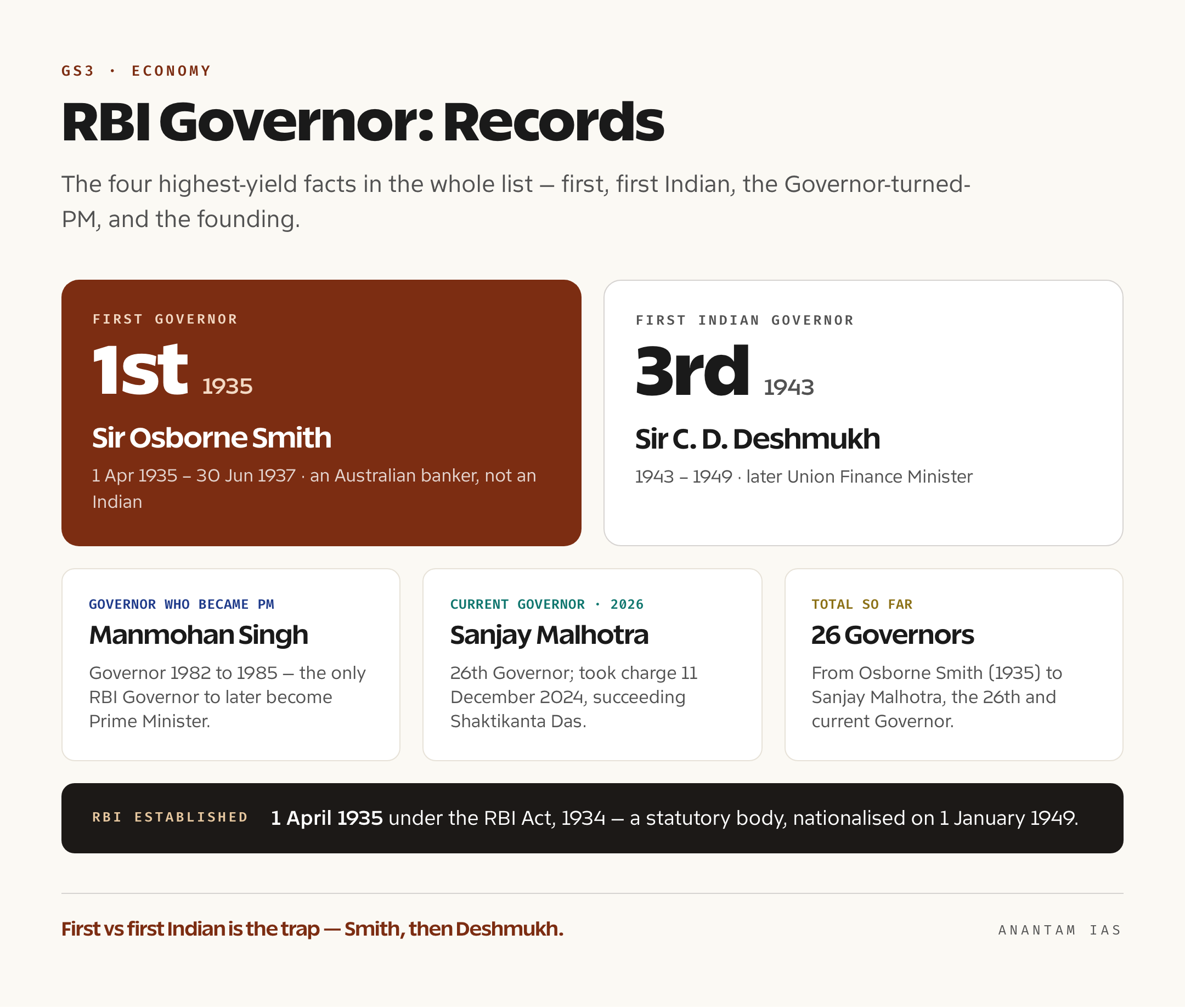
These four facts are the highest-yield part of the entire list, so lock them in first. Sir Osborne Smith was the first Governor of the RBI (1935 to 1937), and the catch is that he was a foreigner, an Australian banker, not an Indian. Sir C. D. Deshmukh was the first Indian Governor (1943 to 1949), and he went on to become Union Finance Minister, which makes him a doubly useful name.
For tenures, Sir Benegal Rama Rau is the longest-serving Governor at roughly seven and a half years (1949 to 1957), while the interim Governor A. Ghosh had the shortest tenure at about 20 days in 1985. And the single most-quoted fact of all: Dr. Manmohan Singh, Governor from 1982 to 1985, is the only RBI Governor who later became Prime Minister of India. One more worth knowing is M. Narasimham, the only person promoted to Governor from within the RBI’s own staff, who later chaired the banking-reform committees that carry his name.
| Record | Holder | Detail |
|---|---|---|
| First Governor | Sir Osborne Smith | 1935 – 1937; an Australian banker |
| First Indian Governor | Sir C. D. Deshmukh | 1943 – 1949; later Finance Minister |
| Longest-serving Governor | Sir Benegal Rama Rau | about 7.5 years (1949 – 1957) |
| Shortest tenure | A. Ghosh | about 20 days (1985) |
| Governor who became PM | Dr. Manmohan Singh | Governor 1982 – 1985 |
| Current Governor (2026) | Sanjay Malhotra | 26th Governor, since Dec 2024 |
Recent Governors You Should Know in Depth
For the recent past, four names carry real exam weight because their tenures shaped the monetary policy you read about today. Dr. Y. V. Reddy (2003 to 2008) is widely credited with keeping Indian banks conservative, which softened the blow of the 2008 global financial crisis. Dr. Raghuram Rajan (2013 to 2016) matters most for one structural reason: he pushed the move to a formal inflation-targeting framework, which led to the creation of the Monetary Policy Committee and the legal target of keeping retail inflation at 4 percent, with a band of plus or minus 2 percent.
Dr. Urjit Patel (2016 to 2018) was in office during the 2016 demonetisation of the 500 and 1,000 rupee notes and resigned before his term ended, a rare event for a Governor. Shaktikanta Das (2018 to 2024) served a full six years, the longest in the modern era, and is remembered for steering policy through the COVID-19 shock with rate cuts and liquidity support. His term ended on 11 December 2024, when Sanjay Malhotra took over as the 26th Governor. To see how their decisions feed into the rate-setting cycle, pair this list with our note on monetary policy and the MPC.
How to Study This for UPSC
Start with the four records, not the full list. If you can rattle off the first Governor, the first Indian Governor, the longest-serving Governor, and the Governor who became PM, you have covered the bulk of what Prelims has historically asked. Memorise the 26 total count and the current incumbent next, because “current Governor” questions appear often and the answer changes, so verify it close to your exam.

Lucent's General Knowledge 2026 — English (15th revised edition)
- 460 pages, Lucent Publications, 15th revised edition for 2026
- Static GK in the compressed, list-heavy form these tables come from
- Overrated for UPSC Prelims; exactly right for state PSC, SSC and factual recall
Then learn the recent block from Reddy to Malhotra, since that is where Mains overlaps. For Prelims, the trap questions match a Governor to a wrong “first” (calling Deshmukh the first Governor, for example) or to the wrong reform. For Mains GS3, you will not be asked to list names. You will be asked to discuss monetary policy, inflation targeting, the MPC, or RBI autonomy, and a single well-placed line like “the inflation-targeting framework introduced under Raghuram Rajan” adds credibility. Skip the four interim Governors beyond knowing they exist. Tie this to the broader economy syllabus through our Indian economy notes for UPSC so the names sit inside a framework, not in a vacuum.
One honest note: this is a memory topic, and memory topics feel boring. That is fine. Spend 20 minutes, anchor the firsts, and move on. You will not regret the easy mark.
This list is the kind of static fact Lucent holds in one chapter. The Lucent GK reading guide covers which sections of the book are worth reading and which are not.
Frequently Asked Questions
Who was the first Governor of the RBI? Sir Osborne Smith was the first Governor of the Reserve Bank of India, serving from 1 April 1935 to 30 June 1937. He was an Australian professional banker, not an Indian, and resigned before completing his term.
Who was the first Indian Governor of the RBI? Sir C. D. Deshmukh was the first Indian to serve as RBI Governor, from 11 August 1943 to 30 June 1949. He later became the Union Finance Minister.
Who is the current Governor of the RBI in 2026? Sanjay Malhotra is the current and 26th Governor of the Reserve Bank of India. He took charge on 11 December 2024, succeeding Shaktikanta Das, for the usual three-year term.
Which RBI Governor later became Prime Minister of India? Dr. Manmohan Singh is the only RBI Governor to later become Prime Minister. He served as Governor from 1982 to 1985 and as Prime Minister from 2004 to 2014.
Who was the longest-serving RBI Governor? Sir Benegal Rama Rau was the longest-serving Governor, in office for about seven and a half years from 1 July 1949 to 14 January 1957.
Practice Questions
Prelims MCQs
- Who was the first Governor of the Reserve Bank of India? (a) Sir C. D. Deshmukh (b) Sir Osborne Smith (c) Sir Benegal Rama Rau (d) Sir James Braid Taylor. Answer: (b) Sir Osborne Smith, an Australian banker, served as the first Governor from 1935 to 1937; Deshmukh was the first Indian Governor.
- Consider the following about the Reserve Bank of India: 1. It was established under the RBI Act, 1934. 2. It is a constitutional body. 3. It was nationalised in 1949. Which are correct? (a) 1 and 2 only (b) 1 and 3 only (c) 2 and 3 only (d) 1, 2 and 3. Answer: (b) The RBI is a statutory body created under the RBI Act, 1934, and nationalised in 1949; it is not a constitutional body.
- Which RBI Governor later went on to become the Prime Minister of India? (a) C. Rangarajan (b) Y. V. Reddy (c) Manmohan Singh (d) Bimal Jalan. Answer: (c) Dr. Manmohan Singh, RBI Governor from 1982 to 1985, is the only Governor to later become Prime Minister.
- The Monetary Policy Committee (MPC), which sets the repo rate, is chaired by which of the following? (a) The Finance Minister (b) The RBI Governor (c) The Chief Economic Adviser (d) The Finance Secretary. Answer: (b) The RBI Governor chairs the six-member MPC, the body responsible for setting the policy repo rate.
- The framework of flexible inflation targeting, which led to the creation of the MPC, was introduced during the tenure of which Governor? (a) D. Subbarao (b) Urjit Patel (c) Raghuram Rajan (d) Shaktikanta Das. Answer: (c) Raghuram Rajan (2013 to 2016) drove the shift to inflation targeting, with a 4 percent retail inflation target.
Mains Practice Questions
- The Reserve Bank of India is a statutory, not a constitutional, body, yet it functions with significant operational autonomy. Examine the basis and the limits of RBI’s autonomy. (15 marks, 250 words)
- Trace the evolution of India’s monetary policy framework from discretionary rate-setting to flexible inflation targeting under the Monetary Policy Committee. (15 marks, 250 words)
- “The independence of the central bank is essential for macroeconomic stability.” Discuss in the context of recent tensions between the RBI and the central government. (15 marks, 250 words)
- Evaluate the role of the RBI Governor as both the regulator of the banking system and the manager of monetary policy. Are these roles in tension? (10 marks, 150 words)
- Discuss how the RBI’s regulatory choices in the years before 2008 helped insulate the Indian banking system from the global financial crisis. (10 marks, 150 words)
The honest takeaway: this is a quick-win topic. The full list of 26 names looks intimidating, but Prelims has only ever cared about a handful of firsts, the longest server, the Governor-turned-PM, and whoever holds the chair right now. Lock those down, keep the Reddy-to-Malhotra block fresh for Mains context, and you have turned a memory chore into reliable marks. Bookmark this page, verify the current Governor a week before your exam, and you are done.
Tell Google you want more of this.
Add Anantam IAS as a preferred sourceOne tap, and this site shows up more often in your own Top Stories, AI Overviews and AI Mode. Remove it any time.