The Indian Constitution treats parliamentary representation as a public trust rather than a personal entitlement. A Member of Parliament holds the seat to discharge legislative functions on behalf of the constituency, and prolonged unjustified absence from the House strikes at that core obligation. Article 101(4) provides the constitutional mechanism for the House to call out such absence and, if the House so chooses, to declare the seat vacant. The provision is rarely invoked and even more rarely results in actual loss of seat, but it sits at the doctrinal centre of parliamentary discipline.
The text is short and the practice is sparing. The House does not lose patience easily. Members fall ill, travel on official assignments, face arrest, or simply skip sessions. Article 101(4) gives the House the discretion to draw a line, and the structure of the provision, with its 60-day threshold, its exclusions for prorogation and lengthy adjournment, and its requirement of a House motion, builds in genuine deliberation rather than automatic forfeiture.
This guide walks through the constitutional text, the calculation of the 60-day period, the procedural steps that follow, the parallel provision in Article 190(4) for State legislatures, the historical examples including the rare Barjinder Singh Hamdard precedent of 2000, and the contemporary question of arrested or detained MPs whose seats may be at risk through no fault of their own. The discussion connects to the Lok Sabha vs Rajya Sabha framework and to the broader law of parliamentary motions.
Quick Facts on Article 101(4)
Article 101(4) of the Constitution of India provides that if a Member of either House of Parliament is absent from all meetings of the House for a period of sixty days without the permission of the House, the House may declare the seat vacant. The provision applies to both the Lok Sabha and the Rajya Sabha. A parallel provision in Article 190(4) governs Members of State Legislative Assemblies and Legislative Councils. In computing the 60-day period, no account is taken of any period during which the House is prorogued, or during which it is adjourned for more than four consecutive days. The seat does not become vacant automatically. The House must pass a motion declaring the seat vacant. The House may, in its discretion, choose to condone the absence and let the Member retain the seat. The most cited Indian example is the 2000 case where Rajya Sabha MP Barjinder Singh Hamdard lost his seat under this provision.
The Constitutional Text and Its Place in Article 101
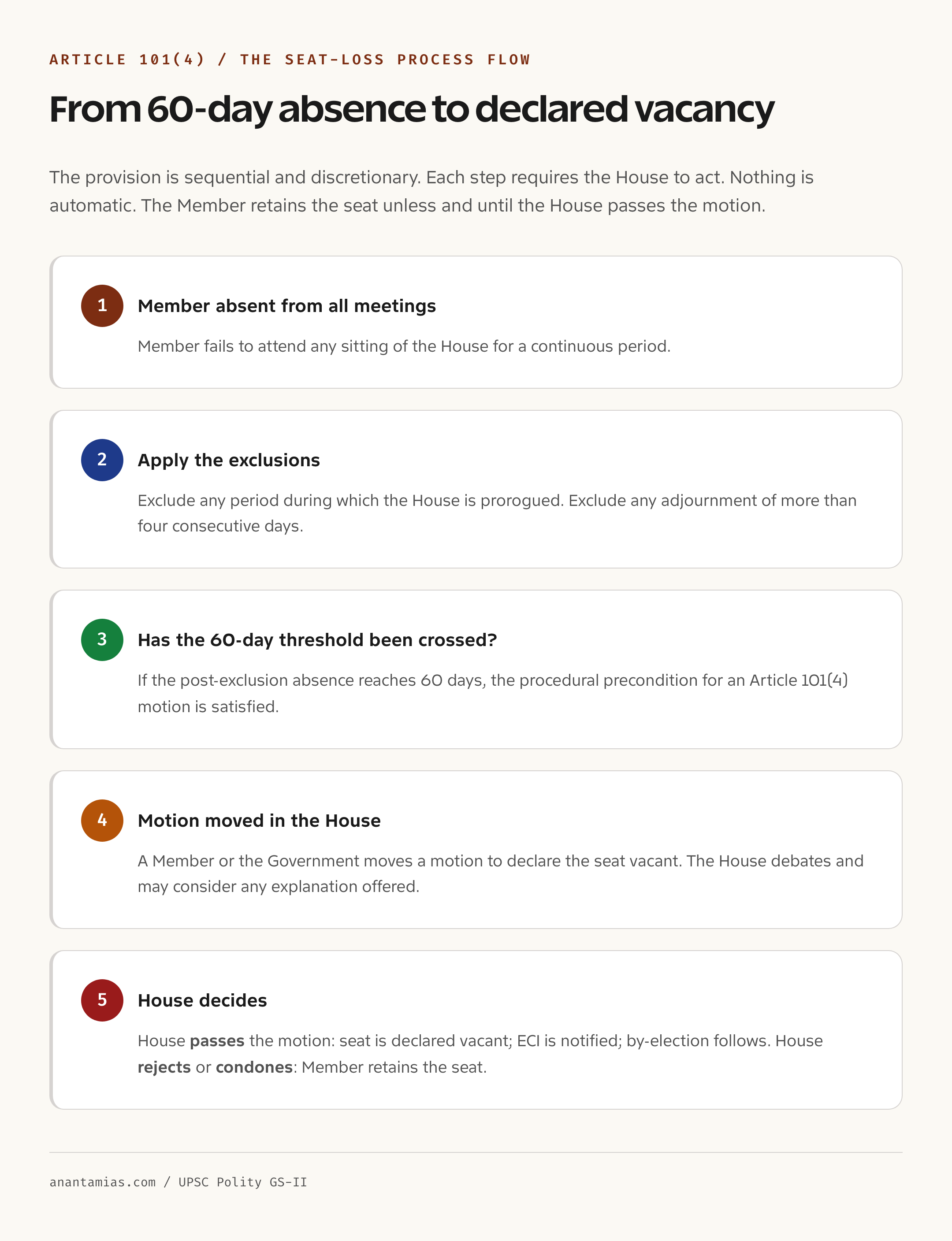
Article 101 deals with vacation of seats in Parliament. It contains four grounds. Clause (1) prohibits dual membership of both Houses and requires the Member to vacate one. Clause (2) prohibits a Member of Parliament from being a member of a State Legislature simultaneously. Clause (3) provides for vacation on disqualification or resignation, with the resignation requiring acceptance by the Speaker or the Chairman as the case may be. Clause (4) is the absence provision. The four grounds together form the exhaustive set of circumstances in which a parliamentary seat is vacated by operation of the Constitution.
Clause (4) reads: if for a period of sixty days a member of either House of Parliament is without permission of the House absent from all meetings thereof, the House may declare his seat vacant. The proviso explains the calculation: in computing the said period of sixty days, no account shall be taken of any period during which the House is prorogued or is adjourned for more than four consecutive days.
Why the 60-Day Threshold
The 60-day threshold reflects the Constituent Assembly’s calibration of two competing considerations. The first is the public interest in active representation. A constituency that has elected a Member is entitled to have that Member participate in the deliberations of the House. The second is recognition that legitimate reasons for absence exist: illness, family bereavement, foreign assignments, personal hardship, and the conduct of constituency work that necessarily takes the Member out of Delhi.
A 60-day continuous absence is significant enough to be unusual but not so long that the provision becomes a trap for routine absences. The proviso then calibrates further by excluding prorogation periods and adjournments of over four days, recognising that a Member cannot be expected to attend a House that is itself not sitting. The drafters thus distinguished between absence from sittings the House actually held and the calendar period during which the House was technically in session but not meeting.
How the 60 Days Are Computed
Two exclusions matter. First, any period during which the House is prorogued is excluded. Prorogation is the formal end of a session by the President, after which the House does not meet until the next session is summoned. Days that fall within a prorogation period therefore do not count. Second, any period during which the House is adjourned for more than four consecutive days is excluded. The four-day cutoff is generous: only adjournments exceeding four days are excluded.
The calculation is sitting-day-aware rather than calendar-day-aware. A Member who attends one or two sittings within a session can break the running 60-day count. Conversely, a Member who skips an entire session of, say, three weeks of continuous sittings is well on the way to crossing the threshold. The Speaker’s office maintains attendance records, and the threshold is empirically verifiable from those records.
The Procedure: Why It Is Not Automatic
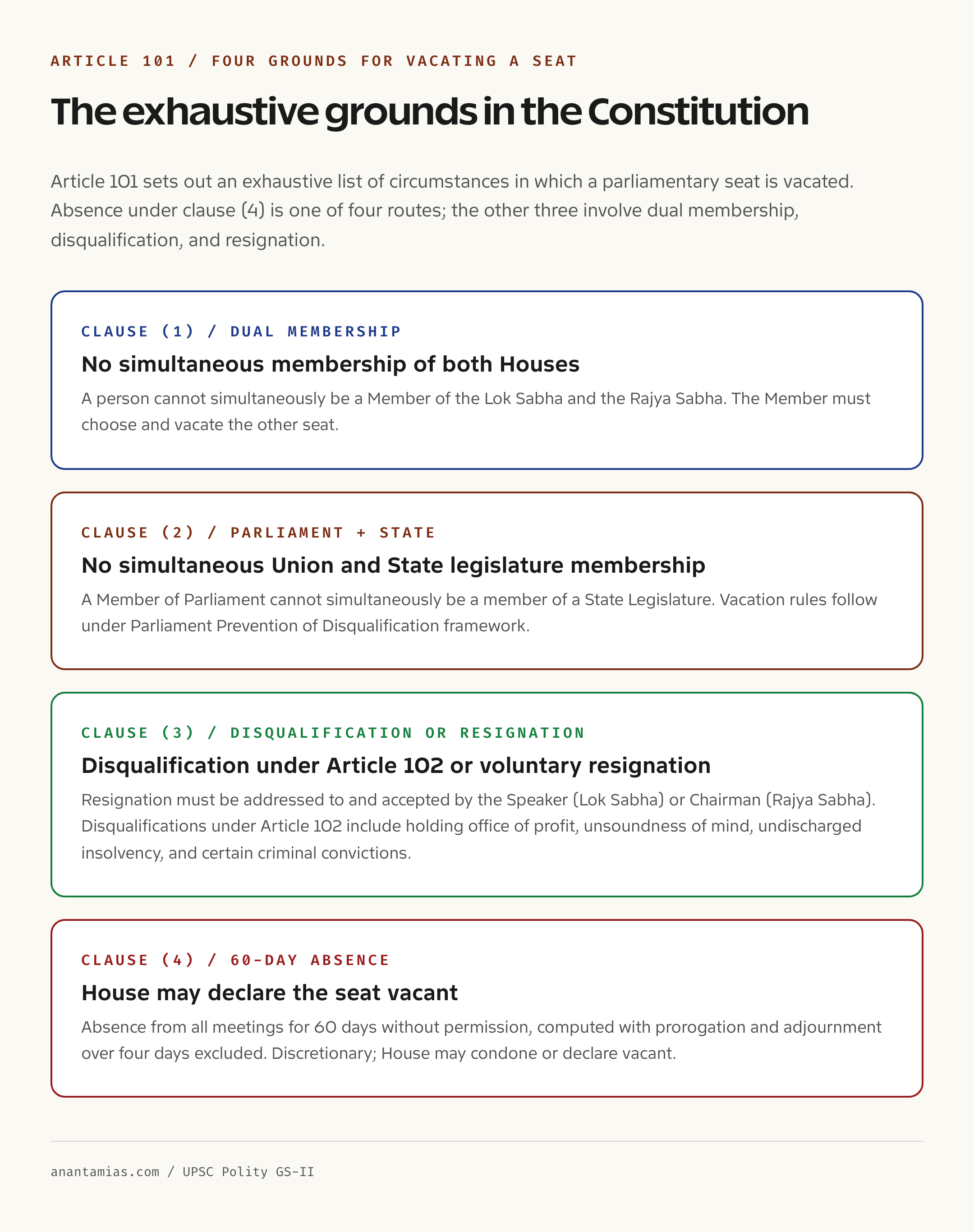
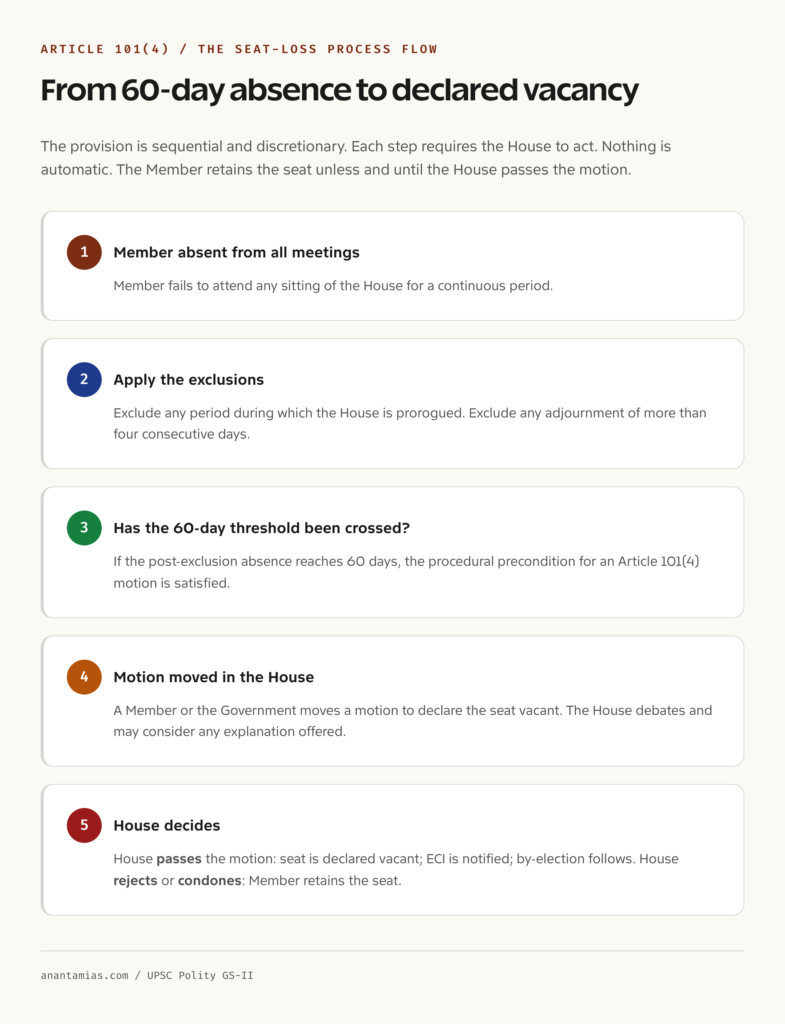
The most often-missed point about Article 101(4) is that it is not self-executing. The text uses the word “may”, not “shall”. The House may declare the seat vacant. It is not bound to do so. The procedural mechanism is a motion in the House. A Member or the Government moves a motion proposing that the seat be declared vacant under Article 101(4). The House debates the motion, considers any explanation offered by the absent Member, and votes.
Three outcomes are possible. The House may pass the motion and declare the seat vacant, in which case the Election Commission of India is notified and a by-election is held. The House may reject the motion, in which case the Member retains the seat regardless of the absence. Or the House may, with the absent Member’s request or otherwise, formally condone the absence by granting retrospective leave, which removes the foundation for the motion altogether.
The discretionary structure means that political relationships matter. A Member from the ruling party with strong floor support is unlikely to lose the seat under this provision because the Government has the numbers to defeat any motion. A Member from a fragmented opposition with no party protection is more vulnerable, but the practice has been one of considerable forbearance.
Article 190(4): The State Legislature Parallel
Article 190(4) replicates the Article 101(4) framework for the State Legislative Assemblies and the Legislative Councils. The threshold, the exclusions, and the discretionary character of the House’s power are identical. State assemblies have invoked the provision more frequently than Parliament, particularly in States where defection or extended detention has produced patterns of structural absence.
The parallel provisions ensure constitutional consistency between the Union and State legislative regimes on this discipline. Together they form a unified architecture of absence-related vacation that runs across all elected legislative bodies in India, with the exception of local self-government institutions which are governed by separate statutory frameworks.
Historical Examples: When the Provision Was Actually Invoked
The most cited Indian example is the case of Barjinder Singh Hamdard, a Rajya Sabha Member who lost his seat in 2000 under Article 101(4) for prolonged absence. The case is unusual not because the absence itself was unprecedented but because the House actually pressed the matter to a motion and a vote. In most comparable instances, the Member either resigned, was readmitted with retrospective leave, or quietly served out the rest of the term while the House looked the other way.
The historical pattern reveals three things about Indian parliamentary practice. First, the provision is rarely invoked. Second, even when invoked, the House often condones the absence. Third, when the House does declare the seat vacant, it tends to be in cases where the political relationship between the Member and the leadership of his own party has irretrievably broken down. The constitutional discipline is therefore real but politically mediated.
Arrested or Detained MPs and the 60-Day Question
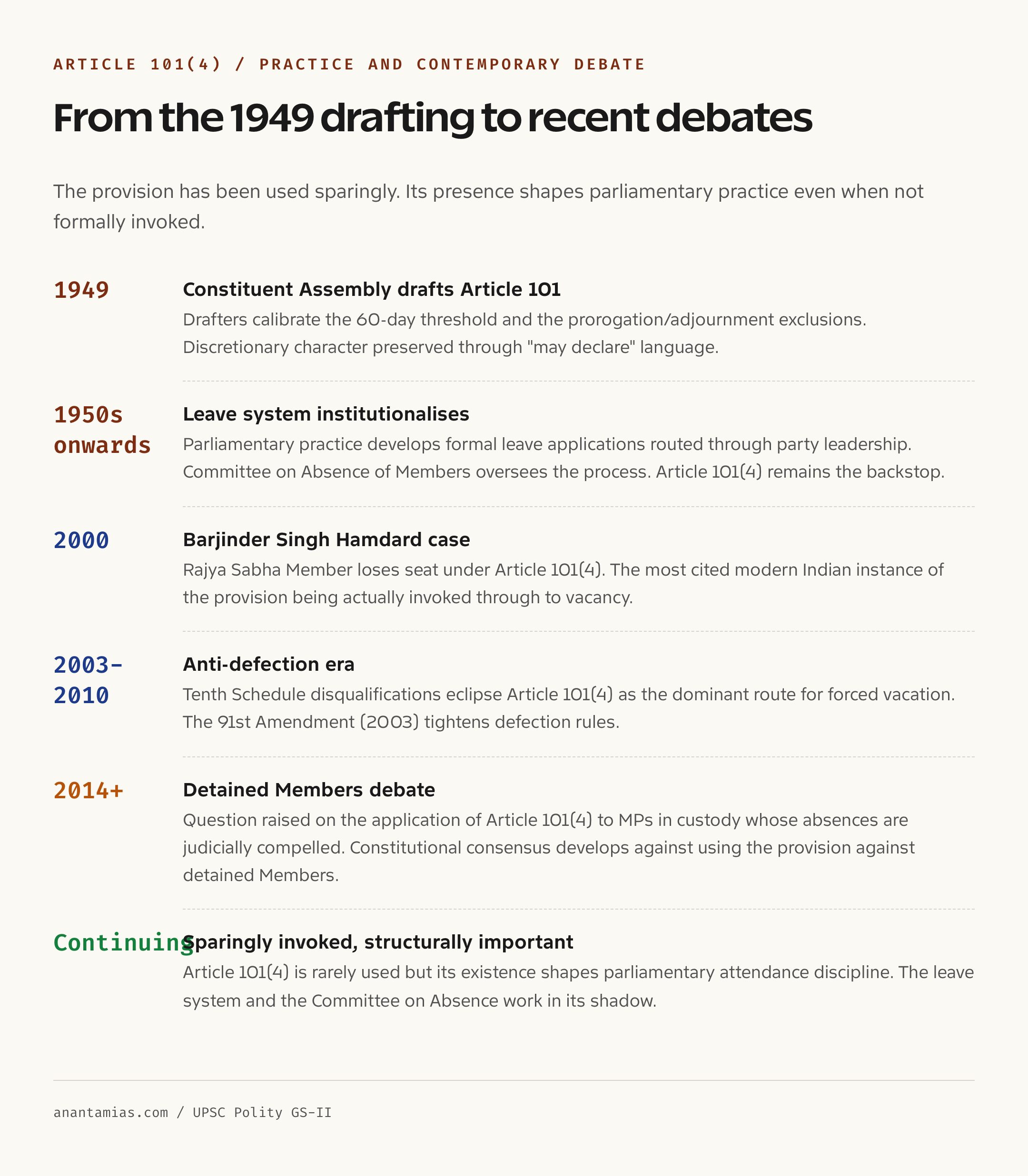
The most contemporary application of Article 101(4) concerns Members who are under arrest or judicial detention. An arrested MP does not automatically lose the seat. Article 101 does not list arrest or detention as an independent ground of vacation, and the disqualifications under Article 102 do not include pre-trial detention. The arrested Member retains the seat unless and until convicted in a manner that triggers Article 102 read with the Representation of the People Act, 1951.
However, the arrested Member may be unable to attend the House without the court’s permission. The court may grant or deny custody parole or general permission to attend. If the court denies permission and the Member’s absence crosses 60 days excluding the standard exclusions, the formal precondition for an Article 101(4) motion is satisfied. The House then has the discretion to move or not to move. Most often the House does not, recognising that the absence is involuntary in a meaningful sense and that conviction-based disqualification under Article 102 will resolve the situation if it ever arises.
The recent debate around Article 101(4) and detained Members has therefore been less about whether the threshold is crossed and more about whether the House should use its discretionary power against a Member whose absence is judicially compelled. Constitutional scholars have argued that doing so would amount to political punishment for circumstances beyond the Member’s control and would set a precedent that future ruling majorities could exploit against opposition Members in custody. The House has, by and large, accepted this reading and has refrained from invoking the provision in such cases.
How Article 101(4) Connects with Anti-Defection and the Tenth Schedule
The Tenth Schedule of the Constitution, inserted by the 52nd Amendment, governs disqualification on the ground of defection. Disqualification under the Tenth Schedule is a separate path to losing the seat and operates through the Speaker or Chairman acting on a petition. Article 101(4) is a different mechanism: it works on absence rather than party loyalty, on a House motion rather than a presiding officer’s decision, and on discretion rather than mandatory disqualification.
The two provisions can intersect in fact. A defecting Member who also stays away from the House to avoid voting or to delay a defection petition exposes himself to both proceedings simultaneously. The Speaker may disqualify under the Tenth Schedule. The House may, separately and independently, declare the seat vacant under Article 101(4). The two paths are not exclusive but cumulative. In practice, the Tenth Schedule has been the more frequently used route for forced vacation of seats in modern Indian politics.
The Indirect Effect on Discipline and Attendance
Article 101(4) shapes parliamentary behaviour even when it is not invoked. The provision creates an outer limit beyond which absence becomes constitutionally vulnerable. Members who anticipate prolonged absence on legitimate grounds, including foreign travel, illness, or family circumstances, formally seek leave from the House through their party leadership. The leave application is processed and either granted or refused on a routine basis.
The leave system is the practical operationalisation of Article 101(4). It converts what would otherwise be unauthorised absence into permitted absence and removes the ground for any subsequent motion. The system depends on parliamentary practice rather than on detailed constitutional rule, and it reflects a settled convention that has built up over decades. The Lok Sabha Committee on Absence of Members from the Sittings of the House and its Rajya Sabha equivalent oversee the process and submit periodic reports.
Prelims and Mains Pointers for UPSC
For prelims, four anchors deserve memorisation. The threshold is 60 days of absence. The exclusions are prorogation and adjournment of more than four consecutive days. The provision is discretionary: the House may declare the seat vacant. Article 190(4) is the parallel provision for State legislatures.
For mains, the question typically asks how the Constitution balances the public interest in active legislative representation against the legitimate reasons that may keep a Member from attending. The answer should integrate Article 101(4) with the leave mechanism, with Article 102 disqualifications, with the parliamentary motions framework on House procedure, and with the Tenth Schedule on anti-defection. Aspirants writing on parliamentary discipline can connect this to the doctrines underpinning the basic structure doctrine and to the Indian judiciary on the limits of House autonomy.
Conclusion: Discretion as Constitutional Wisdom
Article 101(4) is a study in calibrated constitutional discipline. The threshold is set high enough to filter out routine absences. The exclusions are fair to Members during periods when the House itself is not sitting. The discretionary character of the House’s power preserves space for political judgment about the specific circumstances of each absence. And the rarity of actual invocations reflects a parliamentary culture that prefers persuasion and self-correction over forfeiture.
The provision is unlikely to be the most frequently used disciplinary tool in Indian constitutional practice. The Tenth Schedule and Article 102 occupy that space. But Article 101(4) holds the doctrinal floor: it confirms that elected representation is a public function, that prolonged unjustified absence is a constitutional concern, and that the House itself, not any external authority, is the guardian of its own membership discipline. For UPSC aspirants, the provision is a clean illustration of how the Constitution distinguishes between rule and discretion, between automatic forfeiture and deliberative judgment, and between the calendar of the House and the underlying public interest in active representation.
Frequently Asked Questions
What is Article 101(4) of the Indian Constitution?
Article 101(4) provides that if a Member of either House of Parliament is absent from all meetings of the House for a period of 60 days without the permission of the House, the House may declare the seat vacant.
Is the loss of seat under Article 101(4) automatic?
No. The provision uses the word u0022mayu0022, not u0022shallu0022. The House must pass a motion declaring the seat vacant. The House may, in its discretion, condone the absence and allow the Member to retain the seat.
How are the 60 days computed?
In computing the 60-day period, no account is taken of any period during which the House is prorogued or during which it is adjourned for more than four consecutive days.
Does Article 101(4) apply to State legislatures?
A parallel provision in Article 190(4) governs Members of State Legislative Assemblies and Legislative Councils with identical thresholds and exclusions.
Can an arrested or detained MP lose the seat under Article 101(4)?
An arrested MP does not automatically lose the seat. If the court denies permission to attend Parliament and the absence crosses 60 days, the formal precondition is satisfied, but the House retains the discretion not to invoke the provision. In practice, the House has refrained from doing so where the absence is judicially compelled.
What is a famous example of Article 101(4) being invoked?
The most cited Indian example is the 2000 case where Rajya Sabha Member Barjinder Singh Hamdard lost his seat under Article 101(4) for prolonged absence.
How does Article 101(4) relate to anti-defection law?
The Tenth Schedule on anti-defection is a separate mechanism that operates through the Speaker or Chairman on a petition. Article 101(4) is independent and works on absence and a House motion. The two paths can be invoked in parallel where both grounds are made out.
Tell Google you want more of this.
Add Anantam IAS as a preferred sourceOne tap, and this site shows up more often in your own Top Stories, AI Overviews and AI Mode. Remove it any time.