The Indian Parliament conducts most of its political work through motions. A motion is a proposal moved by a Member for the consideration of the House. Some motions are routine procedural devices that decide when the House sits and when it adjourns. Others are substantive instruments that can topple a government, censure a minister, or force the executive to defend a specific policy on the floor. Understanding the architecture of parliamentary motions is therefore not a matter of trivia. It is the operational language of accountability between the executive and the legislature in a parliamentary system.
The motions framework in India derives from the Constitution, the Rules of Procedure and Conduct of Business in the Lok Sabha and the Rajya Sabha, and a body of conventions that has accumulated since 1952. The Constitution mentions some motions explicitly, such as the No-Confidence Motion under Article 75, while others, like the Adjournment Motion and the Calling Attention Motion, are creatures of the rules. The Speaker of the Lok Sabha and the Chairman of the Rajya Sabha exercise substantial discretion in admitting, scheduling, and disposing of motions, which makes the office of the presiding officer central to the working of the system.
This guide walks through the classification of motions, the four most consequential ones (the “Big Four”), the procedural mechanics, the differences between the Lok Sabha and the Rajya Sabha, the recent significant motions in Indian parliamentary history, and the prelims and mains pointers for UPSC. The topic connects with Lok Sabha vs Rajya Sabha, the rules on the private member’s bill, and the broader work of parliamentary committees in India.
Quick Facts on Parliamentary Motions
A motion is a proposal moved by a Member for the consideration of the House. Motions are classified into substantive motions, substitute motions, and subsidiary motions. The four most consequential motions are the Adjournment Motion, the Privilege Motion, the Censure Motion, and the No-Confidence Motion. The No-Confidence Motion is the only motion under which the Council of Ministers is constitutionally obliged to resign if it is passed in the Lok Sabha. The Adjournment Motion, the Censure Motion, and the No-Confidence Motion can be moved only in the Lok Sabha. The Privilege Motion can be moved in both Houses. The Adjournment Motion and the No-Confidence Motion require the support of at least 50 Members for the Speaker to admit them. A No-Confidence Motion does not require any reasons to be stated in the notice. A Censure Motion must state specific charges. The first No-Confidence Motion in India was moved by Acharya J. B. Kripalani against the Nehru government in 1963; it was defeated. The Morarji Desai government resigned in 1979 after a No-Confidence Motion. The most recent No-Confidence Motions against the Modi government were in 2018 and 2023, both defeated.
What a Parliamentary Motion Is
A parliamentary motion is a formal proposal placed before a House for its consideration. The Member who moves the motion expresses an intention that the House should take a specified action: declare an opinion, pass a resolution, censure an authority, withdraw confidence in the government, or adjourn proceedings. The House then deliberates on the motion and votes on it. The outcome is a decision of the House.
The motions system performs three institutional functions. The first is the structuring of debate. The Rules of Procedure require that any matter discussed on the floor of the House be discussed on a motion, so that the House has a specific proposition to vote on at the end of the debate. The second function is the holding of the executive to account. Motions like the No-Confidence Motion, the Censure Motion, and the Calling Attention Motion give the legislature procedural instruments to compel the executive to defend its conduct. The third function is the management of the House’s time. Adjournment, closure, and dilatory motions are tools through which the House decides what to take up next, when to end a debate, and when to suspend proceedings.
Background and Constitutional Source
The Constitution of India does not provide a comprehensive list of parliamentary motions. The motions framework is built primarily through the Rules of Procedure and Conduct of Business of the Lok Sabha (the Rules) and the corresponding rules of the Rajya Sabha. The Constitution mentions only a handful of motions specifically. Article 75(3) provides that the Council of Ministers shall be collectively responsible to the Lok Sabha, which is the constitutional foundation of the No-Confidence Motion. Article 105 deals with parliamentary privileges, which is the source of the Privilege Motion. The provisions on Money Bills and Financial Bills, in Articles 109 to 117, generate the framework for Cut Motions on the Demands for Grants.
The Rules then build out the operative system. The Speaker of the Lok Sabha and the Chairman of the Rajya Sabha have substantial powers to interpret and apply the Rules, including the power to admit or refuse motions, to determine the time allotted, and to call for the vote at the end of the debate. The accumulation of rulings from successive Speakers has produced a body of parliamentary precedent that supplements the formal Rules.
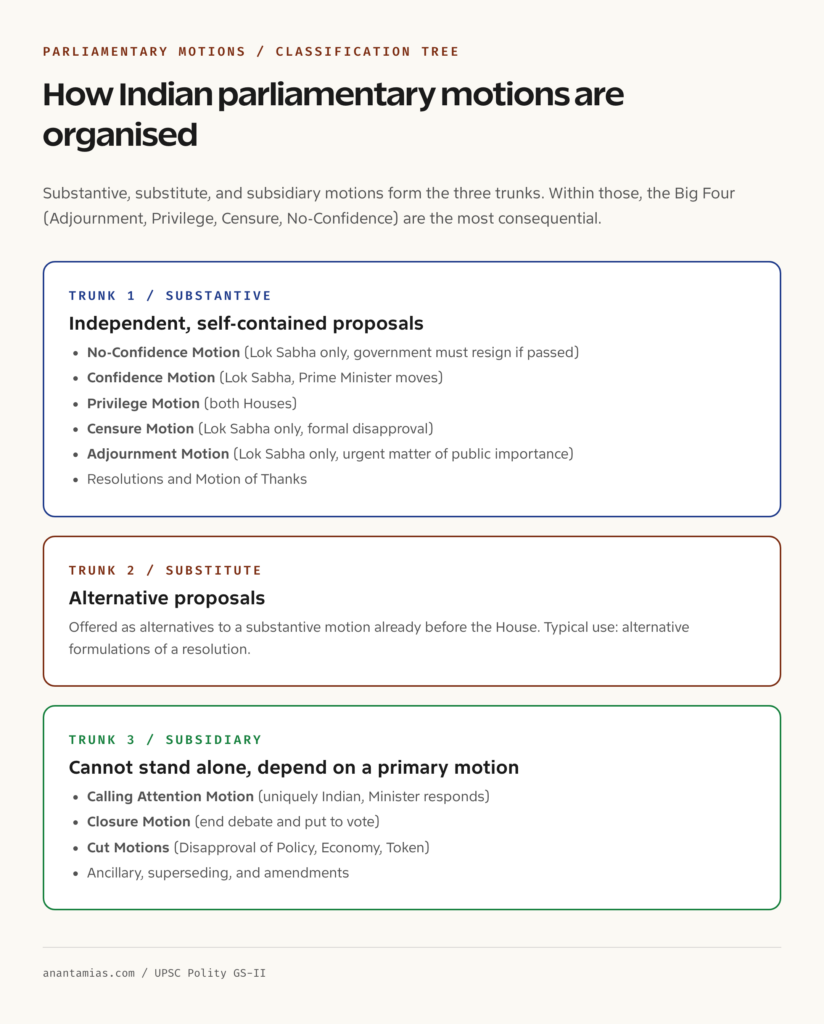
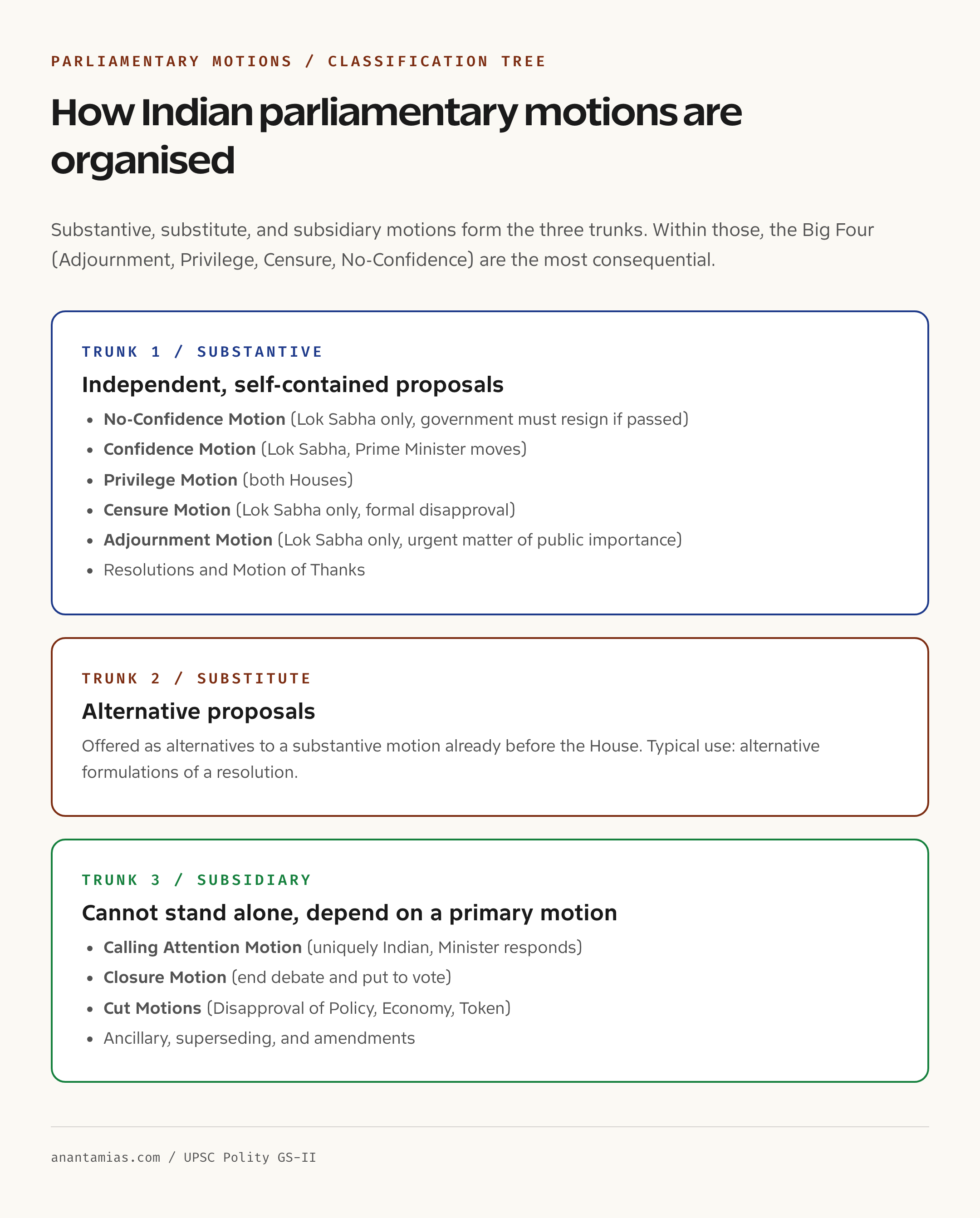
The classification of motions has settled into three main categories. Substantive motions are independent and self-contained proposals, like the No-Confidence Motion or a Privilege Motion. Substitute motions are alternative proposals offered against a substantive motion. Subsidiary motions cannot stand alone; they depend on a primary motion. Within subsidiary motions, the further sub-categories are ancillary motions (like the motion to be put to vote), superseding motions (which cut across an ongoing debate), and amendments. The classification matters because the procedural treatment of different motion types varies.
The Big Four: Adjournment, Privilege, Censure, and No-Confidence
The Adjournment Motion is the formal mechanism for drawing the attention of the House to a definite matter of urgent public importance. The motion proposes that the regular business of the House be set aside so that the urgent matter can be discussed. The Adjournment Motion is available only in the Lok Sabha. It requires the support of at least 50 Members to admit. The Speaker’s discretion on admissibility is significant: the matter must be specific, urgent, and of public importance. If passed, the House adjourns, and the passage carries a strong implication of disapproval of the government’s conduct on the matter.
The Privilege Motion is moved by a Member who alleges that another Member or a Minister has breached parliamentary privilege or shown contempt of the House. Privileges include freedom of speech in the House, freedom from arrest in civil cases during the session, and the right of the House to regulate its own composition and conduct. The Privilege Motion can be moved in both the Lok Sabha and the Rajya Sabha. The Speaker or Chairman has discretion to admit it; there is no fixed numerical requirement. If admitted, the motion is referred to the Committee of Privileges, which examines and reports. The House then decides on the basis of the report.
The Censure Motion expresses formal disapproval of the conduct of a specific Minister, a group of Ministers, or the entire Council of Ministers. The motion is available only in the Lok Sabha. Unlike the Adjournment Motion, no leave of the House is required; the Speaker decides on admissibility. The motion must state specific charges. The Censure Motion does not, by itself, oblige the government to resign, but a government censured by the Lok Sabha is widely expected to seek a Confidence Motion to demonstrate that it retains majority support.
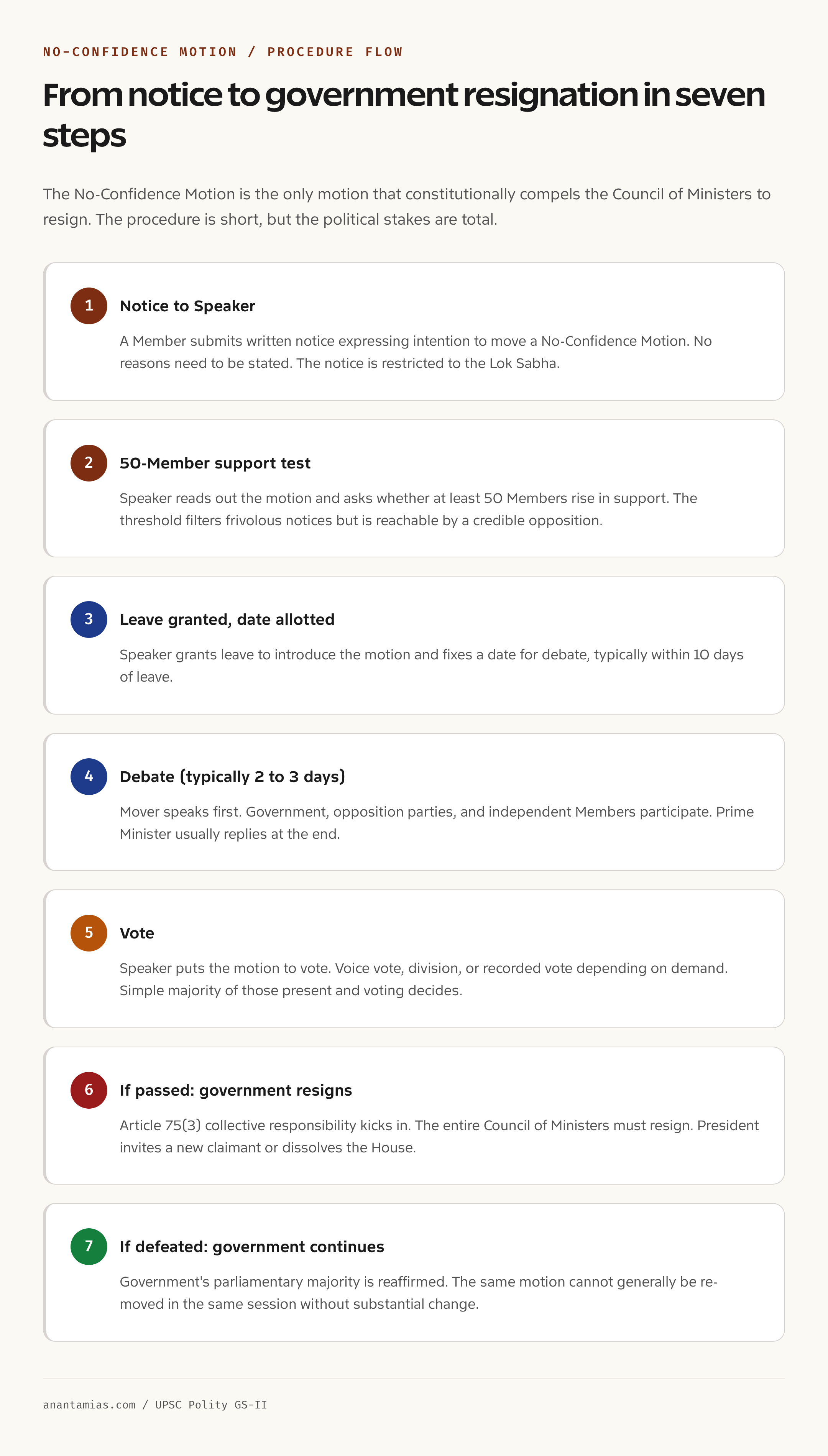
The No-Confidence Motion is the most consequential. It is the procedural instrument through which the Lok Sabha withdraws confidence in the Council of Ministers. The motion is available only in the Lok Sabha. The notice requires the support of at least 50 Members. No reasons need to be given; the motion is a direct test of confidence. If passed, the Council of Ministers must resign under Article 75(3). The motion is rooted in the constitutional principle of collective responsibility and is the ultimate accountability instrument in a parliamentary system.
Why It Matters
The motions system matters because it is the operational expression of parliamentary government. In a presidential system, the executive’s tenure is fixed by the constitutional term and the impeachment process. In a parliamentary system, the executive’s tenure depends on its capacity to retain majority support in the popular chamber, and motions are the instruments through which that support is tested. A Lok Sabha that cannot move and pass a No-Confidence Motion is a Lok Sabha in which the executive cannot be removed except through dissolution.
The smaller motions matter for daily accountability. The Adjournment Motion forces the government to engage with an urgent matter on the floor of the House. The Privilege Motion protects the integrity of parliamentary process. The Censure Motion expresses formal disapproval and creates political pressure even where the constitutional threshold for removal is not met. The Calling Attention Motion, the Cut Motion, and the Closure Motion together build the texture of daily parliamentary work.
The system also matters for the protection of minority and opposition voice. Most of the substantive motions can be moved by any Member, including opposition Members, subject to the procedural thresholds. The 50 Member requirement for the Adjournment Motion and the No-Confidence Motion is calibrated to be high enough to prevent frivolous motions but low enough to be reachable by a credible parliamentary opposition. The discretion of the Speaker, while broad, operates within a body of precedent and can be challenged through the procedure of the House.
Detailed Analysis: The No-Confidence Motion in Practice
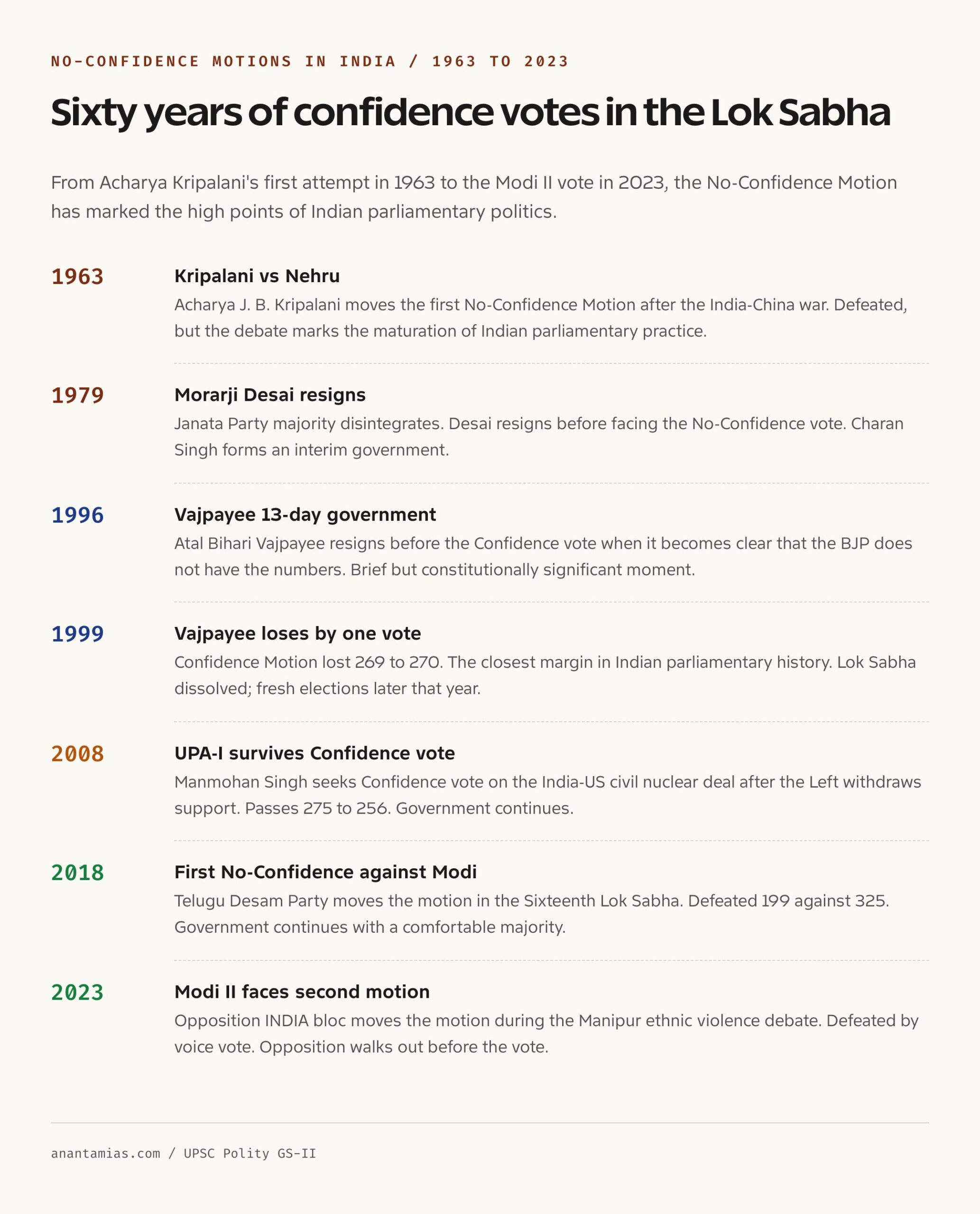
The No-Confidence Motion has been moved many times in the Lok Sabha. Acharya J. B. Kripalani moved the first No-Confidence Motion against the Nehru government in August 1963, in the aftermath of the India-China war. The motion was defeated, but the debate is remembered as a significant moment in the maturation of Indian parliamentary practice.
The Morarji Desai government, the first non-Congress government at the Centre, fell in 1979 when the Janata Party majority disintegrated. A No-Confidence Motion was moved, and Desai resigned before the vote, leading to the formation of the Charan Singh interim government. The 1996 Atal Bihari Vajpayee government, which lasted thirteen days, resigned before facing a Confidence vote when it became clear that the BJP did not have the numbers. The 1999 Vajpayee government lost a Confidence vote by a single vote (269 to 270), leading to the 1999 general election.
The Manmohan Singh government in 2008 sought a Confidence vote on the India-United States civil nuclear deal after the Left parties withdrew support. The Confidence Motion was moved by the Prime Minister, debated extensively, and passed (275 to 256), allowing the government to continue.
The Narendra Modi government has faced two No-Confidence Motions during its tenure. The first, in July 2018, was moved by the Telugu Desam Party in the Sixteenth Lok Sabha and was defeated (199 against 325). The second, in August 2023, was moved during the Manipur ethnic violence debate in the Seventeenth Lok Sabha and was defeated by a voice vote, with the opposition INDIA bloc walking out before the vote.
The procedural sequence in each of these cases follows a standard pattern. A Member submits a notice to the Speaker stating the intention to move a No-Confidence Motion. If at least 50 Members rise in support, the Speaker reads out the motion and asks the House to grant leave to introduce it. If leave is granted, a date is fixed for debate. The debate is typically allowed two to three days. At the end of the debate, the motion is put to vote. If passed, the Council of Ministers resigns; if defeated, the government continues.
Comparative Look: Other Motions
Beyond the Big Four, the Indian Parliament uses a wider set of motions. The Calling Attention Motion is moved with the consent of the Speaker to call the attention of a Minister to a matter of urgent public importance, on which the Minister makes a brief statement. The motion is uniquely Indian and does not exist in the same form in the British or American legislatures.
The Confidence Motion is the inverse of the No-Confidence Motion. The Prime Minister, on his own initiative or on the President’s invitation, may move a Motion of Confidence in the Council of Ministers. If passed, the government continues with renewed parliamentary support; if defeated, the government must resign. The Vajpayee government in 1999 and the Manmohan Singh government in 2008 are major recent examples.
Cut Motions are moved during the discussion on Demands for Grants. They include the Disapproval of Policy Cut (reduction of the demand to one rupee), the Economy Cut (reduction by a specified amount), and the Token Cut (reduction by 100 rupees, indicating disapproval). Cut Motions are powerful symbolic instruments even when they fail, because the debate forces the government to defend the policy underlying the demand.
Closure Motions are moved to bring a debate to an end and put the matter to vote. The motion can take different forms: simple closure, closure by compartments (where a Bill is closed by sections), guillotine (where remaining demands or clauses are closed without further debate), and closure by kangaroo (selective closure of certain clauses). The Speaker has discretion on admissibility.
Challenges in the Motions System
Three challenges affect the contemporary motions system. The first is the use of motions as instruments of disruption rather than deliberation. Privilege Motions, in particular, have been used to settle political scores rather than to address genuine breaches of privilege. The result is a backlog at the Committee of Privileges and a dilution of the seriousness of the procedure.
The second challenge is the time available for substantive motions. The shrinking number of sitting days, the frequent disruption of proceedings, and the prioritisation of government business have together reduced the floor time available for opposition-moved motions. The institutional vitality of the motions system depends on the floor time, and recent decades have seen a consistent reduction in that time.
The third challenge is the discretion of the presiding officer. The Speaker’s power to admit or refuse motions, to decide the time allotted, and to interpret the rules has come under criticism in cases where the discretion appears to favour the ruling side. Recent academic and parliamentary writing has called for a more transparent rule-bound exercise of the discretion, with reasons recorded for major admissibility decisions.
Prelims Pointers
A motion is a formal proposal moved by a Member for the consideration of the House. The Big Four motions are the Adjournment Motion, the Privilege Motion, the Censure Motion, and the No-Confidence Motion. The Adjournment Motion, the Censure Motion, and the No-Confidence Motion are available only in the Lok Sabha. The Privilege Motion is available in both Houses. The Adjournment Motion and the No-Confidence Motion require the support of at least 50 Members for admission. The No-Confidence Motion is the only motion that constitutionally obliges the Council of Ministers to resign if it is passed in the Lok Sabha. Article 75(3) provides for collective responsibility, which is the constitutional foundation of the No-Confidence Motion.
The first No-Confidence Motion was moved by Acharya J. B. Kripalani in 1963. The Morarji Desai government resigned in 1979. The 1999 Vajpayee government fell by one vote on a Confidence Motion. The Manmohan Singh government won a Confidence Motion in 2008. The Modi government faced No-Confidence Motions in 2018 and 2023, both defeated.
A common trap statement: “A Censure Motion, if passed, requires the government to resign.” This is incorrect. Only the No-Confidence Motion has that constitutional consequence. A Censure Motion expresses disapproval but does not, by itself, oblige resignation. Another trap: “A No-Confidence Motion can be moved in the Rajya Sabha.” This is incorrect. The motion can be moved only in the Lok Sabha.
Mains Practice Questions
- Parliamentary motions are the operational language of accountability between the executive and the legislature in a parliamentary system. Discuss the architecture of motions in the Indian Parliament and the institutional rationale for each major type. (GS Paper 2, 250 words)
- Compare and contrast the Adjournment Motion, the Censure Motion, and the No-Confidence Motion. What are the political and constitutional consequences of each? (GS Paper 2, 150 words)
- The discretion of the Speaker in admitting or refusing motions has come under scrutiny. Discuss the scope of the discretion and the case for greater procedural transparency. (GS Paper 2, 150 words)
- Trace the history of the No-Confidence Motion in India from 1963 to 2023. What does the trajectory tell us about the institutional health of parliamentary government in India? (GS Paper 2, 250 words)
Way Forward
The motions system in the Indian Parliament is constitutionally robust but procedurally under pressure. Three reforms could strengthen it. The first is the protection of floor time for opposition-moved motions, perhaps through a rule that reserves a specified number of sittings per session for opposition-business. The second is greater procedural transparency in the Speaker’s discretion, with reasons recorded for major admissibility decisions, in line with comparative parliamentary practice. The third is the strengthening of the Committee of Privileges, with clearer guidelines on what constitutes a genuine breach of privilege and a faster timeline for disposal.
For UPSC aspirants, the motions framework offers a high-yield revision area. The classification of motions, the procedural mechanics, the case histories of major No-Confidence and Confidence Motions, and the comparative use of motions in the British and American legislatures together provide a complete working understanding of how parliamentary government operates. The connection with Lok Sabha vs Rajya Sabha, the private member’s bill procedure, and parliamentary committees in India makes the topic central to GS Paper 2.
Frequently Asked Questions
What is a parliamentary motion?
A parliamentary motion is a formal proposal moved by a Member for the consideration of the House. The Member proposes that the House take a specific action, debate a matter, or express an opinion. The House deliberates and votes on the motion, and the outcome is a decision of the House.
What are the Big Four motions in the Indian Parliament?
The Big Four motions are the Adjournment Motion, the Privilege Motion, the Censure Motion, and the No-Confidence Motion. The Adjournment Motion, the Censure Motion, and the No-Confidence Motion can be moved only in the Lok Sabha. The Privilege Motion can be moved in both Houses.
What is the constitutional source of the No-Confidence Motion?
Article 75(3) of the Constitution provides that the Council of Ministers shall be collectively responsible to the Lok Sabha. The No-Confidence Motion is the procedural instrument through which the Lok Sabha withdraws confidence and forces the Council of Ministers to resign. The motion is therefore the operational expression of the constitutional principle of collective responsibility.
How many Members must support a No-Confidence Motion for it to be admitted?
At least 50 Members of the Lok Sabha must rise in support of the motion when the Speaker calls for it. If the threshold is met, the Speaker grants leave to introduce, and a date is fixed for debate. No reasons need to be stated in the notice.
What is the difference between a No-Confidence Motion and a Censure Motion?
The No-Confidence Motion, if passed in the Lok Sabha, constitutionally obliges the Council of Ministers to resign. The Censure Motion expresses formal disapproval of a Minister, a group of Ministers, or the entire Council, but does not require resignation. The No-Confidence Motion does not require reasons; the Censure Motion must state specific charges.
Can a No-Confidence Motion be moved in the Rajya Sabha?
No. The No-Confidence Motion can be moved only in the Lok Sabha, because the Council of Ministers is collectively responsible to the Lok Sabha and not to the Rajya Sabha. The Rajya Sabha can move other motions, including a Privilege Motion or a substantive resolution, but not a No-Confidence Motion.
Who moved the first No-Confidence Motion in India?
Acharya J. B. Kripalani, the veteran socialist leader, moved the first No-Confidence Motion in the Lok Sabha in August 1963 against the Nehru government, in the aftermath of the India-China war. The motion was defeated, but the debate is remembered as a significant moment in the maturation of Indian parliamentary practice.
What happened to the Vajpayee government on the 1999 Confidence Motion?
The Vajpayee government in April 1999 lost a Confidence Motion by a single vote, 269 against 270. The defeat led to the dissolution of the Lok Sabha and a fresh general election in late 1999. The episode is the closest example in Indian parliamentary history of a government falling by the narrowest possible margin.
What is the Calling Attention Motion?
The Calling Attention Motion is a motion moved with the consent of the Speaker to call the attention of a Minister to a matter of urgent public importance, on which the Minister makes a brief statement. The motion is uniquely Indian and does not exist in the same form in the British or American legislatures.
What are Cut Motions and when are they used?
Cut Motions are moved during the discussion on the Demands for Grants in the Lok Sabha. They take three forms: the Disapproval of Policy Cut (reduction of the demand to one rupee), the Economy Cut (reduction by a specified amount), and the Token Cut (reduction by 100 rupees, indicating disapproval). Cut Motions are powerful symbolic instruments even when they fail, because the debate forces the government to defend the policy underlying the demand.
Tell Google you want more of this.
Add Anantam IAS as a preferred sourceOne tap, and this site shows up more often in your own Top Stories, AI Overviews and AI Mode. Remove it any time.