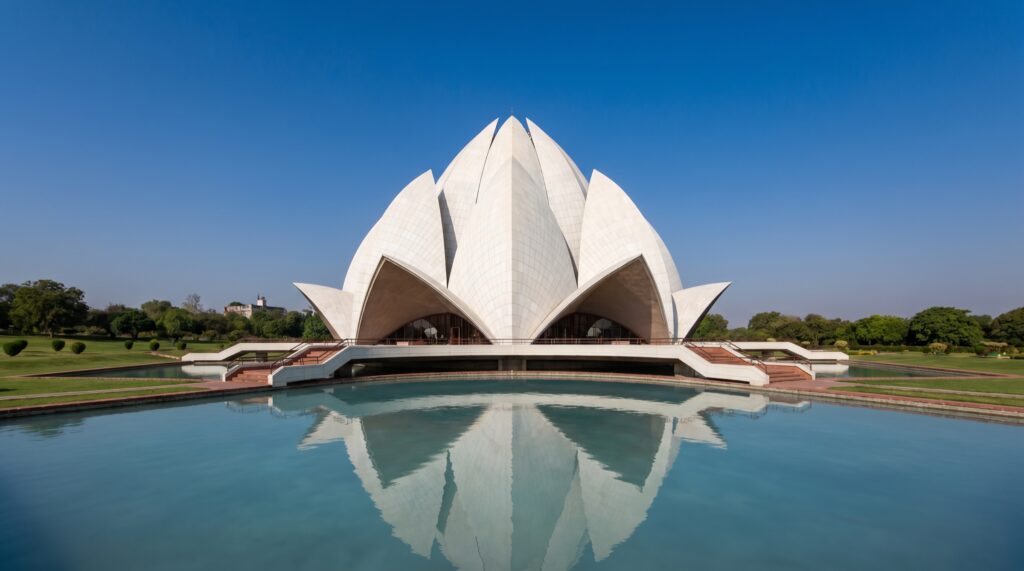
Most visitors call it the Lotus Temple, photograph the white flower rising out of its pools, and assume it belongs to whatever religion built it. That last assumption is the one to drop first. The building is a Bahai House of Worship, and the whole point of a Bahai temple is that it belongs to no single faith at all. There is no idol inside, no altar, no priest, no sermon, and no ritual. A Hindu, a Muslim, a Christian, an atheist, and a Bahai can walk through the same door, sit in the same hall, and pray or simply sit in silence, and none of them is a guest. Understanding the Lotus Temple means understanding that its architecture, the petals, the nine sides, the nine doors, is not decoration. It is an argument about the oneness of religion, built in marble.
What is the Lotus Temple, and what is the Bahai faith?
The Lotus Temple is a Bahai House of Worship in Delhi, completed in 1986, shaped like a half-open lotus flower and open to people of every religion for prayer and meditation. It sits in the Bahapur area of Kalkaji, in south Delhi, and it is the Mother Temple of the Indian subcontinent for the Bahai community, the seventh such temple built worldwide and, for a long time, the most visited of them all. Inside is a single large hall and nothing else: no images, no statues, no ceremonial objects.
To grasp why the building is the way it is, you need a quick, fair sketch of the faith behind it. The Bahai faith was founded in nineteenth-century Persia by Bahá’u’lláh, and its central teaching is unity on three levels: the oneness of God, the oneness of religion, and the oneness of humanity. Bahais hold that the great religions of the world are not rivals but successive chapters of one unfolding revelation, each brought by a messenger, from Krishna and Buddha to Moses, Christ, Muhammad, and, in their belief, Bahá’u’lláh. That single idea, that the faiths are one river seen at different bends, explains everything about how the temple works. A house of worship that welcomes all religions equally is not a gimmick here. It is the doctrine made physical. If you are building a base on the world’s major religions, the Bahai faith is worth knowing precisely because it frames itself as their continuation rather than their competitor.
Here is the rule that surprises first-time visitors. Inside a Bahai House of Worship, the only activity is the reading, reciting, or chanting of the scriptures of any religion, and choirs may sing, but no sermons are delivered, no rituals performed, and no musical instruments played inside the hall. There is no clergy at all. The silence and the openness are not an absence of religion. They are the form the religion takes.
The architecture: 27 petals, nine sides, nine doors
The design of the Lotus Temple is a piece of pure structural theatre, and the man behind it was the Iranian-Canadian architect Fariborz Sahba, who worked on it through the late 1970s and 1980s. The building takes the form of a lotus because the flower is a shared symbol of purity across Indian religious traditions, a neutral, universally resonant image rather than the emblem of any one faith. That choice is itself Bahai in spirit: pick the symbol everyone already reveres.
The structure is made of 27 free-standing marble-clad “petals,” arranged in clusters of three to form the building’s nine sides. Think of it as three rings of nine leaves each: an outer set that fold outward like entrance canopies, a middle set, and an inner set of nine tall petals that curve inward and almost meet at the top, leaving a gap through which daylight falls into the hall. The petals are clad in white marble quarried from Mount Pentelikon in Greece, the same source that supplied the marble for the Parthenon in Athens, cut to precise patterns and set on a concrete shell. The building rises to about 34 metres and the central hall seats around 2,500 people.
Around the temple lie nine pools of water, set between the outer petals, which serve two purposes at once. They make the flower look as though it is floating on water, the way a lotus grows out of a pond, and they are part of the natural cooling system, helping ventilate and cool the hall without heavy air-conditioning. It is a genuinely clever piece of passive-climate design that most visitors never notice.
Then there are the nine doors, one opening from each side into the central hall. The number nine runs through the whole building on purpose, because in the Bahai faith nine is the highest single-digit number and stands for completeness and unity, the point at which all the separate paths converge. Every Bahai House of Worship in the world shares this nine-sided, nine-door plan for exactly that reason. So the geometry is not the architect showing off. Nine sides, nine doors, nine pools, all repeating one idea: many approaches, one centre. That fusion of engineering and meaning places it among the landmark works of modern Indian architecture, even though the design language it draws on is universal rather than regional.
The principle: all faiths, no idols, no rituals
The rule that defines the Lotus Temple is simple to state and radical in practice: people of all faiths are welcome to worship together, and there are no idols, no sermons, and no rituals. This is the feature that makes it different from almost every other place of worship in India, where the building usually belongs to one tradition and often to one deity. Here the hall is deliberately empty of anything that would mark it as Hindu, Muslim, Christian, or anything else.
What actually happens inside is quiet and open-ended. Visitors enter in silence, sit, and pray or meditate however their own faith or conscience directs. Volunteers may read short passages from the scriptures of different religions, and that is the extent of any organised activity. No collection is taken, no ceremony is performed, and no one preaches. For a country whose religious life is usually loud, crowded, and richly ritualised, the emptiness of the Lotus Temple hall is startling, and that is the point. It is a space designed to hold difference without erasing it.
This openness is why the temple sits so comfortably with the Indian constitutional idea of religious pluralism and secularism. It does not ask visitors to convert or to abandon their own faith. It offers a shared room instead, which is a small architectural version of the same principle the Constitution tries to hold at the level of the state: equal respect for all religions, preference for none.
One of the most-visited buildings in the world
The Lotus Temple is one of the most-visited buildings on earth, and this is not marketing language, it is measurable. Since it opened, it has drawn well over 70 million visitors, and by some counts more than 100 million, with daily footfall running into the tens of thousands and rising far higher on holidays. In the early 2000s it was reported to be attracting more visitors than the Taj Mahal and the Eiffel Tower, which puts a Delhi house of worship, free to enter and barely a few decades old, in the company of the most famous monuments in the world.
Part of the draw is simply how the building looks, a gleaming white lotus that reads as instantly photogenic from any angle. But part of it is the openness itself. Because it turns nobody away and asks nothing of anyone, it pulls in the curious, the devout of every faith, tourists, school groups, and people who just want a quiet place to sit in a chaotic city. A temple that belongs to no one religion ends up belonging, in a sense, to everyone, and the visitor numbers show it.
Awards and its place in modern architecture
The Lotus Temple has collected a long list of international architectural honours, and they are worth knowing because they mark it as a serious work of engineering and not just a pretty shape. It received the GlobArt Academy Award from Austria in 1987 for promoting the unity of humankind through its architecture, an award from the Institution of Structural Engineers in the United Kingdom for its structural design, recognition from the American Concrete Institute for the complex concrete shell beneath the marble, and lighting and design awards as well. Few modern Indian buildings have been so widely honoured abroad.
The engineering behind the flower is the part that specialists admire. Translating a lotus, all compound curves and no straight lines, into a stable structure of concrete shells clad in precisely cut marble was a formidable problem, solved through years of computer modelling and careful casting at a time when such tools were far less capable than they are now. The temple stands as proof that a building can be spiritually symbolic and structurally demanding at once, which is why it appears in architecture curricula and on lists of the twentieth century’s notable buildings. Set it beside the monuments of Delhi and it holds its own against structures many centuries older, not by age but by ambition.
Quick facts: Lotus Temple at a glance
| Feature | Detail |
|---|---|
| Type | Bahai House of Worship (Mother Temple of the Indian subcontinent) |
| Location | Bahapur, Kalkaji, south Delhi |
| Completed | 1986 |
| Architect | Fariborz Sahba (Iranian-Canadian) |
| Form | Half-open lotus flower |
| Petals | 27 free-standing marble-clad petals in clusters of three |
| Sides and doors | Nine sides, nine doors, nine surrounding pools |
| Marble | White marble from Mount Pentelikon, Greece (as used for the Parthenon) |
| Central hall | About 34 m tall, seats roughly 2,500 |
| Worship | Open to all faiths; no idols, sermons, rituals, or clergy |
| Significance of nine | Highest single digit; symbol of unity and completeness |
| Visitors | Among the most-visited buildings in the world |
How to study and remember this
Fix the topic on one sentence, that the architecture is the theology, and the details fall into place. The Bahai faith teaches the oneness of religion, so its temple welcomes all faiths and holds no idols. The number nine, standing for unity, repeats everywhere: nine sides, nine doors, nine pools. The 27 petals are simply three sets of those nine. Learn the meaning first and you will never forget the count, because the count is the meaning.
For the exam-ready facts, memorise the short chain: Bahai House of Worship, completed 1986, architect Fariborz Sahba, lotus form, Greek marble, all faiths welcome, one of the world’s most-visited buildings. Then connect it outward. The Lotus Temple pairs naturally with the study of religious diversity and secularism, because it is one of the clearest built expressions of the pluralist ideal, and with modern architecture, because it shows an Indian building winning global honours on engineering, not antiquity. Two anchors, the doctrine and the seven-fact chain, and the topic is secure.
Frequently Asked Questions
Which religion does the Lotus Temple belong to?
It is a Bahai House of Worship, but the Bahai faith opens its temples to people of every religion. There is no idol, no sermon, and no ritual, and anyone of any faith or none may enter to pray or meditate.
When was the Lotus Temple completed and who designed it?
It was completed in 1986 and designed by the Iranian-Canadian architect Fariborz Sahba. It is the Mother Temple of the Indian subcontinent for the Bahai community.
Why is it shaped like a lotus?
The lotus is a shared symbol of purity across Indian religious traditions, so it is neutral and universally recognised rather than tied to one faith. The building has 27 marble petals arranged in clusters of three to form nine sides.
Why does the number nine appear so often?
In the Bahai faith, nine is the highest single-digit number and stands for unity and completeness, the convergence of all paths. Every Bahai House of Worship has nine sides and nine doors for this reason.
What can visitors do inside the Lotus Temple?
Sit in silence and pray or meditate. Passages from the scriptures of different religions may be read or sung, but there are no sermons, no rituals, no musical instruments inside the hall, and no clergy.
What marble is the Lotus Temple made of?
Its petals are clad in white marble quarried from Mount Pentelikon in Greece, the same source that supplied the marble for the Parthenon in Athens, set over a concrete shell structure.
Is the Lotus Temple really one of the most-visited buildings in the world?
Yes. It has drawn tens of millions of visitors, by some counts more than 100 million, and in the early 2000s reportedly received more visitors than the Taj Mahal and the Eiffel Tower.
Practice Questions
1. The Lotus Temple in Delhi is a house of worship of which faith?
a) Jainism
b) Zoroastrianism
c) Bahai faith
d) Sikhism
Answer: c) Bahai faith
2. The Lotus Temple was designed by which architect?
a) Le Corbusier
b) Fariborz Sahba
c) Charles Correa
d) Edwin Lutyens
Answer: b) Fariborz Sahba
3. The Lotus Temple is composed of how many free-standing marble petals?
a) 9
b) 18
c) 27
d) 36
Answer: c) 27
4. The recurring number nine in the temple’s design symbolises, in the Bahai faith:
a) The nine planets
b) Unity and completeness
c) The nine founders of world religions
d) The nine directions
Answer: b) Unity and completeness
5. Which of the following is true of worship inside the Lotus Temple?
a) Daily sermons are delivered by Bahai priests
b) Idols of Bahá’u’lláh are placed in the central hall
c) People of all faiths may worship, with no idols or rituals
d) Entry is restricted to members of the Bahai community
Answer: c) People of all faiths may worship, with no idols or rituals
Mains-style questions
1. “In the Lotus Temple, the architecture is the theology.” Discuss how the building’s design expresses the core beliefs of the Bahai faith.
2. Examine the significance of houses of worship that admit people of all religions in a plural society such as India, with reference to the Lotus Temple and the constitutional idea of secularism.
3. The Lotus Temple is celebrated as much for its engineering as for its symbolism. Discuss the structural and design challenges involved in translating the form of a lotus into a permanent building.
4. Compare the Lotus Temple with older monuments of Delhi as an example of modern Indian architecture achieving international recognition.
5. Explain the central teachings of the Bahai faith and how they distinguish it from the older religious traditions of the subcontinent.
Walk into the Lotus Temple expecting a temple and you will be briefly lost, because there is nothing to look at, no deity, no altar, no ceremony, just a tall white hall full of quiet and light. That emptiness is the whole message. A faith that believes the religions are one built a house with room for all of them and images of none, and then made it so beautiful that the world came to see it anyway. Learn it as an idea given a shape, and the lotus stops being a pretty photograph and becomes the clearest thing in Delhi about what it means to hold every faith as equal.
Tell Google you want more of this.
Add Anantam IAS as a preferred sourceOne tap, and this site shows up more often in your own Top Stories, AI Overviews and AI Mode. Remove it any time.