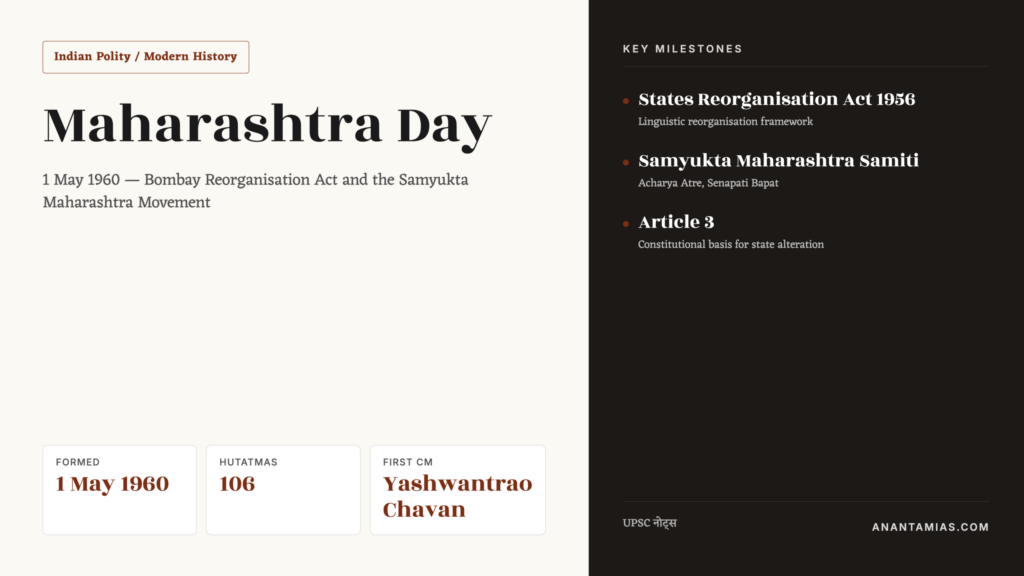
Maharashtra Day — also called Maharashtra Divas or Maharashtra Rajya Sthapana Diwas — is observed every year on 1 May to mark the formation of the State of Maharashtra. The state came into existence on 1 May 1960 when the Bombay Reorganisation Act, 1960, passed by Parliament under Article 3 of the Constitution, bifurcated the bilingual Bombay State into two linguistic states — Maharashtra (Marathi-speaking) and Gujarat (Gujarati-speaking). 1 May 2026 marks the 66th Maharashtra Day. The day commemorates the Samyukta Maharashtra Movement and the 106 Hutatmas (martyrs) who died during the agitation for a separate Marathi-speaking state with Mumbai as its capital.
Quick Facts at a Glance
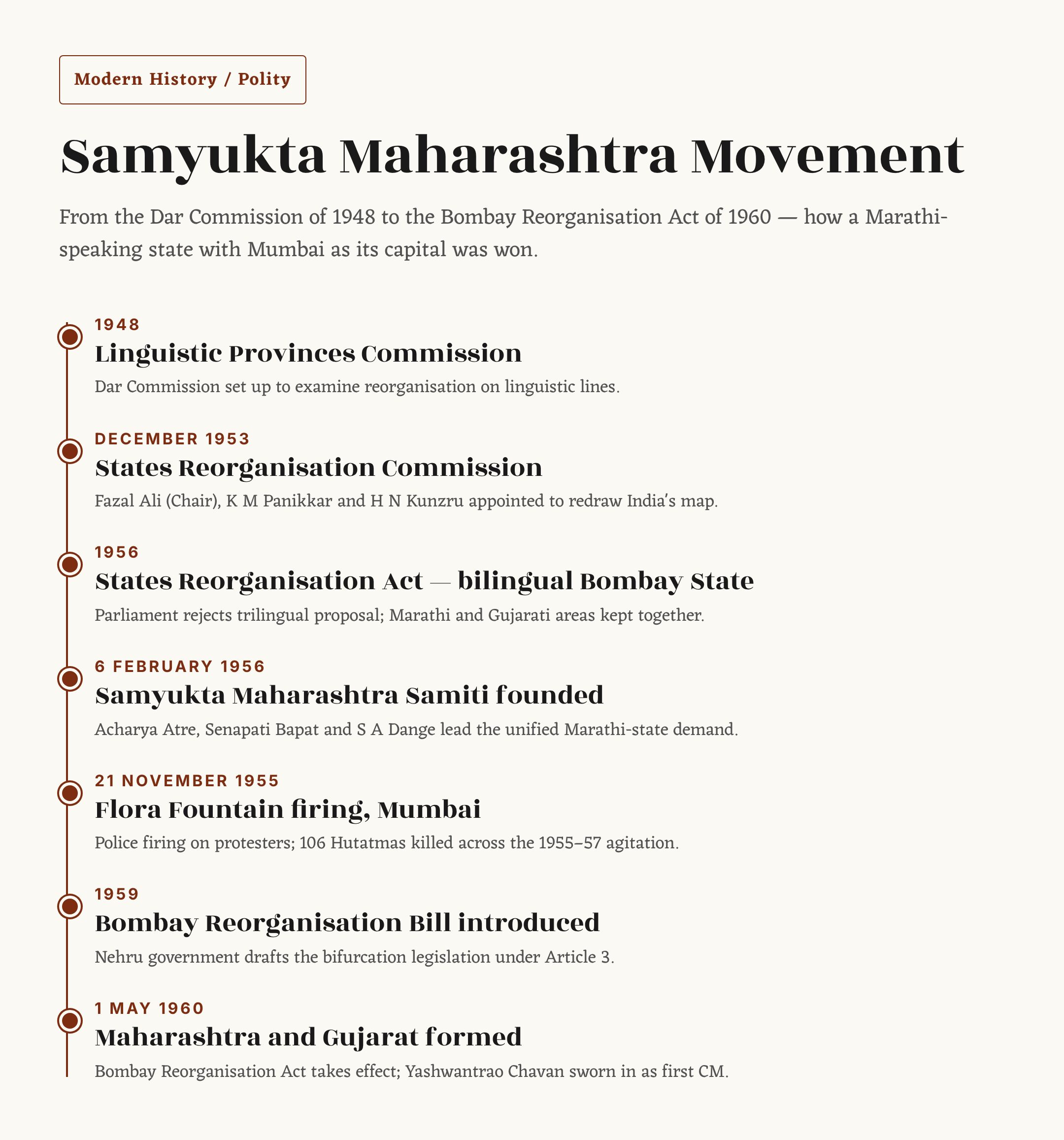
- Date: 1 May (every year); 1 May 2026 = 66th Maharashtra Day
- Statutory basis: Bombay Reorganisation Act, 1960 (Act No. 11 of 1960)
- Effective date: 1 May 1960
- Constitutional power: Article 3 of the Constitution (Parliament's power to alter areas, boundaries or names of states)
- Capital: Mumbai (Bombay was renamed Mumbai in 1995)
- First Chief Minister: Yashwantrao Chavan (1 May 1960 – 19 November 1962)
- Current Chief Minister (2026): Devendra Fadnavis (sworn in 5 December 2024 after the Mahayuti landslide in the November 2024 Assembly election)
- Current Governor: Jishnu Dev Varma (22nd Governor, sworn in 10 March 2026)
- State capital: Mumbai; winter / second capital: Nagpur
- State bird: Yellow-footed Green Pigeon (Hariyal)
- State animal: Indian Giant Squirrel (Shekru)
- State tree: Mango (Mangifera indica); state flower: Jarul (Pride of India)
- Area: 3.08 lakh sq km (3rd largest by area)
- Population: 11.24 crore (Census 2011); ~12.6 crore estimated for 2026
- GSDP: Largest state economy in India — Maharashtra's GSDP for FY 2024-25 is around ₹42 lakh crore (largest contribution to all-India GDP at ~13–14%)
- Lok Sabha seats: 48 (second highest after Uttar Pradesh)
- Rajya Sabha seats: 19
Constitutional Basis — Article 3 and the Power to Reorganise
The formation of Maharashtra is a textbook application of Article 3 of the Indian Constitution, which empowers Parliament to:
- form a new state by separation of territory from any existing state;
- increase the area of any state;
- diminish the area of any state;
- alter the boundaries of any state; and
- alter the name of any state.
A bill under Article 3 must be introduced only on the recommendation of the President, and the President must refer it to the legislature of the affected state(s) for views, though the views are not binding. The Bombay Reorganisation Act, 1960, was passed under exactly this procedure, splitting the existing Bombay State into Maharashtra and Gujarat with effect from 1 May 1960.
This legal architecture is why Maharashtra Day is also a federalism teaching moment — it demonstrates how the Indian Union, despite being described as an "indestructible union of destructible states," accommodates linguistic and cultural assertion through orderly statutory reorganisation rather than secession.
Historical Background — Why a Separate Maharashtra Was Needed
After Independence, Bombay Province (later Bombay State) was a sprawling bilingual entity that included present-day Maharashtra, Gujarat, parts of Karnataka and Madhya Pradesh. Following the States Reorganisation Act, 1956, Bombay State was retained as a "bilingual state" (dvibhashi pradesh — bilingual state) housing Marathi and Gujarati speakers together, along with Saurashtra and Kutch.
The 1956 settlement satisfied no one. Marathi speakers — supported by leaders rooted in the Lokmanya Tilak, Mahatma Jyotiba Phule and Babasaheb Ambedkar traditions — demanded a unified state of all Marathi-speaking areas (including Mumbai, Vidarbha and Marathwada). Gujarati speakers, in parallel, launched the Mahagujarat Movement for a separate Gujarat. The bilingual experiment lasted barely four years before mass politics on both sides forced Parliament to bifurcate the state.
States Reorganisation Commission and the 1956 Act
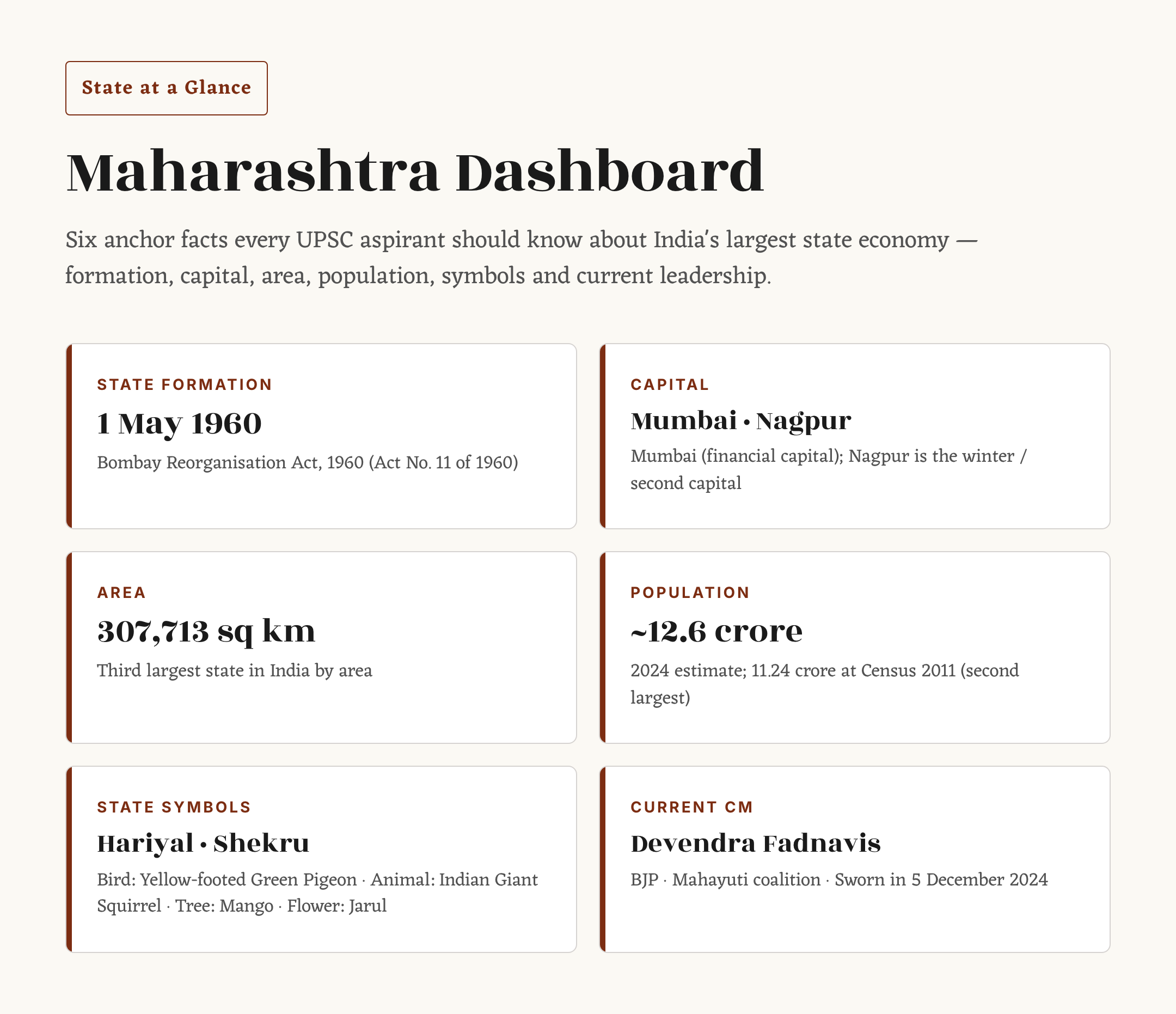
The first systematic effort to redraw India's internal map was the States Reorganisation Commission (SRC), set up by the Government of India in December 1953 with three members:
- Fazal Ali (Chairman) — former judge of the Supreme Court
- K M Panikkar — historian-diplomat
- H N Kunzru — parliamentarian and member of the Constituent Assembly
The SRC submitted its report on 30 September 1955, recommending reorganisation broadly on a linguistic basis but with safeguards for administrative cohesion. The recommendations were enacted as the States Reorganisation Act, 1956, which created 14 states and 6 Union Territories.
However, on Bombay, the SRC recommended a trilingual arrangement — separate Maharashtra, separate Gujarat, and Bombay city as a centrally administered city-state. Parliament rejected this and instead created a single bilingual Bombay State. That decision triggered the Samyukta Maharashtra Movement.
The Samyukta Maharashtra Movement
The Samyukta Maharashtra Samiti (SMS) — literally "United Maharashtra Committee" — was formed on 6 February 1956 in Pune to fight for a unified Marathi-speaking state with Mumbai as its capital. The movement cut across party lines and was led by an exceptional cast of leaders:
- Acharya Pralhad Keshav Atre (Acharya Atre) — fiery orator, journalist and editor of Maratha
- Senapati Bapat (Pandurang Mahadev Bapat) — freedom fighter and Mulshi Satyagraha veteran
- S A Dange (Shripad Amrit Dange) — Communist leader and trade unionist
- S M Joshi (Shreedhar Mahadev Joshi) — socialist leader, future SMS Chairman
- Prabodhankar Thackeray — social reformer and journalist
- Madhu Limaye, N G Goray — socialists who supplied parliamentary muscle
The Samiti combined three distinct streams — Congress dissidents, the Communist Party of India (CPI), and the socialist Praja Socialist Party (PSP) — under a single banner. Its core demand was simple: Marathi-speaking Bombay must remain with Maharashtra.
The 106 Hutatmas and Hutatma Chowk
Opposition to the bilingual state turned violent on 21 November 1955, when police opened fire on a Samyukta Maharashtra demonstration at Flora Fountain in Bombay. Protests continued through 1956 and 1957, and across multiple incidents in Mumbai and across Marathi-speaking areas, 106 protesters were killed in police firings. They are remembered as the 106 Hutatmas (hutatma — martyr).
After Maharashtra's formation, Flora Fountain was renamed Hutatma Chowk in their honour. The memorial — an eternal flame and a sculpted figure with an upraised torch — stands today in the heart of South Mumbai and is a focal point of every Maharashtra Day commemoration. The names of all 106 martyrs are inscribed on the memorial.
Bombay Reorganisation Act, 1960 — The Decisive Statute
By 1959 the political pressure was overwhelming. Prime Minister Jawaharlal Nehru's government drafted and Parliament passed the Bombay Reorganisation Act, 1960 (Act No. 11 of 1960). The key provisions:
- Section 3 — created the State of Gujarat comprising the Gujarati-speaking districts (Saurashtra and Kutch areas plus North/Central Gujarat)
- The residuary territory continued as the State of Maharashtra with Mumbai as its capital
- Mumbai (then Bombay) was assigned to Maharashtra — the central plank of the Samyukta Maharashtra demand
- The Act came into force on 1 May 1960
Yashwantrao Chavan of the Indian National Congress (INC) became Maharashtra's first Chief Minister on the same day. Sri Prakasa was appointed the first Governor. Yashwantrao Chavan is widely regarded as the architect of modern Maharashtra, balancing rapid industrialisation in Mumbai-Pune with cooperative-led agrarian growth in western Maharashtra. He later moved to the Union Cabinet as Defence Minister during the 1962 war.
Why Mumbai Stayed with Maharashtra
The fate of Mumbai was the most contested question of the 1955–60 period. Three rival positions had been advanced:
- Mumbai as a centrally administered city-state (the SRC view, supported by Morarji Desai)
- Mumbai with Gujarat, given the dominant Gujarati and Marwari business community
- Mumbai with Maharashtra, on the strength of Marathi-speaking demographics in the city and contiguous geography
The Marathi-majority demographic argument prevailed, supported by the SMS-led mass mobilisation and the political cost the Congress could not afford to pay before the 1962 elections. Mumbai's continued integration with Maharashtra is the foundational political bargain of the state.
Maharashtra in Numbers — A Snapshot for 2026
- Economy — Largest state economy in India; FY 2024-25 GSDP estimated at ~₹42 lakh crore; per-capita income ~₹2.78 lakh (FY 2023-24, RBI Handbook)
- Industrialisation — Mumbai-Pune-Nashik-Aurangabad industrial corridor; financial capital (RBI, BSE, NSE, SEBI all headquartered in Mumbai); MIDC operates 290+ industrial estates
- Agriculture — Largest sugarcane producer; cooperative-led sugar mills are a defining institution; Marathwada and Vidarbha agrarian distress remain a policy challenge
- HDI — Among the higher-HDI states; recent NFHS-5 data shows mixed outcomes — better income indicators but lagging on stunting and anaemia in tribal districts
- Maratha reservation agitation — A central political issue since 2018; the Maharashtra State Reservation for Socially and Educationally Backward Classes Act 2024 grants 10% Maratha reservation, currently under judicial scrutiny
- Politics — The November 2024 Assembly election produced a Mahayuti landslide (BJP, Shiv Sena Eknath Shinde faction, NCP Ajit Pawar faction); Devendra Fadnavis was sworn in as Chief Minister on 5 December 2024, with Eknath Shinde and Ajit Pawar as Deputy CMs. Maharashtra Navnirman Sena (MNS) and the Uddhav Thackeray Shiv Sena (UBT) sit in opposition with Congress
Symbols, Culture and Maharashtra Day Observance
The state's emblem features the Ashoka Pillar with the inscription "Pratipachchandralekheva Vardhishnurvishvavandita Maharashtrasya Rajyasya Mudra Bhadraya Rajate" — drawn from the seal of Chhatrapati Shivaji Maharaj. The state symbols include:
- Bird: Yellow-footed Green Pigeon (Treron phoenicoptera) — Hariyal in Marathi
- Animal: Indian Giant Squirrel (Ratufa indica) — Shekru, found in Bhimashankar
- Tree: Mango; Flower: Jarul (Pride of India)
- Sport: Kabaddi (de facto); Dance: Lavani
On 1 May, the official parade is held at Shivaji Park in Dadar, Mumbai, where the Governor unfurls the state flag and takes the salute. Hutatma Chowk hosts a wreath-laying ceremony for the 106 martyrs. Maharashtra Day is a gazetted state holiday and coincides with International Labour Day — a fitting overlap given the working-class character of Mumbai's mill belt and the role of trade unions in the Samyukta Maharashtra movement.
UPSC Relevance
Prelims:
- Article 3 — power of Parliament to form new states (a perennial favourite)
- States Reorganisation Commission, 1953 — Fazal Ali, K M Panikkar, H N Kunzru
- States Reorganisation Act, 1956 vs Bombay Reorganisation Act, 1960 — distinguish
- First CM of Maharashtra: Yashwantrao Chavan
- State symbols — Yellow-footed Green Pigeon, Indian Giant Squirrel
- Hutatma Chowk → previously Flora Fountain
Mains GS-I (Modern Indian History) and GS-II (Polity):
- Linguistic reorganisation as a settled principle of Indian federalism — strengths and limitations
- The Samyukta Maharashtra and Mahagujarat movements as case studies in mass mobilisation
- Mumbai's continued status as Maharashtra's capital and India's financial capital — the political-economy implication
- Article 3 and the constitutional debate on consent of state legislatures
For the federalism dimension, the relevant deep dive is the Article 3 and States Reorganisation guide and the wider Indian Polity timeline. Maharashtra's first CM links directly to the Governors General and Viceroys of India sequence in the broader history syllabus.
Conclusion
Maharashtra Day is more than a state holiday — it is the anniversary of one of the most successful exercises in constitutional democracy in post-Independence India. The Samyukta Maharashtra movement showed that linguistic, cultural and economic demands could be channelled through agitation, electoral pressure and parliamentary process to produce a peaceful redrawing of the political map. The 106 Hutatmas remind us that this peace had a cost, and that Mumbai's eventual integration with Maharashtra was secured at the price of lives lost in the 1955–57 firings. As Maharashtra steps into 2026 with the largest state economy, an ongoing Maratha reservation debate, and a Mahayuti government navigating coalition politics, the original bargain of 1 May 1960 — Marathi-majority statehood with Mumbai as its capital — continues to define the state's identity. For UPSC aspirants, Maharashtra Day is a single, well-documented case that ties together Article 3, linguistic reorganisation, mass movements and federal practice.
Frequently Asked Questions
When was Maharashtra formed?
Maharashtra was formed on 1 May 1960 under the Bombay Reorganisation Act, 1960, when the bilingual Bombay State was bifurcated into Maharashtra and Gujarat.
Why is Maharashtra Day celebrated on 1 May?
1 May is the date the Bombay Reorganisation Act, 1960, came into force, creating the Marathi-speaking State of Maharashtra. The day also coincides with International Labour Day.
Who was the first Chief Minister of Maharashtra?
Yashwantrao Chavan of the Indian National Congress was sworn in as the first CM on 1 May 1960 and is regarded as the architect of modern Maharashtra.
What was the Samyukta Maharashtra Movement?
It was a mass movement formed in 1956 demanding a unified Marathi-speaking state with Mumbai as its capital. Its leadership included Acharya Atre, Senapati Bapat, S A Dange and S M Joshi, and it forced Parliament to bifurcate Bombay State in 1960.
Who are the 106 Hutatmas?
The 106 Hutatmas are the martyrs killed in police firings during the Samyukta Maharashtra agitation between November 1955 and 1957. They are commemorated at Hutatma Chowk (formerly Flora Fountain) in South Mumbai.
Which constitutional Article was used to form Maharashtra?
Article 3 of the Constitution, which empowers Parliament to alter the areas, boundaries or names of existing states by ordinary law upon the President's recommendation.
What is the difference between the States Reorganisation Act, 1956 and the Bombay Reorganisation Act, 1960?
The 1956 Act reorganised the entire country on broadly linguistic lines but created a single bilingual Bombay State. The 1960 Act separately bifurcated that bilingual state into Maharashtra and Gujarat in response to the Samyukta Maharashtra and Mahagujarat movements.
Who is the Chief Minister of Maharashtra in 2026?
Devendra Fadnavis of the Bharatiya Janata Party (BJP) is the Chief Minister of Maharashtra. He was sworn in on 5 December 2024 after the Mahayuti's victory in the November 2024 Assembly election.
What are Maharashtra's state symbols?
Maharashtra's state bird is the Yellow-footed Green Pigeon (Hariyal), state animal the Indian Giant Squirrel (Shekru), state tree the mango, and state flower the Jarul (Pride of India).
Tell Google you want more of this.
Add Anantam IAS as a preferred sourceOne tap, and this site shows up more often in your own Top Stories, AI Overviews and AI Mode. Remove it any time.