The Union Budget is the central instrument of fiscal policy under Article 112 of the Constitution ("Annual Financial Statement"). Over the past decade, India has implemented a cluster of structural budget reforms that transformed both how the Budget is prepared and what it discloses. Five reforms stand out: (1) advancing the Budget date to 1 February, (2) merging the Railway Budget into the Union Budget, (3) abolishing the Plan/Non-Plan classification, (4) improving fiscal transparency through off-budget disclosure and realistic revenue projections, and (5) restructuring the FRBM framework with new fiscal anchors. Together, they have made the Budget more integrated, predictable, and credible. This guide covers each reform with rationale, mechanism, and 2024-26 updates — essential UPSC GS-III material on government budgeting and Indian economy.
Reform 1: Advancing the Budget Date to 1 February
What Changed
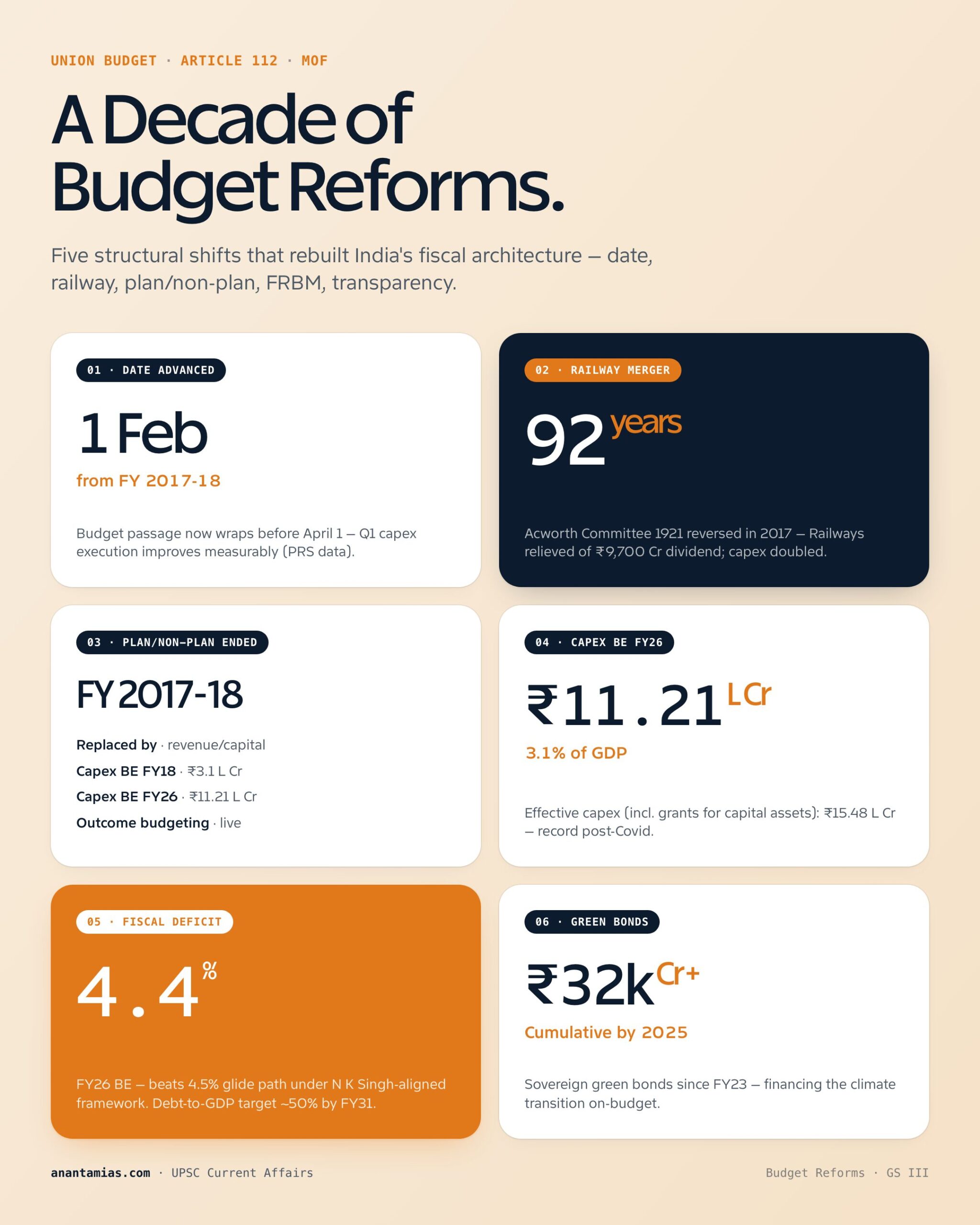
Until FY 2017-18, the Union Budget was presented on the last working day of February. The Modi government advanced the date to 1 February beginning with the Budget for FY 2017-18 (presented February 1, 2017).
Why It Was Done
- The earlier date meant that the Finance Bill and Appropriation Bill were typically passed in mid-May, just before the fiscal year ended. Departments operated under Vote on Account or interim arrangements for the first 1-2 months of the financial year.
- This caused delays in scheme rollout, especially for capital expenditure programmes that needed mobilisation in the early monsoon-construction window.
- The advanced date allows complete budget cycle to close before April 1, with appropriations passed by end-March.
- Ministries get ready cash from the start of the financial year, enabling better planning and execution.
Outcome
- Pre-2017, Capex tended to bunch in Q3-Q4 (March rush). Post-2017, Capex spreads more evenly across the year, raising execution efficiency.
- PRS Legislative Research notes a measurable improvement in expenditure pacing across ministries.
- Overall fiscal discipline benefits from better coordination between the Budget cycle and the construction season.
Reform 2: Merging the Railway Budget with the Union Budget
What Changed
For 92 years (1924-2016), the Railway Budget was presented separately, a relic of the Acworth Committee (1921) recommendation. From FY 2017-18, the Railway Budget was merged into the Union Budget.
Why It Was Done
- The colonial-era separation outlived its purpose — Railways no longer accounted for the bulk of central government finances.
- Separation fragmented the picture of government finances and reduced the focus on multimodal transport planning.
- Railways had to pay an annual dividend to the Consolidated Fund (~Rs 9,700 crore), which constrained its capital investments.
- A unified Budget would allow integrated infrastructure planning across roads, railways, ports, and inland waterways.
Outcome
- Railways relieved of dividend payment, freeing ~Rs 9,700 crore annually for capex.
- Strengthened the case for PM Gati Shakti National Master Plan (October 2021) — integrating 36 ministries on one geographic information platform for multimodal logistics.
- National Logistics Policy 2022 complemented this by setting cost targets (cut logistics from 14 percent to ~9 percent of GDP).
- Railway capex scaled to Rs 2.65 lakh crore (BE 2025-26) from ~Rs 1.4 lakh crore in 2017-18 — a near-doubling.
- Better dashboard-style reporting of total transport spending (rail+road+aviation+ports) in budget documents.
Reform 3: Discontinuation of Plan/Non-Plan Classification
What Changed
Since the First Five-Year Plan (1951), government expenditure had been split into:
- Plan expenditure: Capital and revenue spending on Five-Year Plan schemes (development outlays).
- Non-Plan expenditure: Establishment costs, salaries, subsidies, interest payments, defence (recurring obligations).
This dichotomy was dropped from FY 2017-18 in line with the NITI Aayog's recommendation following the dissolution of the Planning Commission (2014).
Why It Was Done
- The classification had no economic rationale — the same activity (e.g., school maintenance) could be Plan in one year and Non-Plan in the next.
- It distorted political and bureaucratic incentives — "Plan" expenditure was treated as good and growth-promoting, "Non-Plan" as bad — leading to under-funding of operations and maintenance.
- It created skewed allocations — new schemes received Plan funds while existing infrastructure decayed for want of Non-Plan support.
- The Rangarajan Committee (2011) had recommended its replacement with a more meaningful revenue-capital classification.
What Replaced It
- Revenue expenditure (recurring — salaries, interest, subsidies, pensions) versus
- Capital expenditure (asset-creating — roads, bridges, weapons, public sector equity).
- Scheme expenditure further classified as Centrally Sponsored Schemes (CSS) with cost-sharing or Central Sector Schemes fully funded by Centre.
Outcome
- Cleaner revenue/capital lens that aligns with the FRBM Act targets.
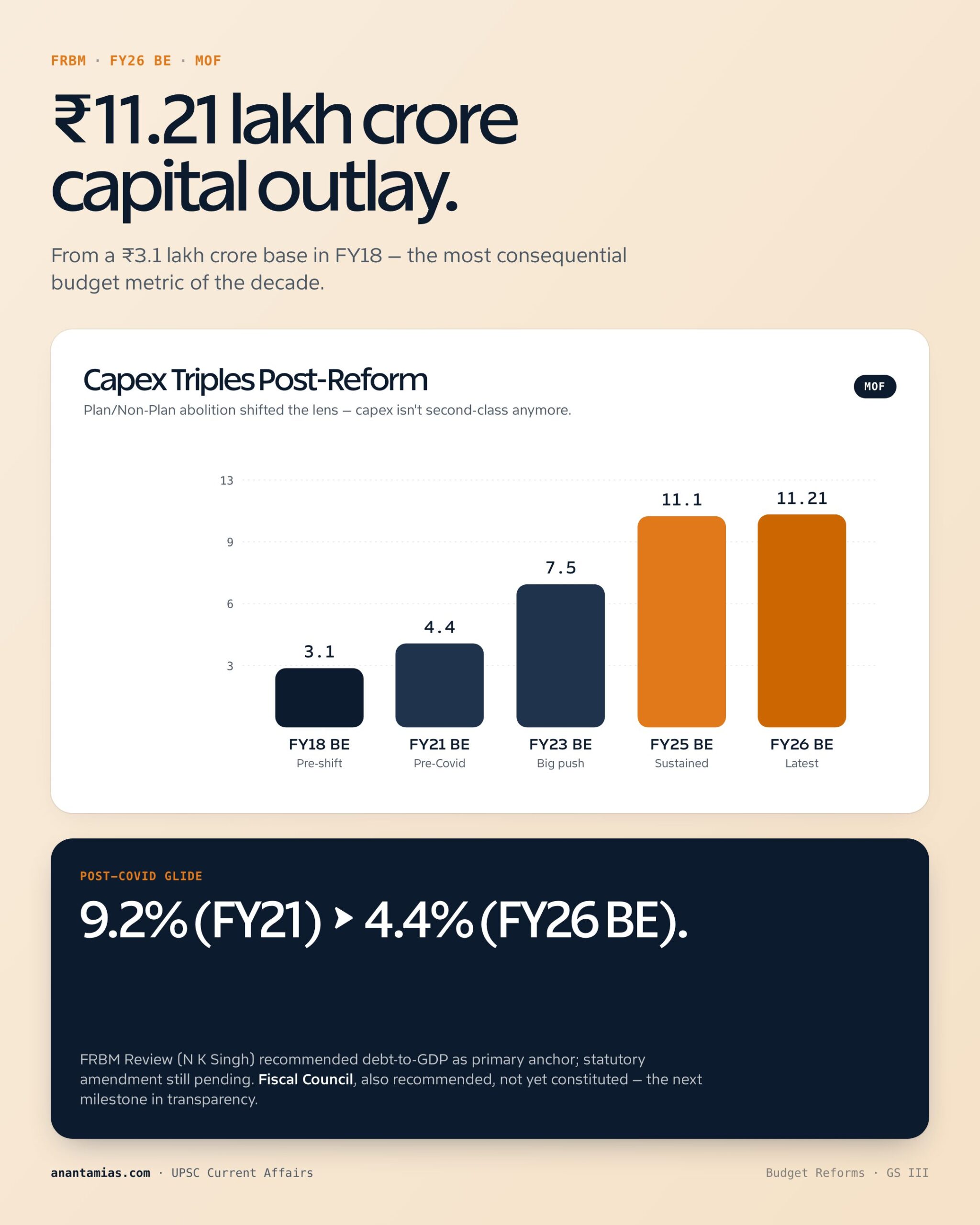
- Greater focus on capital expenditure quality — capex jumped from ~Rs 3.1 lakh crore (BE FY18) to Rs 11.21 lakh crore (BE FY26) under the new framework.
- Operations and maintenance budgets are no longer second-class.
Reform 4: Fiscal Transparency and Realistic Revenue Assumptions
Off-Budget Borrowings Disclosure
- Earlier, governments financed schemes through off-budget borrowings by entities like Food Corporation of India (FCI), National Highways Authority of India (NHAI), and public sector undertakings, which kept reported fiscal deficits artificially low.
- Budget 2021-22 began publishing a separate statement on extra-budgetary resources (EBRs).
- By Budget 2022-23, the bulk of FCI's borrowing was brought on-budget, sharply raising reported food subsidy outgo.
- This significantly improved comparability with international fiscal-deficit norms (IMF GFS framework).
Realistic Revenue Projections
- Earlier Budgets often used optimistic revenue assumptions to project lower deficits, with subsequent shortfalls met by last-minute expenditure cuts.
- Budget 2022-23 based revenue projections on conservative assumptions, providing a buffer in an uncertain global environment.
- Subsequent Budgets (2023-24, 2024-25, 2025-26) have continued this practice, supported by buoyant tax collections post-GST simplification.
- GST collections have averaged Rs 1.7-1.9 lakh crore monthly through 2024-25.
Outcome
- IMF Article IV reports praised India's improved fiscal transparency post-2021.
- Sovereign rating agencies (S&P, Moody's, Fitch) upgraded India's outlook through 2024-25, partly citing fiscal transparency reforms.
Reform 5: Restructuring the FRBM Framework
Original Architecture
The Fiscal Responsibility and Budget Management (FRBM) Act, 2003 required the Centre to bring revenue deficit to zero and fiscal deficit below 3 percent of GDP. The targets were repeatedly missed, especially during the GFC and Covid years.
N K Singh Committee Recommendations
The N K Singh Committee (2017) recommended:
- Debt-to-GDP as the primary fiscal anchor (40 percent for Centre; 60 percent for general government).
- Fiscal deficit as the operational target.
- Escape clauses for war, calamities, or growth shocks (>3 standard deviations).
- Fiscal Council to provide independent forecasts (not yet implemented).
Post-Covid Glide Path
- Fiscal deficit spiked to 9.2 percent of GDP (FY21) during Covid.
- Glide path under Budget 2021-22: bring fiscal deficit below 4.5 percent by FY26.
- Budget 2025-26 projects fiscal deficit at 4.4 percent of GDP — actually beating the 4.5 percent target.
- Centre's debt-to-GDP projected to fall from 57.1 percent (FY24 RE) toward 50 percent by 2030-31.
What's Still Pending
- Statutory amendment to FRBM Act to switch primary anchor to debt-to-GDP.
- Fiscal Council — recommended by FRBM Review Committee, OECD; still not constituted.
- More detailed medium-term expenditure framework.
A Snapshot of Reforms
| Reform | Year | Core Change | Key Outcome |
|---|---|---|---|
| Budget date advance | 2017 | Feb-end → Feb 1 | Full passage by Mar 31; better Q1 capex |
| Railway Budget merger | 2017 | Separate → Unified | Multimodal planning; Gati Shakti |
| Plan/Non-Plan abolition | 2017 | Plan vs Non-Plan → Revenue vs Capital | Capex focus; rational allocation |
| Off-budget disclosure | 2021 | Hidden EBRs → On-budget | Fiscal transparency; rating upgrade |
| FRBM glide path | 2021 onwards | 9.2% (FY21) → 4.4% (BE FY26) | Discipline restored |
Recent Developments (2024-26)
- Capital expenditure in BE FY 2025-26 was Rs 11.21 lakh crore (~3.1 percent of GDP) — record high, sustaining the post-Covid capex push.
- Effective capital expenditure (including grants-in-aid for capital assets) at Rs 15.48 lakh crore in FY26 BE.
- Fiscal deficit target: 4.4 percent of GDP in FY26 BE (vs 4.8 percent in FY25 RE).
- Debt-to-GDP of central government projected at around 56 percent (FY26 BE), with downward trajectory to ~50 percent by FY31.
- Output Outcome Monitoring Framework: every Budget scheme tracked through measurable outputs and outcomes (DARPG-NITI joint exercise).
- Public Financial Management System (PFMS) integration: real-time tracking of CSS releases.
- Tax simplification (Budget 2025-26): zero income tax up to Rs 12 lakh (with rebate); marginal tax slab rationalisation.
- GST 2.0 review anticipated in 2025-26 — rationalisation of slabs, simpler compliance.
- Sovereign green bonds issued since FY23 — Rs 32,000+ crore raised by 2025; aligned with India's green transition financing.
- Direct Tax Code (DTC): review committee constituted; new DTC Bill expected in 2025-26 to replace the Income Tax Act, 1961.
Concerns and Way Forward
Concerns
- Fiscal Council still not operational — independent forecasting weak.
- State finances still opaque on off-budget borrowings, despite 15th Finance Commission recommendations.
- Net borrowing of states under Article 293(3) restricted, but special-purpose vehicles continue.
- Subsidy bills still volatile — food, fertiliser, fuel — exposing fiscal projections to commodity cycles.
Way Forward
- Constitute Fiscal Council to provide independent macro-fiscal forecasts.
- Statutory FRBM amendment to make debt-to-GDP the primary anchor.
- Further GST rationalisation for revenue stability.
- Standardise off-budget disclosure at state level.
- Outcome Budgeting to be deepened with real-time PFMS data.
UPSC Relevance
GS-III Mapping
- Government budgeting (directly named in syllabus).
- Indian economy and issues relating to planning, mobilization of resources.
- Issues of growth, development and employment.
Prelims Pointers
- Budget date — advanced to 1 February from FY 2017-18.
- Railway Budget merged with Union Budget from FY 2017-18 (Acworth Committee, 1921 ended).
- Plan/Non-Plan classification discontinued from FY 2017-18.
- Article 112 — Annual Financial Statement.
- Article 110 — Money Bill (Budget is a Money Bill).
- FRBM Act, 2003 — fiscal discipline framework; N K Singh Committee, 2017.
- Vote on Account — Article 116; allows interim spending.
- Capex BE 2025-26: Rs 11.21 lakh crore.
Mains Hooks
- "Discuss the major reforms in the Indian Union Budget over the past decade and their impact on fiscal management." (GS-III)
- "Examine the rationale and impact of merging the Railway Budget with the Union Budget."
- "Why is fiscal transparency a precondition for credible fiscal policy? Evaluate India's progress."
- "Should India shift from a fiscal-deficit anchor to a debt-to-GDP anchor under FRBM?"
The Union Budget reforms of the past decade — date shift, railway merger, plan/non-plan abolition, fiscal transparency, FRBM glide path — together amount to a structural modernisation of India's fiscal architecture. The 2024-26 Budgets have built on these foundations with record capex, conservative revenue projections, and a credible glide path. For UPSC, master the timeline, the constitutional and legal anchors, and the 2024-26 numerical updates — and you will have one of the strongest GS-III tools for any government-finance question.
Tell Google you want more of this.
Add Anantam IAS as a preferred sourceOne tap, and this site shows up more often in your own Top Stories, AI Overviews and AI Mode. Remove it any time.