Malayalam Literature Optional works when your background and temperament match the paper. It is not a shortcut. It is a 500-mark commitment, and it will punish you if you choose it only because someone else scored well with it.
The right question is simple: can you read Malayalam Literature for months, write precise answers under pressure, and revise it without losing GS momentum? If yes, this optional can serve you well. If no, choose a subject you can actually sustain.
Quick Verdict
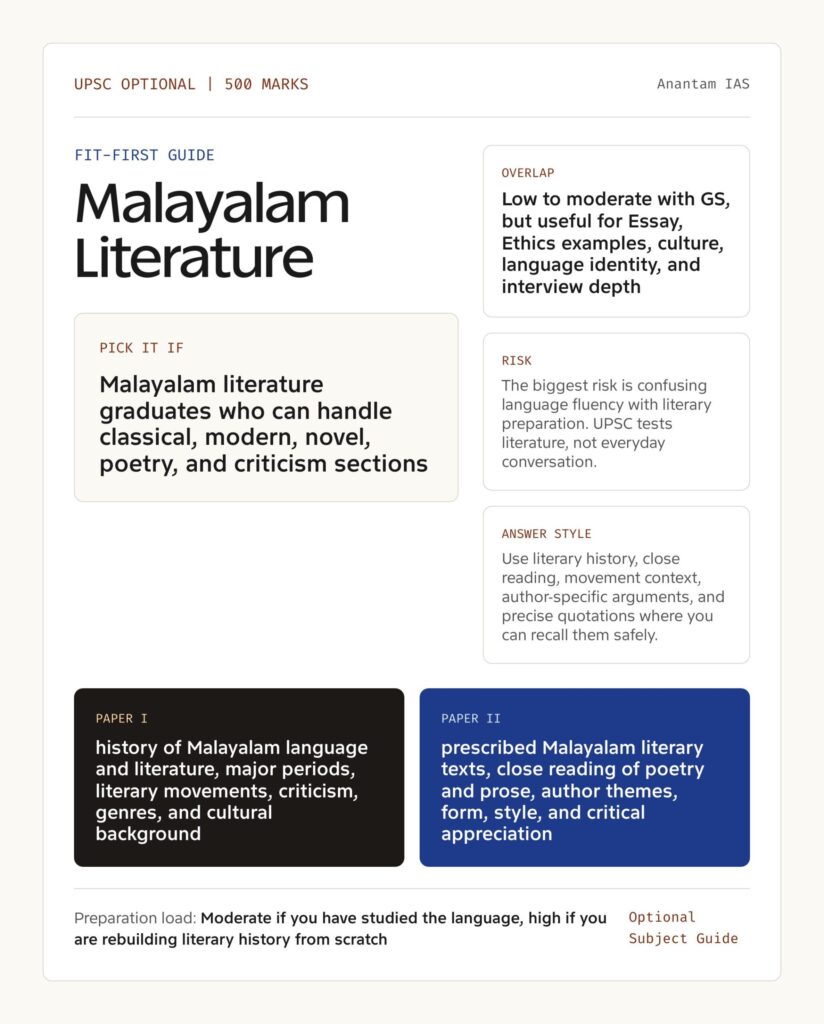
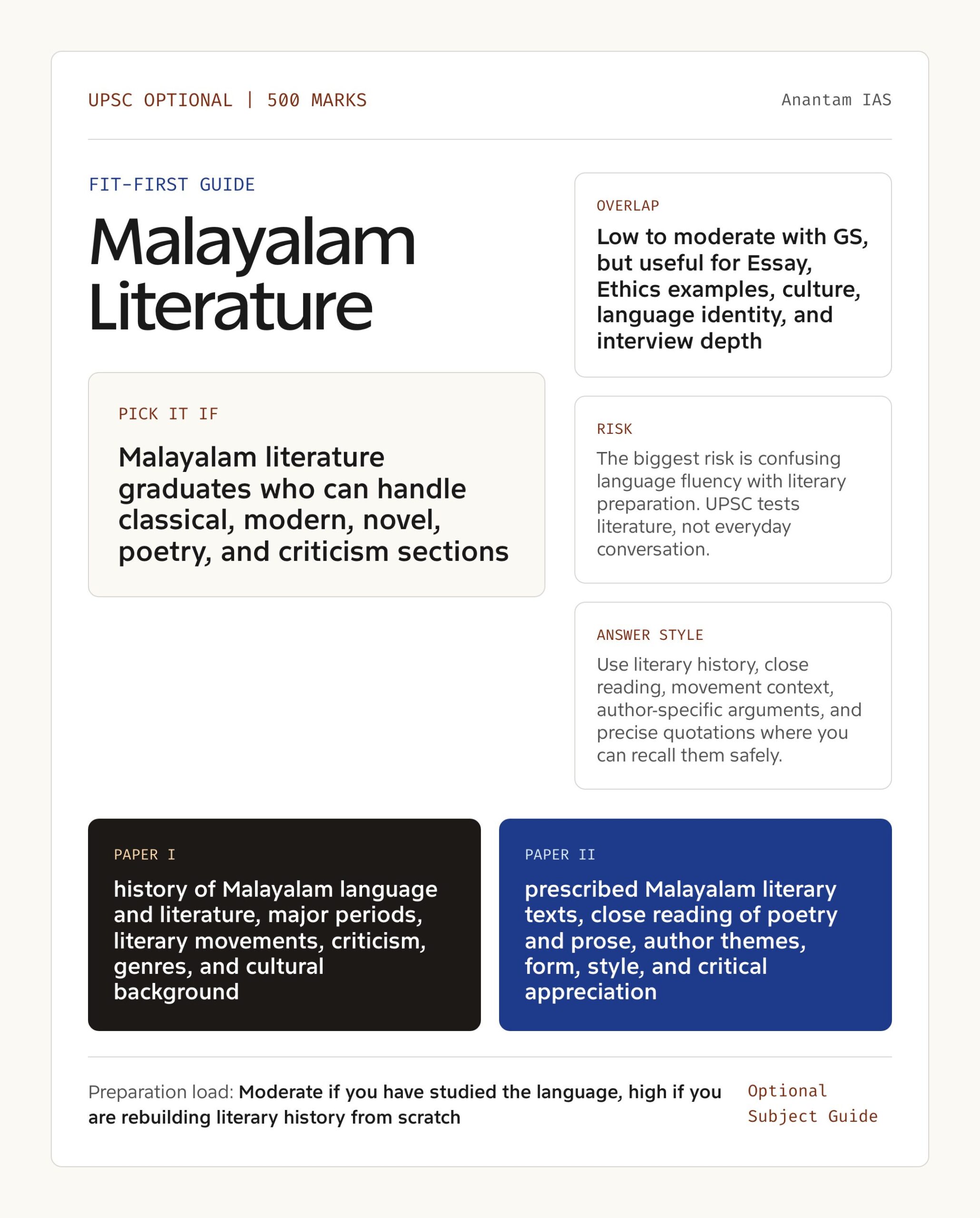
Choose Malayalam Literature Optional if this describes you: Malayalam literature graduates who can handle classical, modern, novel, poetry, and criticism sections. Skip it if you only speak Malayalam conversationally but have not read literary texts or criticism seriously.
The big advantage is the overlap: low to moderate with GS, but useful for Essay, Ethics examples, culture, language identity, and interview depth. The catch is equally clear: The biggest risk is confusing language fluency with literary preparation. UPSC tests literature, not everyday conversation.
For the full comparison across subjects, use the main optional hub after you shortlist two or three choices: UPSC Optional Subjects.
Malayalam Literature Optional At A Glance
| Factor | What It Means |
|---|---|
| Marks | 500 marks across Paper I and Paper II |
| Best fit | Malayalam literature graduates who can handle classical, modern, novel, poetry, and criticism sections |
| GS overlap | Low to moderate with GS, but useful for Essay, Ethics examples, culture, language identity, and interview depth |
| Preparation load | Moderate if you have studied the language, high if you are rebuilding literary history from scratch |
| Answer style | Use literary history, close reading, movement context, author-specific arguments, and precise quotations where you can recall them safely. |
| Main risk | The biggest risk is confusing language fluency with literary preparation. UPSC tests literature, not everyday conversation. |
What The Syllabus Feels Like
The syllabus should be read paper-wise, not book-wise. A booklist gives you material. The syllabus tells you what UPSC can actually test.
Paper I
Paper I broadly covers history of Malayalam language and literature, major periods, literary movements, criticism, genres, and cultural background. Treat this paper as the conceptual base. Your goal is not to collect facts. Your goal is to develop the vocabulary and structure that the examiner expects from a candidate who has genuinely studied the subject.
Paper II
Paper II broadly covers prescribed Malayalam literary texts, close reading of poetry and prose, author themes, form, style, and critical appreciation. This is where candidates often lose balance. Paper II may feel more applied, but it still needs subject depth. A good answer uses the same core concepts from Paper I and applies them to Indian, practical, or contemporary contexts wherever the syllabus allows it.
Who Should Choose Malayalam Literature
You should choose this optional if three conditions are true.
First, you can revise the basic language of the subject without constantly returning to beginner material. Optional preparation becomes painful when every topic feels like a first reading.
Second, you can write answers in the subject’s natural style. Use literary history, close reading, movement context, author-specific arguments, and precise quotations where you can recall them safely. If that feels natural, you have an advantage. If it feels forced, test the subject for two weeks before committing.
Third, your GS plan can survive the optional workload. The optional is important, but it cannot eat the entire year. A subject that gives you 20 extra optional marks but costs you 50 GS marks is not a win.
Booklist And Sources
Start with the UPSC notification’s prescribed text list first. Add the literary history and critical companions below as your second read — they give you the framing UPSC examiners look for.
- UPSC prescribed Malayalam Section A & Section B text list (latest notification)
- K.M. George — A Survey of Malayalam Literature
- Ulloor S. Parameswara Iyer’s literary history
- Annotated editions of Ezhuthachan, Kumaran Asan, Vailoppilly, M.T. Vasudevan Nair, O.V. Vijayan
- Previous year UPSC Malayalam papers — minimum last 10 years
For literature optionals, owning your text editions matters more than collecting commentaries. Read the prescribed text twice before opening any external history.
24-Week Preparation Roadmap
Weeks 1 to 4: Syllabus Mapping
Print the syllabus and mark every topic as familiar, weak, or unknown. Read one basic source quickly. Do not make bulky notes yet. At this stage, you are building a map.
Weeks 5 to 12: First Serious Coverage
Prepare literary history and criticism first, then prescribed texts author-wise, then build quotation and theme sheets. Keep PYQs beside you while reading. If a topic has appeared repeatedly, prepare it as an answer unit, not just as a note.
Weeks 13 to 18: Notes And Answer Frameworks
Compress every major topic into a revision sheet. A good optional note should contain definition, core argument, examples, diagrams or data where useful, and two previous year question angles.
Weeks 19 to 24: Tests And Revision
Write sectional tests first, then full-length papers. The last six weeks should not be a reading marathon. They should be a retrieval marathon: recall, write, check, improve, repeat.
Answer Writing Strategy
Optional answers are not longer GS answers. They must show subject command in the first few lines.
Use this basic structure:
- Define the concept or locate the issue.
- Bring in the subject vocabulary.
- Add evidence, theory, diagram, case, or data as the subject demands.
- Evaluate both sides where the question asks for analysis.
- End with a clear conclusion, not a vague line.
For Mains answer practice outside the optional, use UPSC Mains Answer Writing. The mechanics of timing and structure are the same, but the optional needs sharper subject vocabulary.
Common Mistakes
- The biggest risk is confusing language fluency with literary preparation. UPSC tests literature, not everyday conversation.
- Ignoring previous year questions until the syllabus is complete.
- Making notes that are too long to revise in the final 30 days.
- Writing generic GS answers when the optional needs subject vocabulary.
Final Advice
Do not choose Malayalam Literature because it looks fashionable. Choose it because you can see yourself revising it three times and still writing with energy. That is the real test of an optional.
If you are confused between this and another optional, compare three things: the first 20 PYQs, one standard book chapter, and one topper answer copy. Your decision will become much clearer than any generic ranking list.
Related Optional Guides
Compare Malayalam Literature with a few sibling optionals before you commit. A two-week trial across two or three candidates beats any ranking list.
- Kannada Literature Optional — Complete Guide
- Kashmiri Literature Optional — Complete Guide
- Mechanical Engineering Optional — Complete Guide
- Commerce and Accountancy Optional — Complete Guide
- Management Optional — Complete Guide
- Bengali Literature Optional — Complete Guide
- Maithili Literature Optional — Complete Guide
FAQs
Is Malayalam Literature Optional good for UPSC?
It is good if your background and interest match the subject. Malayalam Literature can work well for candidates who can handle its preparation load and answer style. It is not automatically good for everyone.
How long does Malayalam Literature Optional take?
Most candidates need 4 to 6 months for first coverage and answer writing. If you are new to the subject, add extra time for foundation building.
Does Malayalam Literature Optional overlap with General Studies?
Low to moderate with GS, but useful for Essay, Ethics examples, culture, language identity, and interview depth. Use overlap as a bonus, not as the only reason to choose the subject.
Can I prepare Malayalam Literature Optional without coaching?
You can, if you have reliable sources, a strict PYQ plan, and answer evaluation. Coaching is useful when the syllabus feels scattered or when you cannot judge answer quality yourself.
What should I check before finalizing this optional?
Read the syllabus, solve or outline 5 previous year questions, and read one standard chapter. If all three feel manageable, the optional deserves serious consideration.
Tell Google you want more of this.
Add Anantam IAS as a preferred sourceOne tap, and this site shows up more often in your own Top Stories, AI Overviews and AI Mode. Remove it any time.