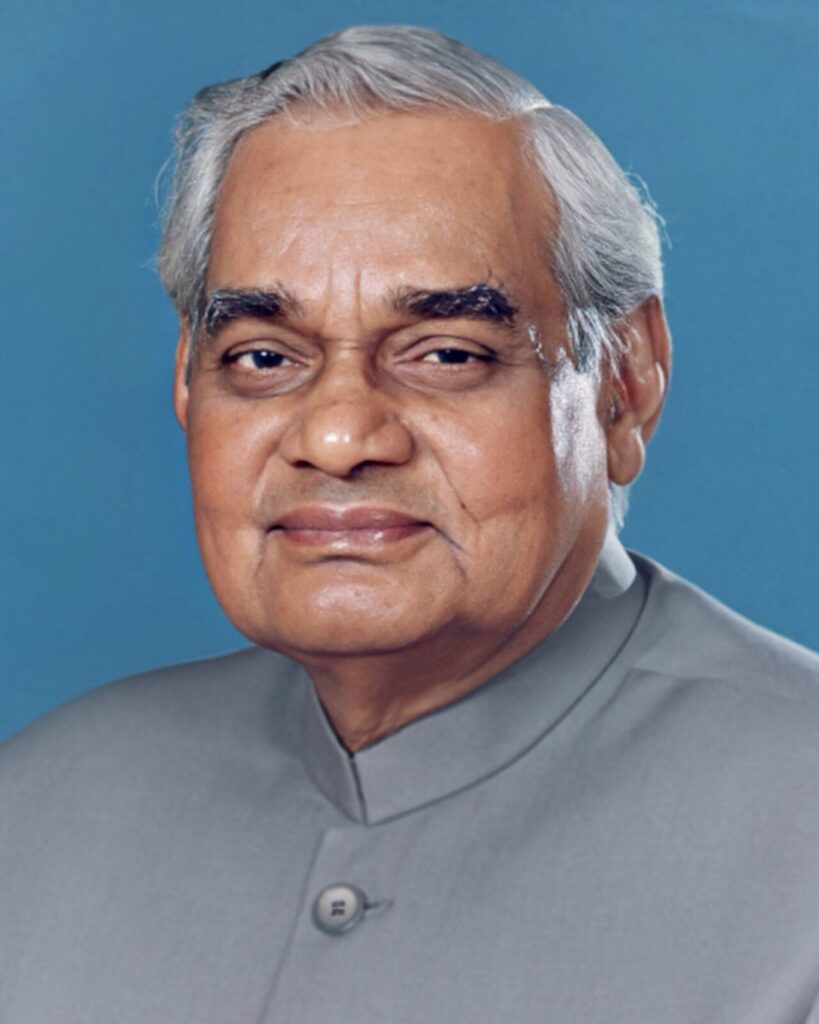
Atal Bihari Vajpayee served as India’s Prime Minister three times — for 13 days in 1996, 13 months in 1998-99, and a full term from October 1999 to May 2004 — and remains the only non-Congress leader to complete a full term in office before 2014. Atal Bihari Vajpayee built the National Democratic Alliance, made Pokhran-II a strategic certainty in May 1998, took the Lahore Bus to Pakistan in February 1999, fought and won the Kargil War later that year, and stitched a coalition of two dozen parties around a moderate Hindu-nationalist core.
His government opened roads, telecom and disinvestment on a scale not seen since 1991, legislated fiscal responsibility, and ran an external sector that turned current-account surplus by 2003-04. He lost the 2004 election to the “India Shining” backlash, retired from active politics after a 2009 stroke, received the Bharat Ratna in 2015, and died on 16 August 2018. The annual oration cycle in his memory and the Atal Bihari Vajpayee statue at Parliament’s lawns confirm what UPSC modern-history students need to absorb: he is the consensus-builder against whom successor coalitions are still measured.
Early life: from Bateshwar to the Jana Sangh
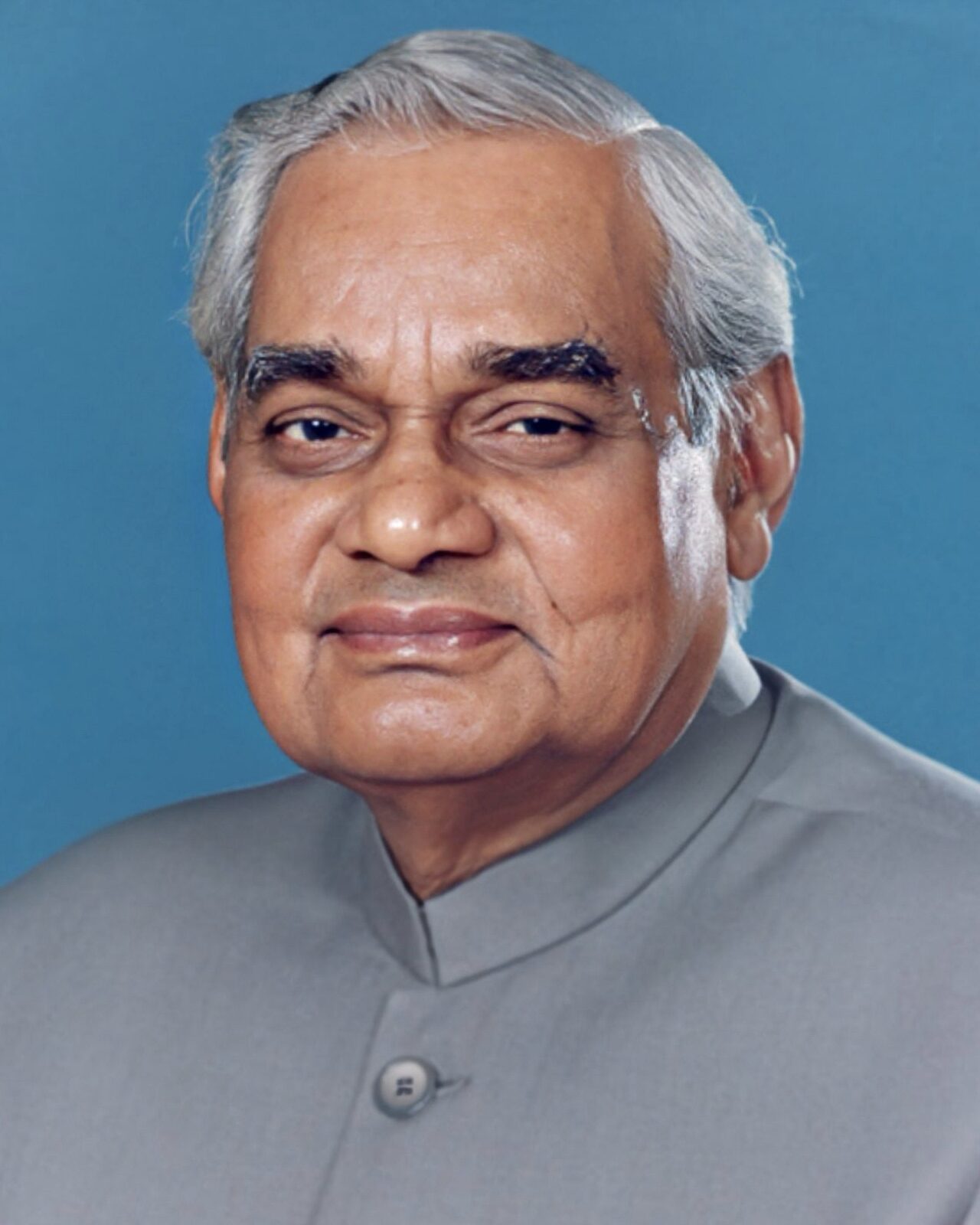
Atal Bihari Vajpayee was born on 25 December 1924 in Gwalior, Madhya Bharat, into a Brahmin family of teachers. He took an MA in Political Science from DAV College Kanpur, briefly studied law, and joined the Rashtriya Swayamsevak Sangh in his teens. He was jailed during the Quit India Movement in 1942 — a fact often used to defend his nationalist credentials against critics of the Sangh Parivar’s wartime record.
He apprenticed under Syama Prasad Mookerjee in the Bharatiya Jana Sangh from 1951, edited its publications, and entered the Lok Sabha in 1957 from Balrampur. Nehru reportedly told a visiting dignitary that the young Vajpayee would one day be Prime Minister. He served as External Affairs Minister in the Morarji Desai government (1977-79), delivering a UN General Assembly speech in Hindi — the first Indian to do so. After the Janata Party split, Atal Bihari Vajpayee co-founded the Bharatiya Janata Party in 1980 and served as its first president.
Wilderness years and the Ayodhya question
Through the 1980s the BJP fluctuated between 2 and 85 Lok Sabha seats. The Ram Janmabhoomi movement and L.K. Advani’s Rath Yatra of 1990 — which followed V.P. Singh’s Mandal Commission implementation — shifted the party’s trajectory. Atal Bihari Vajpayee positioned himself as the moderate face who could broker alliances when the Congress organisation weakened after the assassinations and the P.V. Narasimha Rao succession.
The three terms
13 days, May 1996
The 1996 verdict made the BJP the single largest party. President Shankar Dayal Sharma invited Atal Bihari Vajpayee to form a government, but he resigned on 28 May 1996 before facing a confidence vote rather than horse-trade. His resignation speech — broadcast live — is considered one of the great parliamentary addresses of independent India.
13 months, March 1998 – April 1999
The 1998 election produced a BJP-led coalition. Within ten weeks Atal Bihari Vajpayee authorised Operation Shakti — five nuclear tests at Pokhran on 11 and 13 May 1998. The material had been kept ready by his predecessor governments, including under P.V. Narasimha Rao. International sanctions followed; Vajpayee held the political line. In February 1999 he took the inaugural Delhi-Lahore bus ride and signed the Lahore Declaration with Nawaz Sharif. The AIADMK withdrew support in April 1999 and his government fell by one vote — 269 to 270 — in the no-confidence motion.
Full term, October 1999 – May 2004
The 1999 verdict gave the National Democratic Alliance a comfortable majority. The interim Kargil War of May-July 1999 had already restored political momentum. The full term produced:
- Golden Quadrilateral and Pradhan Mantri Gram Sadak Yojana — the largest highway construction programme since independence, linking Delhi-Mumbai-Chennai-Kolkata.
- Disinvestment of CPSEs — VSNL, BALCO, Maruti Udyog, Hindustan Zinc and IPCL were privatised through a dedicated Department of Disinvestment.
- Fiscal Responsibility and Budget Management Act 2003 — capped fiscal deficit and revenue deficit, the framework still cited in every Budget.
- National Highways Development Project, Sagarmala precursor work, the Antyodaya Anna Yojana 2000, and the Sarva Shiksha Abhiyan 2001.
- 86th Constitutional Amendment 2002 — made the Right to Education a fundamental right (Article 21A), later operationalised by the RTE Act 2009 under Manmohan Singh.
- Pradhan Mantri Gramodaya Yojana, Antyodaya, and the start of the National Rural Employment Programme tradition.
Pokhran-II and the strategic doctrine
Operation Shakti on 11 and 13 May 1998 conducted five tests — three on day one (a thermonuclear device, a fission device, and a sub-kiloton device) and two more on day two. Atal Bihari Vajpayee read the announcement at 7 Race Course Road. India declared a No First Use doctrine in 1999. The American CIA had not detected the preparations — a strategic surprise that reset the South Asian deterrence calculus.
Kargil War 1999
Pakistani Northern Light Infantry intrusions into Kargil heights were detected in May 1999. The Indian Army, with IAF Mirage 2000s deploying laser-guided bombs at altitudes never tested in combat, regained Tololing, Tiger Hill and Point 4875 by 26 July 1999 — Kargil Vijay Diwas. Atal Bihari Vajpayee held a self-imposed restriction: Indian forces would not cross the Line of Control. The political dividend converted into the October 1999 mandate.
Diplomatic legacy
Atal Bihari Vajpayee carried the Look East policy forward, opened the strategic partnership track with the US under President Clinton’s 2000 visit and President Bush’s first term, deepened ties with Russia and France, hosted Pervez Musharraf at Agra in 2001 (the summit failed), and finally signed the joint statement with Musharraf in January 2004 that restarted dialogue. His oratory — pauses, gravitas, Hindi cadences — set the parliamentary standard for a generation.
India Shining and the 2004 verdict
The “India Shining” campaign launched in late 2003 projected GDP at 8 percent, rising forex reserves and a buoyant urban India. The May 2004 verdict surprised the BJP: the rural and southern Indian electorate did not feel the shine. Atal Bihari Vajpayee handed power to Manmohan Singh on 22 May 2004 and gracefully exited.
Bharat Ratna and legacy
The Bharat Ratna was conferred on Atal Bihari Vajpayee on 25 December 2014 — his 90th birthday — and announced on Good Governance Day, now observed annually on the same date. He died on 16 August 2018. The Atal Tunnel under Rohtang Pass (inaugurated 2020) and AIIMS Atal Bihari Vajpayee Bhopal carry his name. His verse — Geet Naya Gaata Hoon — is taught alongside policy decisions, an unusual literary residue for a head of government.
For an integrated reading of Indian Prime Ministers across the 1989-2014 period, the Atal Bihari Vajpayee record complements V.P. Singh’s social-justice turn, P.V. Narasimha Rao’s economic opening, and Manmohan Singh’s rights-based welfare expansion.
The poet, the parliamentarian, the coalition manager
Atal Bihari Vajpayee’s distinctive contribution to Indian public life ran beyond policy. He was a published poet — Meri Ekyavan Kavitayein remains in print — and his oratory style influenced two generations of parliamentarians. As Leader of Opposition (1980-84, 1993-96) he set the convention of substantive engagement with ruling-party Bills, including bipartisan support for sensitive Indo-Sri Lanka and Cauvery decisions. He also pioneered the modern coalition Common Minimum Programme as a governance instrument, an idea later adopted by Manmohan Singh’s UPA.
His Cabinet — featuring L.K. Advani as Deputy PM and Home Minister, Yashwant Sinha and later Jaswant Singh as Finance Ministers, Arun Shourie as Disinvestment Minister, George Fernandes as Defence Minister, and Murli Manohar Joshi in Human Resource Development — held together through the AIADMK pullout of 1999 and the post-Godhra communal flashpoint of 2002. The decision-making style was consensual; the political costs of the 2002 Gujarat riots were absorbed at the state level but shadowed the national party’s image in the 2004 campaign.
Frequently Asked Questions
Who was Atal Bihari Vajpayee and how many times was he Prime Minister?
Atal Bihari Vajpayee was India’s 10th, 11th and 12th Prime Minister. He served three terms — 13 days in May 1996, 13 months in 1998-99, and a full term from October 1999 to May 2004. He was the first non-Congress leader to complete a full term as Prime Minister of India.
What were Atal Bihari Vajpayee’s major economic achievements?
He launched the Golden Quadrilateral and Pradhan Mantri Gram Sadak Yojana, accelerated CPSE disinvestment through a dedicated department, passed the Fiscal Responsibility and Budget Management Act 2003, opened the telecom sector under the New Telecom Policy 1999, and presided over current-account surplus by 2003-04.
What is Pokhran-II and why was it significant?
Pokhran-II refers to five nuclear tests conducted under Operation Shakti on 11 and 13 May 1998 — three on day one including a thermonuclear device, two on day two. Atal Bihari Vajpayee made India a declared nuclear-weapons state. India adopted a No First Use doctrine in 1999. The tests reset South Asian deterrence and triggered US-led sanctions that were progressively rolled back.
How did India win the Kargil War under Atal Bihari Vajpayee?
The Indian Army, supported by IAF Mirage 2000s deploying laser-guided bombs at altitudes never combat-tested, regained Tololing, Tiger Hill and Point 4875 between May and 26 July 1999. Atal Bihari Vajpayee imposed a self-restriction that Indian forces would not cross the Line of Control, retaining international legitimacy.
What is the FRBM Act 2003?
The Fiscal Responsibility and Budget Management Act 2003 set legal limits on the fiscal deficit and revenue deficit, requiring the Union government to follow a glide path to fiscal consolidation. It is the legal backbone of every subsequent Budget exercise and was last amended through the Finance Act 2018 to add an escape clause.
Why did Atal Bihari Vajpayee lose the 2004 election?
The u0022India Shiningu0022 campaign projected urban prosperity but missed rural distress, southern-state political shifts, and dissatisfaction among farm-distress regions. The Congress-led UPA secured 218 seats against the NDA’s 181, and Manmohan Singh took oath on 22 May 2004.
When did Atal Bihari Vajpayee receive the Bharat Ratna?
The Bharat Ratna was announced for Atal Bihari Vajpayee on 24 December 2014 and conferred on 27 March 2015 — his 90th birthday year. His birthday, 25 December, is observed annually as Good Governance Day.
How does Atal Bihari Vajpayee compare with other Prime Ministers?
Among modern PMs, Atal Bihari Vajpayee is recognised for coalition stewardship — running a 24-party NDA — and for combining nuclear assertion with economic reform. He sits alongside P.V. Narasimha Rao (1991 reforms), Manmohan Singh (rights-based welfare), and V.P. Singh (Mandal Commission) as architects of the 1989-2014 transformation phase.
Tell Google you want more of this.
Add Anantam IAS as a preferred sourceOne tap, and this site shows up more often in your own Top Stories, AI Overviews and AI Mode. Remove it any time.