
A country can ban something, prosecute it, build a scheme to end it, and watch its highest court triple the compensation for dying in it. And the work can still go on. That’s the strange place India sits with manual scavenging. The law has said no since 1993. The Supreme Court has said no, with money attached, twice. The government tells Parliament the practice is gone. But the deaths it reports in the same breath say otherwise. So the topic isn’t really “is manual scavenging banned.” It is. The question is why a banned, caste-bound, lethal job keeps killing the same people, and what it would take to stop it.
That tension is the whole editorial. The legal ban and the policy effort are real, not cosmetic. The deaths and the caste pattern behind them are real too. A good answer holds both. It refuses to pretend the State has done nothing, and it refuses to accept the comforting line that a job nobody admits exists can’t be the one that’s still killing people. Dignity isn’t a slogan here. It’s the missing variable in a problem everyone says they’ve already solved.
The Issue, Framed
The fight here isn’t whether manual scavenging should be banned. Everyone agrees it should, and on paper it is. The fight is about a definition, because the definition decides who gets counted, who gets compensated, and whether the State can call the problem finished.
Let’s fix the vocabulary, because almost all the confusion on this topic comes from two words that sound similar and mean very different things in law. Manual scavenging is the manual handling of human excreta. Think of a person clearing a dry latrine by hand, carrying nightsoil, emptying an insanitary toilet that has no flush and no safe disposal. The Employment of Manual Scavengers and Construction of Dry Latrines (Prohibition) Act, 1993 banned exactly this, along with building the dry latrines that create the work. So this part of the practice has been illegal for over three decades.
Then came the Prohibition of Employment as Manual Scavengers and their Rehabilitation Act, 2013, the PEMSR Act, which did two big things. It widened the net to cover cleaning of septic tanks, sewers, and railway tracks, not just dry latrines. And it created a second category: hazardous cleaning. That’s the entry of a person into a sewer or septic tank without protective gear and safety devices, which the Act makes a punishable offence. The same Act puts the duty on states to identify manual scavengers and rehabilitate them, with training, loans, and housing.
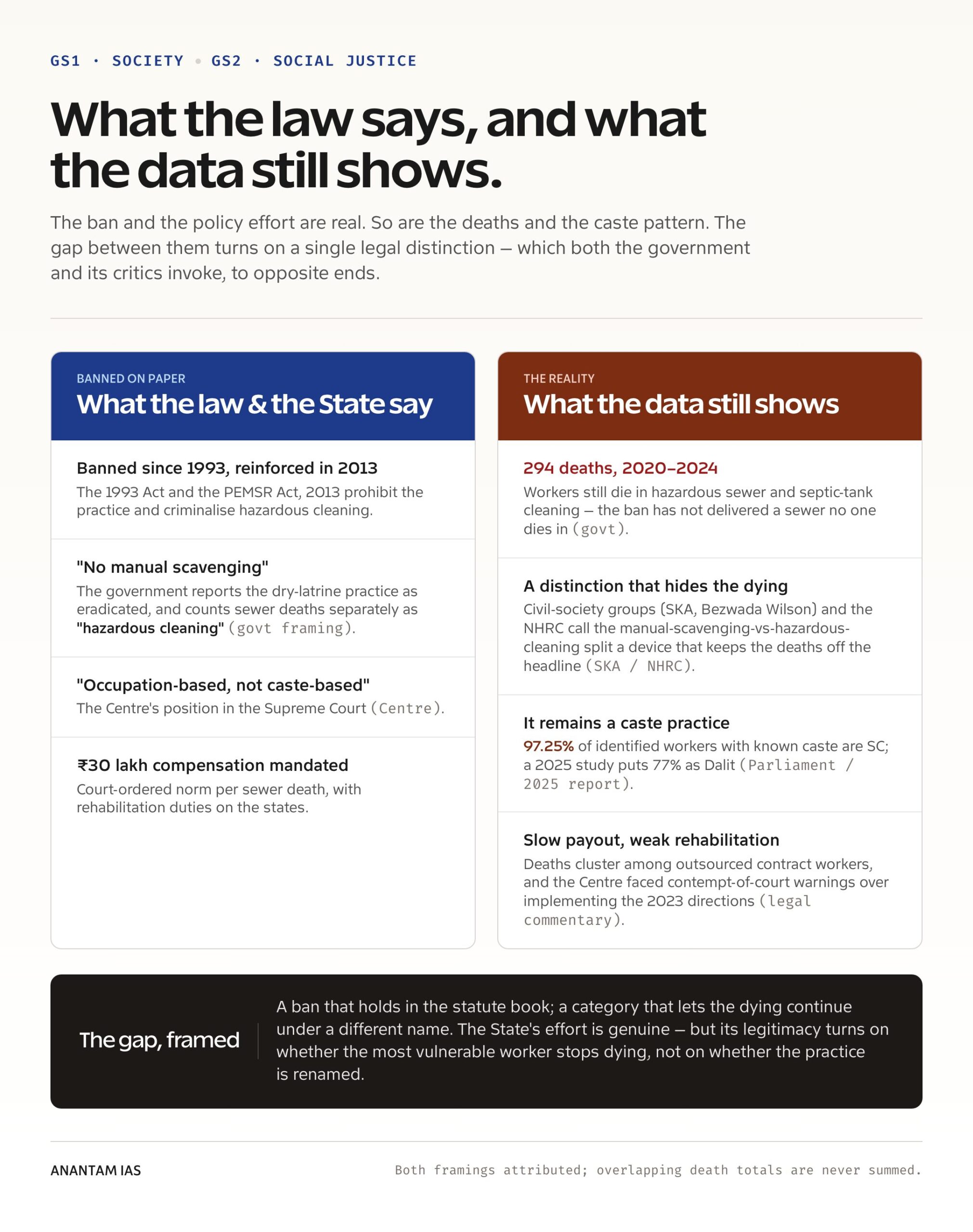
Here’s where it gets slippery. The government’s position is that manual scavenging, the dry-latrine kind, has been eradicated, while the people dying in sewers and septic tanks are doing hazardous cleaning, a legally separate thing. So you get the line that runs through every Parliament reply: deaths, yes; manual scavenging, no. Civil-society groups led by the Safai Karamchari Andolan (SKA) and its convener Bezwada Wilson reject that as a word game that lets the State count the dead while denying the practice. Both framings have to be stated, and each attributed to its source, because the whole topic turns on this distinction.
A ban that holds in the statute book. A category that lets the dying continue under a different name. That gap is the issue, framed.
What the Data Says
The numbers here need careful handling, because the government’s own figures come from different Parliament replies covering overlapping years, and they should never be added together. Take them one at a time and attribute each.
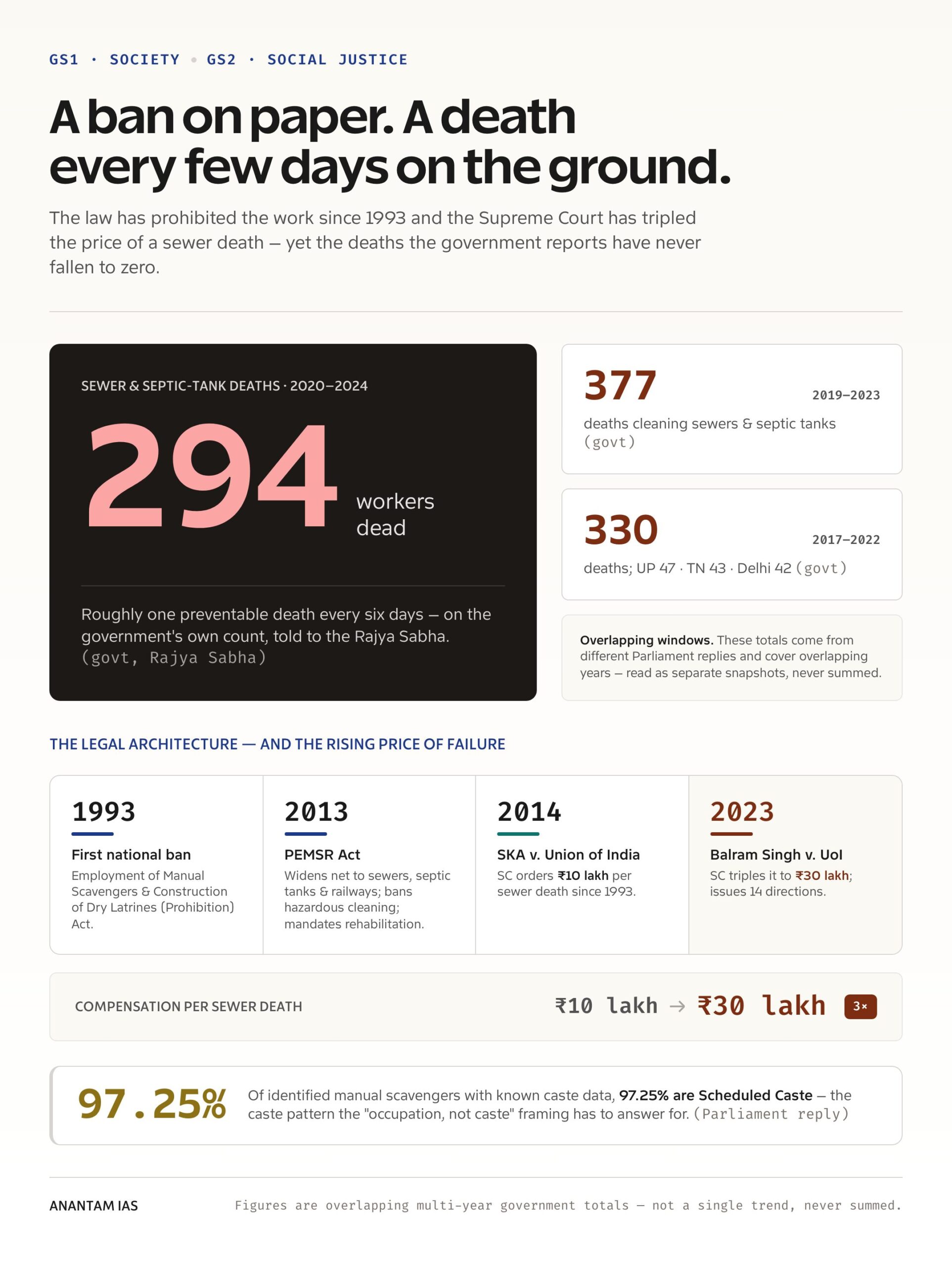
The freshest figure: the government told the Rajya Sabha in February 2025 that 294 workers died cleaning sewers and septic tanks between 2020 and 2024. That’s roughly one preventable death every six days. In the 2024 Monsoon Session, the government had told Parliament that 377 people died cleaning sewers and septic tanks during 2019-2023, and in the same answer maintained there was “no report of practice of manual scavenging” as the law defines it. Earlier still, in August 2022, the figure given was 330 deaths over 2017-2022, with Uttar Pradesh at 47, Tamil Nadu 43, and Delhi 42. These three windows overlap. So read them as separate snapshots of the same grim baseline, never as a running total. The honest takeaway is simpler than any single number: on the State’s own record, the deaths have never dropped to zero, and rarely below about 40 a year.
The cumulative count is where the dispute is sharpest, so here it has to be a range, not a point. The government’s figure is 1,035 sewer-related deaths since 1993, with compensation paid to the kin of 948. The National Commission for Safai Karamcharis (NCSK) has cited around 814. And the SKA puts it at at least 1,760. Three numbers, three counting methods, one reality nobody disputes: people keep dying. Present the spread, attribute each source, and resist crowning one as “the” figure. An NCSK member has himself conceded the official numbers “do not reveal the true picture.”
The caste pattern is the part that the “occupation, not caste” framing can’t survive. Of 58,098 manual scavengers identified under the 2013 Act’s criteria across 17 states and union territories, caste data was available for 43,797, and of those, 97.25% were Scheduled Caste. Uttar Pradesh alone accounted for 32,473 of those identified. Under the NAMASTE scheme, about 92% of profiled sanitation workers belong to SC, ST, or OBC communities, and a 2025 study found 77% of manual scavengers are Dalit, even as the Union government argues in court that this is an “occupation-based, not caste-based” activity. So the State’s denial of the caste link runs straight into the State’s own profiling data.
And the counting itself has never been honest. SECC-2011 recorded 80,843 manual scavengers and about 26 lakh insanitary latrines, while the Ministry of Rural Development separately put rural manual scavengers at 1,82,505 in 2015. The NHRC has cited 10,228 people engaged in manual scavenging across eight states during 2013-2018, which sits awkwardly beside any claim of zero. When the State can’t say how many manual scavengers exist within a factor of two, it can’t credibly say the practice is over.
The Case For
The case that India is genuinely working to end this is stronger than critics like to admit, and a lazy answer that waves it away will read as one-sided. So state it at full strength.
The legal architecture is real, and it has teeth. The 2013 PEMSR Act doesn’t just ban a practice. It criminalises hazardous cleaning without safety devices, with imprisonment up to a year and fines, enhanced for repeat offences, and it makes states legally responsible for finding and rehabilitating workers. So this isn’t a moral exhortation. It’s a statute with offences and duties attached.
The courts have enforced it, and raised the price of failure. In Safai Karamchari Andolan v. Union of India (2014), the Supreme Court directed states to identify the families of everyone who died in sewerage work since 1993 and pay ₹10 lakh compensation per death. Then in Dr Balram Singh v. Union of India (2023), the Court tripled that to ₹30 lakh for a sewer death, set at least ₹20 lakh for permanent disability and ₹10 lakh for other disability, and issued 14 directions, including full elimination of manual sewer cleaning even where it’s outsourced, a fresh National Survey, scholarships for dependants, and High Court monitoring. The Court’s own words name the wrong squarely: each of us owes it to a population that has “remained unseen, unheard and muted, in bondage.” So the judiciary hasn’t treated this as policy preference. It’s treated it as a constitutional debt.
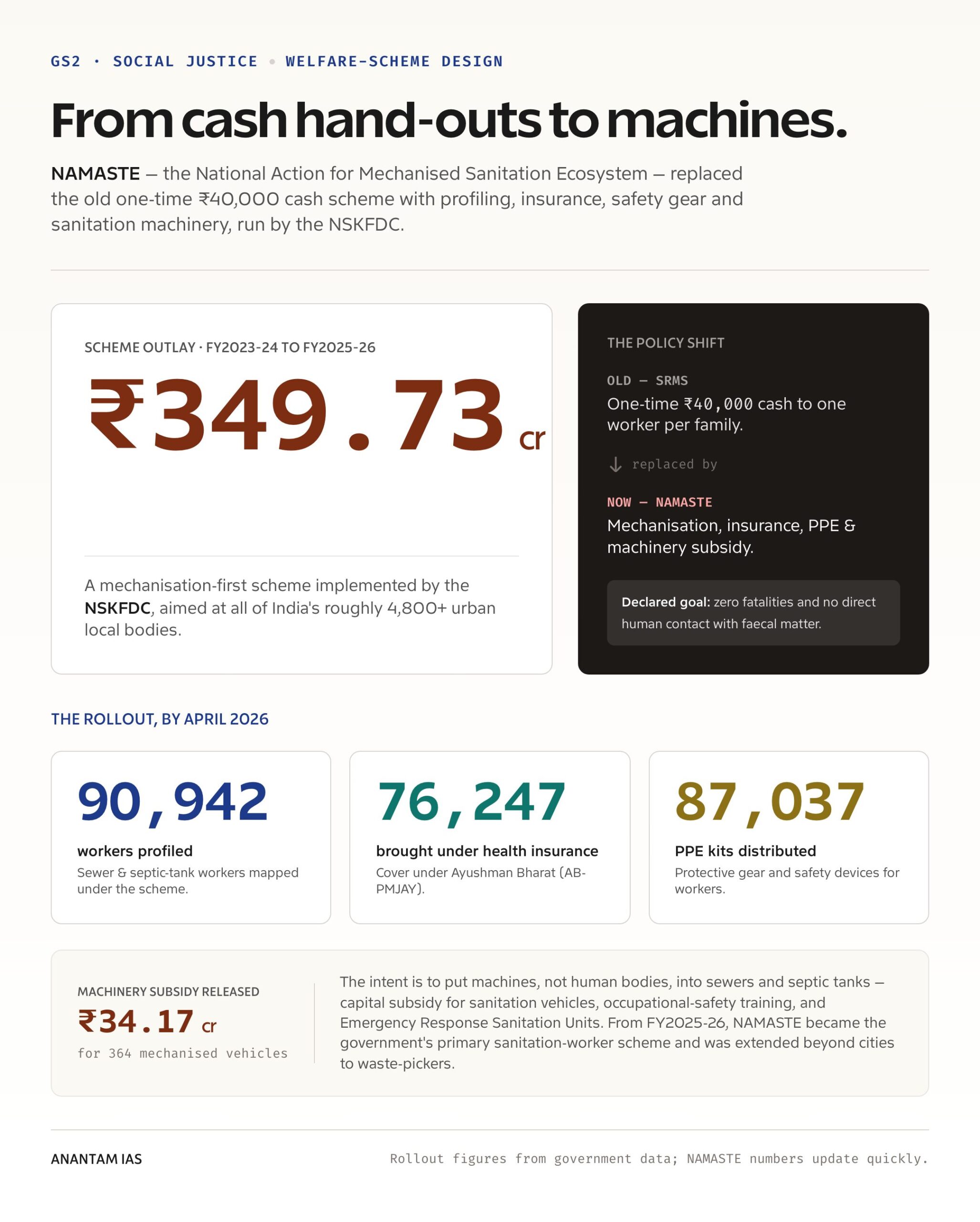
The policy has shifted from cash to machines. The old Self Employment Scheme for Rehabilitation of Manual Scavengers (SRMS) offered a one-time ₹40,000 to one identified worker per family, which was charity, not transformation. The National Action for Mechanised Sanitation Ecosystem (NAMASTE), launched in July 2023 by the social-justice and housing ministries and run by the National Safai Karamcharis Finance & Development Corporation (NSKFDC), replaced it. NAMASTE carries an outlay of ₹349.73 crore over FY2023-24 to FY2025-26, and it pays for the things that keep people alive: profiling, health insurance under Ayushman Bharat, occupational safety training, capital subsidy for sanitation machinery, PPE kits, and Emergency Response Sanitation Units. Mechanisation, the use of machines instead of human bodies to clean sewers and tanks, is the whole point. The declared goal is zero fatalities and no direct human contact with faecal matter.
And the rollout has numbers behind it. As of April 2026, NAMASTE had profiled about 90,942 sanitation workers, distributed 87,037 PPE kits, brought 76,247 under health insurance, and released ₹34.17 crore in subsidy for 364 mechanised vehicles. From FY2025-26 it was scaled up as the government’s primary sanitation-worker scheme and extended beyond cities to waste-pickers. So the State can fairly say it has moved from denial-plus-cash to mechanisation-plus-cover. That’s real progress, and an honest answer says so before it turns the page.
The Case Against
Here’s what the progress story walks past. A practice isn’t ended when the law bans it. It’s ended when people stop dying doing it. On that test, the record is damning, and the kindest reading of the government’s own data still shows a job that kills.
The deaths haven’t stopped. 294 between 2020 and 2024, 377 between 2019 and 2023, on the State’s own record. A ban that’s been law since 1993 and reinforced in 2013 has not produced the one outcome that matters, a sewer nobody dies in. So whatever the statute achieved, it didn’t achieve that.
The definitional loophole is doing heavy lifting. By logging these as “hazardous cleaning” rather than “manual scavenging,” the government can report “no manual scavenging” while reporting the deaths in the same answer. It’s technically consistent with the law’s two categories. But the effect is that the most lethal version of the work, going into a sewer with no machine and no safety gear, sits outside the headline the State chooses to defend. The NHRC has recommended widening the legal definition of manual scavenging to fold in hazardous cleaning, precisely so the deaths get counted as what they are. When a national rights body says the category needs fixing, the category is the problem.
It is still a caste practice, whatever the framing says. Hold the State’s “occupation-based, not caste-based” line against its own profiling: 97.25% of identified manual scavengers with known caste are SC, about 92% of NAMASTE-profiled workers are SC/ST/OBC, and an independent 2025 study puts 77% as Dalit. Workers come overwhelmingly from the Valmiki, Balmiki, and Mehtar sub-castes, placed at the bottom even within Dalit communities. So this isn’t a job that happens to be done by Dalits. It’s a job assigned to them by a hierarchy the Constitution outlawed in 1950 and society didn’t.
The counting is too weak to trust the all-clear. Between SECC-2011’s 80,843, the Rural Development ministry’s 1,82,505, the 58,098 identified figure, and the NHRC’s 10,228, the State’s own estimates contradict each other badly. Undercounting isn’t a clerical problem here. It hides the scale and starves rehabilitation of the people it’s meant to reach. You can’t rehabilitate a worker you’ve decided not to count.
Sub-contracting outsources the dying. Many deaths cluster among contract workers hired through layers of municipal and private outsourcing, the kind who don’t appear cleanly in any official register. The Balram Singh court specifically barred outsourced contracts that require entering sewers, which tells you the practice was alive enough to need banning again. And rehabilitation has been slow enough that by December 2024 the Centre faced contempt-of-court warnings for not implementing the 2023 directions.
Then there’s the Swachh Bharat irony, which belongs in any honest answer. India’s flagship cleanliness mission built crores of toilets, but the underlying design still leaves work for human hands. Bezwada Wilson’s charge is blunt: without mechanisation and modern sewage systems, Swachh Bharat is “an illusion,” and “we have invested our money to kill Dalits”. Reported estimates suggest only about 13% of mission toilets had twin pits, with large shares on septic tanks and single pits that can still need manual emptying. A clean nation built on toilets that still need someone to climb in by hand is a contradiction the data won’t let you ignore.
The Deeper Structural Read
Step back from the schemes and the death counts, and the real fault line shows up. This was never only a sanitation problem. It’s a caste problem wearing a sanitation uniform, and the Constitution already named it.
Read the relevant articles together and the moral architecture is unmistakable. Article 17 abolishes untouchability and forbids its practice in any form. Article 23 prohibits forced labour. Article 21 guarantees life with dignity, which the Court has long read to mean more than mere survival. Article 14 promises equality, and Article 46 directs the State to protect the weaker sections, especially Scheduled Castes, from social injustice. Put plainly: a job that is hereditary, caste-assigned, degrading, and deadly violates not one provision but a cluster of them at once. So when a sewer death happens, it isn’t only an industrial accident. It’s a constitutional failure with a name and a caste attached.
The “occupation, not caste” framing is the move to watch, because it quietly does two things. It detaches the work from history, as though people wandered into sewer cleaning the way they might wander into plumbing. And it lets the State treat the problem as one of equipment and training rather than of caste and dignity. But the data refuses the detachment. When 97 of every 100 identified workers come from one social group, the occupation didn’t choose the workers. The hierarchy did. So a policy that buys machines without confronting the caste assignment behind the work treats the symptom and leaves the disease.
The judiciary has done the structural lifting the executive avoided. Continuing mandamus, the technique where a court keeps a case open and supervises compliance over years, is how SKA (2014) and Balram Singh (2023) turned a dead-letter ban into enforceable compensation and timelines. That’s the court acting as conscience-keeper of a right the political system found easy to forget. But name the limit: a court can mandate ₹30 lakh and a National Survey, yet it cannot, by itself, dismantle the caste logic that keeps refilling the sewers with the same families. Judicial enforcement is necessary. It was never going to be sufficient.
And here’s the part that should sit uncomfortably with any future administrator. The strongest technical case for ending manual entry, that machines clean sewers better and more safely than people, is also the easiest to fund and announce. The harder work, breaking the inherited link between a caste and a kind of labour, doesn’t fit in a scheme outlay. So the risk is that the State mechanises the visible deaths while leaving the invisible assignment intact, and calls that success. Real success looks like the children of today’s sanitation workers never being offered this work at all.
What Should Be Done
So what would actually end it, not on paper but in the sewers? Not a vague call for “political will,” but measures you could hand a secretary tomorrow. Six of them, and none weakens the legal ban.
- Close the definitional gap. Adopt the NHRC’s recommendation to fold all hazardous sewer and septic-tank cleaning into the legal definition of manual scavenging. So long as deaths sit in a separate category, the State can keep reporting “no manual scavenging” while people die. Honest counting starts with an honest definition. The reform machinery already runs through bodies like the National Commission for Safai Karamcharis, which can drive the change.
- Make mechanisation the default and manual entry the rare, regulated exception. Take NAMASTE’s machinery and Emergency Response Sanitation Units to all of India’s roughly 4,800-plus urban local bodies, not a favoured few, and bar manual entry into any sewer without mechanical and safety backup on site. The whole point of the scheme is to replace bodies with machines, so fund it like the goal is zero deaths, because it is. Track this alongside the broader Swachh Bharat sanitation push so toilet design stops creating the work in the first place.
- Count honestly, in public, in real time. Complete the court-ordered National Survey and build one unified, public database that reconciles the NCSK, SKA, and NAMASTE figures instead of letting them contradict each other. You cannot rehabilitate workers you refuse to count, and you cannot prove a practice ended while your own estimates range from ten thousand to nearly two lakh.
- End death-by-sub-contracting with real accountability. Make an FIR the default after every sewer death, prosecute the employer whether municipal or private contractor, and enforce the Balram Singh bar on outsourced contracts that require entering sewers. Pay the ₹30-lakh compensation on a fixed timeline, not after years of follow-up, with High Court monitoring as the Court ordered.
- Rehabilitate into a different life, not a cleaner version of the same one. Move decisively past the old ₹40,000 cash model to skilling, enterprise subsidy through schemes like Swachhata Udyami, and education scholarships for dependants, so the exit is from caste-bound work, not merely from unsafe versions of it. Re-employing a worker as “skilled sanitation labour” alone isn’t rehabilitation if the caste assignment survives.
- Treat dignity as a measurable outcome, not a sentiment. Track whether the children of sanitation workers leave the sector entirely, whether PPE and machines actually reach the worker rather than the storeroom, and whether deaths fall to the declared zero. What gets measured is what gets managed, and dignity has been managed by slogan for too long.
Every one of these strengthens, not weakens, the ban. A practice you count honestly, mechanise fully, prosecute seriously, and exit permanently is a practice you can finally say has ended. That’s the only version of “no manual scavenging” worth claiming.
For Your Mains Answer
This is a rich GS1-plus-GS2 topic. It sits exactly where Indian society, caste, the Constitution, statutory enforcement, and welfare-scheme design all meet, which is why examiners keep returning to it.
GS paper mapping: GS1 (Indian Society): caste and untouchability as a living institution, social exclusion of Dalits, the gap between constitutional values and social reality. GS2 (Polity, Governance, Social Justice): fundamental rights, statutory bans and the enforcement gap, the judiciary as enforcer, welfare schemes for vulnerable sections, government accountability and data integrity.
Likely question frames:
- “Manual scavenging has been banned for over three decades, yet sewer deaths continue. Examine the gap between law and reality, and the reforms needed to close it.”
- “The dignity of sanitation workers is a constitutional question, not merely an administrative one.” Discuss with reference to Articles 17, 21, and 23 and recent Supreme Court directions.
- “Mechanisation alone cannot end a caste-rooted practice.” Critically analyse India’s policy response to manual scavenging.
Quotable data points:
- 294 sewer and septic-tank deaths during 2020-2024 (govt, Rajya Sabha, Feb 2025); 377 during 2019-2023.
- Cumulative deaths since 1993: 1,035 on the government’s record (948 families compensated); NCSK around 814; SKA at least 1,760, present as a range.
- 97.25% of identified manual scavengers with known caste are Scheduled Caste; about 92% of NAMASTE-profiled workers are SC/ST/OBC; a 2025 study puts 77% as Dalit.
- Supreme Court compensation rose 3x, from ₹10 lakh (SKA v. UoI, 2014) to ₹30 lakh (Balram Singh, 2023), which also issued 14 directions.
- NAMASTE: ₹349.73 crore outlay, about 90,942 workers profiled and 87,037 PPE kits by April 2026, with a goal of zero fatalities.
Keywords to use: manual scavenging, hazardous cleaning, PEMSR Act 2013, mechanised sanitation, dignity of labour, untouchability, rehabilitation, sub-contracting, undercounting, continuing mandamus.
Syllabus linkages: caste system and social exclusion; Fundamental Rights (Articles 14, 17, 21, 23) and DPSP (Article 46); statutory and regulatory bodies (NCSK); judicial activism and PIL; welfare-scheme design; centre-state responsibility; government accountability and transparency.
Balanced conclusion line: A ban that the worst-off citizen still dies under isn’t an achievement to defend; manual scavenging ends not when the State stops naming it, but when the last family bound to it is finally free to do something else.
How to Build the Answer
Open with the paradox, not a definition. The hook is that the practice is banned, prosecuted, and scheme-targeted, and still kills, which signals to the examiner that you grasp both the State’s effort and its failure. Let a one-line definition follow in the second sentence, distinguishing manual scavenging from hazardous cleaning, because that distinction carries the whole topic. The opening should frame the value clash between law and dignity, not read like a glossary.
Bring data in early, and ration it. A strong first body paragraph can carry three figures: 294 deaths in 2020-24, the 97.25% SC share, and the ₹10-lakh-to-₹30-lakh rise in compensation. Then say what each proves. The death figure shows the ban’s enforcement gap, the caste figure shows it’s not “occupation-based,” and the compensation rise shows the judiciary doing the executive’s job. UPSC rewards the move from fact to inference, so the “this means” matters more than the number.
The second body paragraph should steelman the State. Whatever your stance, first credit the real ban, the rising compensation, and the mechanisation shift under NAMASTE before you turn to the deaths and the definitional loophole. An answer that admits the progress reads balanced; one that doesn’t reads like a press release for the other side.
Group the way forward; never scatter it. Cluster the reforms: fix the definition, mechanise as default, count honestly, end sub-contracting with FIRs, rehabilitate into a different livelihood, and measure dignity. Use the topic’s own vocabulary, hazardous cleaning, continuing mandamus, rehabilitation, so the answer sounds like governance analysis rather than a news recap.
Close on the constitutional link, Articles 17, 21, and 23, and on caste. The last line should show judgment, not echo the introduction. The reliable pattern here is “the practice ends not when the State stops naming it, but when the families bound to it are free of it.”
Common Mistakes to Avoid
- Don’t merge the death figures. The 294, 377, and 330 totals cover overlapping years from different replies. Cite one or two with their windows; never add them into a single number.
- Don’t accept or reject the “no manual scavenging” line uncritically. Present it as the government’s framing, present the civil-society rejection, and attribute both. That’s how you show you understand the definitional dispute.
- Don’t reduce it to a sanitation or technology problem. The caste dimension is the core. An answer that solves it with machines alone misses what the Constitution is actually about.
- Don’t pile on adjectives. “Inhuman” and “shameful” earn nothing unless a number or an Article is doing the work behind them.
- Don’t forget the worker. Name the contract worker who vanishes from the register, the Valmiki family for whom this is hereditary. UPSC rewards policy that names who bears the cost.
A Compact Answer Spine
- Introduction: Open with the banned-yet-persisting paradox; define manual scavenging versus hazardous cleaning in the next line.
- Evidence: Two or three attributed figures, each tied to a policy implication.
- Arguments: The case that India is ending it (PEMSR Act, court-ordered compensation, NAMASTE), then the case that it persists (continuing deaths, definitional loophole, caste pattern). Keep both fair.
- Structural diagnosis: Articles 17, 21, 23, and 46 together; the caste assignment behind the occupation; the judiciary as conscience-keeper.
- Way forward: Five to six grouped measures, each with a clear actor, the Union, states, ULBs, NCSK, the courts.
- Conclusion: Adapt the balanced conclusion line to the exact question wording.
Diagram or Flowchart Idea
For a 15-marker, draw one causal chain, not a decorative web. The cleanest version: caste assignment to sanitation work → dry-latrine and sewer cleaning by hand → ban (1993, 2013 PEMSR Act) with weak enforcement → deaths reclassified as “hazardous cleaning” → judicial intervention (₹30 lakh, 14 directions) plus NAMASTE mechanisation → unfinished agenda: caste exit, honest counting. The examiner reads the logic in five seconds.
For a 10-marker, skip the diagram and use a two-column table instead, “On paper” against “On the ground,” with the ban, the zero-claim, the occupation-not-caste line, and the compensation mandate on the left, and the 294 deaths, the “hazardous cleaning” reclassification, the 97.25% SC share, and the contempt warning on the right. It does the same work faster.
Ethics and Governance Angle
Add one ethical line even in a GS2 answer, because this topic is built for it. The deepest issue isn’t efficiency; it’s that a democracy assigns its most degrading and dangerous labour to one social group and then looks away. Name the concrete person: the contract worker lowered into a sewer with no machine and no gear, the family that has done this work for generations because caste, not choice, put them there.
Then convert empathy into design. Don’t just say “protect sanitation workers.” Say how: criminalise the employer after every death, mechanise so no human enters a sewer, count workers honestly so rehabilitation reaches them, and fund an exit from the sector for their children. That’s the move from moral language to administrative maturity, and it’s exactly what the examiner wants to see.
A sentence pattern that travels well: “The State’s effort is genuine, but its legitimacy depends on whether the most vulnerable worker stops dying, not on whether the practice is renamed.” It credits the effort without handing the State a clean chit.
How to Use Data Without Sounding Mechanical
Use fewer numbers than you know. Three well-explained figures beat ten thrown at the page. Lead with one human-scale number (294 deaths in five years, about one every six days), use one for the caste truth (97.25% Scheduled Caste), and use one for the response (₹30 lakh compensation, up 3x). One scale figure, one structural figure, one policy figure is enough.
Never leave a statistic standing alone. Follow each with “This means” or “The policy implication is.” The 294 deaths mean the ban isn’t enforced; the 97.25% means the caste link is undeniable; the ₹30 lakh means the courts are carrying the executive’s load. That tiny move turns a fact sheet into analysis.
Finish by asking whether a tired examiner can follow your answer in one pass. Short introduction, data early, both sides marked cleanly, a grouped way forward, a constitutional close. Clarity isn’t a lower standard than depth. For Mains, clarity is how depth becomes visible. Cut any line that sounds impressive but does no work, and replace it with a fact, a cause, a consequence, or a reform.
FAQ
What is the difference between manual scavenging and hazardous cleaning?
Manual scavenging is the manual handling of human excreta, classically from dry latrines, banned outright since 1993. Hazardous cleaning, defined under the PEMSR Act 2013, is a person entering a sewer or septic tank without protective gear and safety devices. The government treats them as legally separate, which lets it report “no manual scavenging” while reporting sewer deaths as hazardous cleaning. Civil-society groups reject the distinction as a way to keep the deaths off the headline.
Is manual scavenging banned in India?
Yes. The Employment of Manual Scavengers and Construction of Dry Latrines (Prohibition) Act, 1993, first banned it, and the PEMSR Act 2013 widened the ban to cover sewers, septic tanks, and railway tracks, criminalised hazardous cleaning without safety devices, and made states responsible for rehabilitation. The practice is illegal. The problem is that sewer and septic-tank deaths continue despite the ban, on the government’s own record.
What did the Supreme Court rule in Balram Singh v. Union of India (2023)?
In Dr Balram Singh v. Union of India (2023), the Court raised sewer-death compensation to ₹30 lakh, set at least ₹20 lakh for permanent disability and ₹10 lakh for other disability, and issued 14 directions, including ending manual sewer cleaning even where outsourced, conducting a fresh National Survey, providing scholarships for dependants, and High Court monitoring. It built on Safai Karamchari Andolan v. UoI (2014), which had set the original ₹10 lakh norm dating back to 1993.
What is the NAMASTE scheme?
NAMASTE, the National Action for Mechanised Sanitation Ecosystem, launched in July 2023 and run by the NSKFDC, replaced the old cash-based SRMS with a mechanisation-first approach. With a ₹349.73 crore outlay for FY2023-24 to FY2025-26, it funds worker profiling, health insurance, safety training, PPE kits, and capital subsidy for sanitation machinery, aiming for zero fatalities and no human contact with faecal matter. By April 2026 it had profiled about 90,942 workers and distributed 87,037 PPE kits.
Tell Google you want more of this.
Add Anantam IAS as a preferred sourceOne tap, and this site shows up more often in your own Top Stories, AI Overviews and AI Mode. Remove it any time.