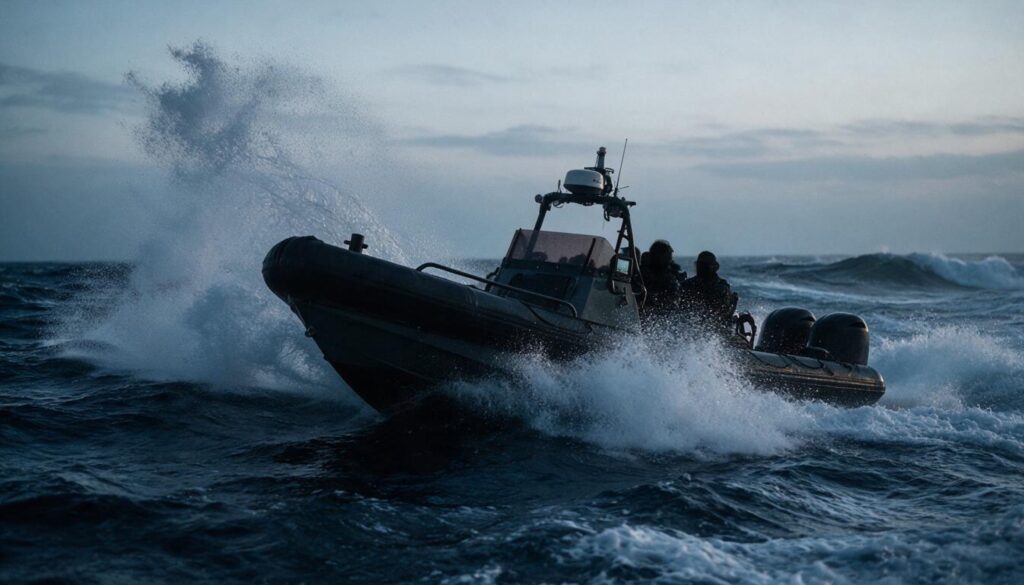
Most people meet the MARCOS through a single image: bearded men in wetsuits rising out of the sea, the caption calling them “the most feared force in the world.” That mystique sells well, and it also gets in the way of the two things an aspirant actually needs, which is what this force is for and where it sits in India’s security architecture. The Marine Commando Force, abbreviated MARCOS, is the special forces arm of the Indian Navy, and its job is not to look fearsome in photographs. Its job is to fight where the sea meets the land, at the exact seam where a warship cannot go and a soldier cannot swim.
Get that seam right and the rest of the topic falls into place. So we will build the answer the way the Navy built the force, from the water outward.
What exactly is MARCOS?
MARCOS is the Indian Navy’s special operations unit, raised to conduct missions in the maritime environment that regular sailors and even regular naval divers are not trained for. Think of the Navy as a body: the warships are the muscle, the submarines are the hidden reach, and MARCOS is the scalpel, small, precise, and used only when brute force would fail. When a hijacked merchant vessel needs boarding at night, when an offshore oil platform is threatened, when a beach has to be scouted before an amphibious landing, that is MARCOS work.
The force was raised in February 1987, first under the name Indian Marine Special Force (IMSF). The Navy later renamed it the Marine Commando Force to give it, in its own words, “an element of individuality,” and the short form MARCOS stuck. The origin story matters because it tells you the standard they were built to: three volunteer officers were sent to train with the United States Navy SEALs at Coronado and later with Britain’s Special Boat Service, and they came back to seed the unit. So MARCOS was not improvised. It was deliberately modeled on the two most established maritime special forces in the world.
Their motto is “The Few, The Fearless.” The nicknames tell you more than the motto does. Inside the service they are called Magarmach (crocodiles), for the way they emerge from water, and enemies in Kashmir once called them the Dadhiwala Fauj, the bearded army, because operating undercover meant growing beards and shedding the clean-shaven naval look. That detail, a naval unit fighting in a landlocked valley, is the first clue that “marine” commando does not mean “sea-only” commando.
What do the Marine Commandos actually do?
MARCOS is trained for maritime special operations, and the cleanest way to hold the mandate is by the roles they rehearse. Each one answers a specific gap that conventional forces leave open.
- Maritime counter-terrorism. Retaking a ship, an oil rig, or a coastal target that terrorists have seized. This is the role the whole country saw in 2008.
- Visit, Board, Search and Seizure (VBSS). Boarding a suspicious or hostile vessel at sea, often from a fast boat or a helicopter, to inspect, detain, or clear it. This is the bread-and-butter of anti-piracy work.
- Hostage rescue at sea. Freeing crews from hijacked merchant ships, the mission that has defined the last decade of MARCOS operations in the Arabian Sea.
- Amphibious reconnaissance and raids. Scouting a hostile beach before a landing, or striking a coastal target and withdrawing by sea.
- Combat diving and underwater demolition. Clearing obstacles, attaching or removing charges, and unseen approach. This is the skill inherited from the Navy’s diving units, out of which MARCOS grew.
- Unconventional and special reconnaissance on land. Yes, on land. MARCOS deployed for years in the Wular Lake and Jhelum river areas of Jammu and Kashmir, precisely because those water bodies were infiltration routes.
Here is the point that trips people up. The word “marine” fixes the environment they specialize in, not a fence they cannot cross. A commando who can lock out of a submarine, swim miles in cold water, and then fight on a rig is more than capable of ambushing on a riverbank. The sea is the hard part. Everything else is downhill from there.
The selection: why “the Few” is literal
The “Few” in the motto is not marketing, it is arithmetic. MARCOS selection is deliberately designed so that most volunteers fail, and the reported washout rate sits around 80 to 85 percent. Only serving Navy personnel can even apply, and they volunteer, they are not posted in.
Selection opens with a three-day physical and aptitude screening that eliminates the majority before real training begins. Those who survive enter roughly a two and a half to three year pipeline before a commando is fully operational, of which the core commando qualification course runs about seven and a half to eight months. The training is famous for a phase informally called “hell”, days of continuous activity on minimal sleep, and for drills like being made to perform tasks with hands and feet bound, which build the specific composure a commando needs when a plan goes wrong underwater and panic would kill him.
The honest way to read this: the brutality is not machismo, it is a filter for temperament. The Navy is not trying to find the strongest man in the room. It is trying to find the man who stays calm when he is cold, exhausted, outnumbered, and cannot see. That is a rare wiring, and no amount of gym work reveals it. Only the ordeal does. If this section makes the force sound superhuman, hold that thought, because the operations show they are extremely well-trained humans doing very hard jobs, not comic-book figures.
Once qualified, commandos add specializations, para-jumping, advanced diving, demolitions, sniping, so a small team carries a wide toolkit. A MARCOS team is designed to be self-sufficient a long way from support.
How they get there: insertion and the underwater edge
What sets a maritime commando apart is not the shooting, it is the getting there unseen, and this is the part worth understanding because it explains why the training is so long. A MARCOS team can reach a target by several routes, and choosing the right one is half the skill. They can free-fall or static-line parachute into the sea, then swim in. They can lock out of a submerged submarine, leaving through a special chamber and rising to the surface underwater, so no boat and no aircraft signals the approach. They can ride a fast interceptor craft and board a moving ship using ladders and hooks, the classic VBSS entry. Or they can swim in from a distance using closed-circuit rebreathers, which recycle the diver’s air so no telltale bubbles rise to give the game away.
That last detail, bubble-free diving, is the quiet heart of the whole force. A regular scuba diver leaves a trail of bubbles that a lookout can spot from a deck. A combat diver on a rebreather leaves nothing. The ability to approach a hostile ship at night, underwater, silent and invisible, and to arrive with the strength and composure to then fight, is exactly what months of brutal water training buys. Everything else a MARCOS commando does, most soldiers could be trained to do faster. The sea approach cannot be shortcut, and that is why the pipeline runs into years.
The land role follows from the same skill set. Because MARCOS mastered the water, they were the natural choice for operations on Kashmir’s lakes and rivers, where militants used waterways to move. A force that can swim a mile in cold water and fight on arrival is not going to be defeated by a riverbank.
The operations that defined them
MARCOS earns its reputation on a short list of real missions, and knowing three or four well beats reciting a dozen vaguely.
The 26/11 Mumbai attacks (2008) are the operation the public remembers. When ten Lashkar-e-Taiba terrorists came ashore by sea and struck multiple sites in Mumbai, MARCOS were among the first special forces to enter the Taj Mahal Palace and Trident-Oberoi hotels, before the National Security Guard arrived and took over the sustained hostage-rescue operation codenamed Operation Black Tornado. It is worth being precise here, because coaching notes often blur it: MARCOS did the early entry, the NSG ran the main operation. That division of labour, naval commandos first on a coastal target and the NSG as the dedicated counter-terror force, is itself an exam-worthy point about how India’s forces fit together. The attack also exposed how a maritime route left the coast under-guarded, which reshaped coastal security afterwards.
Anti-piracy in the Gulf of Aden is where MARCOS works most often. Since Indian warships began escorting merchant traffic through the piracy-infested waters off Somalia, MARCOS boarding teams have foiled repeated hijacking attempts. A well-documented case is the INS Trikand action, when the ship’s marine commandos thwarted a pirate attack on a merchant vessel in the region. If you want a single current example to cite, the INS Trikand piracy response in the Gulf of Aden is clean and recent, and it sits inside India’s larger role as a security provider across the maritime sector.
Operation Sankalp (2024) is the modern showcase. In March 2024, after the Maltese-flagged bulk carrier MV Ruen was hijacked by Somali pirates and used as a mother ship, the Indian Navy’s INS Kolkata intercepted it far out in the Arabian Sea. MARCOS operators, some para-dropped in with combat equipment by the Air Force, rescued the 17-member crew and forced the surrender of 35 pirates, who were later brought to India for prosecution. It was the Navy’s first anti-piracy operation in which captured pirates were brought to Indian soil for trial, and it showed the full VBSS chain working end to end, air insertion, boarding, rescue, and legal follow-through.
Older but instructive is Operation Cactus (1988), the Indian intervention that helped defeat a coup attempt in the Maldives, where marine commandos featured in the maritime pursuit of the fleeing mercenaries. It remains a case study in India acting as a first responder in its neighbourhood.
Where MARCOS fits among India’s special forces
MARCOS is one of three service-specific special forces, and the quickest way to stop confusing them is to remember that each belongs to a different armed service and specializes in a different terrain. The commonest exam trap is mixing up which force is whose and what the National Security Guard does differently from all of them.
| Force | Parent service | Raised | Core domain |
|---|---|---|---|
| MARCOS (Marine Commando Force) | Indian Navy | 1987 | Maritime, amphibious, coastal special operations |
| Para SF (Parachute Regiment, Special Forces) | Indian Army | 1966 (para commandos) | Airborne assault, deep raids, direct action on land |
| Garud Commando Force | Indian Air Force | 2004 | Airbase defence, combat search and rescue, air operations |
| NSG (National Security Guard) | Ministry of Home Affairs | 1984 | Counter-terrorism and hostage rescue, federal contingency |
Read the table as a division of labour, not a ranking. Para SF is the Army’s cutting edge for airborne and deep-penetration missions on land, the force behind the 2016 and 2019 cross-border strikes. Garud protects air assets and does combat search and rescue for the Air Force. The NSG, the black-cat force, is not tied to a service at all, it is the country’s dedicated counter-terror and hostage-rescue unit under the Home Ministry, which is why it, not MARCOS, ran the main 26/11 operation. If you want the NSG side of that story in depth, the explainer on NSG Commandos and the Black Cat unit covers its structure and operations, and the piece on the National Security Guard’s SAG and SRG components unpacks the NSG Act.
So MARCOS owns the water. When a threat comes from or moves across the sea, when a ship or a rig or a beach is the target, MARCOS is the specialist. That single-sentence test, “does the sea define the mission?”, sorts nine out of ten confusions.
How this connects to bigger themes
MARCOS is a small unit with an outsized place in three larger stories, and linking it to those stories is what turns a trivia answer into an analytical one.
First, coastal and maritime security. The 26/11 attackers came by sea, and the response was a layered coastal security grid, the Coast Guard for the near seas, the Navy and marine commandos for the far seas, and marine police for the shoreline. MARCOS sits at the sharp end of this system, and it connects directly to the wider subject of border management, where India’s long coastline is the least visible and most exposed frontier.
Second, India as a net security provider in the Indian Ocean. Anti-piracy escorts, hostage rescues, and rapid interventions like Operation Sankalp are how India signals that it will police the sea lanes its own trade depends on. Roughly 95 percent of India’s trade by volume moves by sea, so a hijacked ship is not a distant nuisance, it is a direct hit on the economy.
Third, capability and cost. Special forces are cheap in numbers and expensive in training, and how much a country spends on this edge is a live policy question that runs through the India’s defence budget debate, where the tension between manpower salaries and modern capability plays out every year.
How to study MARCOS for the exam
Do not memorize the force. Understand the seam it fills, then hang three facts on it. Here is the efficient way to hold this topic.
Lock the identity anchors: Indian Navy special force, raised 1987, first called Indian Marine Special Force, motto “The Few, The Fearless.” Those four facts answer most direct questions.
Learn one operation per role. Use 26/11 for maritime counter-terrorism and for the MARCOS-versus-NSG distinction, Operation Sankalp / MV Ruen for VBSS and hostage rescue, and any Gulf of Aden anti-piracy action for the routine escort role. Three operations, three roles, done.
Nail the comparison table above, because the highest-value confusion the examiner tests is which force belongs to which service. If you can place MARCOS, Para SF, Garud, and the NSG in one line each, you have covered the analytical part.
Finally, connect it upward. Whenever MARCOS appears in the news, it is really a story about coastal security, the Indian Ocean, or defence capability. Answer the bigger question and the specific one takes care of itself. That is the whole secret with niche security topics, they are only worth marks when you tie them to a theme the syllabus actually rewards.
Frequently Asked Questions
What is the full form of MARCOS?
MARCOS stands for Marine Commandos, the informal short form of the Marine Commando Force, the special operations unit of the Indian Navy. It was originally raised as the Indian Marine Special Force in 1987.
When was MARCOS raised and by which service?
The force was raised in February 1987 by the Indian Navy, initially under the name Indian Marine Special Force, and was later renamed the Marine Commando Force.
What is the motto of MARCOS?
The motto is “The Few, The Fearless.” Within the service the commandos are also nicknamed Magarmach (crocodiles), and in Kashmir operations they were called the Dadhiwala Fauj, the bearded army.
Did MARCOS or the NSG handle the 26/11 Mumbai attacks?
Both, in sequence. MARCOS were among the first to enter the Taj and Trident-Oberoi hotels, and the National Security Guard then took over and ran the sustained hostage-rescue operation, codenamed Operation Black Tornado. The NSG is India’s dedicated counter-terror force.
How is MARCOS different from Para SF and Garud?
Each belongs to a different service and terrain. MARCOS is the Navy’s force for maritime and amphibious operations, Para SF is the Army’s airborne and land special force, and Garud is the Air Force’s unit for airbase defence and combat search and rescue.
What was Operation Sankalp and why is it important?
In March 2024, MARCOS operators from INS Kolkata rescued the 17-member crew of the hijacked ship MV Ruen and forced 35 Somali pirates to surrender in the Arabian Sea. It was significant because the captured pirates were, for the first time, brought to India for prosecution.
How hard is it to become a MARCOS commando?
Extremely. Only serving Navy volunteers can apply, and the reported dropout rate is around 80 to 85 percent. Full operational readiness takes roughly two and a half to three years, with the core commando course running about seven and a half to eight months.
Where are MARCOS based?
The force operates from naval establishments including INS Abhimanyu in Mumbai and INS Karna in Visakhapatnam, with detachments positioned to cover both the western and eastern seaboards.
Practice Questions
1. With reference to MARCOS, consider the following statements. Which is/are correct?
a) It is the special forces unit of the Indian Army
b) It was raised in 1987 and was initially called the Indian Marine Special Force
c) Its motto is “The Few, The Fearless”
d) Only (b) and (c)
Answer: d) MARCOS belongs to the Indian Navy, not the Army, so (a) is wrong.
2. During the 2008 Mumbai (26/11) attacks, the sustained hostage-rescue operation, Operation Black Tornado, was primarily conducted by:
a) MARCOS
b) Para SF
c) The National Security Guard
d) The Central Reserve Police Force
Answer: c) MARCOS entered early, but the NSG ran the main operation.
3. Match the special force with its parent service. Which pairing is incorrect?
a) MARCOS, Indian Navy
b) Garud, Indian Air Force
c) Para SF, Indian Army
d) NSG, Indian Navy
Answer: d) The NSG is under the Ministry of Home Affairs, not the Navy.
4. “Visit, Board, Search and Seizure” (VBSS) operations by MARCOS are most closely associated with:
a) Airbase defence
b) Anti-piracy and counter-hijacking at sea
c) Mountain warfare
d) Disaster relief on land
Answer: b) VBSS is the core skill used in boarding hostile or suspicious vessels.
5. Operation Sankalp (2024), involving MARCOS, was notable because:
a) It was the first para-drop by the Indian Army
b) Captured pirates were brought to India for prosecution for the first time
c) It took place in the Bay of Bengal
d) It was a joint operation with the United States Navy
Answer: b) The rescue of MV Ruen’s crew ended with 35 pirates brought to India for trial.
Mains-style questions
- “The Marine Commando Force fills a gap that neither conventional naval forces nor land-based special forces can cover.” Examine the role of MARCOS in India’s maritime security architecture.
- Distinguish between MARCOS, Para SF, Garud, and the NSG in terms of parent service, domain, and mandate. Why does India maintain service-specific special forces rather than a single unified command?
- The 26/11 Mumbai attacks reshaped India’s coastal security. Discuss the layered coastal security framework that emerged and the place of the Navy’s commandos within it.
- Anti-piracy operations in the Gulf of Aden and the Arabian Sea reflect India’s ambition to be a net security provider in the Indian Ocean. Critically analyse this claim with recent examples.
- Special forces are cheap in numbers but expensive in training and capability. In the context of India’s defence budget, discuss how the country should balance manpower costs against building elite capability.
India does not need many marine commandos, and that is exactly the point. A force of a few hundred, kept at the edge of what the human body can do, buys the country an option it would otherwise not have: to reach a target on the water that nothing else can reach. Read past the wetsuit-and-beard mystique and the force becomes legible, a scalpel held for the one seam where the sea meets the fight. For the exam, and for understanding how India actually secures its coast, that is the version worth carrying.
Tell Google you want more of this.
Add Anantam IAS as a preferred sourceOne tap, and this site shows up more often in your own Top Stories, AI Overviews and AI Mode. Remove it any time.