
UPSC CSE 2026 Essay Paper Discussion

MCQ SUBJECT

Art & Culture

92 UPSC Prelims MCQs tagged "Art & Culture". Free practice with answer keys, explanations, and timed mock tests on Anantam IAS.

  1. Which of the following kingdoms were associated with the life of Buddha? 1. Avanti…

    Which of the following kingdoms were associated with the life of Buddha? 1. Avanti 2. Gandhara 3. Kosala 4. Magadha Select the correct answer using the code given below

    1. A1,2 and 3
    2. B2 and 3 only
    3. C1,3 and 4
    4. D3 and 4 only
    Answer and explanation

    Correct answer: D

    Avanti: Although Buddhism spread to Avanti during the Mauryan period, it wasn't directly connected to the life of the Buddha. Gandhara: While Gandhara became a significant centre for Buddhist culture and art later in history, it wasn't directly associated with the Buddha's life. Thus, Avanti and Gandhar have no direct relation with Buddha's life.

    Kosala: This was the kingdom where the Buddha was born, with his birthplace being Lumbini (present-day Nepal). His mother's family belonged to the Kosala dynasty.

    Magadha: Though the Buddha didn't spend a significant amount of time here during his early life, he travelled and taught in Magadha. Notably, the city of Rajgir (present-day Bihar) was an important centre where he interacted with King Bimbisara.
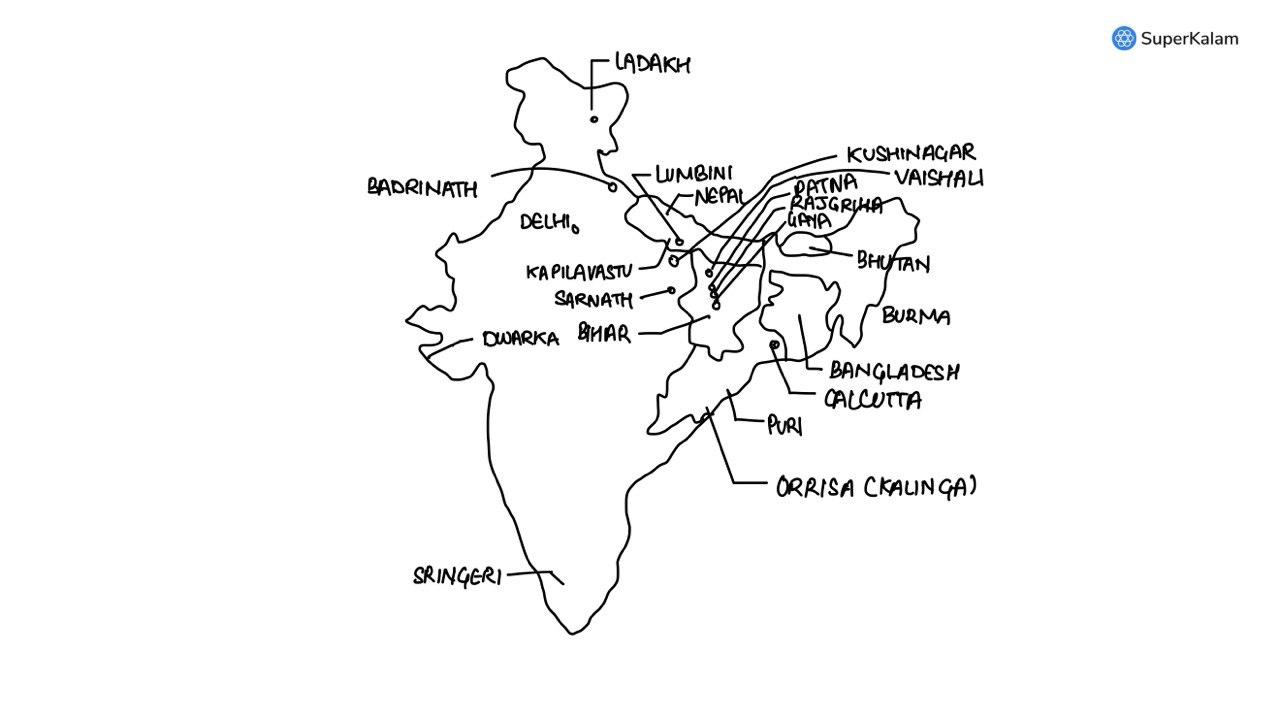
    ![Kingdoms Associated with the Life of Buddha](https://d39jluplm5thpx.cloudfront.net//kingdoms_associated_with_the_life_of_Buddha_4032284908.jpg)

  2. With reference to the Indian history of art and culture, consider the following pairs:…

    With reference to the Indian history of art and culture, consider the following pairs: |Famous work of sculpture|Site| |-- |--| |1. A grand image of Buddha's Mahaparinirvana with numerous celestial musicians above and the sorrowful figures of his followers below|Ajanta| |2. A huge image of Varaha Avatar (boar incarnation) of Vishnu, as he rescues Goddess Earth from the deep and chaotic waters, sculpted on rock|Mount Abu| |3. "Arjuna's Penance" /"Descent of Ganga" sculpted on the surface of huge boulders|Mamallapuram| Which of the pairs given above is/ are correctly matched?

    1. A1 and 2 only
    2. B3 only
    3. C1 and 3 only
    4. D1, 2 and 3
    Answer and explanation

    Correct answer: C

    Pair 1 is correctly matched: The Ajanta Caves, located in Maharashtra, are famous for their Buddhist rock-cut sculptures and paintings, including the grand image of Buddha's Mahaparinirvana in Cave 26.

    Pair 2 is not correctly matched: The huge image of Varaha Avatar of Vishnu is sculpted on the rock at Udayagiri Caves, near Vidisha in Madhya Pradesh, not at Mount Abu.

    Pair 3 is correctly matched: Mamallapuram, also known as Mahabalipuram, is famous for its rock-cut sculptures, including the iconic "Arjuna's Penance" or "Descent of Ganga" carved on two massive boulders.

  3. With reference to Buddhist history, tradition and culture in India. Consider the following pairs:…

    With reference to Buddhist history, tradition and culture in India. Consider the following pairs: |Famous Shrine|Location| |-- |--| |1. Tabo monastery and temple complex | Spiti Valley| |2. Lhotsava Lhakhang temple|Nako Zanskar Valley| |3. Alchi temple complex | Ladakh| Which of the pairs given above is/are correctly matched?

    1. A1 only
    2. B2 and 3 only
    3. C1 and 3 only
    4. D1, 2 and 3
    Answer and explanation

    Correct answer: C

    Pair 1 is correctly matched: Tabo Monastery is located in the Tabo village of Spiti Valley, Himachal Pradesh, northern India.

    Pair 2 is incorrectly matched: Nako is a village in the Himalayas of northern India, located near the Indo-China border in the Trans-Himalayan region of Kinnaur district in Himachal Pradesh. Nako Lake is a prominent feature here, where it borders the village. Nako Monastery, dated to 1025, is located in the village, as well as several other Buddhist chortens.

    Pair 3 is correctly matched: Alchi Monastery or Alchi Gompa is a Buddhist monastery, known more as a monastic complex (chos-'khor) of temples in Alchi village in the Leh District, of the Indian state under the Ladakh Autonomous Hill Development Council of Jammu and Kashmir.

  4. With reference to the cultural history of India, the term ‘Panchayatan’ refers to

    With reference to the cultural history of India, the term 'Panchayatan' refers to

    1. Aan assembly of village elders
    2. Ba religious sect
    3. Ca style of temple construction
    4. Dan administrative functionary
    Answer and explanation

    Correct answer: C

    Panchayatan (from Sanskrit: pañcha = five + āyatana = dwelling or shrine) refers to a style of temple architecture in which the main shrine is surrounded by four subsidiary shrines at the four corners of the temple platform. This layout symbolizes the worship of five deities (Panchadevata), typically: - Shiva - Vishnu - Shakti (Devi) - Surya (Sun) - Ganesha or Skanda It was popularized during the Gupta period and became a hallmark of Nagara-style temple architecture in North India.

  5. A community of people called Manganiyars is well-known for their –

    A community of people called Manganiyars is well-known for their -

    1. Amartial arts in North-East India
    2. Bmusical tradition in North-West India
    3. Cclassical vocal music in South India
    4. Dpietra dura tradition in Central India
    Answer and explanation

    Correct answer: B

    The Manganiyars are professional Muslim folk musicians belonging to Jaisalmer, Barmer, parts of Jalore, Bikaner and Jodhpur districts in Western Rajasthan. Like other hereditary caste musicians, they cultivate a close relationship with their patrons.

    For generations, they provide musical service to their patrons to receive cattle, camels, goats or cash as a gift. On the other side, they function as record keepers and keep the different family histories alive through their songs, based on pure oral tradition.

  6. Consider the following statements: 1. ‘Bijak’ is a composition of the teachings of Saint…

    Consider the following statements: 1. 'Bijak' is a composition of the teachings of Saint Dadu Dayal. 2. The Philosophy of PushtiMarg was propounded by Madhvacharya. Which of the statements given above is/are correct?

    1. A1 only
    2. B2 only
    3. CBoth 1 and 2
    4. DNeither 1 nor 2
    Answer and explanation

    Correct answer: D

    Statement 1 is incorrect: This is a collection of the teachings of Kabir, a 15th-century Indian mystic poet and philosopher. It is not associated with Saint Dadu Dayal.

    Statement 2 is incorrect: This philosophy was propounded by Vallabhacharya, not Madhvacharya. Madhvacharya is known for his Dvaita philosophy, which emphasizes the duality of existence.

    Therefore, both statements are incorrect.

  7. Consider the following pairs 1. Garba : Gujarat 2. Mohiniattam : Odisha 3. Yakshagana…

    Consider the following pairs 1. Garba : Gujarat 2. Mohiniattam : Odisha 3. Yakshagana : Karnataka Which of the pairs given above is/are correctly matched?

    1. A1 only
    2. B2 and 3 only
    3. C1 and 3 only
    4. D1, 2 and 3
    Answer and explanation

    Correct answer: C

    Statement 1 is correct: Garba is a traditional folk dance from Gujarat, performed especially during the Navratri festival in honour of Goddess Durga.

    Statement 2 is incorrect: Mohiniyattam is a classical dance form of Kerala, not Odisha. It is known for its graceful, feminine movements and is performed solo by women.

    Statement 3 is correct: Yakshagana is a traditional theatre form from Karnataka, combining dance, music, dialogue, and elaborate costumes to depict mythological stories.

  8. Consider the following towns of India: 1. Bhadrachalam 2. Chanderi 3. Kancheepuram 4. Karnal…

    Consider the following towns of India: 1. Bhadrachalam 2. Chanderi 3. Kancheepuram 4. Karnal Which of the above are famous for the production of traditional sarees / fabric?

    1. A1 and 2 only
    2. B2 and 3 only
    3. C1, 2 and 3
    4. D1, 3 and 4
    Answer and explanation

    Correct answer: B

    Statement 1 is Incorrect: Bhadrachalam, located in Telangana, is primarily known as a major pilgrimage site for the Sri Sita Ramachandra Swamy Temple and is not a recognized hub for traditional saree or fabric production.

    Statement 2 is Correct: Chanderi in Madhya Pradesh is world-famous for its traditional Chanderi sarees and fabrics, which are characterized by their lightweight feel, sheer texture, and fine zari work on silk and cotton.

    Statement 3 is Correct: Kancheepuram in Tamil Nadu is renowned for its hand-woven Kancheepuram silk sarees, distinguished by their heavy silk, contrasting borders, and traditional temple-inspired motifs.

    Statement 4 is Incorrect: Karnal in Haryana is known for its agricultural importance, particularly rice production, and as the home of the National Dairy Research Institute (NDRI), rather than for traditional textile manufacturing.

  9. With reference to India’s culture and tradition, what is ‘Kalaripayattu’?

    With reference to India's culture and tradition, what is 'Kalaripayattu'?

    1. AIt is an ancient Bhakti cult of Shaivism still prevalent in some parts of South India
    2. BIt is an ancient style bronze and brass work still found in southern part of Coromandel area
    3. CIt is an ancient form of dance-drama and a living tradition in the northern part of Malabar
    4. DIt is an ancient martial art and a living tradition in some parts of South India
    Answer and explanation

    Correct answer: D

    Kalaripayattu is an ancient Indian martial art that originated in Kerala, a state on the southwestern coast of India. It's considered one of the oldest and most scientific martial arts in the world, with a rich history and tradition.

  10. The national motto of India, ‘Satyameva Jayate’ inscribed below the Emblem of India is…

    The national motto of India, 'Satyameva Jayate' inscribed below the Emblem of India is taken from

    1. AKatha Upanishad
    2. BChandogya Upanishad
    3. CAitareya Upanishad
    4. DMundaka Upanishad
    Answer and explanation

    Correct answer: D

    * 'Satyameva Jayate' (Truth alone triumphs ) is a mantra from the ancient Indian scripture Mundaka Upanishad.

    * Following the independence of India, it was adopted as the national motto of India on 26 January 1950. It is inscribed in the script at the base of the national emblem. The emblem and the words 'Satyameva Jayate' are inscribed on one side of all Indian currency.

    * The emblem is an adaptation of the Lion Capital of Ashoka which was erected around 250 BCE at Sarnath, near Varanasi in the Indian state of Uttar Pradesh. It is inscribed on all currency notes and national documents.

  11. Ibadat Khana at Fatehpur Sikri was

    Ibadat Khana at Fatehpur Sikri was

    1. Athe mosque for the use of Royal Family
    2. BAkbar's private prayer chamber
    3. Cthe hall in which Akbar held discussions with scholars of various religions.
    4. Dthe room in which the nobles belonging to different religions gathered to discuss religious affairs.
    Answer and explanation

    Correct answer: C

    The Ibadat Khana (House of Worship) was a meeting house built in 1575 AD by the Mughal Emperor Akbar at his capital, Fatehpur Sikri.

    * Initial Purpose: It was originally intended as a place for Sunni Muslim scholars to gather and discuss theological matters. * Universal Discussions: In 1578 AD, Akbar opened the doors of the Ibadat Khana to scholars of all religions—including Hindus, Jains, Christians (Jesuits), and Zoroastrians—after becoming disillusioned with the narrow-mindedness and conflicts among the orthodox Muslim clergy. * Significance: These debates took place on Thursday evenings. The interactions with various religious leaders led Akbar to believe that truth could be found in all religions, eventually leading to the formulation of Din-i-Ilahi (a syncretic ethical code).

  12. Which one of the following pairs does not form part of the six systems…

    Which one of the following pairs does not form part of the six systems of Indian Philosophy?

    1. AMimamsa and Vedanta
    2. BNyaya and Vaisheshika
    3. CLokayata and Kapalika
    4. DSankhya and Yoga
    Answer and explanation

    Correct answer: C

    Mimamsa and Vedanta: These are both orthodox schools of Hindu philosophy within the six systems. Nyaya and Vaisheshika: These are also part of the six orthodox systems, known for their focus on logic and epistemology. Sankhya and Yoga: These are considered two of the six orthodox systems, with Sankhya focusing on dualism and Yoga on achieving liberation through practices like meditation.

    Lokayata: This was a materialistic philosophy that is not considered part of the six orthodox systems of Hindu philosophy. It emphasized materialism and scepticism towards spiritual concepts. Kapalika: While the exact nature and origin of Kapalika are debated, it's generally not considered among the six orthodox systems. It's associated with tantric practices and rituals that deviate from the mainstream Hindu philosophy.

    Therefore, Lokayata and Kapalika are not part of the six established systems of Indian philosophy.

  13. Chaitra 1 of the national calendar based on the Saka Era corresponds to which…

    Chaitra 1 of the national calendar based on the Saka Era corresponds to which one of the following dates of the Gregorian calendar in a normal year of 365 days?

    1. A22 March or 21st March
    2. B15th May or 16th May
    3. C31st March or 30th March
    4. D21st April or 20th April
    Answer and explanation

    Correct answer: A

    In a leap year, Chaitra has 31 days and Chaitra 1 coincides with March 21. In a normal year Chairta 1 coincides with March 22.

    The Saka era calendar, also known as the Shaka calendar or the Indian national calendar, is a solar calendar used alongside the Gregorian calendar in India. It is based on the Saka era, believed to have begun in 78 CE.

  14. With reference to the famous Sattriya dance, consider the following statements: 1. Sattriya is…

    With reference to the famous Sattriya dance, consider the following statements: 1. Sattriya is a combination of music, dance and drama. 2. It is a centuries-old living tradition of Vaishnavites of Assam. 3. It is based on classical Ragas and Talas of devotional songs composed by Tulsidas, Kabir and Mirabai. Which of the statements given above is /are correct?

    1. A1 only
    2. B1 and 2 only
    3. C2 and 3 only
    4. D1, 2 and 3
    Answer and explanation

    Correct answer: B

    Sattriya originated in Sattra, a monastery, as a part of neo-Vaishnavite movement started by Srimanta Sankardev in the 15th Century. He propagated the 'ek sharan Naama dharma' (chanting the name of one God devotedly).

    Statement 1 is correct: Sattriya is indeed a combination of music, dance, and drama. It incorporates storytelling through movement and expressions.

    Statement 2 is correct: Sattriya has a rich history and is a living tradition practiced for centuries by Vaishnavites of Assam.

    Statement 3 is incorrect: While devotional in nature, Sattriya dance is based on compositions by Sankardeva and other Assamese saints, not Tulsidas, Kabir, and Mirabai who belonged to different Bhakti traditions. Sattriya uses its own distinct Ragas and Talas.

  15. Consider the following Bhakti Saints: 1. Dadu Dayal 2. Guru Nanak 3. Tyagaraja Who…

    Consider the following Bhakti Saints: 1. Dadu Dayal 2. Guru Nanak 3. Tyagaraja Who among the above was/were preaching when the Lodi dynasty fell and Babur took over?

    1. A1 and 3
    2. B2 only
    3. C2 and 3 only
    4. D1 and 2
    Answer and explanation

    Correct answer: B

    Babur took over in 1526, Dadu Dayal lived between 1544-1603 and Tyagaraja between 1767-1847, thus statements one and three are definitely incorrect.

    Guru Nanak lived between 1469 and 1539 and was preaching in 1526 when the Lodi Dynasty fell and Babur took over.

  16. Some Buddhist rock-cut caves are called Chaityas, while the others are called Viharas. What…

    Some Buddhist rock-cut caves are called Chaityas, while the others are called Viharas. What is the difference between the two?

    1. AVihara is a place of worship, while Chaitya is the dwelling place of the monks
    2. BChaitya is a place of worship, while Vihara is the dwelling place of the monks
    3. CChaitya is the stupa at the far end of the cave, while Vihara is the hall axial to it
    4. DThere is no material difference between the two
    Answer and explanation

    Correct answer: B

    A chaitya is a Buddhist shrine or prayer hall with a stupa at one end. In modern texts on Indian architecture, the term chaitya-griha is often used to denote an assembly or prayer hall that houses a stupa.

    Vihara generally refers to a monastery for Buddhist renunciates. The concept is ancient and in early Sanskrit and Pali texts, it meant any arrangement of space or facilities for pleasure and entertainment.

    The term evolved into an architectural concept wherein it refers to living quarters for monks with an open shared space or courtyard, particularly in Buddhism. The term is also found in Ajivika, Hindu, and Jain monastic literature, usually referring to the temporary refuge for wandering monks or nuns during the annual Indian monsoons.

    In modern Jainism, the monks continue to wander from town to town except during the rainy season (Chaturmas), the term "vihara" refers to their wanderings. Vihara or vihara hall has a more specific meaning in the architecture of India, especially ancient Indian rock-cut architecture. Here it means a central hall, with small cells connected to it, sometimes with beds carved from stone.

  17. Which one of the following describes best the concept of Nirvana in Buddhism?

    Which one of the following describes best the concept of Nirvana in Buddhism?

    1. AA state of bliss and rest
    2. BThe complete annihilation of self
    3. CThe extinction of the flame of desire
    4. DA mental stage beyond all comprehension
    Answer and explanation

    Correct answer: C

    Nirvana (Sanskrit for "becoming extinguished" or "blowing out") is a central concept in Indian religious thought, particularly within Buddhism.

    It represents the ultimate goal sought by practitioners of certain meditation disciplines, signifying the extinction of desire, hatred, and ignorance.

    In Buddhism, Nirvana holds the distinction of being the oldest and most prevalent designation for the ultimate objective on the Buddhist path. This state of liberation is believed to lead to the cessation of suffering and rebirth.

  18. Which of the following statements is/are applicable to Jain doctrine? 1. The surest way…

    Which of the following statements is/are applicable to Jain doctrine? 1. The surest way of annihilating Karma is to practice penance. 2. Every object, even the smallest particle has a soul. 3. Karma is the bane of the soul and must be ended. Select the correct answer using the codes given below

    1. A1 only
    2. B1 and 2 only
    3. C2 and 3 only
    4. D1, 2 and 3
    Answer and explanation

    Correct answer: D

    Jainisms, Indian religion teaching a path to spiritual purity and enlightenment through disciplined nonviolence (ahimsa, literally noninjury) to all living creatures.

    Statement 1 is correct: The annihilation (nirjara) of karma comes about through penance.

    Statement 2 is correct: Souls are not only the property of animal and plant life, but also of entities such as stones, rocks, running water, and many other natural objects not looked upon as living by other sects.

    Statement 3 is correct: The Jaina holds that every living and non-living being is gifted with souls. They are obstructed by karma, just as the natural light of the sun is hindered by clouds. By removing the karma, a soul can remove bondage and regain its natural perfections.

  19. With reference to the history of Indian rock-cut architecture, consider the following statements: 1.…

    With reference to the history of Indian rock-cut architecture, consider the following statements: 1. The caves at Badami are the oldest surviving rock-cut caves in India. 2. The Barabar rock-cut caves were originally made for Ajivikas by Emperor Chandragupta Maurya. 3. At Ellora, caves were made for different faiths. Which of the statements given above is/are correct?

    1. A1 only
    2. B1 and 2 only
    3. C3 only
    4. D1, 2 and 3
    Answer and explanation

    Correct answer: C

    Statement 1 is incorrect: The caves at Badami (in Karnataka) were built during the 6th–7th centuries CE under the Chalukyas, but they are not the oldest. The oldest surviving rock-cut caves in India are the Barabar Caves in Bihar, dating to the 3rd century BCE (Mauryan period).

    Statement 2 is incorrect: The Barabar Caves were indeed made for the Ajivika sect, but they were constructed during the reign of Emperor Ashoka (and later his grandson Dasaratha), not Chandragupta Maurya.

    Statement 3 is correct: At Ellora, caves were excavated for three different faiths — Buddhism, Hinduism, and Jainism — reflecting religious harmony during the period (6th to 9th centuries CE).

  20. Consider the following historical places: 1. Ajanta Caves 2. Lepakshi Temple 3. Sanchi Stupa…

    Consider the following historical places: 1. Ajanta Caves 2. Lepakshi Temple 3. Sanchi Stupa Which of the above places is/are also known for mural paintings?

    1. A1 only
    2. B1 and 2 only
    3. C3 only
    4. D1, 2 and 3
    Answer and explanation

    Correct answer: B

    Mural is a painting applied to and made integral with the surface of a wall or ceiling.

    The term may properly include painting on fired tiles but ordinarily does not refer to mosaic decoration unless the mosaic forms part of the overall scheme of the painting.

    Ajanta Caves: It is well known that the Ajanta caves have mural paintings. These paintings have Buddhist religious themes and depict the Jatakales.

    Lepakshi temple: The Lepakshi temple also has mural paintings of Vijayanagara kings.

    Sanchi Stupa: The Sanchi stupa does not have mural paintings.

  21. With reference to the history of philosophical thought in India, consider the following statements…

    With reference to the history of philosophical thought in India, consider the following statements regarding Sankhya school: 1. Sankhya does not accept the theory of rebirth or transmigration of the soul. 2. Sankhya holds that it is the self-knowledge that leads to liberation and not any exterior influence or agent. Which of the statements given above is /are correct?

    1. A1 only
    2. B2 only
    3. C1 and 2
    4. DNeither 1 nor 2
    Answer and explanation

    Correct answer: B

    Statement 1 is incorrect: The Sankhya school accepts: - Existence of the soul (Purusha) - Rebirth and transmigration caused by ignorance (avidya) and attachment (prakriti–purusha entanglement)

    Thus, Sankhya does accept rebirth.

    Statement 2 is correct: Sankhya is a dualistic atheistic system. Liberation (kaivalya) comes from true knowledge of the distinction between Purusha (consciousness) and Prakriti (matter). No god or external agent is needed for liberation.

  22. In the context of the cultural history of India, a pose in dance and…

    In the context of the cultural history of India, a pose in dance and dramatics called 'Tribhanga' has been a favourite of Indian artists from ancient times till today. Which one of the following statements best describes this pose?

    1. AOne leg is bent and the body is slightly but oppositely curved at waist and neck
    2. BFacial expressions, hand gestures and make-up are combined to symbolize certain epic or historic characters
    3. CMovements of body, face and hands are used to express oneself or to tell a story
    4. DA little smile, slightly curved waist and certain hand gestures are emphasized to express the feelings of love or eroticism
    Answer and explanation

    Correct answer: A

    Tribhanga or Tribunga is a (tri-bent pose) standing body position or stance used in traditional Indian sculpture, art, and Indian classical dance forms like Odissi.

    As compared with the contrapposto pose, Tribhanga, literally meaning three parts break, consists of three bends in the body; at the neck, waist, and knee, hence the body is oppositely curved at the waist and neck which gives it a gentle "S" shape and is considered the most graceful and sensual of the Odissi positions.

    It has been closely associated with the Hindu deity Krishna who is often portrayed in this posture.

  23. Consider the following statements with regard to the film ‘Boong’:

    Consider the following statements with regard to the film 'Boong':

    1. The film has recently won the British Academy of Film and Television Arts (BAFTA) Award in the Children's and Family Film category.

    2. The film is directed by Lakshmipriya Devi.

    3. This is the first Indian film to win a BAFTA award in the Children's and Family Film category.

    Which of the statements given above is/are correct?

    1. A1, 2 and 3
    2. B2 and 3 only
    3. C1 and 2 only
    4. D3 only
    Answer and explanation

    Correct answer: A

    'Boong', a Manipuri-language coming-of-age film directed by Lakshmipriya Devi and produced by Excel Entertainment (Farhan Akhtar and Ritesh Sidhwani), won the 2026 BAFTA Award for Best Children's and Family Film at the 79th British Academy Film Awards in London — confirmed by The Hollywood Reporter India, DD News, Outlook India and The Better India. The film is reported in multiple authoritative outlets as the FIRST Indian film to win a BAFTA in the Children's and Family Film category, making statement 3 also correct. Hence all three statements 1, 2 and 3 are correct, option (a).
  24. Which one of the following Carnatic music ragas is similar to Raga Bilawal in Hindustani music?

    Which one of the following Carnatic music ragas is similar to Raga Bilawal in Hindustani music?

    1. ANat Bhairavi
    2. BKamavardhini
    3. CHanumatodi
    4. DDheera Shankarabharanam
    Answer and explanation

    Correct answer: D

    Among the 72 Melakarta ragas of Carnatic music, Dheera Shankarabharanam (29th Melakarta) uses all the natural (shuddha) swaras — S R2 G3 M1 P D2 N3 — exactly corresponding to the Western major scale and to the Hindustani Raga Bilawal, which is the shuddha-swara thaat. Hanumatodi corresponds to Bhairavi, Kamavardhini to Puriya Dhanashri, and Nat Bhairavi to Asavari/Kafi. NCERT XI Fine Arts and standard music-appreciation references both make this Bilawal ↔ Shankarabharanam parallel canonical.
  25. Which of the following temples has/have a Nagara-style shikhara?

    Which of the following temples has/have a Nagara-style shikhara?

    1. Malegitti Shivalaya, Badami

    2. Huchimalligudi Temple, Aihole

    3. Dashavatara Temple, Deogarh

    4. Virupaksha Temple, Pattadakal

    Select the answer using the code given below:

    1. A1 and 2
    2. B2 and 3
    3. C3 only
    4. D3 and 4
    Answer and explanation

    Correct answer: B

    Nagara shikhara = the curvilinear (rekha-prasada) north-Indian tower. Among the four temples, BOTH the Huchimalligudi Temple at Aihole and the Dashavatara Temple at Deogarh bear Nagara-style shikharas. The Huchimalligudi (late 6th–early 7th century, Early Chalukyan) is in fact the only Aihole temple with a north-Indian rekhanagara shikhara, and it is notable for introducing the shukanasa (vestibule projection) — a distinctive Nagara feature. The Dashavatara Temple at Deogarh (early 6th century, Gupta) is the earliest surviving Nagara shikhara. The Malegitti Shivalaya at Badami and the Virupaksha Temple at Pattadakal are both Dravida (pyramidal vimana) in style. Hence statements 2 and 3 are correct — answer (b). Source: Wikipedia/ASI on Aihole temples; NCERT XI Fine Arts Ch. 6.
  26. Pandit Mallikarjun Mansur, the famous classical singer from Karnataka, represented the:

    Pandit Mallikarjun Mansur, the famous classical singer from Karnataka, represented the:

    1. AAgra Gharana
    2. BGwalior Gharana
    3. CPatiala Gharana
    4. DJaipur-Atrauli Gharana
    Answer and explanation

    Correct answer: D

    Pandit Mallikarjun Mansur (1910–1992, Padma Vibhushan 1992) was the foremost twentieth-century exponent of the Jaipur-Atrauli Gharana, founded by Ustad Alladiya Khan. Although born in Karnataka, his musical lineage was Jaipur-Atrauli through his guru Manji Khan and later Bhurji Khan (Alladiya Khan's sons). The trap is geographic — candidates assume a Karnataka singer must belong to a Carnatic tradition or to Gwalior (the oldest Hindustani gharana). The Agra and Patiala gharanas have other famous exponents (Faiyaz Khan; Bade Ghulam Ali Khan).
  27. Which of the following is/are famous for Sun temples? 1. Arasavalli 2. Amarakantak 3.…

    Which of the following is/are famous for Sun temples? 1. Arasavalli 2. Amarakantak 3. Omkareshwar Select the correct answer using the code given below :

    1. A1 only
    2. B2 and 3 only
    3. C1 and 3 only
    4. D1, 2 and 3
    Answer and explanation

    Correct answer: A

    Statement 1 is Correct: Arasavalli, located in the Srikakulam district of Andhra Pradesh, is home to the famous Sun Temple (Suryanarayana Temple). It was built in the 7th century AD by King Devendra Varma of the Eastern Ganga Dynasty. The temple is designed such that the sun's rays fall on the feet of the deity twice a year.

    Statement 2 is Incorrect: Amarakantak in Madhya Pradesh is a significant pilgrimage site known as the source of the Narmada, Son, and Johila rivers. While it houses several ancient temples built by the Kalachuri dynasty (such as the Narmada Udgam Temple), it is not famous for a Sun temple.

    Statement 3 is Incorrect: Omkareshwar, located on the Mandhata island in the Narmada River in Madhya Pradesh, is one of the 12 Jyotirlingas dedicated to Lord Shiva. It is a major Shaivite pilgrimage center and does not host a famous Sun temple.

  28. With reference to the religious history of India, consider the following statements: 1. Sautrantika…

    With reference to the religious history of India, consider the following statements: 1. Sautrantika and Sammitiya were the sects of Jainism. 2. Sarvastivadin held that the constituents of phenomena were not wholly momentary, but existed forever in a latent form. Which of the statements given above is/are correct?

    1. A1 only
    2. B2 only
    3. CBoth 1 and 2
    4. DNeither 1 nor 2
    Answer and explanation

    Correct answer: B

    Statement 1 is incorrect. Sautrantika and Sammitiya were not sects of Jainism but rather were Buddhist philosophical schools. Sautrantika was a Buddhist philosophical school that relied primarily on the sutras (discourses) of the Buddha, as opposed to the Abhidharma (the Buddhist systematic philosophy). Sammitiya was a Buddhist school that held the view that the self (atman) exists, which was in contrast to the mainstream Buddhist view of anatta (non-self).

    Statement 2 is correct. Sarvastivada was a major Buddhist philosophical school that held the view of "sarvam asti" or "everything exists". The Sarvastivadins believed that the constituents of phenomena (dharmas) did not merely exist in the present moment, but had a real and permanent existence in the past, present, and future. This was in contrast to the Theravada Buddhist view of momentariness, where all phenomena are considered to be constantly arising and passing away.

  29. With reference to ‘Changpa’ community of India, consider the following statement: 1. They live…

    With reference to 'Changpa' community of India, consider the following statement: 1. They live mainly in the State of Uttarakhand. 2. They rear the Pashmina goats that yield fine wool. 3. They are kept in the category of Scheduled Tribes. Which of the statements given above is/are correct?

    1. A1 only
    2. B2 and 3 only
    3. C3 only
    4. D1, 2 and 3
    Answer and explanation

    Correct answer: B

    Statement 1 is incorrect: The Changpa community is not found primarily in Uttarakhand. They are mainly concentrated in the Changtang region, a high-altitude plateau that stretches across parts of Ladakh (India) and the Tibet Autonomous Region (China).

    Statement 2 is correct: The Changpa are traditionally semi-nomadic pastoralists. They are well-known for rearing Changthangi goats, a special breed known for their fine wool, also called Pashmina. This wool is prized for its warmth, softness, and luxury.

    Statement 3 is correct: The Changpa community is indeed recognized as a Scheduled Tribe in India. This classification provides them with certain social and legal protections under the Indian Constitution.

    Hence, statements 2 and 3 are correct.

  30. Consider the following pairs : 1. Limboo (Limbu): Sikkim 2. Karbi: Himachal Pradesh 3.…

    Consider the following pairs : 1. Limboo (Limbu): Sikkim 2. Karbi: Himachal Pradesh 3. Dongaria: Odisha 4. Bonda: Tamil Nadu Which of the above pairs are correctly matched?

    1. A1 and 3 only
    2. B1 and 2 only
    3. C2 and 3 only
    4. D1, 2, 3 and 4
    Answer and explanation

    Correct answer: A

    Pair 1 is correctly matched: Limbu, the second most numerous tribe of the indigenous people called Kiranti, live in Nepal, on the easternmost section of the Himalayas east of the Arun River, and in northern India, mostly in the states of Sikkim, West Bengal, and Assam.

    Pair 2 is incorrectly matched: Karbi people live in Assam and Meghalaya, not Himachal Pradesh.

    Pair 3 is correctly matched: The Dongaria Kondh tribe is indigenous to Odisha.

    Pair 4 is incorrectly matched: The Bonda tribe resides in the Malkangiri district of Odisha, not Tamil Nadu.