UPSC CSE 2026 Essay Paper Discussion

MCQ SUBJECT

Art & Culture

92 UPSC Prelims MCQs tagged "Art & Culture". Free practice with answer keys, explanations, and timed mock tests on Anantam IAS.

  1. The first Gandharva Mahavidyalaya, a music training school, was set up in 1901 by…

    The first Gandharva Mahavidyalaya, a music training school, was set up in 1901 by Vishnu Digambar Paluskar in

    1. ADelhi
    2. BGwalior
    3. CUjjain
    4. DLahore
    Answer and explanation

    Correct answer: D

    The first Gandharva Mahavidyalaya was established in Lahore in 1901 by Pandit Vishnu Digambar Paluskar, a pioneer of Hindustani classical music. His aim was to democratize music education, taking it out of the gharana tradition (restricted to hereditary families) and making it accessible to the general public through institutional training. Later, branches were opened in other cities like Bombay and Delhi, greatly influencing the spread of classical music in modern India.

  2. The famous female figurine known as ‘Dancing Girl’, found at Mohenjo-daro, is made of

    The famous female figurine known as 'Dancing Girl', found at Mohenjo-daro, is made of

    1. ACarnelian
    2. BClay
    3. CBronze
    4. DGold
    Answer and explanation

    Correct answer: C

    The 'Dancing Girl' of Mohenjo-daro is a celebrated example of Indus Valley Civilization art, reflecting high craftsmanship in metalwork.

    The Dancing Girl is made of bronze, created using the lost-wax casting method.

    ![DG](https://d39jluplm5thpx.cloudfront.net//Dancing_girl_statue_8b83edd652.png)

  3. Which one of the following is a work attributed to playwright Bhasa?

    Which one of the following is a work attributed to playwright Bhasa?

    1. AKavyalankara
    2. BNatyashastra
    3. CMadhyama-vyayoga
    4. DMahabhashya
    Answer and explanation

    Correct answer: C

    The correct answer is (C) Madhyama-vyayoga. Here's why:

    * Bhasa was an ancient Indian playwright believed to have predated Kalidasa. He is known for his Sanskrit plays, often characterized by their dramatic intensity and focus on emotions.

    * Madhyama-vyayoga (meaning 'The Middle One') is one of Bhasa's famous plays. It's part of a trilogy and tells a story from the Mahabharata.

    _Let's look at the other options:_

    * Kavyalankara is a work on Sanskrit poetics by the renowned scholar Bhamaha.

    * Natyashastra is the foundational text on Indian classical dance and drama, attributed to the sage Bharata Muni.

    * Mahabhashya is a comprehensive commentary on the Sanskrit grammar of Patanjali, based on Panini's Ashtadhyayi.

  4. Consider the following properties included in the World Heritage List released by UNESCO: 1.…

    Consider the following properties included in the World Heritage List released by UNESCO: 1. Shantiniketan 2. Rani-ki-Vav 3. Sacred Ensembles of the Hoysalas 4. Mahabodhi Temple Complex at Bodhgaya How many of the above properties were included in 2023?

    1. AOnly one
    2. BOnly two
    3. COnly three
    4. DAll four
    Answer and explanation

    Correct answer: B

    Out of the four sites listed, two were included in the World Heritage List (WHS) in 2023: Shantiniketan and Sacred Ensembles of the Hoysalas. While Rani-ki-Vav was added to the WHS list in 2014 and the Mahabodhi Temple Complex at Bodhgaya in 2002.

    * Shantiniketan: It was founded by Rabindranath Tagore's father, Maharshi Debendranath Tagore, in 1863 as a spiritual retreat. Shantiniketan was further expanded by Rabindranath Tagore into Visva-Bharati University in 1921, emphasizing the fusion of traditional Indian and modern Western education.

    * Rani ki Vav: It was built in the 11th century CE by Queen Udayamati of the Solanki dynasty in Patan, Gujarat, as a memorial to her husband, King Bhimdev I. It is an exceptional example of stepwell design.

    * Sacred Ensembles of Hoysalas: These were built during the 12th-13th centuries CE under the patronage of the Hoysala dynasty, centered in Karnataka. Hoysala temples are characterized by star-shaped platforms (jagatis). Some of the renowned temples are Chennakeshava Temple (Belur), Hoysaleswara Temple (Halebidu), and Keshava Temple (Somanathapura).

    * Mahabodhi Temple Complex at Bodhgaya: It was built during the reign of Emperor Ashoka in the 3rd century BCE at the site where Gautama Buddha attained enlightenment under the Bodhi tree.

  5. Sanghabhuti, an Indian Buddhist monk, who travelled to China at the end of the…

    Sanghabhuti, an Indian Buddhist monk, who travelled to China at the end of the fourth century AD, was the author of a commentary on :

    1. APrajnaparamita Sutra
    2. BVisuddhimagga
    3. CSarvastivada Vinaya
    4. DLalitavistara
    Answer and explanation

    Correct answer: C

    Sanghabhuti was a prominent Buddhist scholar known for his work on the Sarvastivada school of Buddhism, particularly their Vinaya texts. Vinaya texts focus on monastic rules and discipline. He traveled to China to translate these texts, making them accessible to Chinese Buddhists.

    Let's look at the other options:

    * Prajnaparamita Sutra: These sutras are central to Mahayana Buddhism and focus on the concept of 'emptiness' (sunyata). While important, they are not primarily associated with Sanghabhuti's work.

    * Visuddhimagga: This text, meaning 'Path of Purification,' is a comprehensive Theravada Buddhist treatise written by Buddhaghosa, not Sanghabhuti.

    * Lalitavistara: This Mahayana sutra narrates the life of the Buddha and is not directly linked to Sanghabhuti's scholarship.

  6. Which one of the following was the latest inclusion in the Intangible Cultural Heritage…

    Which one of the following was the latest inclusion in the Intangible Cultural Heritage List of UNESCO ?

    1. AChhau dance
    2. BDurga puja
    3. CGarba dance
    4. DKumbh mela
    Answer and explanation

    Correct answer: C

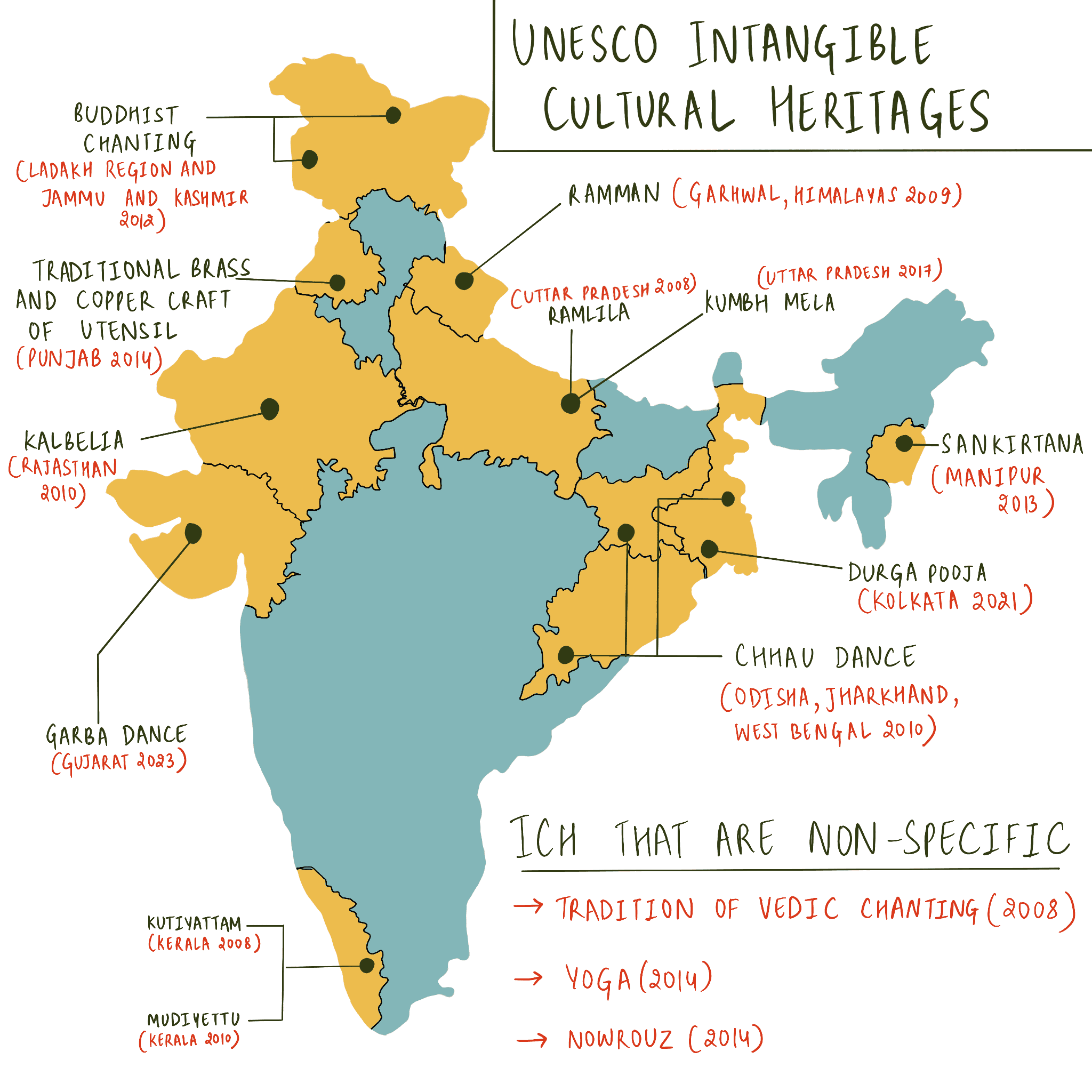
    Chhau dance - Chhau is a traditional Indian dance-drama form originating from eastern India, primarily in Odisha, Jharkhand, and West Bengal. It has three styles: Seraikella Chhau (Jharkhand), Mayurbhanj Chhau (Odisha) and Purulia Chhau (West Bengal). Chhau dance got inscribed in the UNESCO Representative List of the Intangible Cultural Heritage of Humanity in the year 2010.
    ![Intangible Heritage List](https://d39jluplm5thpx.cloudfront.net//unesco_cultural_heritages_9bd157fee9.png)

    _Please Note: Chhau is basically a mask dance. However, Mayurbhanj Chhau is the only one which is performed without a mask._

    Durga Puja (West Bengal) - It is an annual Hindu festival particularly significant in West Bengal, Assam, Odisha, and other parts of India. Durga Puja was added to the UNESCO Representative List of the Intangible Cultural Heritage of Humanity in the year 2021.

    Garba Dance (Gujarat) - has been inscribed in the Representative List of Intangible Cultural Heritage (ICH) of Humanity by UNESCO, under the provisions of the 2003 Convention for the Safeguarding of Intangible Cultural Heritage during the 18th meeting of the Intergovernmental Committee for the Safeguarding of the Intangible Cultural Heritage from 5th -9th December 2023 in Kasane, Botswana.

    Kumbh Mela - Kumbh Mela is a major Hindu pilgrimage and festival celebrated at four sites: Prayagraj (Uttar Pradesh), Haridwar (Uttarakhand), Ujjain (Madhya Pradesh) and Nashik (Maharashtra). The Kumbh Mela was recognized as an Intangible Cultural Heritage of Humanity in the year 2017.

  7. In which one of the following regions was Dhanyakataka, which flourished as a prominent…

    In which one of the following regions was Dhanyakataka, which flourished as a prominent Buddhist centre under the Mahasanghikas, located?

    1. AAndhra
    2. BGandhara
    3. CKalinga
    4. DMagadha
    Answer and explanation

    Correct answer: A

    * Dhanyakataka was an ancient city situated in the region of South India (Andhra Pradesh).

    * It was a significant Buddhist centre, particularly associated with the Mahasanghika sect of Buddhism during ancient times.

    * The Mahasanghika sect (considered to be the origin of Mahayana Sect) was one of the early Buddhist schools that emerged in India, and Dhanyakataka played a crucial role in its development and propagation.

  8. With reference to ancient India, consider the following statements: 1. The concept of Stupa…

    With reference to ancient India, consider the following statements: 1. The concept of Stupa is Buddhist in origin. 2. Stupa was generally a repository of relics. 3. Stupa was a votive and commemorative structure in Buddhist tradition. How many of the statements given above are correct?

    1. AOnly one
    2. BOnly two
    3. CAll three
    4. DNone
    Answer and explanation

    Correct answer: B

    Statement 1 is incorrect: The concept of a stupa predates Buddhism; it originally served as a pre-Buddhist burial mound. However, it was later adopted and popularized by Buddhism as a key religious monument.

    Statement 2 is correct: A stupa typically housed relics of the Buddha or revered monks, serving as a sacred repository.

    Statement 3 is correct: Stupas also functioned as votive and commemorative structures, built to honor significant events or express devotion.

  9. “Souls are not only the property of animal and plant life, but also of…

    "Souls are not only the property of animal and plant life, but also of rocks, running water and many other natural objects not looked on as living by other religious sects." The above statement reflects one of the core beliefs of which one of the following religious sects of ancient India?

    1. ABuddhism
    2. BJainism
    3. CShaivism
    4. DVaishnavism
    Answer and explanation

    Correct answer: B

    The statement reflects the fundamental Jain doctrine that the entire cosmos is alive. According to Jain philosophy, souls (Jivas) are not restricted to humans, animals, and plants but are also present in elements like rocks (earth), running water, air, and fire. These are categorized as Sthavara Jivas (immobile living beings) or Ekendriya (one-sensed beings). This ontological belief is the foundation for the rigorous practice of Ahimsa (non-violence) in Jainism, as harming any natural element is considered harming a living soul. Note that Anekantavada refers to the doctrine of non-absolutism or the many-sidedness of truth, which is an epistemological concept distinct from the belief in the omnipresence of souls.

  10. With reference to ancient Indian History, consider the following pairs: Literary work: Author 1.…

    With reference to ancient Indian History, consider the following pairs: Literary work: Author 1. Devichandragupta: Bilhana 2. Hammira-Mahakavya: Nayachandra Suri 3. Milinda-panha: Nagarjuna 4. Nitivakyamrita: Somadeva Suri How many of the above pairs are correctly matched?

    1. AOnly one
    2. BOnly two
    3. COnly three
    4. DAll four
    Answer and explanation

    Correct answer: B

    * Statement 1 is incorrect: Devichandraguptam is attributed to Vishakhadatta, a Sanskrit playwright. Bilhana was a poet who lived much later.

    * Statement 2 is correct: Hammira-Mahakavya was written by Nayachandra Suri, a Jain scholar and poet.

    * Statement 3 is incorrect: Milinda-Panha is a dialogue between Buddhist philosopher Nagasena and Indo-Greek King Milinda, focusing on Buddhist concepts like non-self (anatta) and nirvana. Nagasena belonged to the Hinayana tradition, while Nagarjuna, often confused with him, was a Mahayana scholar. For clarity in UPSC, refer to the Milinda-Panha philosopher as Nagasena.

    * Statement 4 is correct: Nitivakyamrita was written by Somadeva Suri.

    Thus, statements 2 and 4 are correct.

  11. Consider the following pairs : Site : Well known for 1. Besnagar : Shaivite…

    Consider the following pairs : Site : Well known for 1. Besnagar : Shaivite cave shrine 2. Bhaja : Buddhist cave shrine 3. Sittanavasal : Jain cave shrine How many of the above pairs are correctly matched?

    1. AOnly one
    2. BOnly two
    3. CAll three
    4. DNone
    Answer and explanation

    Correct answer: B

    Pair 1 is incorrectly matched: Besnagar (Bhilsa or Vidisha) in Madhya Pradesh, is not particularly well-known for a Shaivite cave shrine. Archaeological excavations revealed remains of Buddhist, Jain, and Hindu temples, but the site is more famous for the Heliodorus Pillar, an ancient Garuda pillar dedicated to Lord Vishnu.

    Pair 2 is correctly matched: Bhaja Caves (near Pune, Maharashtra) are a group of 22 rock-cut caves built during the 2nd century BC and are well known for their Buddhist architecture and sculptures.

    Pair 3 is correctly matched: Sittanavasal (Pudukottai district, Tamil Nadu) is a village known for its Jain cave shrine, considered to be among the oldest Jain monuments in India.

  12. Which one of the following explains the practice of ‘Vattakirutal’ as mentioned in Sangam…

    Which one of the following explains the practice of 'Vattakirutal' as mentioned in Sangam poems?

    1. AKings employing women bodyguards
    2. BLearned persons assembling in royal courts to discuss religious and philosophical matters
    3. CYoung girls keeping watch over agricultural fields and driving away birds and animals
    4. DA king defeated in a battle committing ritual suicide by starving himself to death
    Answer and explanation

    Correct answer: D

    * 'Vattakirutal' as mentioned in Sangam poems is best explained by a king defeated in a battle who commits ritual suicide by starving himself to death.

    * Sangam poems reflect a strong warrior culture in ancient Tamil society. Kings and warriors were expected to display courage and honour.

    * Defeat in battle was considered a significant dishonour. Hence, Vattakirutal allowed a defeated king to avoid the humiliation of capture by the enemy.

    * This form of suicide through starving was a ritualistic act, demonstrating the king's commitment to his honour and his unwillingness to compromise his dignity.

  13. Consider the following pairs with regard to sports awards: 1. Major Dhyan Chand Khel…

    Consider the following pairs with regard to sports awards: 1. Major Dhyan Chand Khel Ratna Award : For the most Spectacular and outstanding performance by a sportsperson over period of last four years 2. Arujna Award : For the lifetime achievement by a sportsperson 3. Dronacharya Award: To honour eminent coaches who have successfully trained sportspersons or teams 4. Rashtriya Khel Protsahan Puraskar : To recognize the contribution made by sportspersons even after their retirement How many of the above pairs are correctly matched?

    1. AOnly one
    2. BOnly two
    3. COnly three
    4. DAll four
    Answer and explanation

    Correct answer: B

    National Sports Awards are given every year to recognize and reward excellence in sports.

    * Pair 1 is correctly matched: Major Dhyan Chand Khel Ratna Award is given for the spectacular and most outstanding performance over the previous four years.

    * Pair 2 is not correctly matched: Arjuna Award for outstanding performance in Sports and Games is given for good performance over the previous four years and showing qualities of leadership, sportsmanship and a sense of discipline.

    * Pair 3 is correctly matched: Dronacharya Award is given to coaches for doing outstanding and meritorious work consistently and enabling sportspersons to excel in International events.

    * Dhyan Chand Award for Lifetime Achievement in Sports and Games is given to honour sportspersons who have contributed to sports through their performance and continue to contribute to the promotion of sports events after their retirement.

    * Pair 4 is not correctly matched: Rashtriya Khel Protsahan Puruskar is given to corporate entities (both in the private and public sector), sports control boards, and NGOs including sports bodies at the state and national level who have played a visible role in the area of sports promotion and development.

  14. Consider the following statements in respect of the 44th Chess Olympiad, 2022 : 1.…

    Consider the following statements in respect of the 44th Chess Olympiad, 2022 : 1. It was the first time that Chess Olympiad was held in India. 2. The official mascot was named 'Thambi'. 3. The trophy for the winning team in the open section is the Vera Menchik Cup. 4. The trophy for the winning team in the women's section is the Hamilton-Russell Cup. How many of the statements given above are correct?

    1. AOnly one
    2. BOnly two
    3. COnly three
    4. DAll four
    Answer and explanation

    Correct answer: B

    Statement 1 is correct: It was India's first time hosting the Chess Olympiad (held near Chennai/Mamallapuram, 28 July–9 August 2022). Supporting facts: first-ever Olympiad torch relay across multiple Indian cities; record participation with close to 190 teams in Open and over 160 in Women's; as host, India fielded multiple teams in each section.

    Statement 2 is correct: The official mascot was 'Thambi' (Tamil for "younger brother"). Supporting facts: chosen to reflect Tamil Nadu's culture and hospitality; widely used in event branding, promotions, and public outreach.

    Statement 3 is not correct: The Open section winners receive the Hamilton–Russell Cup, not the Vera Menchik Cup. Clarification: Hamilton–Russell Cup is the historic team trophy of the Open section (perpetual trophy retained by the winning federation until the next Olympiad).

    Statement 4 is not correct: The Women's section winners receive the Vera Menchik Cup, not the Hamilton–Russell Cup. Clarification: the trophy honours Vera Menchik, the first Women's World Chess Champion; awarded to the Women's section winners.

  15. The world’s second tallest statue in sitting pose of Ramanuja was inaugurated by the…

    The world's second tallest statue in sitting pose of Ramanuja was inaugurated by the Prime Minister of India at Hyderabad recently. Which one of the following statements correctly represents the teachings of Ramanuja?

    1. AThe best means of salvation was devotion.
    2. BVedas are eternal, self-existent and wholly authoritative.
    3. CLogical arguments were essential means for the highest bliss.
    4. DSalvation was to be obtained through meditation.
    Answer and explanation

    Correct answer: A

    Ramanuja believed in qualified non-dualism (Vishishtadvaita), where the individual soul (atman) and God (Brahman) coexist in a qualified oneness.

    Qualified Non-dualism (Vishishtadvaita): This is the core concept in Ramanuja's philosophy. It contrasts with the strict non-dualism (Advaita) of Adi Shankara. While both acknowledge an ultimate reality, Ramanuja argues for a qualified oneness, where the individual soul (atman) and God (Brahman) exist in a dependent relationship.

    God's supremacy: Ramanuja emphasized the concept of a personal God, often identified with Vishnu, who is both immanent (present within the world) and transcendent (beyond the world).

    Path to salvation: Liberation (moksha) is achieved through devotion (bhakti) to God and his grace.

  16. With reference to Indian history, consider the following pairs: Historical – Person Known as…

    With reference to Indian history, consider the following pairs: Historical - Person Known as 1. Aryadeva - Jaina scholar 2. Dignaga - Buddhist scholar 3. Nathamuni - Vaishnava scholar How many pairs given above are correctly matched?

    1. ANone of the pairs
    2. BOnly one pair
    3. COnly two pairs
    4. DAll three pairs
    Answer and explanation

    Correct answer: C

    Statement 1 is incorrect. Aryadeva was a Buddhist philosopher, not a Jaina scholar. Aryadeva was a Mahayana Buddhist monk, a disciple of Nagarjuna and a Madhyamaka philosopher. He is known for his association with the Nalanda monastery.

    Statement 2 is correct. Dignaga was a Buddhist scholar known for his contributions to logic and philosophy. Dignaga's thought influenced later Buddhist philosophers like Dharmakirti and also Hindu thinkers of the Nyaya school.

    Statement 3 is correct. Nathamuni was a Vaishnava scholar who is credited with reviving the Sri Vaishnava tradition. Nathamuni collected and compiled the Naalayira Divya Prabandham

  17. Which one of the following statements about Sangam literature in ancient South India is…

    Which one of the following statements about Sangam literature in ancient South India is correct?

    1. ASangam poems are devoid of any reference to material culture.
    2. BThe social classification of Varna was known to Sangam poets.
    3. CSangam poems have no reference to warrior ethic.
    4. DSangam literature refers to magical forces as irrational.
    Answer and explanation

    Correct answer: B

    Sangam literature, which dates back to the Sangam period in ancient South India (c. 3rd century BCE to 3rd century CE), does indeed contain references to the social classification of Varna. The poems provide insights into the societal structure of that time, including the division of society into different social groups or Varnas. Therefore, option b is correct.

    Sangam poems often contain references to material culture, including descriptions of trade, agriculture, urban life, and everyday objects.

    Sangam's poems frequently depict warrior ethics, with many poems glorifying valour, bravery, and military prowess.

    Sangam literature includes references to various supernatural or magical forces, but these are typically presented as part of the cultural and religious beliefs of the time rather than being explicitly labelled as irrational.

  18. Consider the following pairs: Site of Ashoka’s major rock edicts — Location in the…

    Consider the following pairs: Site of Ashoka's major rock edicts — Location in the State of 1. Dhauli — Odisha 2. Erragudi — Andhra Pradesh 3. Jaugada — Madhya Pradesh 4. Kalsi — Karnataka How many pairs given above are correctly matched ?

    1. AOnly one pair
    2. BOnly two pairs
    3. COnly three pairs
    4. DAll four pairs
    Answer and explanation

    Correct answer: B

    Pair 1 is correctly matched. Dhauli is located in Odisha.

    Pair 2 is correctly matched. Erragudi or Yerragudi is located in Andhra Pradesh

    Pair 3 is incorrectly matched. Jaugada is located in Odisha.

    Pair 4 is incorrectly matched. Kalsi is located in Uttarakhand.

    ![Ashokan Edicts](https://d39jluplm5thpx.cloudfront.net//Edicts_of_Ashoka_5a1321fad5.PNG)

  19. The Prime Minister recently inaugurated the new Circuit House near Somnath Temple at Veraval.…

    The Prime Minister recently inaugurated the new Circuit House near Somnath Temple at Veraval. Which of the following statements are correct regarding Somnath Temple? 1. Somnath Temple is one of the Jyotirlinga shrines. 2. A description of Somnath Temple was given by Al-Biruni. 3. Pran Pratishtha of Somnath Temple (installation of the present day temple) was done by President S. Radhakrishnan. Select the correct answer using the code given below:

    1. A1 and 2 only
    2. B2 and 3 only
    3. C1 and 3 only
    4. D1, 2 and 3
    Answer and explanation

    Correct answer: A

    Statement 1 is correct. One of the 12 holy Jyotirlingas of Lord Shiva is in Jyotirlinga here in Somnath.

    Statement 2 is correct. Al Biruni writes that the temple was built of stone and constructed about 100 years before Mahmud's attack (which would date it to the 10th century) and that it was set in a fortress surrounded by the sea on 3 sides.

    Statement 3 is incorrect. The Pran Pratishtha (consecration) of the present-day Somnath Temple in 1951 was performed by India's first President, Dr. Rajendra Prasad, at the invitation of K.M. Munshi and Sardar Vallabhbhai Patel. He remarked that it symbolized a victory of reconstruction over destruction.

  20. With reference to Indian history, consider the following texts: 1. Nettipakarana 2. Parishishtaparvan 3.…

    With reference to Indian history, consider the following texts: 1. Nettipakarana 2. Parishishtaparvan 3. Avadanashataka 4. Trishashtilakshana Mahapurana Which of the above are Jaina texts ?

    1. A1, 2 and 3
    2. B2 and 4 only
    3. C1, 3 and 4
    4. D2, 3 and 4
    Answer and explanation

    Correct answer: B

    Statement 1 is Incorrect: Nettipakarana is a Buddhist scripture (Theravada tradition) that serves as a guide to the interpretation of the Pali Canon. It is not associated with Jainism.

    Statement 2 is Correct: Parishishtaparvan (also known as Sthaviravalicharitra) is a Jaina text written by the 12th-century scholar Hemachandra. It is an appendix to his larger work and provides historical accounts of early Jaina teachers.

    Statement 3 is Incorrect: Avadanashataka is a collection of one hundred Buddhist legends (Avadanas) written in Sanskrit. The term 'Avadana' typically refers to Buddhist literature detailing the past lives and deeds of individuals.

    Statement 4 is Correct: Trishashtilakshana Mahapurana (also known as the Mahapurana) is a major Jaina text composed by the Digambara monks Jinasena and Gunabhadra in the 9th century. It details the lives of the 63 'Great Men' (Shalakapurushas) of Jainism.

  21. “Yogavasistha” was translated into Persian by Nizamuddin Panipati during the reign of:

    "Yogavasistha" was translated into Persian by Nizamuddin Panipati during the reign of:

    1. AAkbar
    2. BHumayun
    3. CShahjahan
    4. DAurangzeb
    Answer and explanation

    Correct answer: A

    Nizamuddin Panipati, a Persian scholar, translated the "Yogavasistha" into Persian during the reign of Emperor Akbar, who ruled the Mughal Empire from 1556 to 1605. This translation occurred as part of Akbar's efforts to promote cultural exchange and translations of various works into Persian, the administrative language of the Mughal Empire.

  22. With reference to India, the terms ‘Halbi, Ho and Kui’ pertain to

    With reference to India, the terms 'Halbi, Ho and Kui' pertain to

    1. ADance forms of Northwest India
    2. BMusical instruments
    3. CPre-historic cave paintings
    4. DTribal languages
    Answer and explanation

    Correct answer: D

    Halbi, Ho, and Kui are tribal languages spoken in different regions of India:

    1. Halbi (Halabi): An Indo-Aryan language spoken primarily by the Halba tribe in Chhattisgarh, Odisha, Madhya Pradesh, and Maharashtra. 2. Ho: An Austroasiatic language (Munda group) spoken by the Ho people, mainly in Jharkhand and Odisha. 3. Kui (Kondh): A South-Central Dravidian language spoken by the Kandha (Khond) tribe, primarily in Odisha. It is closely related to Gondi and Pengo languages.

  23. Which one of the following statements is correct?

    Which one of the following statements is correct?

    1. AAjanta Caves lie in the gorge of Waghora river.
    2. BSanchi Stupa lies in the gorge of Chambal river.
    3. CPandu-lena Cave shrines lie in the gorge of Narmada river.
    4. DAmaravati Stupa lies in the gorge of Godavari river.
    Answer and explanation

    Correct answer: A

    Option A is correct: The Ajanta Caves are a series of 29 rock-cut Buddhist cave monuments located in the Aurangabad district of Maharashtra. They are situated in the horseshoe-shaped gorge of the Waghora River.

    Option B is incorrect: Sanchi Stupa is located on a hilltop at Sanchi in the Raisen District of Madhya Pradesh. It is situated near the Betwa River, not the Chambal River.

    Option C is incorrect: The Pandu-Lena Caves (also known as Nasik Caves) are a group of 24 Buddhist caves carved into the Trirashmi hills near Nashik, Maharashtra. They are not located in the gorge of the Narmada River.

    Option D is incorrect: The Amaravati Stupa is located on the banks of the Krishna River in the Guntur district of Andhra Pradesh, not the Godavari River.

  24. With reference to Chausath Yogini Temple situated near Morena, consider the following statements: 1.…

    With reference to Chausath Yogini Temple situated near Morena, consider the following statements: 1. It is a circular temple built during the reign of Kachchhapaghata Dynasty. 2. It is the only circular temple built in India. 3. It was meant to promote the Vaishnava cult in the region. 4. Its design has given rise to a popular belief that it was the inspiration behind the Indian Parliament building. Which of the statements given above are correct?

    1. A1 and 2
    2. B2 and 3 Only
    3. C1 and 4
    4. D2, 3 and 4
    Answer and explanation

    Correct answer: C

    Statement 1 is correct: (Circular temple, Kachchhapaghata Dynasty) The Chausath Yogini Temple near Morena is a circular temple complex built during the reign of the Kachchhapaghata dynasty, estimated to be around the 11th century CE.

    Statement 2 is incorrect: (Not the only circular temple) While the Chausath Yogini Temple is a well-known example, it's not the only circular temple in India. There are other circular temples across the country, such as the Shiva temple at Bhringari in Andhra Pradesh.

    Statement 3 is incorrect: (Vaishnava cult) The temple is not primarily associated with the Vaishnava cult, which worships Vishnu. The specific dedication of the temple is debated, with some theories suggesting a connection to Shaktism or Tantric practices.

    Statement 4 is correct: (Inspiration for Parliament building) There's a popular belief that the circular design of the Chausath Yogini Temple might have inspired the architects of the Indian Parliament building in New Delhi. However, there's no definitive historical evidence to confirm this connection.

    Therefore, the correct statements are 1 and 4.

  25. Consider the following statements in respect of Bharat Ratna and Padma Awards: 1. Bharat…

    Consider the following statements in respect of Bharat Ratna and Padma Awards: 1. Bharat Ratna and Padma Awards are titles under the Article 18(1) of the Constitution of India. 2. Padma Awards, which were instituted in the year 1954, were suspended only once. 3. The number of Bharat Ratna Awards is restricted to a maximum of five in a particular year. Which of the above statements are not correct?

    1. A1 and 2 Only
    2. B2 and 3 Only
    3. C1 and 3 Only
    4. D1, 2 and 3
    Answer and explanation

    Correct answer: D

    Statement 1 is incorrect: The national awards such as Bharat Ratna, Padma Vibhushan, Padma Bhushan, and Padma Shri do not amount to titles within the meaning of Article 18(1) of the Constitution.

    Statement 2 is incorrect: Padma awards were instituted in the year 1954 and have been suspended in years 1978, 1979, 1993, and 1997.

    Statement 3 is incorrect: Although there is a general guideline to limit the Bharat Ratna to three recipients per year, this rule has been exceeded twice: In 1999, four awards were conferred (Jayaprakash Narayan, Amartya Sen, Gopinath Bordoloi, and Ravi Shankar) and in 2024, Five awards were conferred (M.S. Swaminathan, P.V. Narasimha Rao, Chaudhary Charan Singh, Karpoori Thakur, and L.K. Advani).

  26. With reference to the history of ancient India, Bhavabhuti, Hastimalla and Kshemeshvara were famous

    With reference to the history of ancient India, Bhavabhuti, Hastimalla and Kshemeshvara were famous

    1. AJain monks
    2. BPlaywrights
    3. CTemple architects
    4. DPhilosophers
    Answer and explanation

    Correct answer: B

    Bhavabhuti, Hastimalla, and Kshemeshvara were renowned playwrights in ancient and early medieval India.

    Bhavabhuti: An 8th-century scholar and playwright in the court of King Yashovarman of Kannauj. He is famous for his Sanskrit plays *Malatimadhava*, *Mahaviracharita*, and *Uttararamacharita*.

    Hastimalla: A 13th-century Jain playwright who lived during the Hoysala period. He is known for his Sanskrit plays such as *Vikrantakaurava*, *Maithilikalyana*, and *Anjanapavananjaya*.

    Kshemeshvara: A 10th-century playwright who served in the court of King Mahipala of the Pala dynasty. His notable works include the plays *Chandakaushika* and *Naishadhananda*.

  27. Consider the following statements in respect of the 32nd Summer Olympics: 1. The official…

    Consider the following statements in respect of the 32nd Summer Olympics: 1. The official motto for this Olympics is 'A New World'. 2. Sport Climbing, Surfing, Skateboarding, Karate and Baseball are included in this, Olympics. Which of the above statements is/are correct?

    1. A1 only
    2. B2 only
    3. CBoth 1 and 2
    4. DNeither 1 nor 2
    Answer and explanation

    Correct answer: B

    Statement 1 is incorrect. The 32nd Summer Olympics was held in Tokyo in 2021. The Tokyo 2020 official Games motto was United by Emotion. The Rio Olympics 2016 official slogan was A New World.

    Statement 2 is correct. New IOC rules for the Tokyo Olympics allowed host cities to choose popular sports for inclusion in the Games. Tokyo Olympics added six new sports, including baseball, softball, surfing, skateboarding, karate, and sports climbing. Additionally, there were new forms of basketball and cycling and mixed-team events in traditional sports.

  28. Consider the following statements in respect of the Laureus World Sports Award which was…

    Consider the following statements in respect of the Laureus World Sports Award which was instituted in the year 2000: 1. American golfer Tiger Woods was the first winner of this award. 2. The award was received mostly by 'Formula One' players so far. 3. Roger Federer received this award maximum number of times compared to others. Which of the above statements are correct?

    1. A1 and 2 only
    2. B2 and 3 only
    3. C1 and 3 only
    4. D1, 2 and 3
    Answer and explanation

    Correct answer: C

    Statement 1 is Correct: The Laureus World Sports Awards were first presented in the year 2000 in Monte Carlo. American golfer Tiger Woods was the inaugural winner of the Laureus World Sportsman of the Year award.

    Statement 2 is Incorrect: The award has been dominated by tennis players rather than Formula One players. By the time of the 2021 UPSC examination, tennis players had won the Sportsman of the Year award 11 times (Roger Federer-5, Rafael Nadal-2, and Novak Djokovic-4), while Formula One drivers had won it only 4 times (Michael Schumacher-2, Sebastian Vettel-1, and Lewis Hamilton-1).

    Statement 3 is Correct: Roger Federer holds the record for the most wins in the Laureus World Sportsman of the Year category, having won it five times (2005, 2006, 2007, 2008, and 2018). When including his 'Comeback of the Year' award in 2018, he has a total of six Laureus statuettes, making him the most decorated individual in the history of the awards at that time.

  29. Consider the following statements in respect of the ICC World Test Championship : 1.…

    Consider the following statements in respect of the ICC World Test Championship : 1. The finalists were decided by the number of matches they won. 2. New Zealand was ranked ahead of England because it won more matches than England. Which of the above statements is/are correct?

    1. A1 only
    2. B2 only
    3. CBoth 1 and 2
    4. DNeither 1 nor 2
    Answer and explanation

    Correct answer: D

    Statement 1 is Incorrect: The finalists for the inaugural ICC World Test Championship (2019-2021) were decided based on the Percentage of Points (PCT) earned from the total points contested, rather than the absolute number of matches won. This system was introduced by the ICC to account for the disparity in the number of matches played by different teams due to the COVID-19 pandemic.

    Statement 2 is Incorrect: New Zealand was ranked ahead of England because they had a higher PCT (70.0%) compared to England (64.1%). In terms of match wins, England actually won more matches (11) than New Zealand (7) during the tournament cycle, directly contradicting the statement.

  30. Consider the following statements:: 1. St. Francis Xavier was one of the founding members…

    Consider the following statements:: 1. St. Francis Xavier was one of the founding members of the Jesuit Order. 2. St. Francis Xavier died in Goa and a church is dedicated to him there. 3. The Feast of St. Francis Xavier is celebrated in Goa each year. Which of the statements given above are correct?

    1. A1 and 2 Only
    2. B2 and 3 Only
    3. C1 and 3 Only
    4. D1, 2 and 3
    Answer and explanation

    Correct answer: C

    Statement 1 is correct: St. Francis Xavier was a Spanish Jesuit who lived as a Roman Catholic missionary in the 1500s. He was one of the first seven members of the Jesuit order.

    Statement 2 is incorrect: He did not die in Goa but at Sachian, an island off the coast of China. A church in memory of St. Xavier called the Church of Bom Jesus, is located in Goa with his mortal remains.

    Statement 3 is correct: A feast in honor of St. Xavier is celebrated annually in Goa.