
UPSC CSE 2026 Essay Paper Discussion

MCQ SUBJECT

History

182 UPSC Prelims MCQs tagged "History". Free practice with answer keys, explanations, and timed mock tests on Anantam IAS.

  1. The irrigation device called ‘Araghatta’ was

    The irrigation device called 'Araghatta' was

    1. Aa water bag made of leather pulled over a pulley
    2. Ba large wheel with earthen pots tied to the outer ends of its spokes
    3. Ca larger earthen pot driven by bullocks
    4. Da large water bucket pulled up by rope directly by hand
    Answer and explanation

    Correct answer: B

    The Araghatta was an ancient Indian irrigation device consisting of a large wheel with earthen pots fixed around its rim. As the wheel rotated—usually powered by animals or humans—the pots dipped into a water source and lifted water for irrigation. This mechanism is distinct from leather bags or simple buckets pulled by hand and represents early mechanical water-lifting technology.
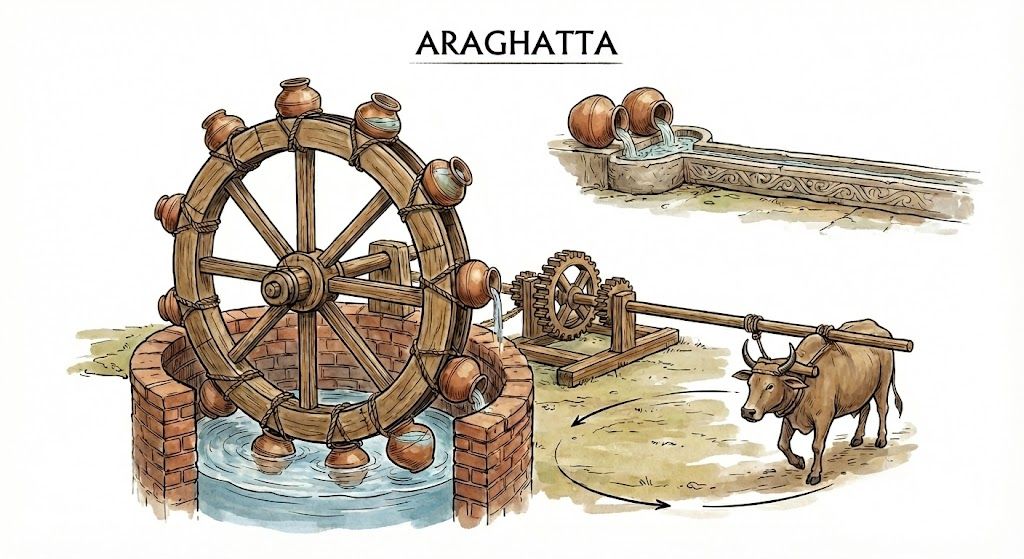
    ![Araghatta](https://d39jluplm5thpx.cloudfront.net//araghatta_0957471c3a.jpg)

  2. Who among the following rulers in ancient India had assumed the titles ‘Mattavilasa’, ‘Vichitrachitta’…

    Who among the following rulers in ancient India had assumed the titles 'Mattavilasa', 'Vichitrachitta' and 'Gunabharata'?

    1. AMahendravarman I
    2. BSimhavishnu
    3. CNarasimhavarman I
    4. DSimhavarman
    Answer and explanation

    Correct answer: A

    The correct answer is A. Mahendravarman I.

    Mahendravarman I, a 7th-century Pallava king, was known for his literary talent and artistic patronage. He adopted the titles 'Mattavilasa' (lover of playful sport), 'Vichitrachitta' (curious-minded or inventive), and 'Gunabharata' (full of virtues). He also authored the Sanskrit play *Mattavilasa Prahasana*, reflecting his cultural contributions.

    The other rulers listed did not assume these titles.

  3. Who among the following led a successful military campaign against the kingdom of Srivijaya?

    Who among the following led a successful military campaign against the kingdom of Srivijaya?

    1. AAmoghavarsha (Rashtrakuta)
    2. BPrataparudra (Kakatiya)
    3. CRajendra I (Chola)
    4. DVishnuvardhana (Hoysala)
    Answer and explanation

    Correct answer: C

    The correct answer is C. Rajendra I (Chola).

    Rajendra Chola I, son of Rajaraja Chola I, led a famous naval expedition against the Srivijaya kingdom around 1025 CE. Srivijaya was a powerful maritime empire controlling the Malay Peninsula, Sumatra, Java, and nearby islands. Rajendra I's campaign asserted Chola naval dominance in the region and secured control over important sea trade routes.

    The other rulers listed did not conduct campaigns against Srivijaya:

    * Amoghavarsha (Rashtrakuta) focused mainly on the Deccan region. * Prataparudra (Kakatiya) ruled much later and was centered in the Deccan. * Vishnuvardhana (Hoysala) focused on South Indian affairs.

  4. Consider the following fruits: I. Papaya II. Pineapple III. Guava How many of the…

    Consider the following fruits: I. Papaya II. Pineapple III. Guava How many of the above were introduced in India by the Portuguese in the sixteenth and seventeenth centuries?

    1. AOnly one
    2. BOnly two
    3. CAll the three
    4. DNone
    Answer and explanation

    Correct answer: C

    Papaya, pineapple, and guava are all non-native fruits to India, originally from the Americas, and were introduced during European colonial expansion, particularly by the Portuguese.

    I. Papaya – Correct * Native to Central America, introduced to India by the Portuguese in the 16th century.

    II. Pineapple – Correct * Originates from South America, brought to India by Portuguese explorers.

    III. Guava – Correct * Native to Central America, introduced to India by the Portuguese in the 17th century.

  5. Ashokan inscriptions suggest that the ‘Pradesika’, ‘Rajuka’ and ‘Yukta’ were important officers at the

    Ashokan inscriptions suggest that the 'Pradesika', 'Rajuka' and 'Yukta' were important officers at the

    1. Avillage-level administration
    2. Bdistrict-level administration
    3. Cprovincial administration
    4. Dlevel of the central administration
    Answer and explanation

    Correct answer: B

    Ashokan inscriptions mention 'Pradesika', 'Rajuka', and 'Yukta' as important officers at the district (Pradesa) level.

    * 'Pradesika' managed the district administration. * 'Rajuka' handled revenue and judicial matters. * 'Yukta' was a subordinate official involved in administration and record-keeping.

  6. Sedition has become my religion’ was the famous statement given by Gandhiji at the…

    Sedition has become my religion' was the famous statement given by Gandhiji at the time of

    1. Athe Champaran Satyagraha
    2. Bpublicly violating Salt Law at Dandi
    3. Cattending the Second Round Table Conference in London
    4. Dthe launch of the Quit India Movement
    Answer and explanation

    Correct answer: B

    Mahatma Gandhi made the famous statement "Sedition has become my religion" during the Salt Satyagraha in 1930.

    In his writings in *Young India* (specifically in March 1930) and his speeches surrounding the Dandi March, Gandhi articulated that when a government becomes exploitative and unjust—exemplified by the salt tax—non-violent defiance or "sedition" against such a regime becomes a moral and religious duty. He used this phrase to emphasize that his commitment to overthrowing British rule through non-violent civil disobedience was not just a political strategy but a spiritual necessity. While he had spoken about the "passion" for sedition during his 1922 trial, the specific declaration of it being his "religion" is most prominently associated with the launch of the Civil Disobedience Movement and the violation of the Salt Law.

  7. Who provided legal defence to the people arrested in the aftermath of Chauri Chaura…

    Who provided legal defence to the people arrested in the aftermath of Chauri Chaura incident?

    1. AC. R. Das
    2. BMadan Mohan Malaviya and Krishna Kant
    3. CDr. Saifuddin Kitchlew and Khwaja Hasan Nizami
    4. DM. A. Jinnah
    Answer and explanation

    Correct answer: B

    After the Chauri Chaura incident in 1922, many people were arrested and faced severe punishment, including death sentences. Legal intervention helped reduce this.

    B. Madan Mohan Malaviya and Krishna Kant – Correct

    * Madan Mohan Malaviya and his son Krishna Kant provided legal defence to the accused. * Their efforts led to major sentence reductions, saving many from execution.

  8. With reference to ancient India (600–322 BC), consider the following pairs: Territorial region –…

    With reference to ancient India (600–322 BC), consider the following pairs: Territorial region – River flowing in the region I. Asmaka : Godavari II. Kamboja : Vipas III. Avanti : Mahanadi IV. Kosala : Sarayu How many of the pairs given above are correctly matched?

    1. AOnly one
    2. BOnly two
    3. COnly three
    4. DAll the four
    Answer and explanation

    Correct answer: B

    Pair 1 is correct: Asmaka (or Assaka) was the southernmost Mahajanapada, located in the Deccan region on the banks of the Godavari river.

    Pair 2 is incorrect: Kamboja was located in the extreme north-west (modern-day Afghanistan and Kashmir). The Vipas (Beas) river flows through Punjab, which is geographically distinct and east of the Kamboja region.

    Pair 3 is incorrect: Avanti was in western Madhya Pradesh (Malwa region). The main rivers flowing through it were the Kshipra and Vetravati, not the Mahanadi (which flows through Odisha and Chhattisgarh).

    Pair 4 is correct: Kosala was a Mahajanapada in present-day eastern Uttar Pradesh. Its capital, Ayodhya, is situated on the banks of the Sarayu river.

  9. Consider the following statements about Raja Ram Mohan Roy: I. He possessed great love…

    Consider the following statements about Raja Ram Mohan Roy: I. He possessed great love and respect for the traditional philosophical systems of the East. II. He desired his countrymen to accept the rational and scientific approach and the principle of human dignity and social equality of all men and women. Which of the statements given above is/are correct?

    1. AI only
    2. BII only
    3. CBoth I and II
    4. DNeither I nor II
    Answer and explanation

    Correct answer: C

    Raja Ram Mohan Roy was a reformer who respected Indian traditions but promoted rational thinking and social equality.

    Statement I is correct: * He respected traditional Eastern philosophies like Vedanta and sought their reform.

    Statement II is correct: * He advocated for rationalism, scientific thinking, and equality of all men and women.

    So, the correct answer is: C

  10. Who among the following was the founder of the ‘Self-Respect Movement’?

    Who among the following was the founder of the 'Self-Respect Movement'?

    1. A'Periyar' E. V. Ramaswamy Naicker
    2. BDr. B. R. Ambedkar
    3. CBhaskarrao Jadhav
    4. DDinkarrao Javalkar
    Answer and explanation

    Correct answer: A

    The Self-Respect Movement, started in 1925, aimed to dismantle caste hierarchies and promote social equality, especially for non-Brahmin communities in Tamil Nadu.

    He founded the Self-Respect Movement to fight caste oppression and promote rationalism and equality.

  11. Subsequent to which one of the following events, Gandhiji, who consistently opposed untouchability and…

    Subsequent to which one of the following events, Gandhiji, who consistently opposed untouchability and appealed for its eradication from all spheres, decided to include the upliftment of 'Harijans' in his political and social programme?

    1. AThe Poona Pact
    2. BThe Gandhi–Irwin Agreement (Delhi Pact)
    3. CArrest of Congress leadership at the time of the Quit India Movement
    4. DPromulgation of the Government of India Act, 1935
    Answer and explanation

    Correct answer: A

    Mahatma Gandhi made the upliftment of *Harijans* a central goal after opposing separate electorates for the Depressed Classes in the British Communal Award.

    After the Poona Pact (1932), signed with Dr. B.R. Ambedkar, Gandhi intensified efforts to eradicate untouchability, forming the Harijan Sevak Sangh and launching the 'Harijan' journal.

  12. Consider the following subjects with regard to Non-Cooperation Programme: I. Boycott of law-courts and…

    Consider the following subjects with regard to Non-Cooperation Programme: I. Boycott of law-courts and foreign cloth II. Observance of strict non-violence III. Retention of titles and honours without using them in public IV. Establishment of Panchayats for settling disputes How many of the above were parts of Non-Cooperation Programme?

    1. AOnly one
    2. BOnly two
    3. COnly three
    4. DAll the four
    Answer and explanation

    Correct answer: C

    The Non-Cooperation Programme aimed to resist British rule through boycott and self-reliance, emphasizing non-violence and alternative institutions.

    Statement I is correct: * Boycott of law courts and foreign cloth was a key part of the movement.

    Statement II is correct: * Strict non-violence was insisted upon by Gandhi during the movement.

    Statement III is incorrect: * The programme required surrendering British titles and honours, not retaining them.

    Statement IV is correct: * Setting up Panchayats to settle disputes locally was encouraged.

    So, the correct answer is: C (Only three)

  13. Fa-hien (Faxian), the Chinese pilgrim, travelled to India during the reign of

    Fa-hien (Faxian), the Chinese pilgrim, travelled to India during the reign of

    1. ASamudragupta
    2. BChandragupta II
    3. CKumaragupta I
    4. DSkandagupta
    Answer and explanation

    Correct answer: B

    The correct answer is B. Chandragupta II.

    Fa-hien (Faxian), the Chinese Buddhist pilgrim, visited India during the reign of Chandragupta II (also known as Chandragupta Vikramaditya) of the Gupta dynasty. He arrived around the early 5th century CE, seeking Buddhist texts and studying the practices of Buddhism in India. His travel accounts provide valuable information about Gupta India's society, administration, and Buddhism.

    The other rulers listed do not align with the period of Fa-hien's visit.

  14. Consider the following statements in respect of the Non-Cooperation Movement: 1. The Congress declared…

    Consider the following statements in respect of the Non-Cooperation Movement: 1. The Congress declared the attainment of 'Swaraj' by all legitimate and peaceful means to be its objective. 2. It was to be implemented in stages with civil disobedience and non-payment of taxes for the next stage only if 'Swaraj' did not come within a year and the Government resorted to repression. Which of the statements given above is/are correct?

    1. A1only
    2. B2 only
    3. CBoth 1 and 2
    4. DNeither 1 nor 2
    Answer and explanation

    Correct answer: C

    * Statement 1 is correct: At the Nagpur Session of the Indian National Congress in December 1920, the Congress formally adopted the objective of attaining 'Swaraj' by all legitimate and peaceful means. This became the central political goal during the Non-Cooperation Movement.

    * Statement 2 is correct: The Non-Cooperation Movement was designed as a phased programme. The initial phase included surrender of titles, boycott of schools, courts, elections, and foreign goods. Advancement to the next phase—civil disobedience including non-payment of taxes—was to be undertaken if Swaraj was not achieved within the expected timeline and if the British Government responded with repression, with the discretion to launch the next stage resting with Mahatma Gandhi and the Congress leadership.

  15. With reference to ancient India, Gautama Buddha was generally known by which of the…

    With reference to ancient India, Gautama Buddha was generally known by which of the following epithets? 1. Nayaputta 2. Shakyamuni 3. Tathagata Select the correct answer using the code given below:

    1. A1 only
    2. B2 and 3 only
    3. C1, 2 and 3
    4. DNone of the above are epithets of Gautama Buddha
    Answer and explanation

    Correct answer: B

    1. Nayaputta: This term means 'the son of Naya' and is NOT associated with Gautama Buddha rather this epithet is used for Mahavira.

    2. Shakyamuni: This epithet means 'Sage of the Shakya clan'. Gautama Buddha belonged to the Shakya clan, making this a correct epithet.

    3. Tathagata: This term means 'one who has thus gone' or 'one who has thus come'. It signifies enlightenment and is a common epithet for Gautama Buddha.

    Therefore, statements 2 and 3 are correct.

  16. With reference to revenue collection by Cornwallis, consider the following statements: 1. Under the…

    With reference to revenue collection by Cornwallis, consider the following statements: 1. Under the Ryotwari Settlement of revenue collection, the peasants were exempted from revenue payment in case of bad harvests or natural calamities. 2. Under the Permanent Settlement in Bengal, if the Zamindar failed to pay his revenues to the state, on or before the fixed date, he would be removed from his Zamindari. Which of the statements given above is/are correct?

    1. A1 only
    2. B2 only
    3. CBoth 1 and 2
    4. DNeither 1 nor 2
    Answer and explanation

    Correct answer: B

    * Statement 1 is incorrect: Introduced primarily in Madras (now Tamil Nadu) and Bombay (now Mumbai) presidencies by Alexander Reed and Thomas Munro. Ryotwari System, while aiming to establish direct contact with the cultivators (ryots), did not offer blanket exemption from revenue payment during bad harvests or calamities. While some provisions for remission existed, they were not automatic or guaranteed.

    * Statement 2 is correct: Introduced in Bengal, Bihar, and parts of Odisha by Lord Cornwallis in 1793. A key feature of the Permanent Settlement was the strict revenue collection timeline. Zamindars were obligated to pay a fixed amount of revenue to the British by a specific date. Failure to do so could result in the auctioning of their Zamindari to recover the dues.

    _Note: UPSC dropped this question from the final answer key._

  17. Who of the following rulers of medieval India gave permission to the Portuguese to…

    Who of the following rulers of medieval India gave permission to the Portuguese to build a fort at Bhatkal?

    1. AKrishnadevaraya
    2. BNarasimha Saluva
    3. CMuhammad Shah III
    4. DYusuf Adil Shah
    Answer and explanation

    Correct answer: A

    * Krishnadeva Raya, the ruler of the Vijayanagara Empire (1509-1529), maintained friendly relations with the Portuguese. In 1510, with his permission, Alphonso de Albuquerque, the Portuguese governor, constructed a fort at Bhatkal, located in the Uttara Kannada district of Karnataka.

    * Narasimha Saluva (**reigned 1491–1505) was a ruler of the Saluva dynasty, which briefly controlled the Vijayanagara Empire. The Portuguese presence in India was only beginning to take root during his reign, and their focus was primarily on establishing trade rather than fortifications.

    * Muhammad Shah III (reigned 1463–1482) was a ruler of the Bahmani Sultanate, a medieval kingdom in the Deccan region. By the time of his reign, the Portuguese had not yet arrived in India (their arrival occurred in 1498).

    * Yusuf Adil Shah: He was the founder of the Adil Shahi dynasty of Bijapur and ruled from 1489 to 1510. His engagements with the Portuguese were more conflictual, particularly over the control of Goa.

  18. Consider the following information: | Archaeological Site | State | Description | |—|—|—| |…

    Consider the following information: | Archaeological Site | State | Description | |---|---|---| | 1. Chandraketugarh | Odisha | Trading Port town | | 2. Inamgaon | Maharashtra | Chalcolithic site | | 3. Mangadu | Kerala | Megalithic site | | 4. Salihundam | Andhra Pradesh | Rock-cut cave shrines | In which of the above rows is the given information correctly matched ?

    1. A1 and 2
    2. B2 and 3
    3. C3 and 4
    4. D1 and 4
    Answer and explanation

    Correct answer: B

    * Statement 1 is incorrect. Chandraketugarh, located in West Bengal, not Odisha, was an ancient port city known for its extensive trade networks.

    * Statement 2 is correct. Inamgaon is a well-known archaeological site in Maharashtra, providing valuable insights into the Chalcolithic period.

    * Statement 3 is correct. Kerala has numerous megalithic sites, The megalithic monuments at Mangadu consisted of 28 hard compact and unhewn laterite blocks within an area of 5 cents of land.

    * Statement 4 is incorrect. Salihundam, is a village and panchayat in Gara Mandal of Srikakulam district in Andhra Pradesh. It is a historically important Buddhist monument of ancient Kalinga, not rock-cut caves.

    Therefore, the correctly matched rows are 2 and 3.

  19. With reference to the Government of India Act, 1935, consider the following statements: 1.…

    With reference to the Government of India Act, 1935, consider the following statements: 1. It provided for the establishment of an All India Federation based on the union of the British Indian Provinces and Princely States. 2. Defence and Foreign Affairs were kept under the control of the federal legislature. Which of the statements given above is/are correct?

    1. A1 only
    2. B2 only
    3. CBoth 1 and 2
    4. DNeither 1 nor 2
    Answer and explanation

    Correct answer: A

    * Statement 1 is correct. The Government of India Act, 1935, proposed an All India Federation that would encompass both the British Indian Provinces and the Princely States. However, this federation never fully materialized due to the reluctance of many Princely States to join.

    * Statement 2 is incorrect. The Act reserved key subjects like Defence and Foreign Affairs under the control of the Governor General, representing the British Crown, and not the federal legislature. This ensured British dominance in these crucial areas.

  20. With reference to the Indian History, Alexander Rea, A. H. Longhurst, Robert Sewell, James…

    With reference to the Indian History, Alexander Rea, A. H. Longhurst, Robert Sewell, James Burgess and Walter Elliot were associated with

    1. AArchaeological excavations
    2. BEstablishment of English Press in Colonial India
    3. CEstablishment of Churches in Princely States
    4. DConstruction of railways in Colonial India
    Answer and explanation

    Correct answer: A

    * Alexander Rea (1858-1924) was a British archaeologist who worked mainly in South British India. He is known for unearthing a sarcophagus from the hillocks of Pallavaram in Tamil Nadu.

    * Albert Henry Longhurst (1876-1955) was a British archaeologist and art historian, working in India and Ceylon. From 1927 to 1931 he was in-charge of the systematic digging of Nagarjunakonda.

    * Robert Sewell (1845-1925) worked in the civil service of the Madras Presidency during the period of colonial rule in India. Sewell undertook archaeological work at the Buddhist stupa at Amaravati, which had already been largely destroyed prior to his arrival. The site had previously been surveyed by Colin Mackenzie and Walter Elliot (1803-1887)

    * James Burgess (1832-1916), was the founder of the Indian Antiquary in 1872 and an important archaeologist of British India in the 19th century. From 1886-89 he was Director General, Archaeological Survey of India.

    * Walter Elliot (1803-1887), visited the Amaravati site in 1854, collecting sculpture panels that later became crucial for understanding South Indian Buddhist art.

  21. With reference to ancient South India, Korkai, Poompuhar and Muchiri were well known as

    With reference to ancient South India, Korkai, Poompuhar and Muchiri were well known as

    1. Acapital cities
    2. Bports
    3. Ccentres of iron-and-steel making
    4. Dshrines of Jain tirthankaras
    Answer and explanation

    Correct answer: B

    Korkai, Poompuhar, and Muchiri were prominent ancient port cities in South India during the Sangam period (c. 3rd century BCE to 3rd century CE). They played a vital role in maritime trade between India and the Roman Empire, as well as Southeast Asia.

    * Korkai: Located at the mouth of the Thamirabarani River in present-day Tamil Nadu, it was an important port of the Pandya dynasty. It was particularly famous for its pearl fishery. * Poompuhar (also known as Kaveripattinam): Situated at the mouth of the Kaveri River, it was the chief port of the Early Cholas. It is vividly described in Sangam literature (like *Silappadikaram*) as a bustling hub of international trade. * Muchiri (Muziris): Located on the Malabar Coast (modern-day Kerala), it was a major port of the Chera dynasty. It was the primary center for the pepper trade with the Roman Empire.

    Note: In Sangam literature, the term 'Puhar' specifically refers to a river mouth or a harbor town where goods were discharged.

  22. Who among the following rulers of Vijayanagara Empire constructed a large dam across Tungabhadra…

    Who among the following rulers of Vijayanagara Empire constructed a large dam across Tungabhadra River and a canal-cum-aqueduct several kilometres long from the river to the capital city?

    1. ADevaraya I
    2. BMallikarjuna
    3. CVira Vijaya
    4. DVirupaksha
    Answer and explanation

    Correct answer: A

    * Devaraya I, around 1410 A.D., got a barrage constructed across the Tungabhadra river and commissioned a 24 km long aqueduct from the Tungabhadra river to the capital.

    * The account provided by Nuniz gives details of the projects undertaken by Deva Raya I that brought prosperity to the Kingdom. Hence option (a) is the correct answer.

  23. Consider the following statements : Statement-I: 7th August is declared as the National Handloom…

    Consider the following statements : Statement-I: 7th August is declared as the National Handloom Day. Statement-II: It was in 1905 that the Swadeshi Movement was launched on the same day. Which one of the following is correct in respect of the above statements?

    1. ABoth Statement-I and Statement-II are correct and Statement-II is the correct explanation for Statement-I
    2. BBoth Statement-I and Statement-II are correct and Statement-II is not the correct explanation for Statement-I
    3. CStatement-I is correct but Statement-II is incorrect
    4. DStatement-I is incorrect but Statement-II is correct
    Answer and explanation

    Correct answer: A

    * Statement 1 is correct The National Handloom Day is observed annually on 7th August to honour the handloom weavers in the country and also highlight India's handloom industry. The first National Handloom Day was held on 7th August 2015.

    * Statement 2 is correct August 7 was chosen as the National Handloom Day to commemorate the Swadeshi Movement which was launched on August 7 in 1905 in Calcutta Town Hall to protest against the partition of Bengal by the British Government. The Swadeshi movement had aimed at reviving domestic products and production processes.

    Hence Statement 2 is the correct explanation of Statement 1.

  24. By which one of the following Acts was the Governor General of Bengal designated…

    By which one of the following Acts was the Governor General of Bengal designated as the Governor General of India?

    1. AThe Regulating Act
    2. BThe Pitt's India Act
    3. CThe Charter Act of 1793
    4. DThe Charter Act of 1833
    Answer and explanation

    Correct answer: D

    * The Charter Act of 1833 was the final step towards centralisation in British India.

    * It made the Governor-General of Bengal as the Governor-General of India and vested in him all civil and military powers. The act created, for the first time, the Government of India having authority over the entire territorial area possessed by the British in India.

    * Lord William Bentick was the first Governor-General of India.

    * It deprived the Governor of Bombay and Madras of their legislative powers. The Governor-General of India was given exclusive legislative powers for the entire British India.

    Hence option (D) is the correct answer.

  25. Who among the following rulers of medieval Gujarat surrendered Diu to Portuguese?

    Who among the following rulers of medieval Gujarat surrendered Diu to Portuguese?

    1. AAhmad Shah
    2. BMahmud Begarha
    3. CBahadur Shah
    4. DMuhammad Shah
    Answer and explanation

    Correct answer: C

    * The ruler of medieval Gujarat who surrendered Diu to the Portuguese was Sultan Bahadur Shah. Diu was an important port city strategically located on the western coast of India, and its surrender to the Portuguese in 1535 marked a significant event in the history of Portuguese colonial expansion in India.

    * This was done to seek Portuguese military assistance against his rival Humayun, the Mughal emperor. As a result, the Portuguese established a strong foothold in Diu, turning it into a significant strategic and trading post.

  26. Consider the following pairs: | King | Dynasty | |————–|———————| |1. Nannuka | Chandela…

    Consider the following pairs: | King | Dynasty | |--------------|---------------------| |1. Nannuka | Chandela | | 2. Jayashakti | Paramara | | 3. Nagabhata II | Gurjara-Pratihara | | 4. Bhoja | Rashtrakuta | How many pairs given above are correctly matched?

    1. AOnly one pair
    2. BOnly two pairs
    3. COnly three pairs
    4. DAll four pairs
    Answer and explanation

    Correct answer: B

    Pair 1 is correctly matched. Nannuka was the founder of the Chandela dynasty.

    Pair 2 is incorrectly matched. Jayashakti belonged to the Chandel dynasty, not the Paramara dynasty.

    Pair 3 is correctly matched. Nagabhata II was indeed a ruler of the Gurjara-Pratihara dynasty.

    Pair 4 is incorrectly matched. Bhoja belonged to the Paramara dynasty, not the Rashtrakuta dynasty.

  27. With reference to Indian history, who of the following were known as “KulahDaran”?

    With reference to Indian history, who of the following were known as "KulahDaran"?

    1. AArab merchants
    2. BQalandars
    3. CPersian calligraphists
    4. DSayyids
    Answer and explanation

    Correct answer: D

    The Sayyids were claimed to descend from the Prophet through his daughter Fatima. They commanded special respect in Muslim society. Even Timur protected the life of Sayyids during his invasion of India, although his policy was one of general slaughter.

    The Sayyids put on a pointed cap (kulah) and they were known as KulahDaran during the Delhi Sultanate.

  28. According to Kautilya’s Arthashastra, which of the following are correct? 1. A person could…

    According to Kautilya's Arthashastra, which of the following are correct? 1. A person could be a slave as a result of a judicial punishment. 2. If a female slave bore her master a son, she was legally free. 3. If a son born to a female slave was fathered by her master, the son was entitled to the legal status of the master's son. Which of the statements given above are correct ?

    1. A1 and 2 only
    2. B2 and 3 only
    3. C1 and 3 only
    4. D1, 2 and 3
    Answer and explanation

    Correct answer: D

    Statement 1 is correct: The Arthashastra recognizes several categories of slaves (dasas), including individuals who entered bondage as a consequence of punishment, debt, or distress. Judicial punishment could therefore result in servitude.

    Statement 2 is correct: The Arthashastra provides that if a female slave bore a son to her master, she became entitled to freedom.

    Statement 3 is correct: A son born to a female slave and fathered by her master could receive the legal status and recognition of the master's son.

  29. With reference to Indian history, consider the following statements: 1. The first Mongol invasion…

    With reference to Indian history, consider the following statements: 1. The first Mongol invasion of India happened during the reign of Jalal-ud-din Khalji. 2. During the reign of Ala-ud-din Khalji, one Mongol assault marched up to Delhi and besieged the city. 3. Muhammad-bin-Tughlaq temporarily lost portions of north-west of his kingdom to Mongols. Which of the statements given above is/are correct?

    1. A1 and 2
    2. B2 only
    3. C1 and 3
    4. D3 only
    Answer and explanation

    Correct answer: B

    Statement 1 is Incorrect: The first Mongol invasion of India occurred in 1221 CE under Genghis Khan during the reign of Shamsuddin Iltutmish, not Jalal-ud-din Khalji. Jalal-ud-din Khalji ruled much later, from 1290 to 1296 CE.

    Statement 2 is Correct: During the reign of Ala-ud-din Khalji (1296–1316 CE), the Mongols invaded several times. In 1303 CE, a Mongol army of about 120,000 horsemen led by Targhi marched up to Delhi and besieged the city, forcing Ala-ud-din to take shelter in the Siri Fort.

    Statement 3 is Incorrect: Muhammad-bin-Tughlaq defeated the Mongols (led by Tarmashirin) early in his reign. Instead of losing territory, he took steps to secure the frontier and even planned a 'Khurasan expedition' to mobilize against Mongol territories, though it was later abandoned.

  30. In medieval India, the term “Fanam” referred to:

    In medieval India, the term "Fanam" referred to:

    1. AClothing
    2. BCoins
    3. COrnaments
    4. DWeapons
    Answer and explanation

    Correct answer: B

    In medieval India, the term "Fanam" referred to a unit of currency, particularly a gold coin used in South India, especially in regions like the Vijayanagara Empire, the Nayakas of Madurai, and the various states of the Deccan. The Fanam was often minted in small denominations and was widely used for trade and commerce in the region.