
Opens in a new tab
Join Anantam IAS Channel on Telegram

TOPIC

Climatic Regions of the World

8 UPSC Prelims MCQs tagged "Climatic Regions of the World". Free practice with answer keys, explanations, and timed mock tests on Anantam IAS.

  1. Consider the following pairs: Country – Animal found in its natural habitat 1. Brazil…

    Consider the following pairs: Country - Animal found in its natural habitat 1. Brazil - Indri 2. Indonesia - Elk 3. Madagascar - Bonobo How many of the pairs given above are correctly matched ?

    1. AOnly one
    2. BOnly two
    3. CAll three
    4. DNone
    Answer and explanation

    Correct answer: D

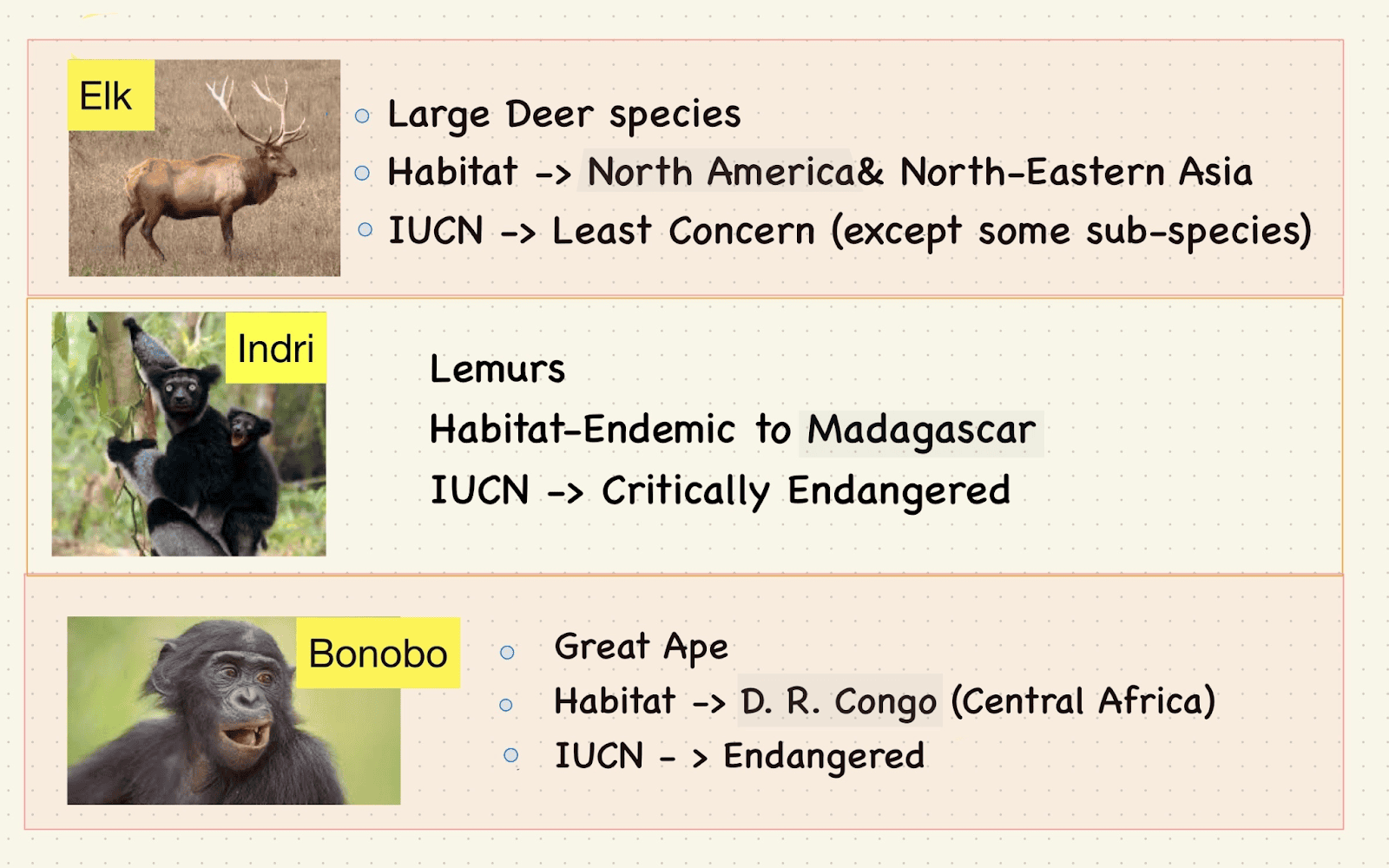
    1. Brazil - Indri: Indris are _lemurs_ found only in Madagascar, not Brazil. So, this pair is incorrect.

    2. Indonesia - Elk: Elks are found in North America, Europe, and Asia, but not in Indonesia. This pair is incorrect.
    ![Indri - Bonobo- Elk](https://d39jluplm5thpx.cloudfront.net//Indri_c5910efc84.png)

    3. Madagascar - Bonobo: Bonobos are found in the Democratic Republic of Congo, not Madagascar. This pair is also incorrect.

    Therefore, none of the pairs are correctly matched.

  2. Consider the following statements: Statement-I : The soil in tropical rain forests is rich…

    Consider the following statements: Statement-I : The soil in tropical rain forests is rich in nutrients. Statement-II : The high temperature and moisture of tropical rain forests cause dead organic matter in the soil to decompose quickly. Which one of the following is correct in respect of the above statements?

    1. ABoth Statement I and Statement II are correct and Statement II is the correct explanation for Statement I
    2. BBoth Statement I and Statement II are correct and Statement II is not the correct explanation for Statement I
    3. CStatement I is correct but Statement II is incorrect
    4. DStatement I is incorrect but Statement II is correct
    Answer and explanation

    Correct answer: D

    * Statement I is incorrect: The soil in tropical rainforests is not rich in nutrients. The heavy rainfall in these regions washes away the nutrients from the soil, preventing them from accumulating.

    * Statement II is correct: In tropical rainforests, high temperature and humidity help dead plants and animals decompose quickly. The warmth and moisture create the perfect conditions for bacteria and fungi, which are tiny organisms that break down dead material. These decomposers work faster in such an environment, turning dead matter into nutrients that go back into the soil to support new plant growth.

    Therefore, Statement-I is incorrect but Statement-II is correct.

  3. The vegetation of savannah consists of grassland with scattered small trees, but extensive areas…

    The vegetation of savannah consists of grassland with scattered small trees, but extensive areas have no trees. The forest development in such areas is generally kept in check by one or more or a combination of some conditions. Which of the following are such conditions? 1. Burrowing animals and termites 2. Fire 3. Grazing herbivores 4. Seasonal rainfall 5. Soil properties Select the correct answer using the codes given below

    1. A1 and 2
    2. B4 and 5
    3. C2, 3 and 4
    4. D1, 3 and 5
    Answer and explanation

    Correct answer: C

    The vegetation of savannah consists of grassland with scattered small trees. The forest development in such areas is generally kept in check by one or more or a combination of some conditions. These conditions include fire, grazing herbivores, and seasonal rainfall.

    2. Fire is a common occurrence in savannahs and it helps to maintain the grassland by burning out tree saplings.

    3. Grazing herbivores also help to maintain the grassland by eating young tree saplings before they can grow into mature trees.

    4. Seasonal rainfall also plays a role as it affects the growth of trees and grasses.

    1. Burrowing animals and termites, while they do have an impact on the ecosystem, are not the primary factors controlling forest development.

    5. Similarly, soil properties can affect the types of vegetation that can grow, but they are not the primary factors controlling forest development in savannahs.

    Therefore, the correct answer is (c) 2, 3 and 4.

    Savannah Climate: - It is a transitional climate between equatorial rainforests and hot deserts. - It has wet and dry seasons like the monsoon climate but with much less rainfall. Unlike the monsoon climate, it lacks a distinct rainy season. - It has only two seasons—winter and summer, with rain occurring in summer. The savanna landscape features tall grasses and scattered short trees. - The savanna is called the 'big game country' because thousands of animals are hunted or trapped annually by people worldwide.

    ![Savannah Climate](https://d39jluplm5thpx.cloudfront.net//savannah_climate_215cc4ab9a.png)

  4. “Each day is more or less the same, the morning is clear and bright…

    "Each day is more or less the same, the morning is clear and bright with a sea breeze; as the sun climbs high in the sky, heat mounts up, dark clouds form than rain comes with thunder and lightning. But the rain is soon over." Which of the following regions is described in the above passage?

    1. ASavannah
    2. BEquatorial
    3. CMonsoon
    4. DMediterranean
    Answer and explanation

    Correct answer: B

    The region described in the passage is most likely experiencing an equatorial climate.

    * Clear and bright mornings with sea breeze: This suggests a warm and humid environment near the ocean.

    * Heat building up during the day: Equatorial regions receive strong, direct sunlight throughout the year, leading to high daytime temperatures.

    * Afternoon thunderstorms: The rising heat in the afternoon creates convection currents, leading to the formation of towering cumulonimbus clouds that bring brief, intense rain showers with thunder and lightning.

    * Short-lived rain: Equatorial regions experience frequent, short bursts of rain, followed by clear skies again.

    ![Equatorial Regions of the World](https://d39jluplm5thpx.cloudfront.net//Equatorial_regions_of_the_world_ced7c0ac27.jpg)

  5. “Climate is extreme, rainfall is scanty and the people used to be nomadic herders.”…

    "Climate is extreme, rainfall is scanty and the people used to be nomadic herders." The above statement best describes which of the following regions?

    1. AAfrican Savannah
    2. BNorth American Prairie
    3. CSiberian Tundra
    4. DCentral Asian Steppe
    Answer and explanation

    Correct answer: D

    Steppes: Steppes are usually characterized by a semi-arid or continental climate. Extremes can be recorded in the summer of up to 45 °C (113 °F) and in winter, -50 °C (-58°F). Besides this huge difference between summer and winter, the differences between day and night are also very great.

    ![Central Asian Steppe](https://d39jluplm5thpx.cloudfront.net//Central_Asian_Steppe_3cf30b3b03.jpg)

    African Savannah & North American Prairie: These regions have more rainfall and varied landscapes compared to the Steppe. Nomadic herding existed, but wasn't the sole way of life.

    Siberian Tundra: Colder, less rain, permafrost. Not ideal for grazing animals. Nomadic herding is less prevalent.

    Therefore, the Central Asian Steppe, with its extreme climate, limited rainfall, and historical dependence on nomadic herding, best fits the description in the statement.

  6. Which of the following is/are unique characteristic/characteristics of equatorial forests? 1. Presence of tall,…

    Which of the following is/are unique characteristic/characteristics of equatorial forests? 1. Presence of tall, closely set trees with crowns forming a continuous canopy 2. Coexistence of a large number of species 3. Presence of numerous varieties of epiphytes Select the correct answer using the code given below:

    1. A1 only
    2. B2 and 3 only
    3. C1 and 3 only
    4. D1, 2 and 3
    Answer and explanation

    Correct answer: D

    Statement 1 is correct: The trees are very tall (up to 50 m or more) and grow close together, competing for sunlight. Their crowns form a dense, multilayered canopy that blocks most sunlight from reaching the ground.

    Statement 2 is correct: Equatorial forests are the most biodiverse ecosystems on Earth. A single hectare can host hundreds of tree species, along with diverse fauna and microorganisms. This is due to stable climate and continuous growing season.

    Statement 3 is correct: Epiphytes (plants growing on other plants) such as orchids, mosses, and ferns thrive here. The humid atmosphere and dense canopy support their growth on trunks and branches.

    ![Equitorial Forest](https://d39jluplm5thpx.cloudfront.net//Tropical_Forest_a907501c65.jpg)

  7. “Leaf litter decomposes faster than in any other biome and as a result the…

    "Leaf litter decomposes faster than in any other biome and as a result the soil surface is often almost bare. Apart from trees, the vegetation is largely composed of plant forms that reach up into the canopy vicariously, by climbing the trees or growing as epiphytes, rooted on the upper branches of trees". This is the most likely description of

    1. Aconiferous forest
    2. Bdry deciduous forest
    3. Cmangrove forest
    4. Dtropical rain forest
    Answer and explanation

    Correct answer: D

    The description provided is characteristic of the Tropical Rain Forest (Tropical Evergreen Forest).

    - Rapid Decomposition: Tropical rain forests are characterized by high temperatures and high humidity throughout the year. These conditions facilitate intense microbial activity, causing leaf litter to decompose much faster than in any other biome. As a result, nutrients are quickly reabsorbed by plants, leaving the soil surface almost bare of organic matter. - Vegetation and Epiphytes: Due to the dense, multi-layered canopy, very little sunlight reaches the forest floor. To survive, many plant forms have adapted by climbing trees (lianas) or growing as epiphytes (plants that grow on the branches of trees to access sunlight without being parasitic). - Key Species: Common trees include Mahogany, Rosewood, Aini, and Ebony. - Distribution in India: According to NCERT, these forests are found in regions with heavy rainfall (over 200 cm), specifically the Western Ghats, the Northeastern states, and the Andaman & Nicobar Islands.

    In contrast, coniferous forests have slow decomposition due to cold climates; dry deciduous forests have seasonal leaf fall and less dense canopies; and mangrove forests are specialized for saline coastal environments with distinct stilt roots.

  8. The seasonal reversal of winds is the typical characteristic of –

    The seasonal reversal of winds is the typical characteristic of -

    1. AEquatorial climate
    2. BMediterranean climate
    3. CMonsoon climate
    4. DAll of the above climates
    Answer and explanation

    Correct answer: C

    The seasonal reversal of winds is the typical characteristic of a monsoon climate.

    Monsoons are seasonal winds that bring predictable patterns of rainfall. In summer, warm, moist air blows inland from the ocean, bringing heavy rainfall. In winter, the winds blow offshore, bringing dry conditions. This seasonal reversal of winds is what defines a monsoon climate.