
Opens in a new tab
Join Anantam IAS Channel on Telegram

TOPIC

Indus Valley Civilisation

5 UPSC Prelims MCQs tagged "Indus Valley Civilisation". Free practice with answer keys, explanations, and timed mock tests on Anantam IAS.

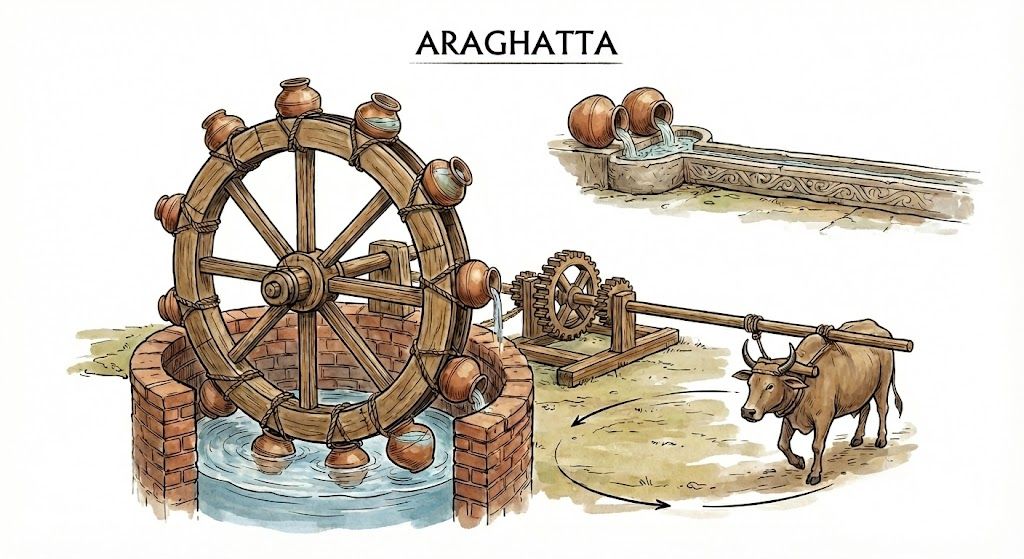
  1. The irrigation device called ‘Araghatta’ was

    The irrigation device called 'Araghatta' was

    1. Aa water bag made of leather pulled over a pulley
    2. Ba large wheel with earthen pots tied to the outer ends of its spokes
    3. Ca larger earthen pot driven by bullocks
    4. Da large water bucket pulled up by rope directly by hand
    Answer and explanation

    Correct answer: B

    The Araghatta was an ancient Indian irrigation device consisting of a large wheel with earthen pots fixed around its rim. As the wheel rotated—usually powered by animals or humans—the pots dipped into a water source and lifted water for irrigation. This mechanism is distinct from leather bags or simple buckets pulled by hand and represents early mechanical water-lifting technology.
    ![Araghatta](https://d39jluplm5thpx.cloudfront.net//araghatta_0957471c3a.jpg)

  2. Which one of the following ancient towns is well-known for its elaborate system of…

    Which one of the following ancient towns is well-known for its elaborate system of water harvesting and management by building a series of dams and channelizing water into connected reservoirs?

    1. ADholavira
    2. BKalibangan
    3. CRakhigarhi
    4. DRopar
    Answer and explanation

    Correct answer: A

    * Dholavira is one of the five largest Harappan sites and is located in the present-day state of Gujarat, India. It was a prominent city of the ancient Indus Valley Civilization, flourishing around 4500 years ago.

    * Dholavira is renowned for its sophisticated water management system, which includes reservoirs, dams, channels, and other hydraulic structures.

    * Dholavira was a well-planned city with three distinct divisions: the citadel, middle town, and lower town. The city also had a large stadium or public gathering area, suggesting community events or administrative functions. A remarkable discovery at Dholavira was the earliest known signboard, with inscriptions on a large wooden board, indicating the use of writing for communication or identification.

    ![Harappan sites in India](https://d39jluplm5thpx.cloudfront.net//harrapan_sites_22cbb16912.png)

    Kalibangan (Rajasthan) - First site to show ploughed field patterns. - Fire altars, indicating ritualistic practices. - Houses made of mud bricks instead of baked bricks. - No large water reservoirs like Dholavira.

    Rakhigarhi (Haryana) - Largest IVC site in India. - Evidence of multi-roomed houses, pottery, and jewelry making. - Skeletons found suggest the continuity of Harappan genes. - No evidence of large-scale fortifications like Dholavira.

    Ropar (Punjab) - First Harappan site excavated after India's independence. - Harappan culture overlapped with later Vedic culture. - Evidence of burials with pottery and personal belongings. - Found near the Sutlej River, showing river-based settlement.

  3. Which one of the following is not a Harappan site?

    Which one of the following is not a Harappan site?

    1. AChanhudaro
    2. BKot Diji
    3. CSohgaura
    4. DDesalpur
    Answer and explanation

    Correct answer: C

    Sohgaura is not a Harappan site and is situated in Uttar Pradesh. It is famous for its copper inscription written in Prakrit in the Brahmi script. It belongs to the Mahajanapad and Mauryan periods.

    All the other three are Harappan sites. Chanhudaro in Sindh, Pakistan, Kot Diji in Sindh, Pakistan, Desalpur in Gujarat, India.

  4. Which of the following characterizes/ characterize the people of Indus Civilization? 1. They possessed…

    Which of the following characterizes/ characterize the people of Indus Civilization? 1. They possessed great palaces and temples. 2. They worshipped both male and female deities. 3. They employed horse-drawn chariots in warfare. Select the correct statement/ statements using the codes given below.

    1. A1 and 2 only
    2. B2 only
    3. C2 and 3 only
    4. DNone of the statements given above is correct
    Answer and explanation

    Correct answer: B

    Statement 1 is incorrect: No temples or religious places have been discovered in Harappan cities.

    Statement 2 is correct: Figurines resembling a female deity have been found. They suggest the worship of Mother Goddess. A seal with a male figure sitting in a yogic posture with a trident-like headgear, surrounded by animals, has been found. This has a lot of similarities with Shiva. From this, it is figured that the Harappans might be worshipping Shiva.

    Statement 3 is incorrect: Based on the Indus seals, it can be said that a large number of animals, including goats, buffaloes, oxen, elephants, dogs, and camels, were domesticated. But the Harappans seem not to have been familiar with the horse.

  5. “During the Indus Valley Civilisation, artisans practiced a specialized metal-casting method. Figures were first…

    "During the Indus Valley Civilisation, artisans practiced a specialized metal-casting method. Figures were first modelled from a specific material, then covered with a coating of clay and dried. The coated figure was heated and the molten inner material drained out through a tiny hole in the clay cover. The hollow mould was filled with molten metal, which took the original shape. Once the metal cooled the clay cover was removed. The famous bronze 'Dancing Girl' from Mohenjodaro was crafted using this method." What is the name of the technique described in the passage above?

    1. ATerracotta casting
    2. BLost wax technique
    3. CSteatite carving
    4. DFaience molding
    Answer and explanation

    Correct answer: B

    Modelling a figure in wax, coating it in clay, melting out the wax through a hole and then pouring in molten metal is the lost-wax (cire perdue) technique. The Mohenjodaro bronze Dancing Girl is the classic Harappan example. Terracotta, steatite carving and faience are entirely different material processes.