India cannot build 500 GW of non-fossil capacity, a domestic battery industry or a semiconductor supply chain without digging. That is the uncomfortable premise behind every conversation about mining and environmental sustainability: the clean-energy transition is mineral-intensive, and minerals come out of ecosystems.
The useful question is therefore not whether to mine, but which mining, where, under what conditions, and with what obligation to restore.
What Mining Does to the Environment
Seven impact pathways recur, whatever the mineral.
- Geomorphological change. Removing soil, rock and sediment modifies landforms, destabilises slopes, accelerates erosion and alters sediment transport. River incision, coastal erosion and land subsidence follow.
- Hydrological disturbance. Mining interferes with surface and groundwater systems, modifies drainage networks, reduces recharge and introduces pollutants into aquatic ecosystems.
- Biodiversity loss. Habitats fragment, vegetation is removed, breeding grounds are disturbed.
- Pollution. Dust and particulate matter in air, suspended sediment in water, sediment plumes and oil leakage at sea.
- Climate linkages. Operations are energy-intensive, and deforestation destroys natural carbon sinks on top of the direct emissions.
- Disaster risk. Destabilised slopes, accelerated coastal erosion and damage to natural barriers such as mangroves and coral reefs raise exposure.
- Livelihood and social impact. Inadequate rehabilitation, displacement and unequal benefit sharing deepen local inequality.
The last one is the one that turns a technical problem into a political one, and it is where most projects actually fail.
Four Mining Types, Four Different Problems
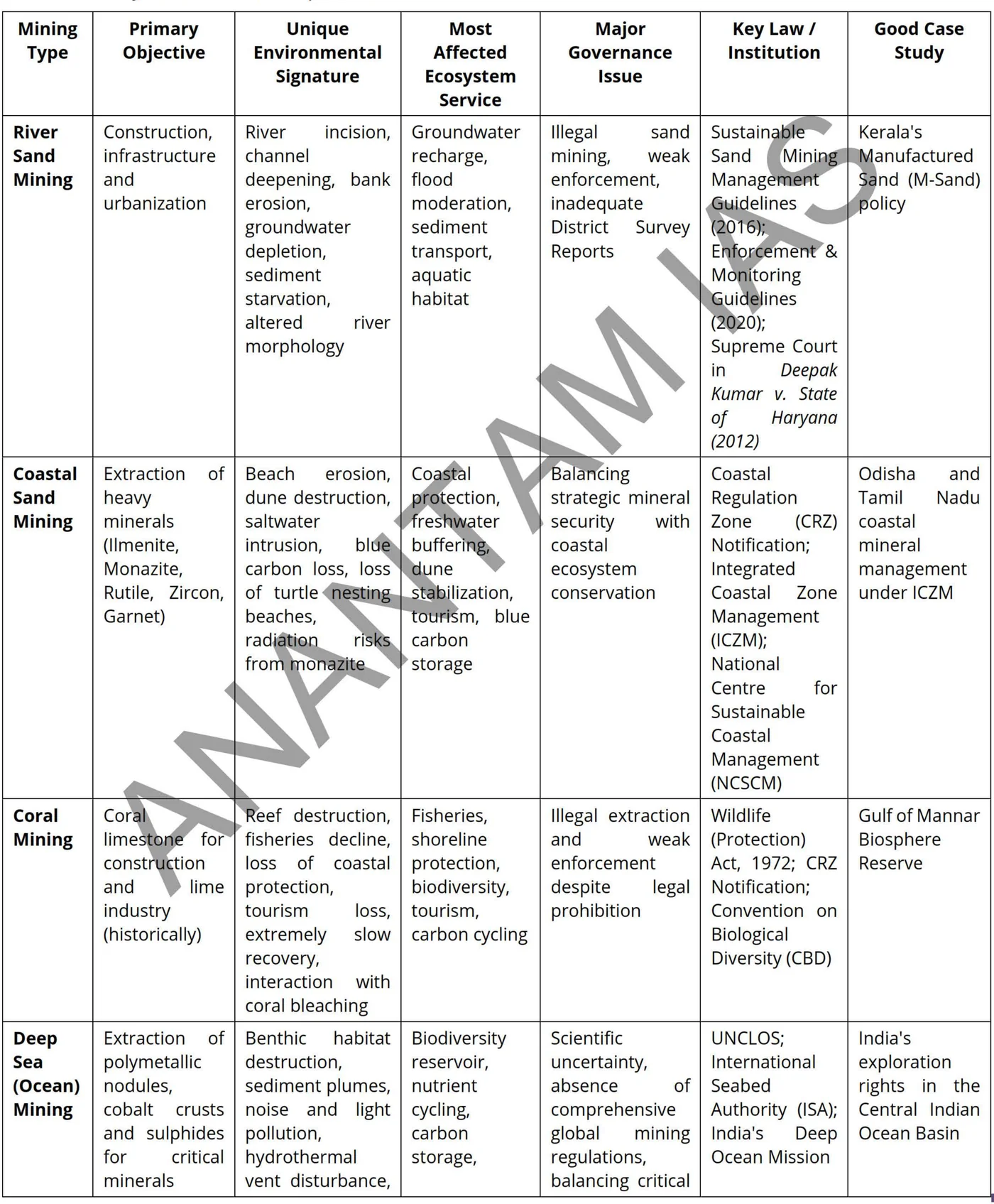
Treating mining as one activity produces weak analysis. The environmental signature, the affected ecosystem service and the governing law differ sharply by type.
River sand mining
Driven by construction and urbanisation. Its signature is channel deepening, bank erosion, groundwater depletion, sediment starvation and altered river morphology. The ecosystem services lost are groundwater recharge, flood moderation, sediment transport and aquatic habitat.
The governance issue is illegal extraction and weak enforcement. The framework rests on sustainable sand mining guidelines, District Survey Reports and the Supreme Court’s ruling in Deepak Kumar v. State of Haryana (2012), which extended environmental clearance to minor minerals.
The instructive response is Kerala’s manufactured sand policy. Substituting crushed-rock M-Sand for river sand reduces demand at source, which enforcement alone has never managed.
Coastal sand mining
Extraction of heavy minerals, ilmenite, monazite, rutile, zircon and garnet. The signature is beach erosion, dune destruction, saltwater intrusion, blue carbon loss and damage to turtle nesting beaches, with radiation handling concerns where monazite is present.
The conflict here is explicit: these are strategic minerals, and the coastline is a protective ecosystem. Governance runs through the Coastal Regulation Zone notification, Integrated Coastal Zone Management and the National Centre for Sustainable Coastal Management, with Odisha and Tamil Nadu as the reference cases.
Coral mining
Historically for lime, construction and industry. Reef destruction reduces fisheries, removes shoreline protection, damages tourism and disrupts carbon cycling, and recovery is extremely slow. It interacts with bleaching, so the damage compounds.
It is prohibited under the Wildlife (Protection) Act, 1972 and the Coastal Regulation Zone notification, and India is party to the Convention on Biological Diversity. Illegal extraction continues despite the prohibition. The Gulf of Mannar Biosphere Reserve is the standard case study.
Deep-sea mining
Extraction of polymetallic nodules, cobalt crusts and sulphides for critical minerals. The signature is benthic habitat destruction, sediment plumes, noise and light pollution, and disturbance of hydrothermal vents.
The governance problem is the sharpest of the four: scientific uncertainty about recovery, and the absence of comprehensive commercial mining regulations. UNCLOS and the International Seabed Authority provide the frame. India holds exploration rights in the Central Indian Ocean Basin through the Deep Ocean Mission.
The Honest Limits
Three things are worth saying plainly.
First, no restoration standard returns a mined ecosystem to its prior state. Reclamation reduces damage; it does not reverse it. Policy language that implies otherwise is misleading.
Second, project-by-project clearance systematically understates harm. Ten individually acceptable sand leases on one river reach are not collectively acceptable. Without cumulative assessment at the basin scale, the appraisal system is measuring the wrong thing.
Third, deep-sea mining is proceeding faster than the science. We do not know how long benthic communities take to recover from nodule removal, and the honest answer to whether it can be done sustainably is that nobody yet knows.
The Way Forward
- Substitute before you extract. M-Sand for river sand, recycled metal for virgin ore, recovery from tailings, fly ash and red mud.
- Assess cumulatively. Move clearance from the project to the river basin or coastal stretch.
- Tie closure to money. Restoration bonds held until closure obligations are met, not promises in a management plan.
- Fix benefit sharing. District mineral funds only work if affected communities can see and direct the spending.
- Regulate the deep sea before mining it. India’s exploration position is an argument for shaping the rules, not for skipping them.
Mineral demand is going to rise, not fall. The question is whether India builds an extraction system that prices its ecological cost honestly, or one that defers the bill to the districts that host the mines.
Frequently Asked Questions
What are the main environmental impacts of mining?
Seven recur across mining types: geomorphological change such as river incision and land subsidence, hydrological disturbance of surface and groundwater, biodiversity loss through habitat fragmentation, air and water pollution, climate linkages through energy-intensive operations and loss of carbon sinks, heightened disaster risk from destabilised slopes, and social impacts from displacement and inadequate rehabilitation.
Why is river sand mining so damaging?
Sand is the sediment that keeps a river channel in equilibrium. Removing it causes river incision and channel deepening, bank erosion, groundwater depletion as the water table follows the lowered bed, sediment starvation downstream, and altered river morphology. The affected ecosystem services are groundwater recharge, flood moderation, sediment transport and aquatic habitat.
What did the Supreme Court hold in Deepak Kumar v. State of Haryana?
The 2012 judgment required environmental clearance for minor mineral mining, including sand, even below the earlier area threshold. It led to the framing of sustainable sand mining guidelines and the requirement of District Survey Reports.
What is manufactured sand and why does it matter?
Manufactured sand, or M-Sand, is produced by crushing rock to sand-sized particles as a substitute for river sand. Kerala’s M-Sand policy is the standard example of demand-side substitution reducing pressure on river beds, which is more effective than enforcement alone.
Which minerals are extracted through coastal sand mining?
Heavy minerals from beach sands, chiefly ilmenite, monazite, rutile, zircon and garnet. The environmental signature is beach erosion, dune destruction, saltwater intrusion, blue carbon loss and damage to turtle nesting beaches, with radiation handling issues in monazite-bearing sands.
Why is coral mining particularly serious?
Coral reefs protect shorelines, support fisheries, sustain tourism and participate in carbon cycling, and they recover extremely slowly. Extraction interacts with coral bleaching to compound damage. It is prohibited under the Wildlife (Protection) Act, 1972 and the Coastal Regulation Zone notification, yet illegal extraction persists.
What governs deep-sea mining?
The United Nations Convention on the Law of the Sea and the International Seabed Authority govern activity beyond national jurisdiction. India holds exploration rights in the Central Indian Ocean Basin and pursues the Deep Ocean Mission. Comprehensive commercial mining regulations are still absent, and the scientific uncertainty about benthic recovery is considerable.
How should India reconcile mineral demand with ecological limits?
Through substitution and recycling first, then strict sequencing: demand-side substitutes such as M-Sand, recovery from tailings and e-waste, District Survey Reports and cumulative-impact assessment rather than project-by-project clearance, restoration bonds tied to closure plans, and benefit sharing with affected communities.
Practice Questions
Prelims MCQs
- River incision and sediment starvation are the characteristic environmental signature of which activity?
(a) Coastal sand mining
(b) River sand mining
(c) Coral mining
(d) Deep-sea mining
Answer: (b) Removing bed sediment deepens the channel, erodes banks, lowers the water table and starves downstream reaches of sediment. - Ilmenite, monazite, rutile, zircon and garnet are associated with
(a) Deep-sea polymetallic nodules
(b) Beach and coastal heavy mineral sands
(c) Coral reef formations
(d) Alluvial river beds of the Ganga
Answer: (b) These are the heavy minerals recovered from coastal beach sands, notably in Odisha, Tamil Nadu and Kerala. - The International Seabed Authority derives its mandate from
(a) The Convention on Biological Diversity
(b) UNCLOS
(c) The Ramsar Convention
(d) The Basel Convention
Answer: (b) The International Seabed Authority was established under the United Nations Convention on the Law of the Sea to regulate mineral activity in the international seabed area. - Deepak Kumar v. State of Haryana (2012) is significant for
(a) Banning all mining in tribal areas
(b) Requiring environmental clearance for minor mineral mining including sand
(c) Permitting coral extraction for construction
(d) Allowing deep-sea mining without licence
Answer: (b) The judgment extended the environmental clearance requirement to minor minerals, leading to sustainable sand mining guidelines and District Survey Reports. - India's exploration rights for polymetallic nodules are located in
(a) The Bay of Bengal shelf
(b) The Central Indian Ocean Basin
(c) The Arabian Sea coastal zone
(d) The Andaman back-arc basin
Answer: (b) India holds exploration rights in the Central Indian Ocean Basin, pursued alongside the Deep Ocean Mission.
Mains Questions
- Mining is indispensable to the clean-energy transition and destructive to the ecosystems that transition is meant to protect. Examine this paradox with reference to India's critical mineral strategy. (250 words)
- River sand mining is an enforcement failure and a substitution failure. Discuss, with reference to demand-side alternatives. (250 words)
- Coastal mineral sand mining involves a conflict between strategic mineral security and coastal ecosystem conservation. Evaluate the adequacy of India's regulatory framework. (250 words)
- Deep-sea mining is proceeding ahead of both regulation and scientific understanding. Critically comment on India's position. (150 words)
- Suggest an institutional framework for cumulative environmental impact assessment of mining at the river-basin scale. (150 words)
Tell Google you want more of this.
Add Anantam IAS as a preferred sourceOne tap, and this site shows up more often in your own Top Stories, AI Overviews and AI Mode. Remove it any time.