
A patient with end-stage kidney failure in Bhopal needs a transplant. A young man in Chennai dies in a road accident, and his family agrees to donate his organs. The kidney that saves the patient in Bhopal will travel close to two thousand kilometres in a sealed box, escorted by a team of doctors, through traffic that has been cleared in advance by the police. Behind the scenes of that single transplant sits an institution most Indians have never heard of, NOTTO, the National Organ and Tissue Transplant Organisation.
NOTTO is India’s apex body for the procurement, storage, allocation, and distribution of organs and tissues from deceased and living donors. It does not perform transplants. It is the registry, the matching engine, and the policy node that connects hospitals, donors, and patients across states. For UPSC aspirants, NOTTO matters because it sits at the intersection of public health, federalism, biotechnology, and a growing ethical debate about how scarce medical resources are allocated in a country of 1.4 billion people.
This explainer walks through what NOTTO is, the law and three-tier network that backs it, the major 2023 policy reform that created a single national waitlist, and the persistent gap between the demand for organs and what India actually supplies.
Quick Facts: NOTTO at a Glance
- What it is: The apex national body for coordinating organ and tissue procurement, allocation, and distribution in India
- Parent ministry: Directorate General of Health Services (DGHS) under the Ministry of Health and Family Welfare (MoHFW)
- Headquarters: Safdarjung Hospital campus, New Delhi
- Legal backing: Transplantation of Human Organs and Tissues Act (THOTA), 1994, amended in 2011
- Three-tier network: NOTTO (national) — ROTTO (5 regional) — SOTTO (state-level)
- Major reform: “One Nation, One Organ Allocation” policy, rolled out in 2023
- Key reform changes: No upper age limit, no domicile restriction, no registration fee, single national NOTTO-ID
- Donor types: Living donor (kidney, liver lobe) and deceased donor after brain death
- Demand-supply gap: Estimated 1.8 to 2 lakh patients on waitlists annually; only around 18,000 to 20,000 transplants performed each year
What Is NOTTO?
NOTTO is a national-level organisation set up in 2014 under the Ministry of Health and Family Welfare. It functions as both a registry and a coordinator. The registry maintains a national database of patients waiting for organs and a database of donors and organs available for allocation. The coordination role means it ties together hospitals, regional offices, and state-level bodies so that an organ retrieved in one corner of the country can, in principle, be matched with a patient anywhere else.
NOTTO does not own a hospital, does not employ surgeons, and does not pay for transplants out of its own budget. Its job is allocation logic and policy. It writes the rules that decide who gets the next available kidney, who gets the next liver, and who waits longer. It also runs the National Organ and Tissue Transplant Registry, which collects data on transplants performed across India.
There are five functional divisions inside NOTTO. These cover allocation, donor registry, hospital network, training and awareness, and the National Biomaterial Centre, which handles the storage and distribution of tissues like corneas, skin, bone, and heart valves. The biomaterial side is often forgotten in discussions because organ transplants get the headlines, but tissue donation actually saves and restores function for far more patients each year.
Background and Historical Context
India performed its first successful kidney transplant in 1971 at the Christian Medical College, Vellore. For two decades after that, transplants were unregulated. There was no central law and no national policy. Organs were sourced almost entirely from living relatives, and a black market for kidneys grew alongside the legitimate practice, especially in the 1980s when foreign patients began travelling to India to buy organs.
The Transplantation of Human Organs Act, 1994, was the first attempt to fix this. The law did three things. It legally recognised brain death as a form of death, which is the medical precondition for cadaver donation. It restricted living donation to close relatives unless a state-level Authorisation Committee approved an unrelated donation. And it banned commercial dealings in organs, with criminal penalties.
The 1994 law was a paper framework without an operational backbone. There was no central registry, no system to match donors with recipients across states, and no body to enforce uniform standards. The 2011 amendment, which renamed the law as THOTA, expanded its scope to include tissues and required the central government to set up a national network. NOTTO was created in 2014 to be that backbone, alongside its regional and state counterparts. The five Regional Organ and Tissue Transplant Organisations (ROTTOs) and twenty-plus State Organ and Tissue Transplant Organisations (SOTTOs) were rolled out in stages over the next decade.
The Three-Tier Network
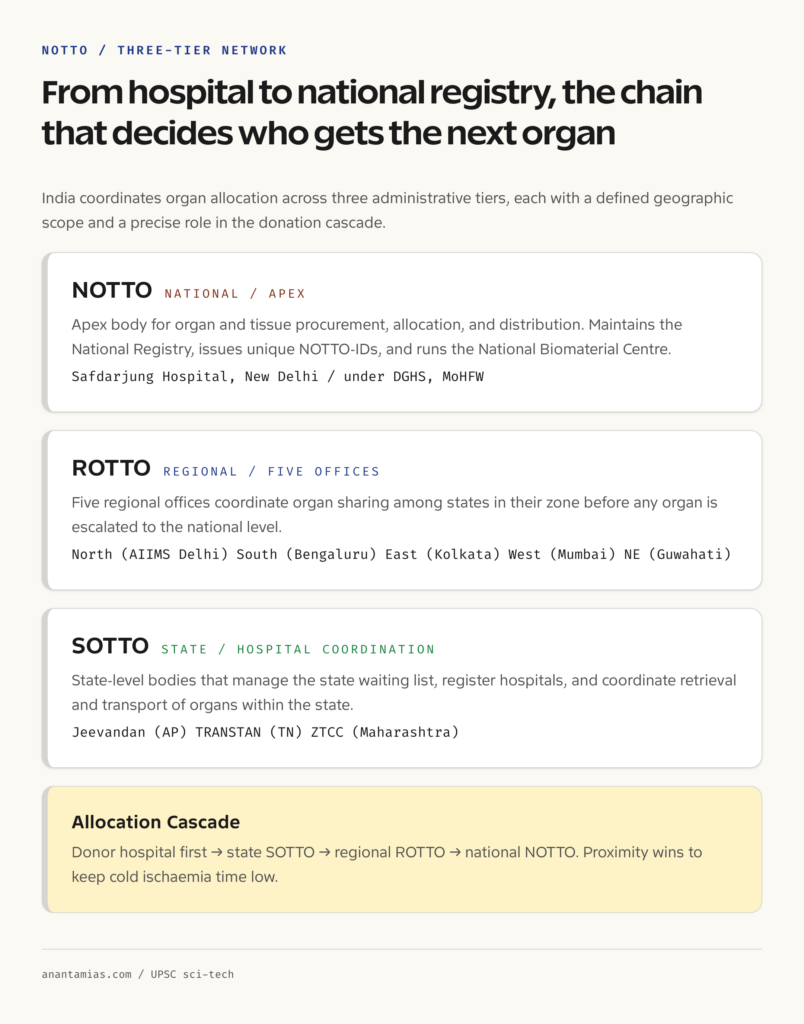
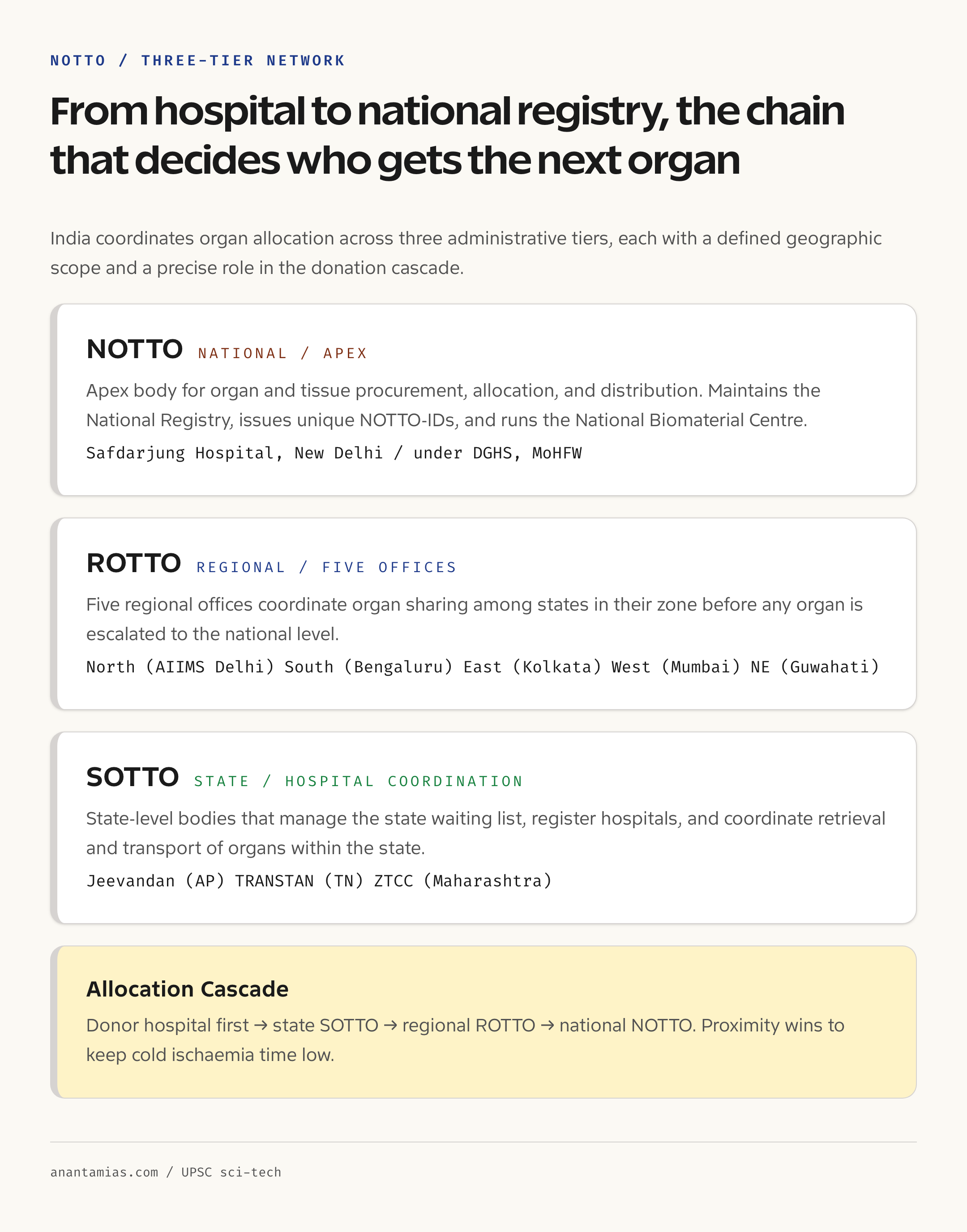
NOTTO operates through a deliberate federal structure that mirrors how health is administered in India. Health is largely a state subject, but transplant medicine requires a national matching engine because organs are time-sensitive and patients are mobile. The three-tier network is how the system reconciles this tension.
Level 1 — NOTTO (National): Maintains the national registry. Coordinates inter-regional allocation when no recipient is found within a region. Issues policies, training standards, and the unique NOTTO-ID for every registered patient. Hosts the National Biomaterial Centre.
Level 2 — ROTTO (Regional): Five regional offices cover North (AIIMS Delhi), South (Bengaluru), East (IPGMER Kolkata), West (KEM Hospital Mumbai), and North-East (Guwahati Medical College). Each ROTTO coordinates organ sharing among states in its zone before any organ is escalated to the national level for allocation.
Level 3 — SOTTO (State): State-level bodies that manage the state waiting list, certify and register hospitals, and coordinate the actual retrieval and transport of organs within the state. Andhra Pradesh’s Jeevandan, Tamil Nadu’s TRANSTAN, and Maharashtra’s ZTCC are well-known SOTTOs that predate the formal SOTTO designation and have been integrated into the network.
The allocation logic flows in cascading order. When a deceased donor’s organ becomes available, the first match is sought within the donor hospital. If no recipient is found, the organ is offered within the state through the SOTTO. If still no match, it goes to the regional ROTTO. Only if all regional matches fail does the organ become available at the national level through NOTTO. This cascade is designed to balance two priorities, minimising cold ischaemia time (the period an organ is outside a body) and giving patients a shot regardless of which state they live in.
The 2023 One Nation, One Organ Allocation Reform
For most of NOTTO’s existence, the registry was effectively a federation of state lists. Each state ran its own waiting list with its own rules. A patient who registered in Telangana could not be considered for an organ retrieved in Karnataka unless both states had a bilateral arrangement. Registration fees varied. Some states excluded patients above 65. Others required state domicile. The result was a patchwork that punished patients who lived in states with weaker transplant programmes.
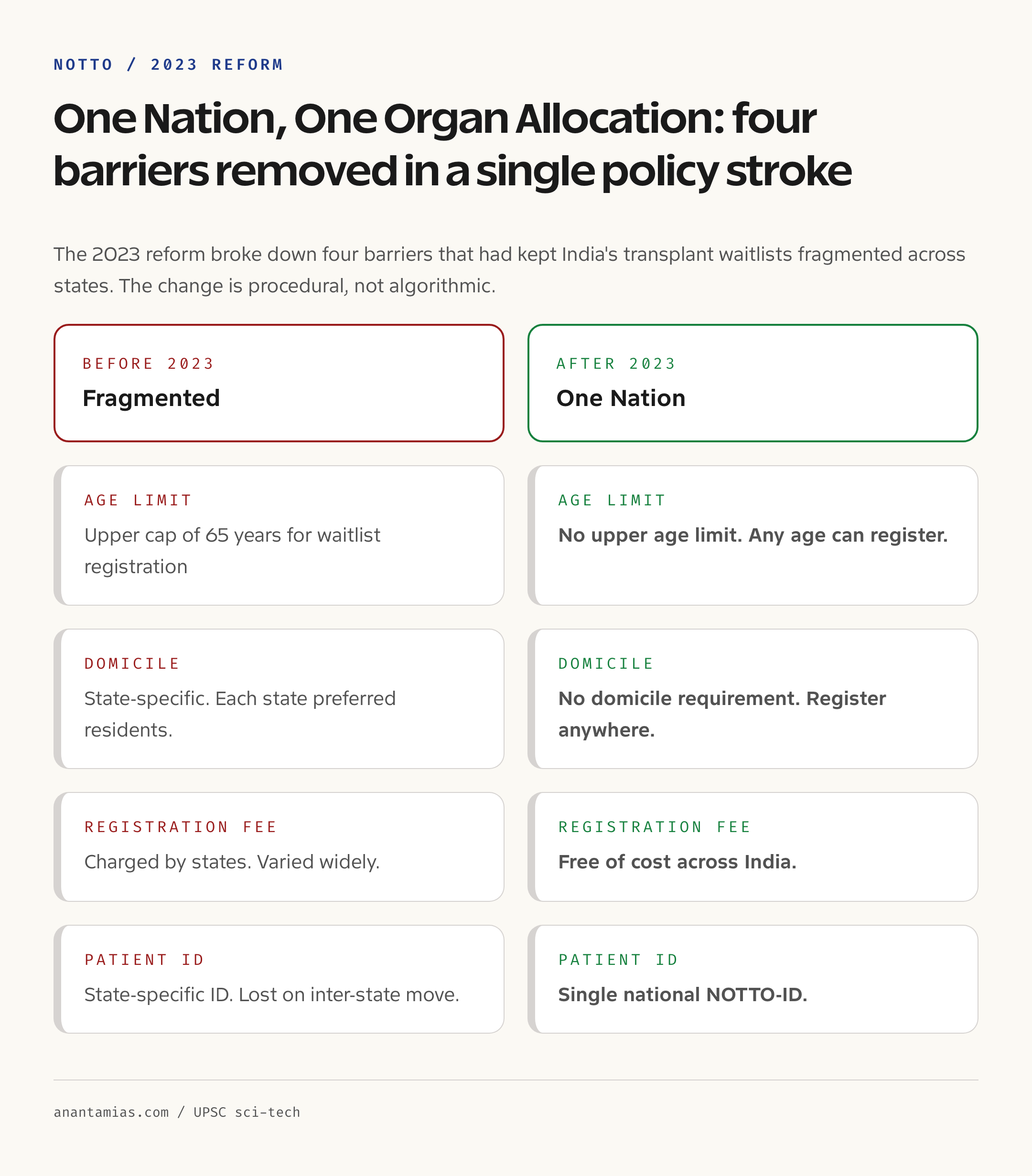
The 2023 policy reform, formally titled the One Nation, One Organ Allocation policy, broke down four of these barriers in a single move.
Age limit gone. The earlier upper cap of 65 years for transplant registration was eliminated. A patient of any age can now register, on the principle that age alone should not determine eligibility, especially when life expectancy in India has risen and a 70-year-old today may have decades of productive life remaining after transplant.
Domicile restriction gone. Patients no longer need to be residents of the state where they register. A patient from Bihar can now register in Delhi, in Tamil Nadu, or in any state with a notified transplant centre. This matters because the highest-volume transplant hospitals are concentrated in a handful of states.
Registration fees abolished. State-level fees varying from a few thousand to over a lakh of rupees were scrapped. Registration on the national waitlist is now free of cost.
Single national NOTTO-ID. Each patient receives one national identification number that follows them across states. Earlier, a patient who moved from one state to another had to re-register and lost their place on the waiting list. The unified ID solves this.
The reform did not change the underlying allocation algorithm, which still gives priority to the state and region of donor origin before going national. What it changed was who gets to be on the list in the first place, and on what terms.
Living Donor Versus Deceased Donor: The Two Pathways
India’s transplant programme runs on two tracks that look very different in practice.
Living donation accounts for the vast majority of kidney transplants in India and a meaningful share of liver transplants. A living donor can give one kidney (humans can survive on one kidney with a small reduction in renal reserve) or a lobe of the liver (which regenerates within months). Under THOTA, the donor must be a near relative as defined by law, or the donation must be approved by an Authorisation Committee that examines the relationship and the absence of commercial intent. Living donation works because the donor is healthy, the surgery is planned, and the cold ischaemia time is minutes rather than hours.
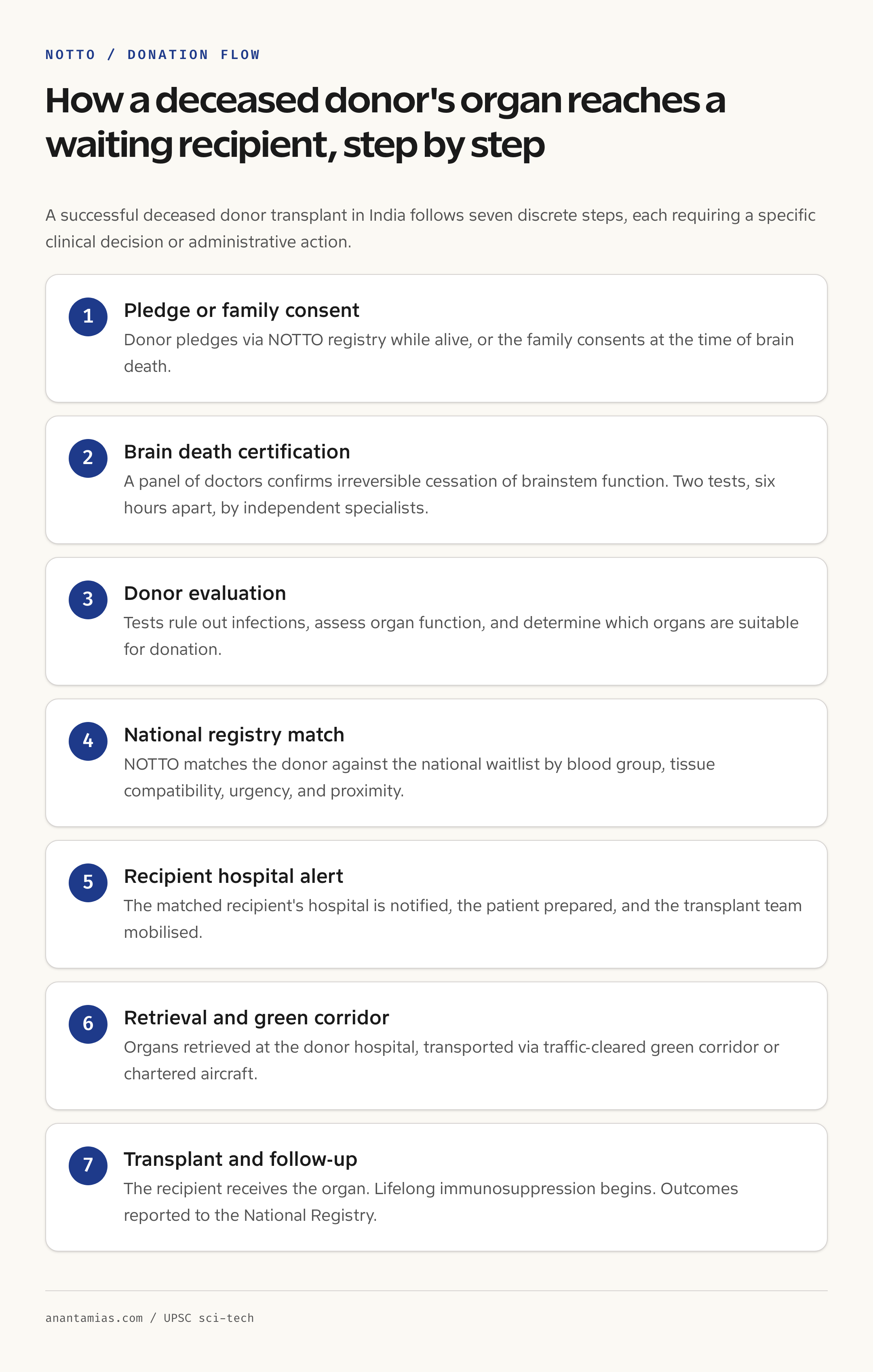
Deceased donation happens after brain death certification, a precise medical determination that the brainstem has irreversibly ceased to function even though the heart may still beat with mechanical support. A single brain-dead donor can save up to eight lives by giving heart, lungs (two), liver, kidneys (two), and pancreas, plus restore sight to two recipients through corneal donation and benefit several more through tissue donation. India performs roughly one deceased donor transplant for every nine to ten living donor transplants. In Spain, which has the world’s highest deceased donation rate, the ratio is the reverse. The gap is the single biggest reason India’s overall transplant numbers remain low.
Why NOTTO Matters: The Demand-Supply Gap
The simplest case for NOTTO is arithmetic. India has roughly 1.8 to 2 lakh people on transplant waiting lists at any given time across kidneys, livers, hearts, and lungs. Annual transplants performed are in the range of 18,000 to 20,000. The gap is an order of magnitude. Most patients on the waiting list will not live to receive an organ.
This gap is not primarily a medical capacity problem. India has world-class transplant surgeons and centres in Delhi, Chennai, Bengaluru, Hyderabad, Mumbai, and several other cities. The constraint is donor availability, especially deceased donors. India’s deceased donor rate sits at roughly 0.8 per million population, against Spain’s 49, the United States’ 48, and even Iran’s 12. The ceiling of what NOTTO can achieve is set by how many families consent to donate after a relative’s brain death.
NOTTO’s policy work tries to attack this ceiling on multiple fronts. The single national waitlist makes the system look fairer and more credible to potential donor families. The standardised brain death protocol gives ICU teams a uniform process. The Pledge to Donate registry, which crossed seven million pledges in 2024, builds a public culture of donation. Awareness campaigns through Organ Donation Day on 13 August try to normalise the conversation in families before tragedy strikes.
Detailed Analysis: Green Corridors and the Logistics of Organs
A green corridor is a special traffic-cleared route, coordinated by police and city traffic authorities, that allows an organ to be transported from the donor hospital to the recipient hospital in record time. The coordination is unromantic and procedural. The donor hospital alerts NOTTO or the SOTTO. The recipient hospital is identified. The route is mapped. Traffic signals are manually overridden along the route. Ambulances move at sustained high speed, sometimes covering 30 kilometres in under 15 minutes in cities where the same trip would normally take an hour.
Green corridors are needed because organs have brutal cold ischaemia limits. A heart can survive outside a body for about four to six hours. Lungs are similar. A liver gives twelve to fifteen hours. A kidney is the most forgiving at twenty-four to thirty-six hours. Beyond these windows, the organ’s tissue starts to die, the transplant fails, and the recipient dies with it. Air corridors involving chartered flights or commercial airlines holding aircraft on the tarmac extend the geographic reach further. The first long-distance heart transplant in India, between Chennai and Bengaluru in 2014, used both a green corridor and an aircraft.
This logistics machinery is the part of organ donation that the public sees in newspapers. It is also the smallest part of the system. The longer story is the registry maintenance, the brain death certification, the family counselling, and the allocation algorithm, all of which run silently between donations.
Comparative: India Versus Global Best Practices
Spain, often cited as the gold standard, organises deceased donation around a network of hospital-based transplant coordinators. Every ICU in the country has a designated coordinator whose job is to identify potential donors among brain-dead patients and counsel families with practiced sensitivity. The Spanish system is built on opt-out consent, where adults are presumed willing donors unless they have explicitly registered otherwise, but the day-to-day practice still involves family conversations rather than legal coercion.
The United States runs a different model with a strong organ procurement organisation (OPO) network, a clear federal regulator (HRSA), and a unified allocation platform run by UNOS. Consent is opt-in but registration is high because driver’s licence renewal includes a donation question.
India’s challenge is partly cultural. Hindu, Muslim, and Christian theological positions all permit organ donation, but family decisions in moments of grief tend to default to no when there is uncertainty. The challenge is also institutional. Most Indian ICUs do not have dedicated transplant coordinators. Brain death certification is not always standardised across states. Counselling varies enormously by hospital. NOTTO’s role in the next decade will be less about the registry and more about pushing this institutional layer down to every tertiary hospital in the country.
Challenges Facing the Indian Transplant System
The largest challenge remains the deceased donor rate. Without raising this rate to even five per million population, the demand-supply gap will continue to widen as non-communicable diseases like diabetes, hypertension, and chronic kidney disease push more patients onto waitlists.
Inter-state inequity is another problem. Tamil Nadu, Telangana, Andhra Pradesh, Karnataka, and Maharashtra together perform a majority of India’s deceased donor transplants. Patients from northern and eastern states still travel south for transplants, which conflicts with the One Nation reform’s spirit even if it now allows the registration to happen anywhere.
Commercial transplant tourism remains a problem at the fringe of the system, with periodic exposes of organ trafficking rings using forged documents to bypass the Authorisation Committee process. Strengthening the Committees and giving NOTTO direct audit powers over them is a recurring policy proposal.
Finally, the transplant ecosystem still excludes the bulk of India’s poor. Even free organ allocation does not solve the cost of immunosuppressant medication, which a transplant recipient takes for life. Without health insurance coverage for post-transplant care, many recipients cannot sustain the medical regime that keeps the organ alive.
Prelims Pointers
- NOTTO operates under the DGHS, MoHFW, headquartered at Safdarjung Hospital, New Delhi
- The legal basis is the Transplantation of Human Organs and Tissues Act (THOTA), 1994, amended in 2011
- Five ROTTOs cover North (Delhi), South (Bengaluru), East (Kolkata), West (Mumbai), North-East (Guwahati)
- The 2023 One Nation, One Organ Allocation policy removed the age cap, domicile rule, and registration fee
- Organ Donation Day is observed on 13 August
- National Biomaterial Centre under NOTTO handles tissues like corneas, skin, bone, heart valves
- A single deceased donor can save up to 8 lives through major organ donation
- India’s deceased donor rate is approximately 0.8 per million population, far below Spain’s 49
Mains Practice Questions
- “India’s transplant system has a registry but not a donation culture.” Critically examine in light of the One Nation, One Organ Allocation policy. (15 marks, 250 words)
- Discuss the role of NOTTO in addressing inter-state inequities in organ transplantation. What further reforms would you suggest? (10 marks, 150 words)
- Brain death certification is the medical and ethical foundation of deceased donation. Examine the institutional gaps in its implementation in Indian ICUs. (15 marks, 250 words)
Way Forward
The next phase of India’s transplant programme has to move beyond policy on paper. NOTTO’s 2023 reform created the legal and procedural conditions for a national system. Turning those conditions into actual transplants requires investment in three places. Hospital-based transplant coordinators in every tertiary ICU, modelled on the Spanish system, would do more for the donor rate than any further policy tweak. Standardised brain death certification with mandatory training for ICU consultants would close the first bottleneck. And insurance coverage for post-transplant immunosuppression under Ayushman Bharat and state schemes would extend the benefit beyond the patients who can already afford it.
NOTTO also has unfinished work on tissue donation, which has far higher donation potential than solid organs because tissue can be harvested up to 24 hours after cardiac death. Cornea donation alone could clear most of India’s corneal blindness backlog if the National Biomaterial Centre were scaled. The relationship between NOTTO and the broader health system in India is the next governance frontier, and the way biotechnology advances in regenerative medicine will reshape what counts as a transplant in the first place.
Frequently Asked Questions
Is organ donation legal in India?
Yes. Organ donation is legal under the Transplantation of Human Organs and Tissues Act, 1994, as amended in 2011. The law permits living donation by close relatives, living donation by unrelated persons subject to Authorisation Committee approval, and deceased donation after brain death certification. Commercial transactions in organs are criminal offences.
How is brain death different from coma?
A patient in a coma has reduced consciousness but the brainstem is still functioning, supporting breathing, heart rate, and reflexes. Brain death means the brainstem has irreversibly ceased to function. The patient cannot breathe without mechanical ventilation, has no brainstem reflexes, and cannot recover. In most legal systems, brain death is death even though the heart may still beat with ventilator support.
Can I pledge to donate my organs while alive?
Yes. The NOTTO Pledge to Donate registry accepts pledges online and through hospital networks. The pledge is morally binding but not legally enforceable, because Indian law gives the family final consent at the time of death. Pledging makes the family conversation easier in the moment of grief, which is why awareness campaigns prioritise pledging.
What organs can be donated after death?
After brain death, a single donor can give heart, lungs (two), liver, kidneys (two), and pancreas. Tissues like corneas, skin, bone, heart valves, and tendons can be donated after both brain death and conventional cardiac death within a window of up to 24 hours.
Does religion permit organ donation?
The major religious authorities in India, across Hindu, Muslim, Christian, Sikh, Jain, Buddhist, and Parsi traditions, have all issued statements affirming that organ donation is permitted and is consistent with their teachings on saving life. Religion is rarely the actual obstacle in family decisions; uncertainty and grief are the real obstacles.
Why does India have a low deceased donor rate?
The low rate reflects three factors. First, the absence of dedicated transplant coordinators in most ICUs. Second, low public awareness of brain death as a clinical reality. Third, decision-making in extended families during grief, where any one objector can veto donation. The 2023 reform addresses none of these directly. They require institutional investment and cultural change.
What is a green corridor?
A green corridor is a traffic-cleared route, coordinated by police, that allows an ambulance carrying a harvested organ to travel from the donor hospital to the recipient hospital at sustained high speed. It is needed because organs have short cold ischaemia limits, especially heart and lungs.
Can foreigners receive transplants in India?
Foreign nationals can receive transplants in India under specific conditions. They must bring a related living donor with documented relationship, the case must be approved by the Authorisation Committee, and the transplant must be performed at a registered hospital. Deceased donor organs are reserved for Indian citizens on the national waitlist.
Who pays for the transplant?
Costs include the surgery, the hospital stay, and lifelong immunosuppression. Public hospitals perform many transplants at subsidised rates. Ayushman Bharat and several state schemes cover specific transplants for eligible patients. The post-transplant immunosuppressant cost, which can run into lakhs over a lifetime, is the largest sustained financial burden and is poorly covered by most insurance schemes.
How does NOTTO decide who gets the next organ?
The allocation logic balances medical urgency, time on the waiting list, blood group and tissue match, and geographic proximity to minimise cold ischaemia time. The cascading rule, donor hospital first, then state, then region, then national, prioritises proximity to keep the organ viable. Within each level, the algorithm weighs urgency and match quality.
Tell Google you want more of this.
Add Anantam IAS as a preferred sourceOne tap, and this site shows up more often in your own Top Stories, AI Overviews and AI Mode. Remove it any time.





