Disclosure: this guide contains Amazon affiliate links. As an Amazon Associate, Anantam IAS earns from qualifying purchases — at no extra cost to you.
PCS means the Provincial Civil Service — a state government’s own administrative cadre, the state-level counterpart of the IAS — and in Punjab it is recruited by the Punjab Public Service Commission (PPSC) through the Punjab Civil Services (PCS) Combined Competitive Examination. The flagship PCS (Executive Branch) post is the SDM-track officer who runs a sub-division. For the wider meaning of the term, see PCS full form.
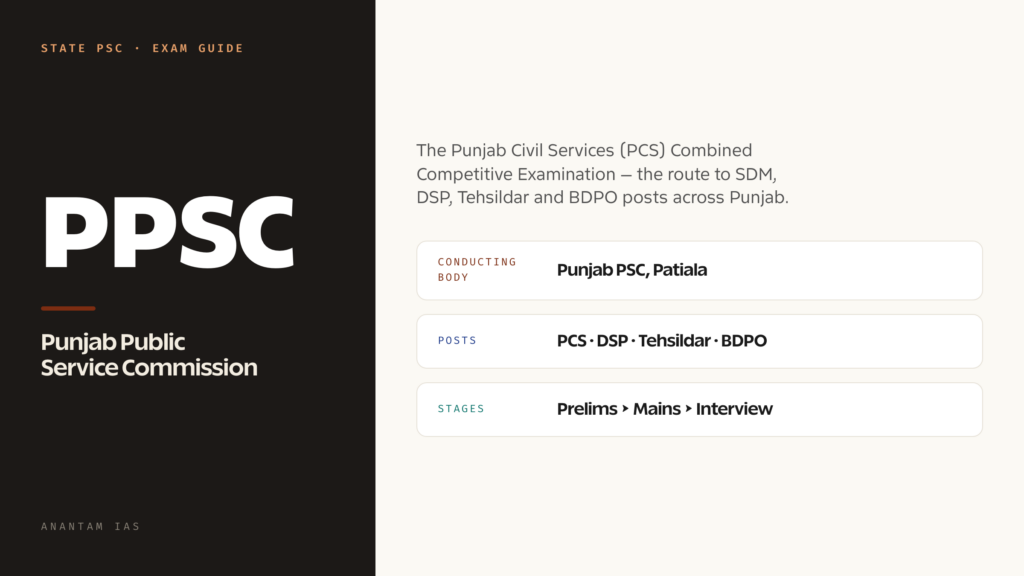
The Punjab Public Service Commission (PPSC) is the constitutional body that recruits for Punjab’s state civil services through the Punjab Civil Services (PCS) Combined Competitive Examination. For an aspirant who wants to serve in the land of the five rivers — running a sub-division, a police district, or a development block — this is the exam that opens the door.
PPSC’s flagship exam selects officers for the posts most graduates in Punjab aspire to: SDM, DSP, Tehsildar, Block Development and Panchayat Officer, and Excise and Taxation Officer, among others. It runs in three stages and carries one feature that sets it apart from almost every other state PSC — a hard Punjabi-language requirement that starts at the eligibility gate itself. This guide walks through the pattern, who can apply, the syllabus with its real Punjab-specific weight, and how to prepare.
What Is the PPSC PCS Exam?
The Punjab Public Service Commission conducts the Combined Competitive Examination — commonly called the Punjab PCS exam — to fill Group A and Group B posts across the state government. A single notification typically advertises several services together, and a candidate’s rank decides which post they are allotted.
The services on offer are the heart of district administration in Punjab. The PCS (Executive Branch) officer is the SDM-track post — the magistrate who runs a sub-division. Alongside it sit the Deputy Superintendent of Police (DSP), Tehsildar, Block Development and Panchayat Officer (BDPO), Excise and Taxation Officer, and Food and Civil Supplies Officer. These are the people who hold land records, maintain law and order, run welfare schemes, and collect state revenue.
Key Facts
- Conducting authority: Punjab Public Service Commission, headquartered in Patiala.
- Exam: Combined Competitive Examination (Punjab PCS), held in three stages — Prelims, Mains, and a Personality Test.
- Posts: PCS (Executive Branch), DSP, Tehsildar, BDPO, Excise and Taxation Officer, Food and Civil Supplies Officer, and allied services.
- Frequency: Conducted as and when vacancies are notified — in recent cycles the Commission has run it more regularly, with the latest combined notification advertising over 300 vacancies.
- Competition: Lakhs of graduates from across Punjab compete for a few hundred seats, so the cut-off is sharp and selection is tight.
PPSC PCS Exam Pattern
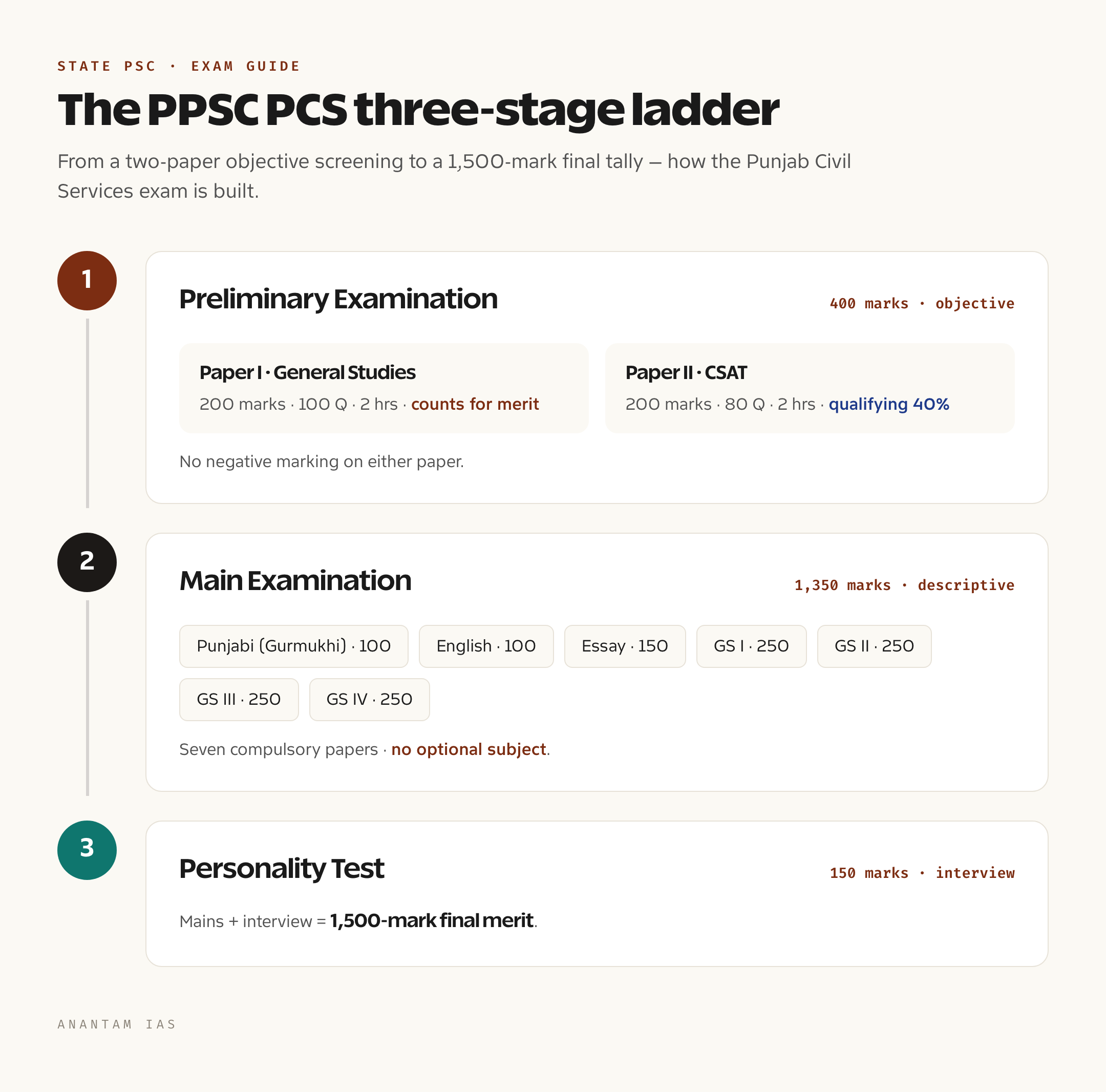
The Punjab PCS exam follows the familiar three-stage civil-services structure — an objective screening test, a long descriptive Mains, and an interview — but the marks weights and the Punjabi paper give it a distinct shape.
Prelims
The Preliminary Examination is a screening test with two objective papers of 200 marks each, taken on the same day.
| Feature | Details |
|---|---|
| Paper I (General Studies) | 200 marks, 100 questions, 2 hours |
| Paper II (CSAT / Aptitude) | 200 marks, 80 questions, 2 hours |
| Type | Objective (multiple choice) |
| Negative marking | None — PPSC does not deduct marks for wrong answers |
| Merit | Decided by Paper I alone |
| CSAT status | Qualifying only — minimum 40% needed |
This is a candidate-friendly structure in two ways. There is no negative marking, so an aspirant can attempt every question without the penalty that dominates UPSC strategy. And the CSAT paper is purely qualifying at 40% — only Paper I (General Studies) counts toward the Prelims merit, the same logic UPSC uses. Candidates ranked roughly 12 to 13 times the number of vacancies advance to Mains.
Mains
The Main Examination is fully descriptive and consists of seven compulsory papers. There is no optional subject — the entire Mains is built on language, essay, and General Studies.
| Paper | Subject | Marks |
|---|---|---|
| Paper I | Punjabi (Gurmukhi script) | 100 |
| Paper II | English | 100 |
| Paper III | Essay | 150 |
| Paper IV | General Studies I | 250 |
| Paper V | General Studies II | 250 |
| Paper VI | General Studies III | 250 |
| Paper VII | General Studies IV | 250 |
| Total | 1,350 |
Two structural points matter here. First, the Punjabi (Gurmukhi) paper is a full 100-mark compulsory paper — not a token qualifier — so a working command of written Punjabi is non-negotiable. Second, with no optional subject, all your Mains marks ride on four GS papers plus essay and the two language papers, which removes the 500-mark optional gamble of UPSC and rewards broad, even GS preparation.
To be called for the interview, a candidate must score at least 45% in aggregate (40% for SC/ST) with a minimum of 25% in each paper — so you cannot afford to bomb a single paper, including Punjabi.
Personality Test (Interview)
The final stage is a 150-mark Personality Test before a board. It assesses awareness, judgement, communication, and suitability for public service. The grand total — Mains plus interview — comes to 1,500 marks, and the final merit list is built on that combined score.
PPSC PCS Eligibility
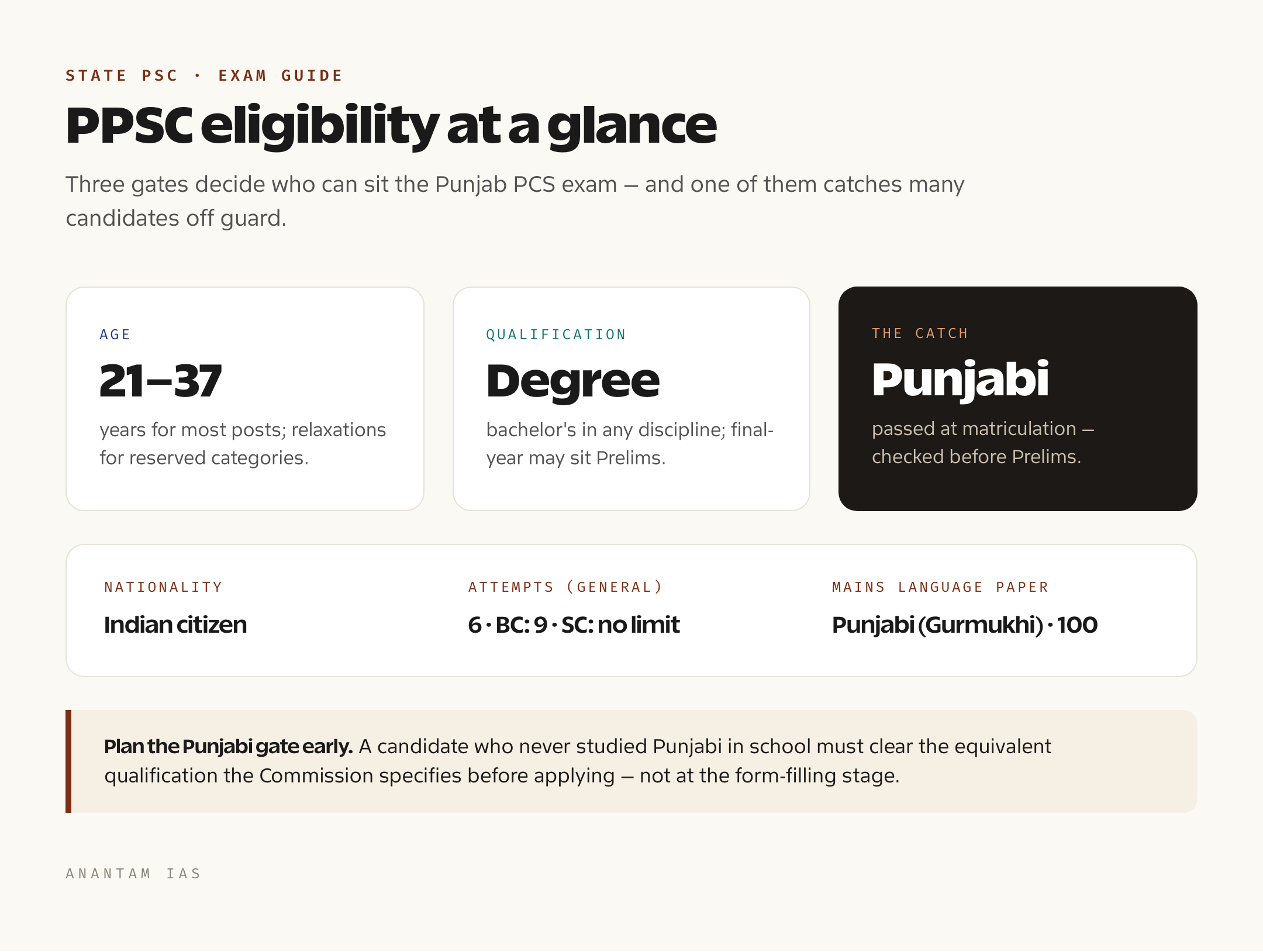
Punjab’s eligibility rules are mostly standard, with one requirement that trips up many otherwise-strong candidates — the Punjabi-language condition.
- Nationality: Indian citizen. Persons of Indian origin who migrated from specified countries may apply with an eligibility certificate, as per the Punjab Civil Services Rules.
- Age: Generally 21 to 37 years for most posts, with age relaxations for reserved categories under Punjab government rules. Police and prisons-service posts can carry a tighter upper limit, so always read the specific notification.
- Educational qualification: A bachelor’s degree in any discipline from a recognised university. Final-year students may sit the Prelims but must produce their degree proof before the Mains.
- Punjabi-language requirement: This is the differentiator. A candidate must have passed Punjabi as a compulsory or elective subject at the Matriculation (Class 10) level, or an equivalent qualification in Punjabi recognised by the government — and this is checked at the Prelims stage itself. Without it, you cannot appear.
- Attempts: General candidates get six attempts; Backward Classes nine; Scheduled Castes have no limit, as per the latest rules.
The Punjabi-at-matriculation rule is an absolute gate. An aspirant from outside Punjab who never studied Punjabi in school will need to clear the equivalent qualification the Commission specifies before applying — so plan for it well in advance.
PPSC PCS Syllabus
The syllabus runs broadly parallel to UPSC at the general-studies level, which is good news for aspirants preparing for both. The real difference is the heavy, recurring weight on Punjab — its history, geography, economy, and society.
Prelims Syllabus
Paper I — General Studies (200 marks) covers:
- History of India and the Indian freedom struggle, with a clear Punjab history component — the Sikh Gurus, the rise of Maharaja Ranjit Singh and the Sikh empire, the Anglo-Sikh wars, and Punjab’s outsized role in the freedom movement (Ghadar movement, Jallianwala Bagh, the Babbar Akali and Kirti movements, Bhagat Singh and the Lahore Conspiracy).
- Indian and Punjab geography — physical, social, and economic, including the Indus-system rivers, the canal network, soils, and cropping patterns.
- Indian polity and governance — Constitution, Panchayati Raj, public policy.
- Economic and social development — poverty, demographics, sustainable development.
- General science, environment, and ecology.
- Current events of national and international importance, with attention to Punjab affairs.
Paper II — CSAT / Aptitude (200 marks, qualifying) tests comprehension, logical reasoning and analytical ability, decision-making and problem-solving, general mental ability, basic numeracy (Class 10 level), and basic English comprehension. You only need 40% here, but do not treat it as optional — a missed qualifying mark ends the attempt regardless of your GS score.
Mains Syllabus
The four GS papers carry the bulk of the Mains, and each blends national content with a Punjab layer:
- GS I — Indian and Punjab history, the freedom struggle, world and Indian geography, and society and culture including Punjab’s culture, social issues, and women’s empowerment.
- GS II — the Constitution, polity and governance, federalism, the judiciary, and international relations.
- GS III — the Indian and Punjab economy, industrial and agricultural policy, science and technology, and internal security.
- GS IV — ethics, integrity, public-service values, emotional intelligence, and case studies.
The two language papers — Punjabi (Gurmukhi) and English at the 10+2 standard — and the 150-mark Essay round out the seven-paper Mains.
State-Specific Focus
This is where the Punjab PCS exam is genuinely won or lost. National GS is contested ground where everyone is strong; the Punjab layer is the differentiator.
- Punjab history: the ten Sikh Gurus and the founding of the Khalsa, Banda Singh Bahadur, the misls, Maharaja Ranjit Singh’s empire and administration, the two Anglo-Sikh wars and annexation, and the freedom movement.
- The Green Revolution: Punjab as its epicentre in the late 1960s — high-yielding wheat and rice, the role of irrigation and assured procurement, and the long tail of consequences (water-table depletion, soil and input stress, the diversification debate). This is a high-frequency theme across Prelims, GS III, and essay.
- Punjab geography and economy: the Malwa, Majha, and Doaba regions, the river-and-canal system, agriculture-led economy, agro-industry, and the migration and employment story.
- Punjab polity and schemes: the state’s administrative structure, Panchayati Raj in Punjab, and current state welfare and development schemes — the kind of fast-moving material that rarely appears in any book and must be tracked through state newspapers and government releases.
PPSC PCS Preparation Strategy
A focused aspirant can build a Punjab PCS plan in clear layers rather than treating it as a vague mountain of GS.
Build the GS foundation on NCERTs
Because the GS syllabus overlaps heavily with UPSC, the standard NCERT-to-standard-reference ladder works. Read NCERTs for history, geography, polity, and economy, then move to one standard reference per subject. If you are already preparing for UPSC, most of this work is shared — you are adding a Punjab layer, not starting over.
Master the Punjab layer early
Treat Punjab history, geography, economy, and current affairs as a dedicated subject from day one. A single reliable Punjab GK source plus the state-board Punjab history and geography textbooks (often in Punjabi) give you the depth that separates selected candidates from the rest. The Green Revolution and the Sikh-empire period deserve special attention.
Take the Punjabi paper seriously
If Punjabi is your mother tongue, this is a scoring paper — practise formal Gurmukhi writing, précis, and essay so you convert it into marks rather than just clearing it. If you are not a fluent writer, start early; a weak Punjabi paper can drag you below the 25%-per-paper floor and end an otherwise good attempt.
Use PYQs and a current-affairs system
Work through PPSC’s previous-year papers to read the Commission’s pattern — how much Punjab content appears, how factual the GS is, and how the CSAT is pitched. Build a current-affairs routine that combines a national monthly compilation with daily tracking of Punjab affairs from a state newspaper.
Practise answer-writing and mocks
Mains is descriptive and seven papers long, so writing stamina matters. Practise structured answers within word limits, write full essays under timed conditions, and take full-length Prelims mocks to fix timing. Since there is no negative marking, train yourself to attempt the maximum in Prelims.
Posts, Salary and Career
The Punjab PCS opens a career at the core of state administration. The flagship PCS (Executive Branch) officer enters on the SDM track and can rise toward senior secretariat and district roles; the DSP heads into the police hierarchy; Tehsildars, BDPOs, and Excise and Taxation Officers anchor revenue, rural development, and state finances.
On pay, an entry-level PCS officer such as an SDM or DSP draws a basic pay of around ₹56,100 per month at Pay Level 10 under the 7th Pay Commission, before allowances. With Dearness Allowance, House Rent Allowance, and other perks, the in-hand figure typically lands in the ₹50,000 to ₹75,000 range depending on the post and station, and rises substantially with service. Beyond the pay, these are posts with real authority and visibility in Punjab’s districts — which is exactly why the competition is fierce.
Books for PPSC PCS
Most of what you read for UPSC transfers to PPSC PCS: polity, economy, modern history and the NCERT base. What does not transfer is the Punjab section, and that is where the selection is decided. One state book, read three times, beats five read once.

Know Your State: Punjab 2026-27 — Arihant
- 312 pages, Arihant, 2026-27 edition
- Punjab history, geography, economy, polity and culture with coloured maps
- Chapter-end MCQs and PYQs

Lucent's General Knowledge 2026 — English (15th revised edition)
- 460 pages, Lucent Publications
- Static GK in the compressed, list-heavy format state PSC prelims reward
- Overrated for UPSC, right for this exam
- Indian Polity, M. Laxmikanth (Amazon.in). The polity questions are the same exam everywhere.
- Lucent’s General Knowledge (Amazon.in). Overrated for UPSC, right for the static questions here.
- Indian Economy, Ramesh Singh (Amazon.in). Read the concept chapters; the state budget goes on top.
- A Brief History of Modern India, Spectrum (Amazon.in). The freedom-struggle questions come straight from here.
- Know Your State: Punjab 2026-27 — Arihant (Amazon.in): the Punjab-specific section for PCS.
- NCERTs, Classes 6 to 12, for history, geography and science. Free from NCERT; nothing to buy.
Skip the coaching compilations until you have finished these. They summarise books you have not read yet.
Frequently Asked Questions
Is Punjabi compulsory for the PPSC PCS exam?
Yes, and at two levels. You must have passed Punjabi as a subject at the Matriculation (Class 10) level just to be eligible to sit the Prelims, and there is a separate 100-mark compulsory Punjabi (Gurmukhi) paper in the Mains. A candidate who never studied Punjabi must clear the equivalent qualification the Commission specifies before applying.
What is the age limit for the Punjab PCS exam?
The general age range is typically 21 to 37 years for most posts, with relaxations for reserved categories under Punjab government rules. Some posts, such as those in the police and prisons services, can carry a lower upper age limit, so always confirm against the specific notification.
Does the PPSC PCS exam have negative marking?
No. The Punjab PCS Preliminary Examination does not deduct marks for wrong answers, so candidates can attempt every question. The CSAT paper is qualifying at 40%, and the Prelims merit is decided by the General Studies paper alone.
How is the Punjab PCS different from UPSC?
The GS syllabus overlaps a lot, so shared preparation works. But PPSC has no optional subject — all Mains marks come from four GS papers, an essay, and two language papers — it has no negative marking in Prelims, and it adds a hard Punjabi-language requirement plus a heavy, recurring focus on Punjab’s history, geography, and economy.
Tell Google you want more of this.
Add Anantam IAS as a preferred sourceOne tap, and this site shows up more often in your own Top Stories, AI Overviews and AI Mode. Remove it any time.