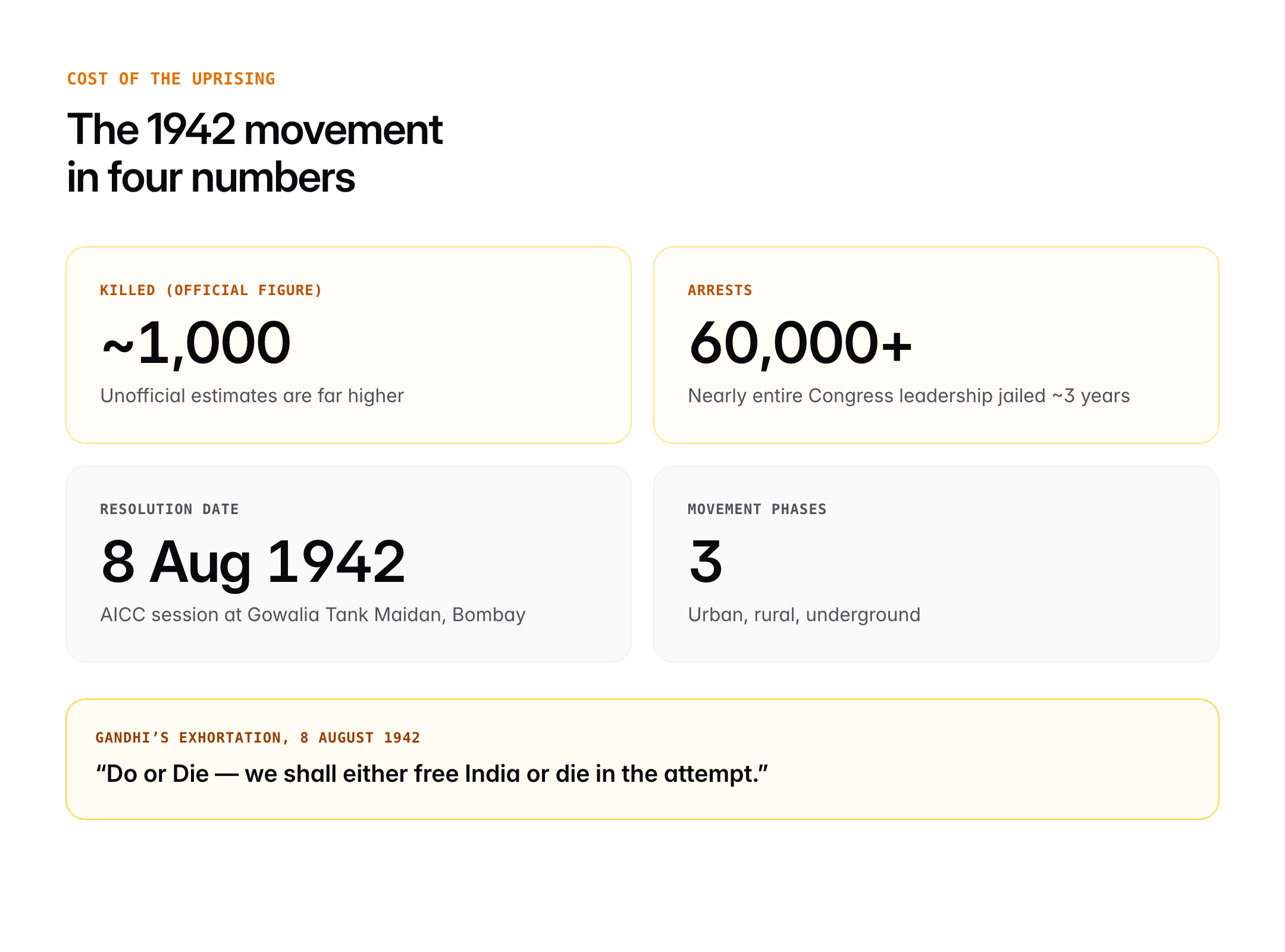
The Quit India Movement date is 8 August 1942, when the All India Congress Committee (AICC) at its Bombay session passed the Quit India Resolution demanding an immediate end to British rule in India. The movement, known in Hindi as Bharat Chhodo Andolan and also as the August Kranti, marked the final mass upsurge of the Indian freedom struggle before independence in 1947. It is associated with Mahatma Gandhi's rousing slogan "Do or Die" (Karo ya Maro), delivered at the Gowalia Tank Maidan in Bombay on the same day. For UPSC aspirants, the 8 August 1942 date is a foundational milestone in GS-I modern Indian history.
Background and Causes
By 1942, a combination of political disappointments and wartime shocks had made a final mass struggle inevitable.
- Failure of the Cripps Mission (March-April 1942): Sir Stafford Cripps arrived with proposals for a Dominion Status post-war, rejected by the Congress as offering "a post-dated cheque on a failing bank" (a phrase often attributed to Gandhi).
- Japanese advance: By 1942 Japan had overrun Burma and was at India's eastern doorstep. The fall of Singapore (February 1942) shattered the myth of British invincibility.
- Economic hardship: Rising prices, famine conditions in Bengal, and forced recruitment for the war effort alienated peasants and workers.
- Disillusionment of moderate Congressmen: After years of constitutional negotiation, they now accepted Gandhi's call for direct action.
The Quit India Resolution
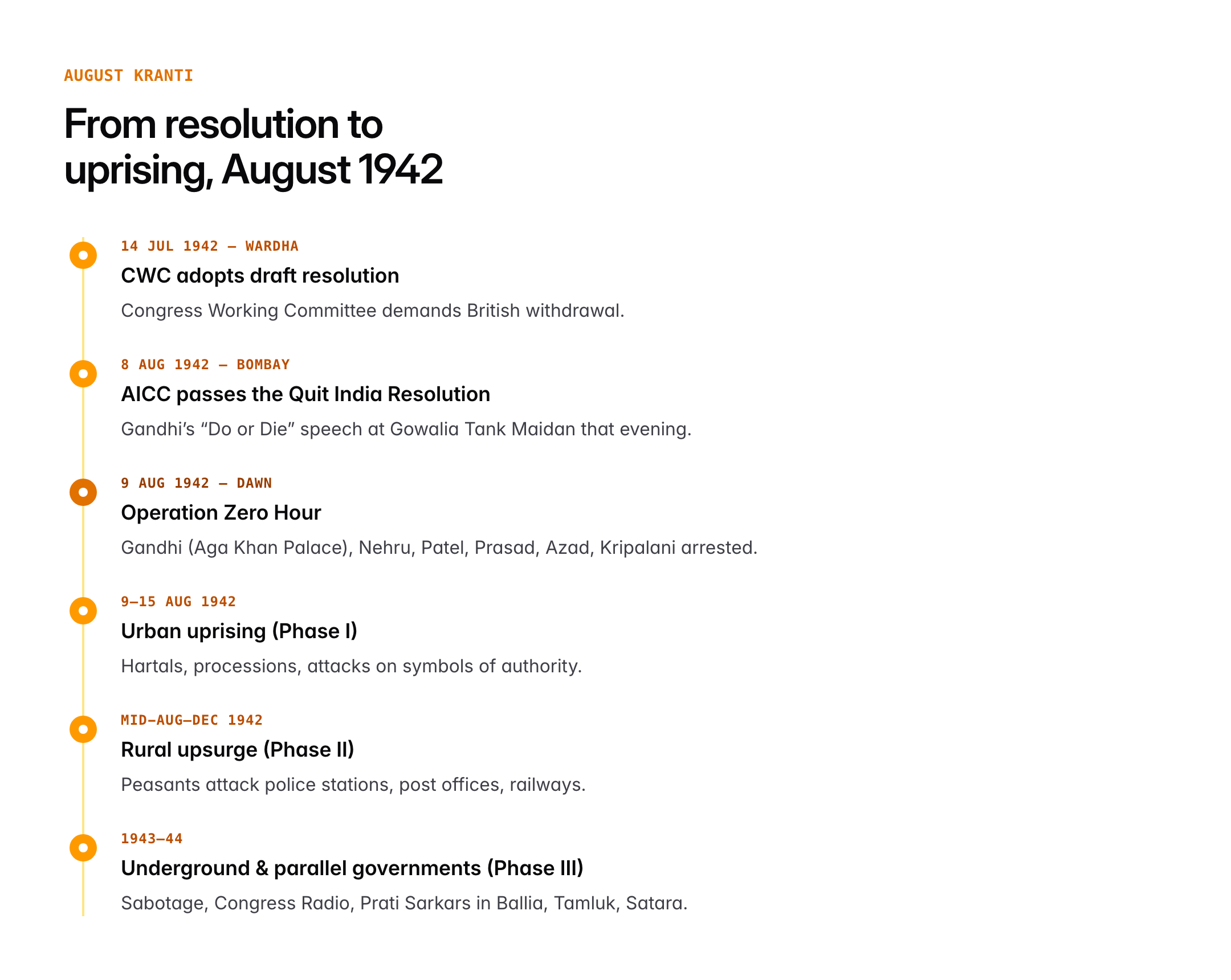
At the Wardha CWC meeting (14 July 1942), the Congress Working Committee adopted a draft resolution demanding British withdrawal. It was formally passed by the AICC at its session in Gowalia Tank Maidan (now August Kranti Maidan), Bombay, on 8 August 1942.
Key lines from the resolution:
- British rule in India must end immediately for the sake of India and the success of the United Nations' cause.
- Authorised a mass struggle on non-violent lines under Gandhi's leadership.
- Called for India's participation in the war to be on the basis of freedom and consent.
That evening, Gandhi delivered his famous speech urging every Indian to consider themselves free and to act accordingly. His exhortation was unambiguous: "Do or Die – we shall either free India or die in the attempt."
Arrests and the Spontaneous Uprising
Within hours of the speech, in the early morning of 9 August 1942, the British government launched Operation Zero Hour, arresting almost the entire top Congress leadership.
Key arrests (9 August 1942):
- Mahatma Gandhi (detained at Aga Khan Palace, Pune)
- Jawaharlal Nehru, Sardar Vallabhbhai Patel, Rajendra Prasad, Maulana Azad, Acharya Kripalani and others
- Kasturba Gandhi and Mahadev Desai, who later died in detention
With the leadership imprisoned, the movement became decentralised, leaderless and, in parts, violent, led by students, workers, peasants and second-rung leaders such as Aruna Asaf Ali, Jayaprakash Narayan, Ram Manohar Lohia, Usha Mehta, and Achyut Patwardhan.
Phases of the Movement
Historians often divide the Quit India Movement into three phases.
| Phase | Timing | Character |
|---|---|---|
| Phase I | 9–15 August 1942 | Urban uprisings: hartals, processions, attacks on symbols of authority |
| Phase II | Mid-August to end 1942 | Rural upsurge: peasant attacks on police stations, post offices, railways |
| Phase III | 1943–44 | Underground activity, sabotage, parallel governments |
Parallel Governments (Prati Sarkars)
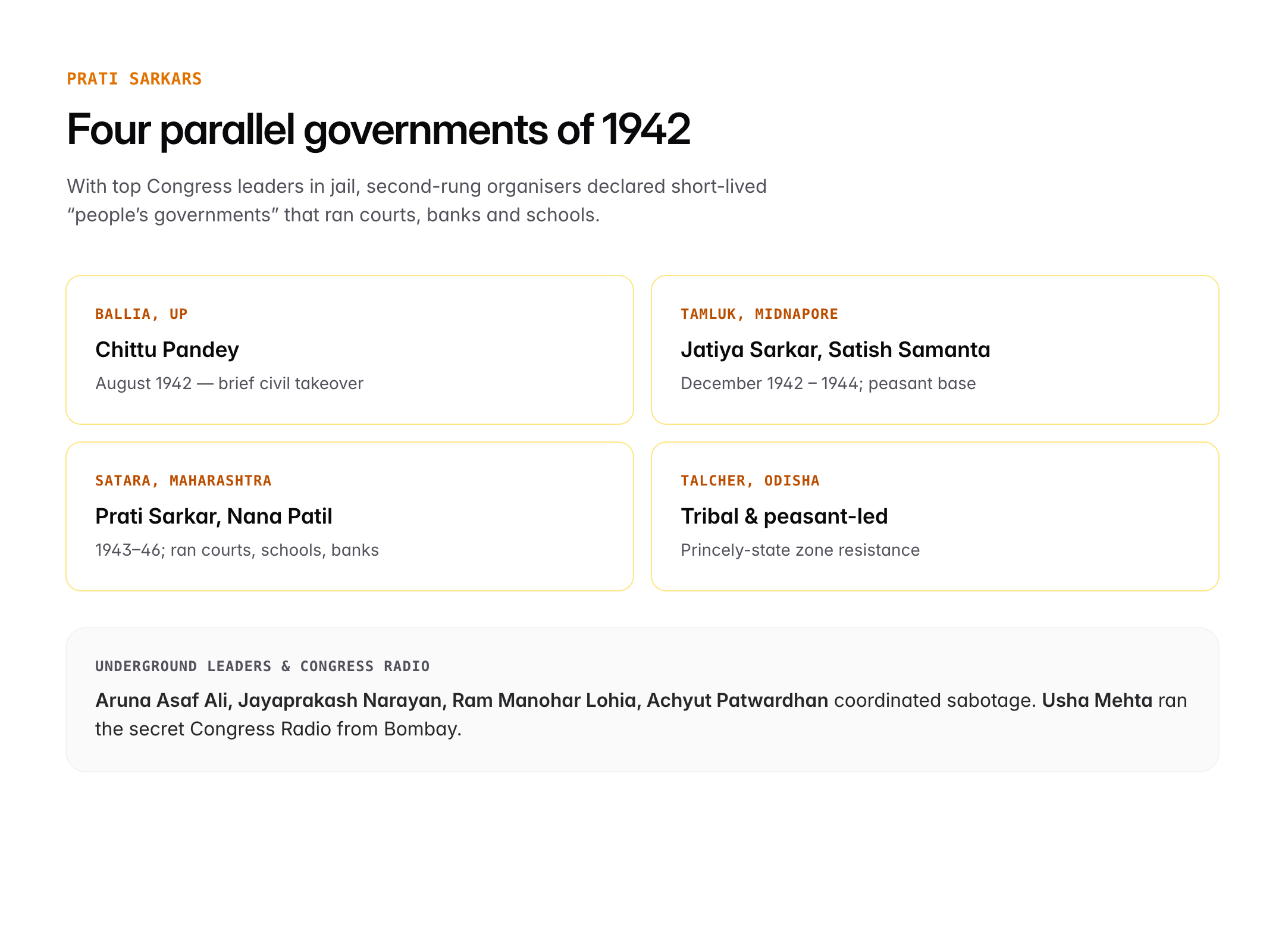
In several pockets, revolutionaries set up short-lived parallel governments, showing remarkable mass organisation.
- Ballia (UP) under Chittu Pandey (August 1942)
- Tamluk (Midnapore, Bengal) — the Jatiya Sarkar under Satish Samanta (December 1942–1944)
- Satara (Maharashtra) — Prati Sarkar under Nana Patil (1943–46), which ran courts, banks and schools
- Talcher (Odisha)
Underground Activities
The underground movement coordinated through secret radio broadcasts and covert leaders:
- Congress Radio, operated by Usha Mehta and associates from Bombay
- Ram Manohar Lohia, Aruna Asaf Ali, JP Narayan, Achyut Patwardhan led underground networks
- Subhas Chandra Bose, outside India, intensified the Indian National Army (INA) campaign from Southeast Asia
Repression and Outcomes
British repression was severe. Official figures cite around 1,000 killed, over 60,000 arrested and large numbers injured; unofficial estimates are far higher. Entire villages were fined; aircraft strafed crowds in Bihar and Bengal.
Outcomes of the movement
- Congress was banned; top leaders were jailed for nearly three years.
- The movement dramatically demonstrated that British control depended on coercion alone.
- Communal balance shifted: The Muslim League used the vacuum to consolidate during the war years.
- The administrative strain of suppressing the movement, combined with the financial cost of WWII, weakened Britain's will to stay.
- Post-war developments — INA trials (1945), Royal Indian Navy Mutiny (1946), Cabinet Mission — drew political energy released by 1942.
Significance
Political: Forced the British to view Indian independence as inevitable.
Social: Drew in students, women, peasants and workers, widening the base of nationalism.
Ideological: Gandhi's willingness to risk an uncontrolled mass movement signalled an end to the incrementalist strategy.
Symbolic: 8 August is observed as Quit India Day (August Kranti Diwas) and the Gowalia Tank Maidan is now August Kranti Maidan.
UPSC Relevance
Prelims focus
- Date: 8 August 1942 (Bombay session of AICC)
- "Do or Die" slogan at Gowalia Tank Maidan
- Arrest on 9 August 1942; Gandhi at Aga Khan Palace
- Parallel governments: Ballia, Tamluk, Satara
- Congress Radio: Usha Mehta
- Related: Cripps Mission (1942), Wavell Plan (1945), INA trials
Mains GS-I angle
- The freedom struggle — its various stages and important contributors
- Role of women, youth, peasants in the movement
- Limits and legacies of mass movements
Sample PYQ-style question
"'The Quit India Movement was spontaneous, violent and decisive.' Examine this statement with reference to the causes, course and impact of the 1942 uprising." (GS-I, 15 marks)
Tell Google you want more of this.
Add Anantam IAS as a preferred sourceOne tap, and this site shows up more often in your own Top Stories, AI Overviews and AI Mode. Remove it any time.