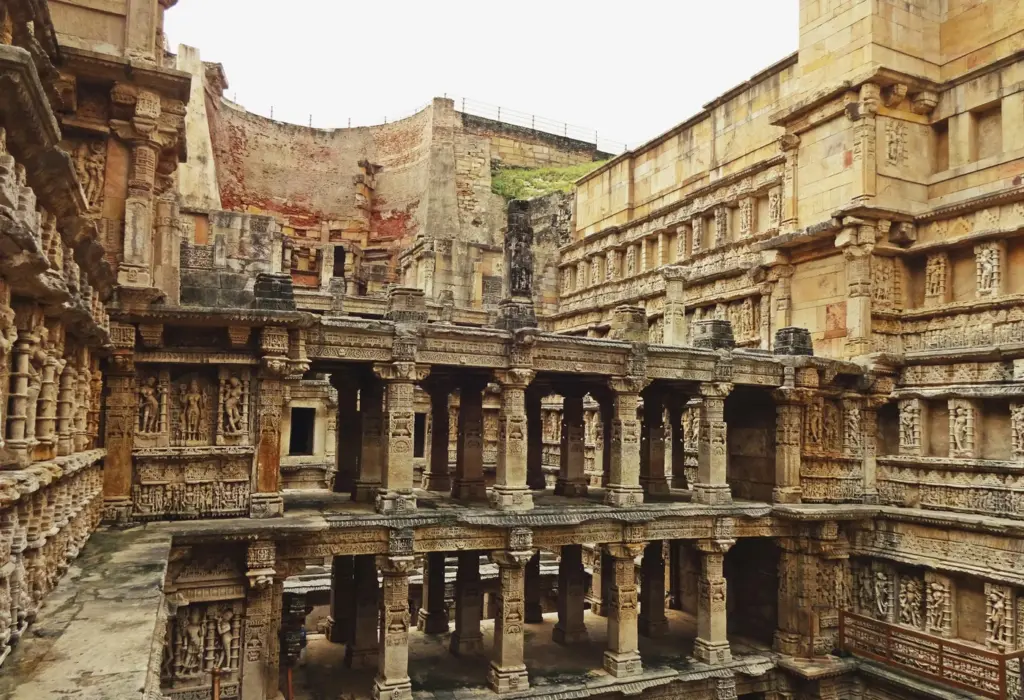
Rani ki Vav, the Queen’s Stepwell, is an 11th-century stepwell at Patan in north Gujarat, dug about 30 meters into the ground near the Saraswati river when Patan was the capital of the Chaulukya, or Solanki, kings. The old record credits it to Queen Udayamati, wife of Bhima I, and it’s built as an inverted temple: seven levels of carved stone that lead down to water instead of up to a shrine. UNESCO added it to the World Heritage List in 2014, and since 2018 it has been the picture on the back of the lavender Rs 100 note.
Most people leave with one tidy line: built in 1063 by a grieving widow in memory of her husband. A chronicle of 1304 does name the queen, but the year 1063 is a later calculation and the memorial motive is how scholars read the building. The other common belief, that the river wrecked the stepwell, has it backwards: the flood silt of the 13th century buried Rani ki Vav and kept its sculpture safe for about seven centuries. This note keeps the record and the reading apart, and explains in plain words how a stepwell held its water.
What Rani ki Vav is and where it stands
Rani ki Vav is a stepwell, a well that people reached by walking down a long stepped corridor instead of hauling a bucket up from the top. It stands at Patan, the old Chaulukya capital about 125 km north of Ahmedabad. These are the facts worth fixing first.
| Fact | Detail |
|---|---|
| What it is | A stepwell (vav in Gujarati) designed as an inverted temple, in the Maru-Gurjara style |
| Location | Patan, north Gujarat, on the Saraswati river; the Chaulukya capital, about 125 km north of Ahmedabad |
| Date | 11th century CE (UNESCO); 1063 is the traditional year, not one carved on the monument |
| Patron | Queen Udayamati, wife of Bhima I and mother of Karna, named in Merutunga’s Prabandha Chintamani of 1304 |
| Plan | East to west: stepped corridor, four pavilions, tank and well; seven levels, about 65 m long |
| Depth | Tank of 9.5 m by 9.4 m at 23 m below ground; well shaft 10 m across and 30 m deep |
| Sculpture | Over 500 principal and over 1,000 minor sculptures (UNESCO); Vishnu outnumbers the other gods |
| Status | UNESCO World Heritage Site since 22 June 2014, criteria (i) and (iv); protected by the ASI |
| On the currency | Reverse of the lavender Rs 100 note announced by the RBI on 19 July 2018 |
The ICOMOS evaluation behind the listing also gives more than 800 sculpted panels at first, about 400 surviving. The two counts measure different units: individual carvings against large panels.
What a stepwell is and how it worked
A stepwell is a well with a staircase built beside it. People dug a shaft down to groundwater, then built a long flight of steps so they could walk down to the water at whatever depth it stood. Gujarat calls it a vav. UNESCO notes that stepwells have been built in the subcontinent since the 3rd millennium BCE; the note on Dholavira covers the Harappan end of Gujarat’s water story.
The part that moves is the water. It entered the shaft from the surrounding ground, and Kirit Mankodi, whose 1991 book is the standard study of the monument, notes that the Saraswati, about 500 meters to the north, supplied it. The water table, the level below which the ground is soaked, sank in the dry months, so people walked down many steps; in the monsoon it rose, and the water could reach the uppermost steps. The steps turned a changing water level into one that people could always reach on foot.
The ICOMOS evaluation finds all four parts of a fully developed stepwell here:
- a stepped corridor that starts at ground level;
- pavilions (mandapas) that divide the descent, each with more floors than the last as you go west;
- a tank (kunda) where water was stored;
- the well itself, a round shaft at the far western end.
Digging the trench was the easy half. Keeping its walls from caving in was the hard half. Mankodi describes a hidden brick buffer behind a stone face only about 45 cm thick, and ICOMOS adds that the structure is mostly burned brick in lime mortar, faced with local Dhrangadhra stone. Stepping the long walls back in terraces cut their height, and the buttresses left at intervals became the pillared pavilions.
Think of the pavilions as the cross-braces in a deep trench on a building site, the members that stop two tall walls from leaning in on each other. The comparison holds for the structure and breaks on the finish, because these braces are carved on every face and hold images of gods.
That carving has a purpose. UNESCO calls Rani ki Vav an inverted temple highlighting the sanctity of water. A Hindu temple rises above its sanctum in a tower, as the note on temple architecture in India explains; this one descends through carved levels to the water, which ICOMOS says was celebrated here as the mother goddess.
Who built Rani ki Vav, and how we know
The builder named in the record is Queen Udayamati, often written Rani Udayamati, wife of the Chaulukya king Bhima I and mother of his successor Karna. The Chaulukyas, also called Solankis, ruled Gujarat from Anahilpur Patan. Bhima I reigned for over four decades until his death in 1064. Mankodi credits him with the Sun temple at Modhera, and the dynasty’s temples also survive at Somnath, whose later history the note on Somnath Mandir follows.
That name rests on one source.
What Merutunga’s chronicle says
Merutunga, a Jain teacher, finished the Prabandha Chintamani, the ‘Wishing-Stone of Narratives’, in 1304, about 240 years after Bhima’s death. In C. H. Tawney’s 1901 translation the passage closes Bhima’s reign: he “began to reign in 1077 V.S. and reigned forty-two years, ten months, and nine days. His queen, named Udayamati, caused to be made in Pattana a new reservoir, surpassing even the Sahasralinga lake.” The next sentence crowns Karna in 1120 V.S.
Read it for what it does and doesn’t say:
- It names the queen and places her work at Pattana, the chronicle’s name for Patan.
- It calls the work a “new reservoir”, which Mankodi reads as this stepwell.
- It gives no year for the building and no motive. UNESCO, careful here, says only that the stepwell was built as a memorial to a king.
Where the year 1063 comes from
The popular date is a small piece of arithmetic. Vikrama Samvat (V.S.) years run about 57 years ahead of the Common Era, so 1077 V.S. gives about 1020 CE for Bhima’s accession and 1120 V.S. gives about 1063 CE for Karna’s coronation. That second figure is very likely the source of 1063: the end of Bhima’s reign, reused as the start of his widow’s memorial. The tourism ministry’s Incredible India page gives 1063 as the year the queen commissioned the stepwell, while Mankodi dates it by style to the 11th century, and neither he nor ICOMOS cites a foundation inscription. It is wise to write “11th century, traditionally 1063” and stop there.
Why a queen would build a well as a memorial
Because a public well earned religious merit, including merit for the dead. Mankodi points to the Dharmashastra pair ishta-purta: ishta is the Vedic sacrifice, and purta is the public work, such as a well. An inscription from Vasantgarh in Sirohi district, dated 1042 CE, records a widowed queen renovating a stepwell after her husband’s death, so Udayamati would have been following a known practice.
Mankodi supports the memorial reading with about 15 images of Shaiva goddesses, many showing Parvati’s five-fire penance, which he reads as the widowed queen cast as Parvati longing for reunion with Shiva. That is his interpretation, and it should be cited as his.
A small marble portrait at the site, inscribed ‘Maharajni Sri Udayamati’, is often offered as proof. Mankodi dates both carving and lettering to the 13th century and says an unknown donor installed it later. It shows how Patan remembered her two centuries on. It isn’t her signature.
What happened to Rani ki Vav after it was built
Rani ki Vav survived because it disappeared. After floods and a change in the Saraswati’s bed in the 13th century, silt filled the stepwell and hid it for about seven centuries, and that burial is why its sculpture is still sharp.
| Phase | When | What happened |
|---|---|---|
| Building | 11th century | The stepwell is built at Patan, credited to Queen Udayamati |
| Burial | 13th century | Floods and a shift in the Saraswati’s bed end its life as a well; silt fills it |
| Stripping | Early 19th century | Exposed pillars and upper parts are carted off to build the Barot Vav in Patan |
| Clearing | 1937 to 2008 | Repairs from 1937; silt removed in stages, most of it in the 1980s |
| Recognition | 1998 to 2018 | Tentative List in 1998, World Heritage List in 2014, Rs 100 note in 2018 |
UNESCO ties the burial to geotectonic changes, shifts in the earth that moved the river’s bed, and credits the flood silt with preserving the stepwell. The silt worked like the packing in a shipping box: it filled every gap, so nothing below the surface could crack or be carried off. Unlike packing, it couldn’t protect what stuck out above it, and Mankodi records that repeated floods brought the upper parts down.
Those exposed parts went first. In the early 19th century, Mankodi notes, the landowner carted away fallen pillars and pieces of the upper floors and reused them in a newer stepwell in Patan, the Barot Vav. When Henry Cousens and James Burgess visited late in the 19th century, the tourism ministry says, they could see only a few pillars and the well shaft.
Clearing took most of the 20th century, and the sources date its start differently. The ICOMOS evaluation records first repairs in 1937 and clearing in phases after that, while the tourism ministry speaks of a rediscovery in the 1940s. They agree on the decisive stretch. Most of the silt came out in the 1980s, when the Archaeological Survey of India (ASI) desilted the monument and reset its sculpture, and archaeologist Narayan Vyas, who spent seven years on the work, told the Hindustan Times in 2018 that the restoration ran from 1981 to 1987. ICOMOS records the conservation works as complete in 2008, with annual maintenance since.
A walk down Rani ki Vav, from east to west
A visitor enters from the east at ground level and walks west and down, through four pavilions, to the tank and the well. The top of every pavilion sits at ground level, Mankodi explains, so the deeper a pavilion stands, the more floors it needs. That is why the entrance looks shallow and the far end is a wall of carved floors.
The style is Maru-Gurjara, the western Indian temple style of the 11th to 13th centuries, also called the Solanki style, whose name joins Maru (Marwar in Rajasthan) and Gurjara (Gujarat). The note on Nagara temple architecture treats it as the Solanki school of the northern style. Here it shows in terrace walls where projecting panels alternate with sunken niches.
The entrance and the stepped corridor
The walk once began under a torana, a freestanding ornamental gateway, which no longer stands. Wide, high steps lead down, broken by small pyramid-shaped risers that make the descent manageable. ICOMOS counts 292 carved pillars in the original structure and 226 in place today.
The third stage, where the sculpture begins
The third stage is the largest and the first where carving survives in quantity; its floor lies up to 22 meters below ground. Each terrace wall runs in three bands, the broad middle one kept for large figures. Deities sit in the sunken niches, while celestial women (apsaras) and the guardians of the directions (dikpalas) stand on the projecting posts between them.
The tank and the deepest pavilion
The fourth stage opens into a rectangular tank of 9.5 by 9.4 meters, 23 meters below ground, walled by seven floors of carved architecture and braced by two-level buttress frames. Hundreds of masons’ marks survive here and elsewhere. Mankodi explains that they identified artisans or guilds so their dues could be settled.
The well
The well sits at the western end, a round shaft 10 meters across and 30 meters deep, divided into seven levels. Three channels at its bottom sent surplus water into the tank. Unusually for a stepwell, sculpture rings the inside of the shaft, and at the lowest ring sit eight Vasus, minor gods whom a Mahabharata story ties to the river Ganga.
Why Vishnu and Parvati fill the walls
Among nearly 400 niches, Vishnu outnumbers the other gods and Parvati outnumbers the goddesses. ICOMOS and Mankodi agree on this, and both choices follow from what the building was for.
Vishnu belongs here because of water. As Narayana he’s tied in myth to the cosmic ocean, and wells and tanks were often consecrated to him. The form to look for is Sheshashayi Vishnu, the god reclining on the serpent Shesha: carved near water, the real surface of the tank becomes the ocean he rests on.
The avatars don’t make the neat set of ten that the label Dashavatara, the ten avatars, suggests. Mankodi identifies seven, running from the south-facing wall to the one opposite:
- Varaha, the boar, lifting the earth goddess;
- Vamana, the dwarf;
- Rama, with four arms, a rare form;
- Balarama, with a plough and snake hoods;
- Parashurama, with his axe;
- the Buddha, as a thin ascetic;
- Kalki, the avatar still to come, on horseback.
Narasimha’s niche is empty, and Matsya and Kurma weren’t carved as separate images in Gujarat at the time. The Buddha looks unusual because Buddhism had faded from Gujarat centuries earlier, so the sculptors no longer knew his standard form.
Parvati belongs here because of memory, through the penance images Mankodi reads as the queen’s grief. Around the deities stand the apsaras, and they’re where daily life gets in: CyArk’s documentation describes figures looking into a mirror or applying lipstick, beside others holding skull cups. Durga killing the buffalo demon (Mahishasuramardini) and a 20-armed dancing Bhairava fill niches in the third stage.
Beyond the masons’ marks, the only royal name the sources report in stone is on the 13th-century portrait. The attribution rests on Merutunga’s chronicle, and the date rests on style.
Rani ki Vav today: UNESCO status, protection and conservation
Rani ki Vav is a UNESCO World Heritage Site, inscribed on 22 June 2014 at the World Heritage Committee’s 38th session in Doha (decision 38 COM 8B.25), after 16 years on India’s Tentative List. The UNESCO listing gives the property as 4.68 ha inside a buffer zone of 125.44 ha, which also takes in the Sahastralinga Talao, the tank Merutunga used as his yardstick.
The two criteria, in plain words:
- (i): a masterpiece of human creative genius, which UNESCO finds in the variety of its motifs and the elegance of its proportions;
- (iv): an outstanding example of a type of building, here the stepwell as a system for storing groundwater, joined to a temple-like structure.
Rani ki Vav is a monument of national importance under the Ancient Monuments and Archaeological Sites and Remains Act, 1958, as amended in 2010. The ASI manages it through a Superintending Archaeologist, with a 100-meter non-development zone on every side and a management plan in effect since 2013. What protection can’t restore is the water: UNESCO says the groundwater changes that followed the Saraswati’s shift ended its life as a well.
The ICOMOS evaluation names three main threats:
- earthquakes;
- urban and infrastructure growth, as Patan expands west toward the stepwell;
- damage to carved surfaces from visitors touching the sculpture.
A few dated moments round off the story:
- October 2011: the Scottish Ten, a heritage partnership that included the nonprofit CyArk, laser-scanned the stepwell over two weeks to build a 3D record.
- October 2016: it won the title of Cleanest Iconic Place at the Indian Sanitation Conference in New Delhi, the Patan district administration records.
- 19 July 2018: the RBI announced a lavender Rs 100 note in the Mahatma Gandhi (New) Series, 66 mm by 142 mm, with a motif of Rani ki Vav on the reverse.
- 23 November 2024: figures reported during the ASI’s World Heritage Week put 2023-24 visitors at over 3.52 lakh Indians and 3,327 foreigners, close to a thousand a day.
The roundup of UNESCO World Heritage Sites in India covers the rest of the list.
How to study Rani ki Vav for exams
Rani ki Vav sits in more of the syllabus than its size suggests:
- GS Paper I, Indian culture: Maru-Gurjara architecture, temple sculpture and iconography;
- medieval history: the Chaulukya kingdom of Gujarat and its capital at Patan;
- heritage: the UNESCO list and the heritage motifs on the new banknotes;
- geography and environment: traditional water harvesting, set beside today’s groundwater crisis.
Mains 2020 GS Paper I asked candidates to discuss this: “Indian philosophy and tradition played a significant role in conceiving and shaping the monuments and their art in India. Discuss.” An inverted temple built to honor water and a husband’s memory answers that in one example. On the objective side, Art and Culture accounts for 94 of the 1,403 questions from 2013 to 2026 in the site’s Prelims question bank, so the names and dates below are worth fixing.
Revise these until they’re automatic:
- Patron: Queen Udayamati, wife of Bhima I and mother of Karna, per Merutunga’s Prabandha Chintamani (1304).
- Dynasty: the Chaulukyas or Solankis, ruling from Anahilpur Patan.
- Date: 11th century; 1063 is traditional, derived from the end of Bhima’s reign.
- Form: an inverted-temple stepwell of seven levels, in the Maru-Gurjara style.
- Recovery: silted in the 13th century; repairs from 1937; most silt removed in the 1980s.
- UNESCO: 2014, at the 38th session in Doha, under criteria (i) and (iv).
- Currency: the lavender Rs 100 note of 2018.
Three confusions cost marks:
- Chaulukya and Chalukya. The Solankis of Gujarat are a separate house from the Chalukyas of Badami and their Deccan successors; only the names are alike.
- Record and reading. The chronicle names the queen; the memorial motive and the year 1063 are later readings of it.
- Stepwell and stepped tank. A stepwell’s stairs lead down to a well that taps groundwater; a stepped tank, like the kund at Modhera, is an open reservoir with steps on its sides.
It also helps to set Rani ki Vav beside its neighbors in the same tradition of water and memory:
| Structure | Place | Date | Type | Patron |
|---|---|---|---|---|
| Rani ki Vav | Patan, Gujarat | 11th century | Stepwell with pavilions, tank and well | Queen Udayamati, as the chronicle records |
| Sahastralinga Talao | Patan, Gujarat | Chaulukya period | Artificial reservoir | Chaulukya rulers |
| Sun temple and kund | Modhera, Gujarat | Reign of Bhima I | Temple with a stepped tank | Bhima I |
| Rani ki Baodi | Bundi, Rajasthan | Late 17th century | Stepwell | Widow of Aniruddh Singh |
Rani ki Vav rewards the reader who keeps two columns, one for what the 1304 chronicle says and one for what later scholars and agencies have built on it. Keep them apart and this single stepwell will carry an answer on patronage as easily as one on conservation, because it was built to hold both water and memory.
Frequently Asked Questions
Who built Rani ki Vav?
Rani ki Vav is credited to Queen Udayamati of the Chaulukya (Solanki) dynasty, wife of Bhima I and mother of Karna. The attribution comes from the Jain scholar Merutunga’s Prabandha Chintamani, written in 1304, which says the queen built a new reservoir at Patan. Scholars and UNESCO read the stepwell as a memorial to a king, most likely her husband.
When was Rani ki Vav built?
It was built in the 11th century CE. The year usually quoted, 1063, matches the date the chronicle gives for Karna’s coronation at the end of Bhima I’s reign, so treat it as a traditional date. Neither UNESCO’s evaluation nor the historian Kirit Mankodi cites a foundation inscription with a year.
What does Rani ki Vav mean?
Rani ki Vav means the Queen’s Stepwell. Vav is the Gujarati word for a stepwell, a well reached by a long flight of steps, and a similar structure in Rajasthan, such as the one at Bundi, is called a baodi.
When did Rani ki Vav become a UNESCO World Heritage Site?
Rani ki Vav was inscribed on 22 June 2014, at the World Heritage Committee’s 38th session in Doha, under criteria (i) and (iv). It had been on India’s Tentative List since 1998. UNESCO recognized it both as a work of creative genius and as an outstanding example of the stepwell as a water-storage system.
Which banknote has Rani ki Vav on it?
The Rs 100 note in the Mahatma Gandhi (New) Series carries a motif of Rani ki Vav on its reverse. The Reserve Bank of India announced the lavender note on 19 July 2018, and the older Rs 100 notes remain legal tender.
How did a stepwell like Rani ki Vav work?
A shaft was dug down to groundwater, and a long stepped corridor was built beside it so people could walk down to the water. The water level rose in the monsoon and fell in the dry months, and the steps let people reach it at any level. Pavilions across the corridor braced the deep side walls against the pressure of the soil.
Why was Rani ki Vav buried for centuries?
Floods and a shift in the Saraswati river’s bed in the 13th century filled the stepwell with silt. That silt hid it for about seven centuries but also protected its sculpture, which is why so much survives. Repairs began in 1937, and the Archaeological Survey of India removed most of the silt in the 1980s.
Does Rani ki Vav still hold water?
No. UNESCO says the change in the Saraswati’s course altered the groundwater levels, so the stepwell hasn’t worked as a well since the 13th century. It survives as a protected monument of national importance managed by the Archaeological Survey of India.
Practice Questions
Prelims
1. Consider the following statements about Rani ki Vav: 1. It was inscribed on the World Heritage List in 2014 under criteria (i) and (iv). 2. It was built under the Chalukyas of Badami. Which of the statements given above is/are correct?
- (a) 1 only
- (b) 2 only
- (c) Both 1 and 2
- (d) Neither 1 nor 2
Answer: (a) It was built under the Chaulukyas (Solankis) of Gujarat, a different dynasty from the Chalukyas of Badami.
2. The motif of Rani ki Vav appears on the reverse of which banknote issued by the Reserve Bank of India?
- (a) Rs 50
- (b) Rs 100
- (c) Rs 200
- (d) Rs 500
Answer: (b) The RBI announced the lavender Rs 100 note with the Rani ki Vav motif on 19 July 2018.
3. Consider the following statements about how a stepwell worked: 1. Its steps let people reach water whose level rose and fell with the seasons. 2. At Rani ki Vav, the well shaft stands at the eastern entrance end of the structure. Which of the statements given above is/are correct?
- (a) 1 only
- (b) 2 only
- (c) Both 1 and 2
- (d) Neither 1 nor 2
Answer: (a) The entrance is on the east and the well shaft is at the westernmost end.
4. Which text names Queen Udayamati as the builder of a new reservoir at Patan?
- (a) Rajatarangini
- (b) Prabandha Chintamani
- (c) Prithviraj Raso
- (d) Ain-i-Akbari
Answer: (b) Merutunga’s Prabandha Chintamani, composed in 1304, records the queen’s work at Patan.
5. Consider the following statements about Rani ki Vav: 1. Among the gods in its niches, Vishnu outnumbers all others. 2. The Buddha appears among the incarnations of Vishnu carved at the site. 3. Most of its silt was removed in the 1980s. Which of the statements given above is/are correct?
- (a) 1 and 2 only
- (b) 2 and 3 only
- (c) 1 and 3 only
- (d) 1, 2 and 3
Answer: (d) ICOMOS records Vishnu’s dominance and the 1980s desilting, and Mankodi describes the Buddha avatar.
Mains
- Safeguarding the Indian art heritage is the need of the moment. Discuss. (10 marks, 150 words) Previous year: Mains 2018, GS Paper I.
- How will you explain that medieval Indian temple sculptures represent the social life of those days? (10 marks, 150 words) Previous year: Mains 2022, GS Paper I.
- Rani ki Vav was designed as an inverted temple. Explain how its plan joins a water-supply function to religious meaning. (15 marks, 250 words)
- The flood silt that ended Rani ki Vav’s life as a well also preserved it. Examine this statement with reference to the stepwell’s burial and conservation history. (10 marks, 150 words)
- Traditional stepwells of western India hold lessons for groundwater management today. Discuss with examples. (15 marks, 250 words)
Tell Google you want more of this.
Add Anantam IAS as a preferred sourceOne tap, and this site shows up more often in your own Top Stories, AI Overviews and AI Mode. Remove it any time.