The RBI Grade B Officer exam is the gateway to a career as a central banker at the Reserve Bank of India — the institution that sets monetary policy, regulates banks, and manages the rupee. For finance and economics aspirants, it carries a prestige that rivals the civil services, and it pays better at entry than almost any other government job in the country.
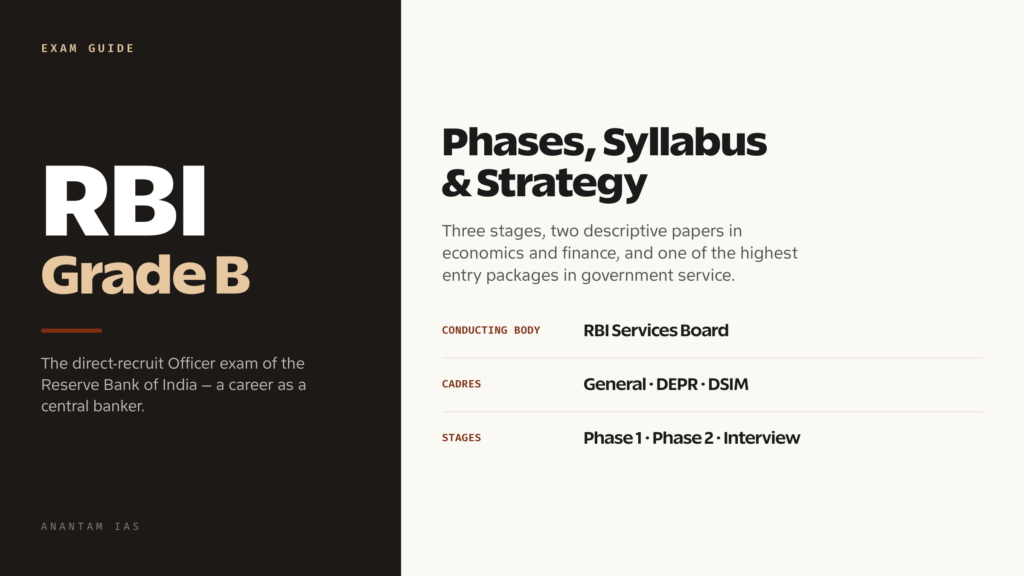
Conducted by the Reserve Bank of India Services Board, the exam recruits officers directly into Grade B (Direct Recruit) on probation. It runs in three stages and rewards a very specific profile: someone who can clear a fast objective test, then write structured descriptive answers on economics and finance. If you enjoy the economy section of competitive exams and want a domain-focused career rather than generalist administration, this is the exam built for you.
What Is RBI Grade B?
RBI Grade B is the entry-level officer grade for direct recruits at the Reserve Bank of India. An officer who joins here can rise through Grade C, then the senior management grades, and a few reach the very top of the institution. The work sits at the heart of the Indian economy — banking supervision, currency management, monetary policy operations, financial regulation, and economic research.
Recruitment happens across three cadres. The General cadre is the largest and most popular, open to any graduate. The two specialist cadres — DEPR (Department of Economic and Policy Research) and DSIM (Department of Statistics and Information Management) — recruit subject experts who work on research, data, and policy modelling. Most aspirants target the General stream, which is what this guide focuses on, while flagging the specialist routes where they differ.
Key Facts
- Conducting authority: Reserve Bank of India Services Board (recruitment is run through the RBI’s official portal, with the application process hosted on the IBPS platform).
- Cadres: Grade B (DR) — General, DEPR, and DSIM.
- Frequency: Usually once a year; the 2025 cycle was notified for 120 vacancies across the three cadres.
- Scale of competition: Lakhs of applicants chase a few hundred posts in a typical year, making the General stream one of the most competitive recruitment exams in the banking sector.
RBI Grade B Exam Pattern
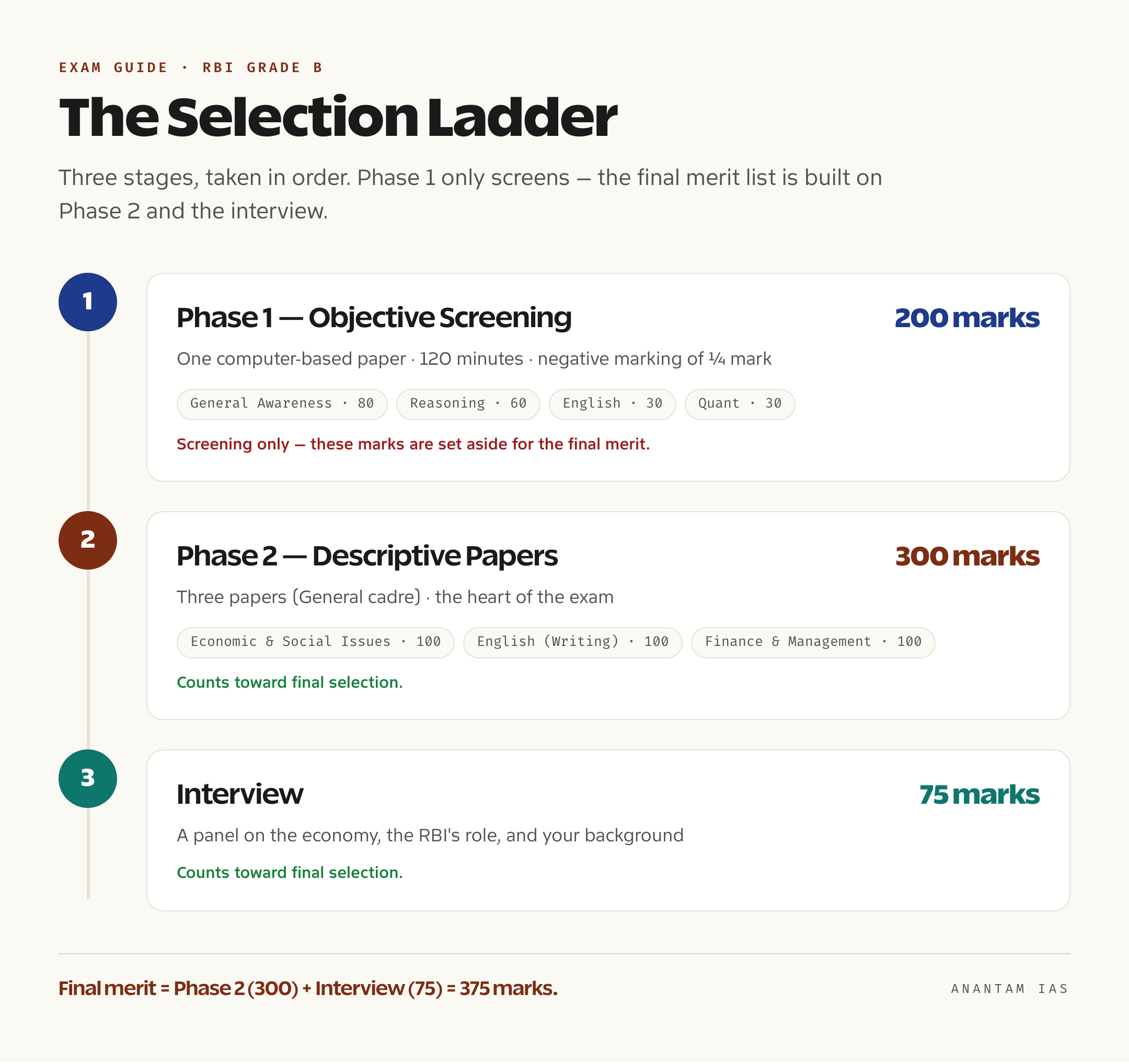
The selection process has three stages — Phase 1 (objective screening), Phase 2 (descriptive papers), and a final Interview. You must clear each stage to advance, and Phase 1 marks do not carry forward to the final merit list; only Phase 2 and the Interview decide selection.
Phase 1
Phase 1 is a single computer-based objective paper of 200 marks, with 200 questions to be answered in 120 minutes. For the General cadre it has four sections, each timed separately.
| Section | Questions | Marks |
|---|---|---|
| General Awareness | 80 | 80 |
| Reasoning Ability | 60 | 60 |
| English Language | 30 | 30 |
| Quantitative Aptitude | 30 | 30 |
| Total | 200 | 200 |
There’s negative marking of one-fourth of a mark for each wrong answer. Phase 1 is purely a screening round — a multiple of the vacancies is shortlisted for Phase 2, and these marks are then set aside. General Awareness carries the heaviest weight, so current economic affairs and banking news matter even at the screening stage.
Phase 2
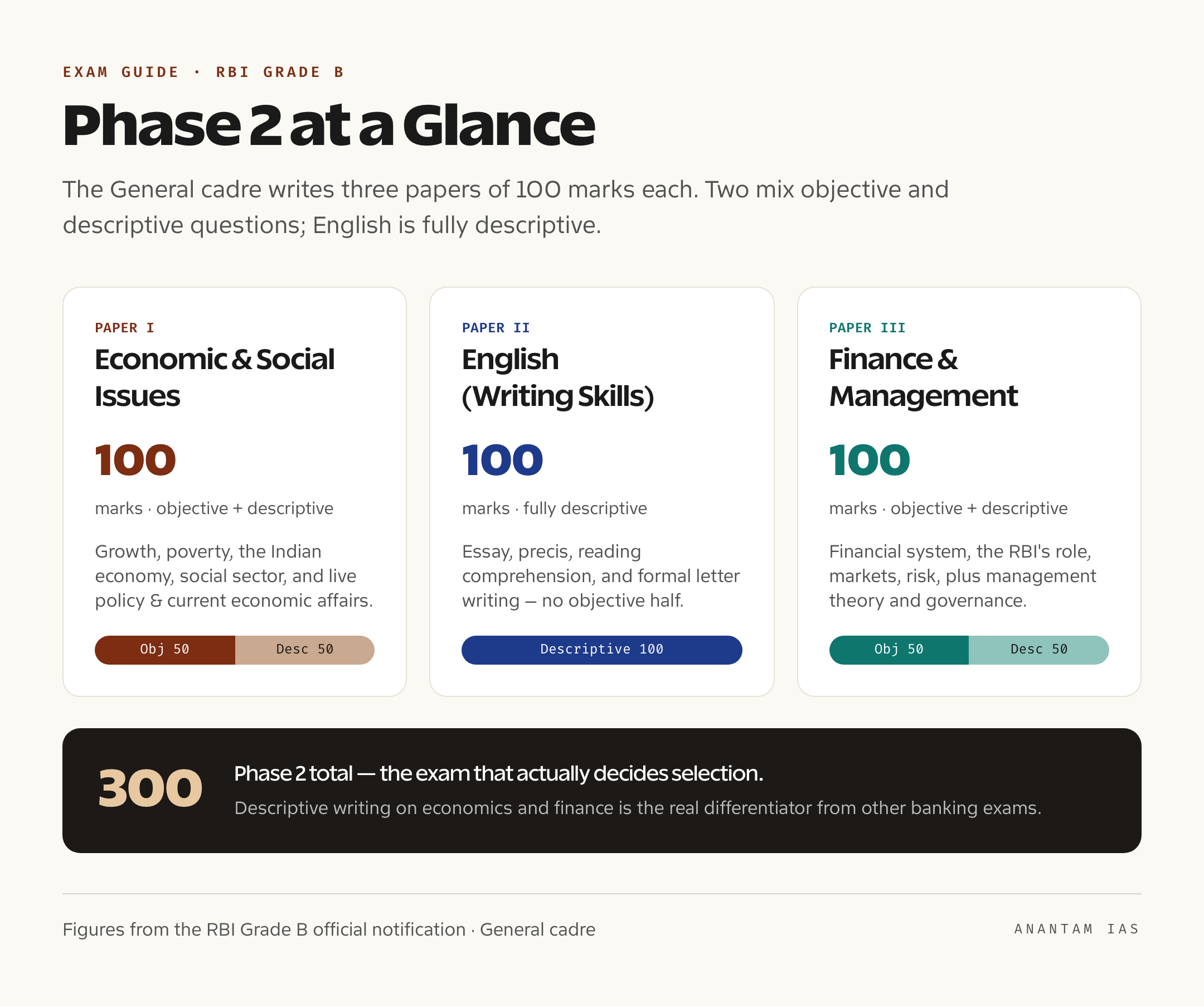
Phase 2 is where the exam earns its reputation. The General cadre writes three papers totalling 300 marks. Two of them — Economic & Social Issues and Finance & Management — mix objective and descriptive questions, while the English paper is fully descriptive.
| Paper | Subject | Format | Marks |
|---|---|---|---|
| Paper I | Economic & Social Issues (ESI) | Objective + Descriptive | 100 |
| Paper II | English (Writing Skills) | Descriptive | 100 |
| Paper III | Finance & Management (FM) | Objective + Descriptive | 100 |
| Total | 300 |
In the ESI and FM papers, the objective half and the descriptive half each carry 50 marks. The descriptive sections ask you to write analytical answers — precis, essays, short notes — which is unusual for a banking exam and is the main reason many SSC and IBPS aspirants find RBI Grade B a different beast.
Interview
Candidates who clear the Phase 2 cut-offs are called for an Interview worth 75 marks. Final selection is decided on Phase 2 (300) plus the Interview (75), a total of 375 marks. The board probes your understanding of the economy, the RBI’s role, your academic background, and current developments in banking and finance.
RBI Grade B Eligibility
Eligibility for the General cadre is straightforward, but the specialist cadres demand specific postgraduate degrees. The nationality rule is the standard one for central government recruitment.
| Criterion | Details (General cadre) |
|---|---|
| Nationality | Indian citizen (or other categories specified by the RBI, with an eligibility certificate where required) |
| Age | 21-30 years as on the date in the notification |
| Education | Bachelor’s degree with minimum 60% marks (50% for SC/ST/PwBD), or a postgraduate degree with minimum 55% |
| Attempts | A maximum number of attempts applies for the General cadre (typically capped, with extra attempts for reserved categories) |
Age relaxation is the usual pattern — five years for SC/ST, three years for OBC, and additional relaxation for PwBD and ex-servicemen, which can push the upper limit well beyond 30 for eligible groups. For the DEPR cadre, you typically need a Master’s in Economics (or allied fields) with a strong percentage, and for DSIM a Master’s in Statistics, Mathematical Statistics, or a related discipline. These specialist routes trade a wider eligibility net for deep subject expertise.
RBI Grade B Syllabus
The syllabus is the real reason aspirants either love or fear this exam. Phase 1 tests speed and accuracy across general aptitude; Phase 2 tests depth in economics and finance, with a heavy current-affairs overlay.
Phase 1 Syllabus
- General Awareness: banking and financial awareness, RBI and monetary policy, economic and budgetary developments, government schemes, national and international current affairs — the dominant section by marks.
- Reasoning Ability: puzzles, seating arrangement, syllogisms, coding-decoding, blood relations, data sufficiency.
- Quantitative Aptitude: number series, simplification, data interpretation, arithmetic (percentages, ratios, time-and-work), basic probability.
- English Language: reading comprehension, cloze tests, error spotting, para-jumbles, vocabulary in context.
Phase 2 Syllabus
- Economic & Social Issues (ESI): growth and development, poverty and inequality, Indian economy since liberalisation, demographics and the social sector, globalisation, and — crucially — current economic and policy issues. RBI publications such as the Economic Survey and the RBI’s own reports feed directly into this paper.
- Finance & Management (FM): the financial system and regulators, the role of the RBI, money and capital markets, risk management, basics of derivatives, financial inclusion, plus a management half covering organisational behaviour, motivation theories, leadership, corporate governance, and communication.
- English (Writing Skills): essay, precis writing, reading comprehension, and business or formal letter writing — assessed entirely through descriptive answers.
The Descriptive Edge
The descriptive halves of ESI and FM, and the whole English paper, are what separate RBI Grade B from IBPS PO or SSC CGL. You can’t get by on objective practice alone. The ability to structure a 250-word analytical answer on, say, monetary transmission or inflation targeting is what builds the marks that decide selection. Understanding how the central bank actually works — read our note on monetary policy and the emerging area of the central bank digital currency — pays off directly in both the GA section and the ESI and FM descriptive answers.
RBI Grade B Preparation Strategy
A focused six-to-eight-month plan is realistic for a working graduate, less if you already have an economics or finance background. The strategy below is built around where the marks actually sit.
Build the Phase 1 Base First
Phase 1 is a filter, not a finish line, so don’t over-invest. Lock down reasoning and quant to a reliable accuracy through daily timed practice, and pour your general-awareness effort into banking and economic current affairs of the last six to eight months — that’s where most GA questions come from.
Make ESI and FM Your Core
Because Phase 1 marks are discarded, your real exam is Phase 2. Start ESI and FM early and treat them as the priority. Build conceptual clarity from a standard economics text and the RBI’s own material, then layer current affairs on top. For management within FM, a focused set of standard theories and frameworks is enough — don’t let it sprawl.
Run a Tight Current-Affairs System
Economics and finance current affairs are the connective tissue of this exam — they show up in GA, in ESI, and in the interview. Track RBI press releases, monetary policy statements, the Economic Survey, and the Union Budget. Keep crisp, revisable notes organised by theme rather than by date.
Practise Descriptive Writing Deliberately
This is the most-skipped step and the one that decides results. Write full-length essays and ESI/FM descriptive answers under time pressure, get them reviewed, and study model answers. Aim for structured, point-wise responses with a clear introduction, body, and conclusion.
Analyse Previous Papers and Take Mocks
Work through previous years’ papers to see how the RBI frames questions, then take regular full mock tests for both phases. Mocks fix your time management, expose weak sections, and — for Phase 2 — train the stamina needed to write three demanding papers across a long exam window.
Posts, Salary & Career
A Grade B officer joins at a basic pay of around ₹78,450 per month, on a scale that rises with annual increments. With Dearness Allowance, House Rent Allowance, and a generous package of perks — family allowance, telephone and internet reimbursement, conveyance, and medical benefits — the initial gross monthly emoluments work out to roughly ₹1.5 lakh, among the highest entry packages in any Indian government job. Officials’ quarters or a housing allowance, and a strong retirement framework, add to the appeal.
The career trajectory is steep and respected. From Grade B, an officer can move up through Grade C and the senior management grades, with postings across departments such as banking supervision, monetary policy, financial markets, currency management, and economic research. Beyond pay, what draws people is the nature of the work itself — shaping and implementing the policies that steer India’s economy from inside the country’s central bank.
Frequently Asked Questions
Is RBI Grade B tougher than the IBPS PO exam?
In a meaningful sense, yes. IBPS PO is fully objective, while RBI Grade B adds three Phase 2 papers with heavy descriptive writing on economics, finance, and management. The conceptual depth and the writing demand make RBI Grade B the harder exam, even though Phase 1 looks similar to other banking tests.
What is the age limit for RBI Grade B?
For the General cadre, candidates must be 21 to 30 years old as on the date specified in the notification. Standard relaxations apply — five years for SC/ST, three for OBC, and further relaxation for PwBD and ex-servicemen — so the effective upper limit is higher for those categories.
How many marks decide the final selection?
Final merit is built on Phase 2 (300 marks across three papers) plus the Interview (75 marks), a total of 375. Phase 1 is only a screening stage, so its 200 marks do not count toward the final list once you’ve qualified for Phase 2.
Do I need an economics background to clear RBI Grade B?
No. The largest, General cadre is open to any graduate, and many selected candidates come from engineering or other non-economics backgrounds. You do need to build solid economics and finance understanding for the ESI and FM papers, but that’s learnable through dedicated preparation. The specialist DEPR and DSIM cadres are the ones that require a relevant Master’s degree.
Tell Google you want more of this.
Add Anantam IAS as a preferred sourceOne tap, and this site shows up more often in your own Top Stories, AI Overviews and AI Mode. Remove it any time.