The power to forgive lies at the heart of any criminal justice system that claims to be more than a calculator of punishment. The Indian Constitution gives this forgiveness power both to the President and to the Governors, and the criminal procedure code mirrors a more administrative version of it through the executive branch. The two streams are separate, the rules that govern them are different, and the Supreme Court has spent decades clarifying where one ends and the other begins. Most aspirants are surprised to learn how much of this clarity emerged not from grand constitutional disputes but from quiet cases involving prisoners whose names rarely make headlines.
The Bilkis Bano remission case in January 2024 forced the country to look again at the architecture of remission. Eleven men serving life sentences for gang rape and multiple murders were released in 2022 by the Gujarat government, and a two-judge bench of the Supreme Court quashed those orders eighteen months later. The judgment set down two foundational rules. The state where the trial was conducted, not the state where the offence took place, is the appropriate government for remission decisions. And mass remission without serious examination of individual cases is invalid.
The case is a useful entry point into a topic that crosses constitutional law, criminal procedure, and administrative practice. This article walks through the executive power of remission for the UPSC aspirant, separates the constitutional and statutory tracks, and works through the leading judgments that any answer on this subject must rely on.
Quick Facts on Remission of Sentence
A short orientation set before deeper analysis.
- Constitutional source: Articles 72 and 161 of the Indian Constitution vest pardoning power in the President and the Governors respectively.
- Statutory source: Sections 432, 433, 433A, 434, and 435 of the older Code of Criminal Procedure, now Sections 473, 474, 475, and 476 of the Bharatiya Nagarik Suraksha Sanhita 2023.
- Five forms of clemency: pardon, commutation, remission, respite, reprieve. Remission reduces the duration of a sentence without changing its character.
- Appropriate government rule: After Bilkis Bano in 2024, the appropriate government for statutory remission is the state in which the offender was sentenced, not the state where the offence occurred.
- 14-year minimum: Under Section 433A of the old Code and Section 475 of the BNSS, life convicts cannot be released through remission until they have served at least 14 years of actual imprisonment.
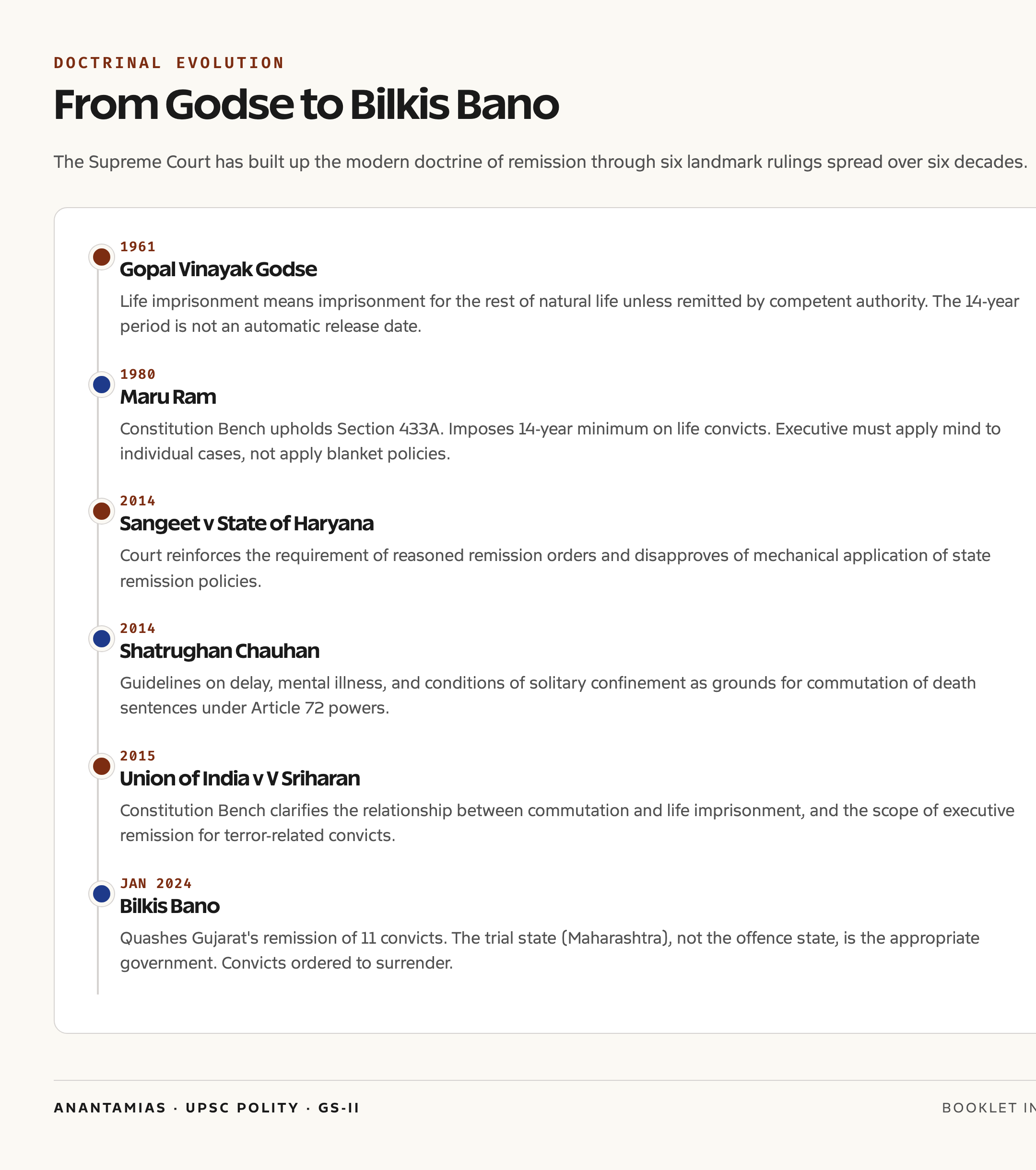
- Life imprisonment meaning: After Gopal Vinayak Godse in 1961, life imprisonment in India means imprisonment for the rest of the convict’s natural life, not 14 years or 20 years.
- Judicial review: Constitutional pardons under Articles 72 and 161 are subject to limited judicial review on grounds of arbitrariness, mala fides, or non-application of mind.
What Remission of Sentence Means
Remission is the reduction of the duration of a sentence without changing its nature. A person sentenced to ten years of rigorous imprisonment whose sentence is remitted by two years still serves rigorous imprisonment, just for eight years instead of ten. The character of the punishment remains, the duration shortens. This is different from commutation, which substitutes a milder form of punishment for a harsher one, such as turning a death sentence into life imprisonment. It is also different from pardon, which wipes out both the conviction and the sentence as if the offence had never been recorded.
Indian law recognises five distinct forms of clemency. Pardon ends both conviction and punishment. Commutation changes the nature of the punishment to something lighter. Remission reduces the duration. Respite delays execution of a sentence on humanitarian grounds. Reprieve grants a temporary stay of execution to allow the convict to seek further legal remedies.
Remission can be granted on two completely different bases. The constitutional pardoning power under Articles 72 and 161 is sovereign, plenary, and rooted in the prerogative of mercy. The statutory power under the BNSS is administrative, structured by procedural rules, and exercised by the appropriate government as a routine part of prison administration.
Background and Historical Context
The pardoning power in modern constitutions is descended from the royal prerogative of mercy in English common law. The English king or queen could pardon any offender as a sovereign act of grace, and this prerogative travelled through colonial criminal justice systems into the early American Constitution and the Indian Constitution after it. The framers of the Indian Constitution debated the scope of the power and chose to vest it in the President for offences against Union law and death sentences, and in Governors for offences against state law.
The statutory power of remission has a different lineage. It evolved in colonial India through the Prisons Act of 1894 and successive criminal procedure codes as a tool of prison administration. Sentence remission for good conduct, completion of vocational training, or special occasions such as Independence Day became part of routine jail management. The current Sections 473 to 476 of the BNSS, which mirror the older Sections 432 to 435 of the CrPC, codify this administrative practice.
The two streams ran in parallel for decades without serious conflict. The prerogative power was exercised rarely and largely for high-profile cases. The statutory power was exercised routinely for ordinary convicts. The first major doctrinal clash came in the late 1970s and early 1980s, when the Supreme Court was forced to decide what relationship the new Section 433A bore to the older constitutional powers, and how a state’s remission policy could be reconciled with its actual statutory authority.
The Maru Ram case in 1980 was the foundational ruling. A Constitution Bench held that Section 433A was constitutional, that it imposed a 14-year minimum on life convicts, and that the executive had to apply mind to individual cases rather than apply blanket policies. Subsequent rulings refined these principles, culminating in the V Sriharan judgment of 2015 on commutation of death sentences and the Bilkis Bano ruling of 2024 on the appropriate government question.
Key Provisions: Constitutional and Statutory Tracks
Articles 72 and 161 set out the constitutional pardoning power. Article 72 vests in the President the power to grant pardons, reprieves, respites, or remissions of punishment, and to suspend, remit, or commute the sentence of any person convicted of any offence. The President can exercise this power for offences punishable by death, for offences against any law to which the executive power of the Union extends, and for offences tried by courts martial. Article 161 vests an analogous power in the Governor of a state, but limited to offences against any law to which the executive power of the state extends. The Governor cannot pardon a person sentenced to death by a state court without acting in accordance with the constitutional position established in case law, although the formal language of Article 161 does not exclude death sentences.
Sections 473 to 476 of the BNSS, which replicate the older Sections 432 to 435 of the CrPC with minor renumbering, set out the statutory remission framework.
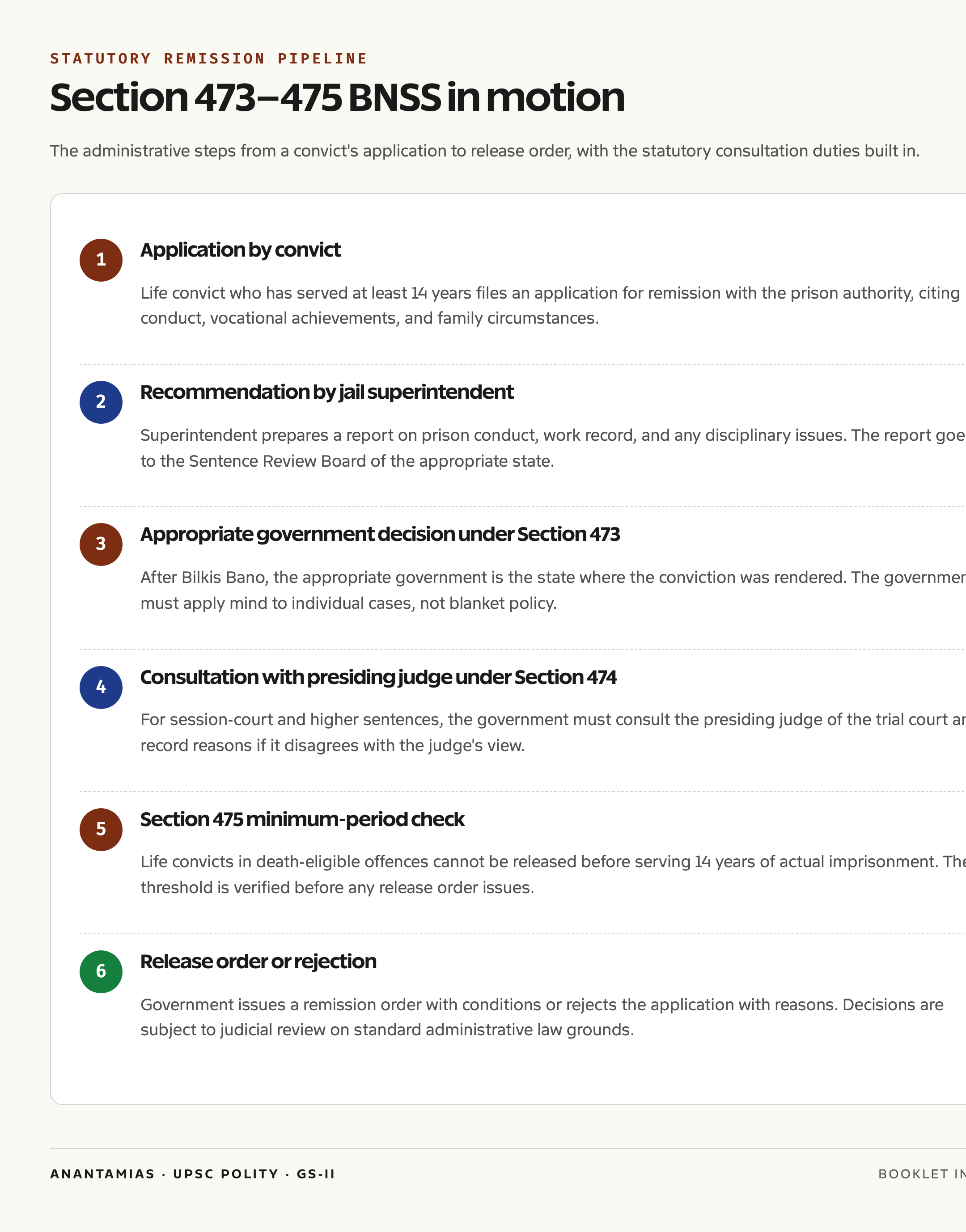
Section 473 of the BNSS, like the older Section 432, allows the appropriate government to suspend or remit the whole or any part of the punishment with or without conditions. The appropriate government is the central government for offences relating to matters within the executive power of the Union, and the state government otherwise.
Section 474 requires the appropriate government, before granting remission of a sentence imposed in a case originally tried by a session court or higher court, to consult the presiding judge of the court that tried the case. The judge gives a reasoned opinion on whether remission is appropriate, and the government must record reasons if it disagrees.
Section 475 imposes the 14-year minimum on life convicts. A person sentenced to imprisonment for life for an offence in which the death penalty was a permissible punishment, or whose death sentence has been commuted to life imprisonment, cannot be released through remission until they have served at least fourteen years of actual imprisonment.
Section 476 provides for concurrent jurisdiction between central and state governments where both have an interest in the prosecution.
Why the Doctrine Matters
The remission framework matters because it sits at the intersection of three large constitutional themes that the UPSC syllabus tracks closely.
Federalism. Remission decisions are usually state government decisions, but the appropriate government question can pull the centre into the picture for offences under Union law or for cases tried in central agencies’ jurisdictions. The Bilkis Bano ruling sharpened the federal logic by tying the power to the trial state rather than the offence state.
Separation of powers. The constitutional pardoning power is vested in the executive but exercised on the advice of the Council of Ministers, which folds it back into the parliamentary system. The Court has insisted that this advice be reasoned and that judicial review remain available, even if narrow. Remission therefore lies on a contested boundary between executive prerogative and judicial oversight.
Rule of law. The statutory remission power is administrative, but the Court has repeatedly held that it must be exercised with application of mind to individual cases. Mass remissions on political occasions, blanket policies that ignore the gravity of individual offences, and decisions that fail to consult the trial judge have all been struck down. The rule-of-law constraint converts what looks like grace into a structured legal process.
Detailed Analysis: The Bilkis Bano Verdict
The Bilkis Bano case in 2024 reshaped the doctrine in three important ways.
First, the Court held that the appropriate government for statutory remission is the state where the offender was sentenced, not the state where the offence was committed. The Bilkis Bano case involved a gang rape and murder during the 2002 Gujarat communal violence. The Supreme Court had earlier transferred the trial to Maharashtra to ensure a fair process. The Gujarat government granted remission to the eleven convicts in 2022 under its remission policy of 1992. The Court held that since the trial was conducted in Maharashtra, only the Maharashtra government had jurisdiction to consider remission. The Gujarat order was therefore void from inception.
Second, the Court reaffirmed that remission decisions must be supported by application of mind to individual cases. Mass remission of multiple convicts on the basis of a single executive order, without examining the gravity of each conviction, the conduct of each prisoner in jail, and the views of the trial judge, is unsustainable. The Court found that the Gujarat government had not properly examined individual files.
Third, the Court ordered the eleven convicts to surrender. This was unusual. Past judgments had often left it to the appropriate government to reconsider. Here, the Court reasoned that the underlying remission orders were void, the release flowed from those void orders, and the convicts therefore had to return to custody. The decision underscored that the Court will not hesitate to reverse a release if the remission process was legally defective.
The judgment is now the leading authority on the appropriate government question and a significant precedent on the limits of mass remission. It has practical consequences for state governments, which must now check the trial location before exercising remission authority, and for jail administrations, which must coordinate across state lines when convicts have been transferred.
Comparative Frame: Articles 72 and 161, BNSS Provisions
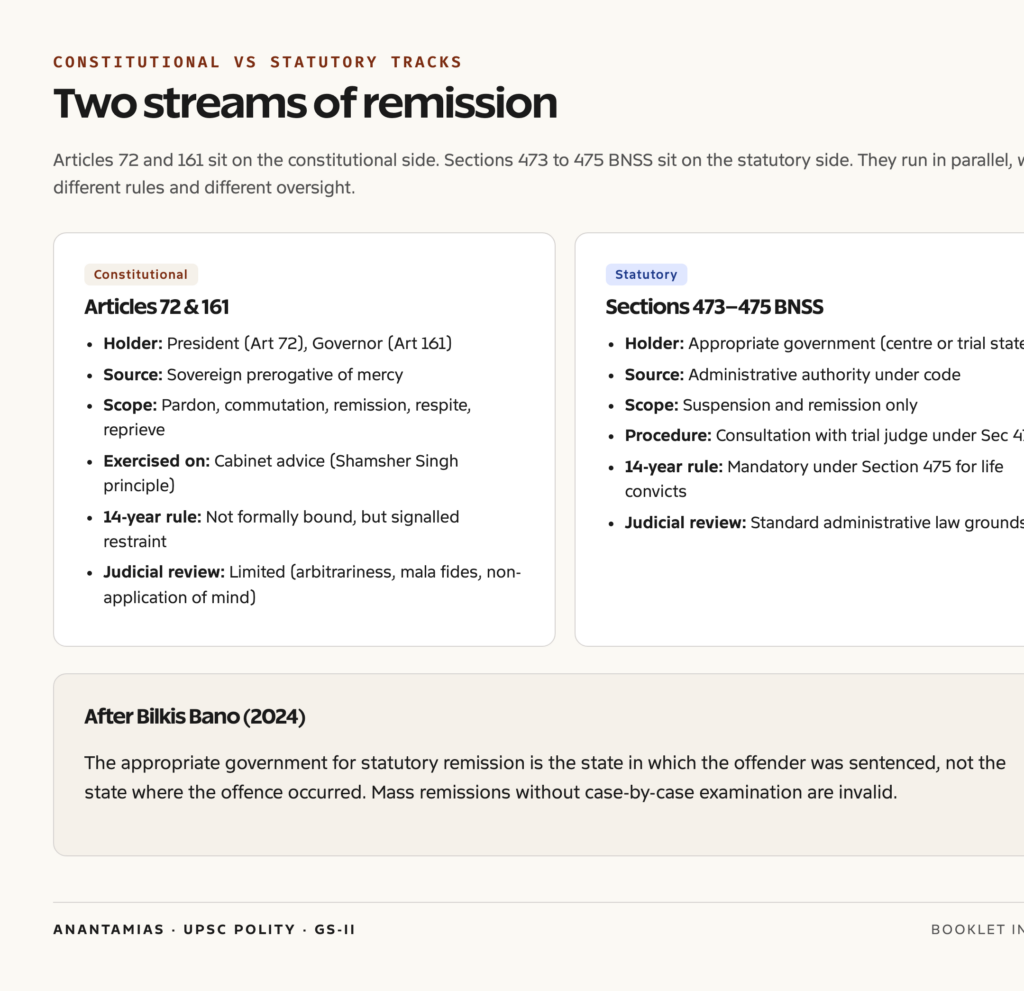
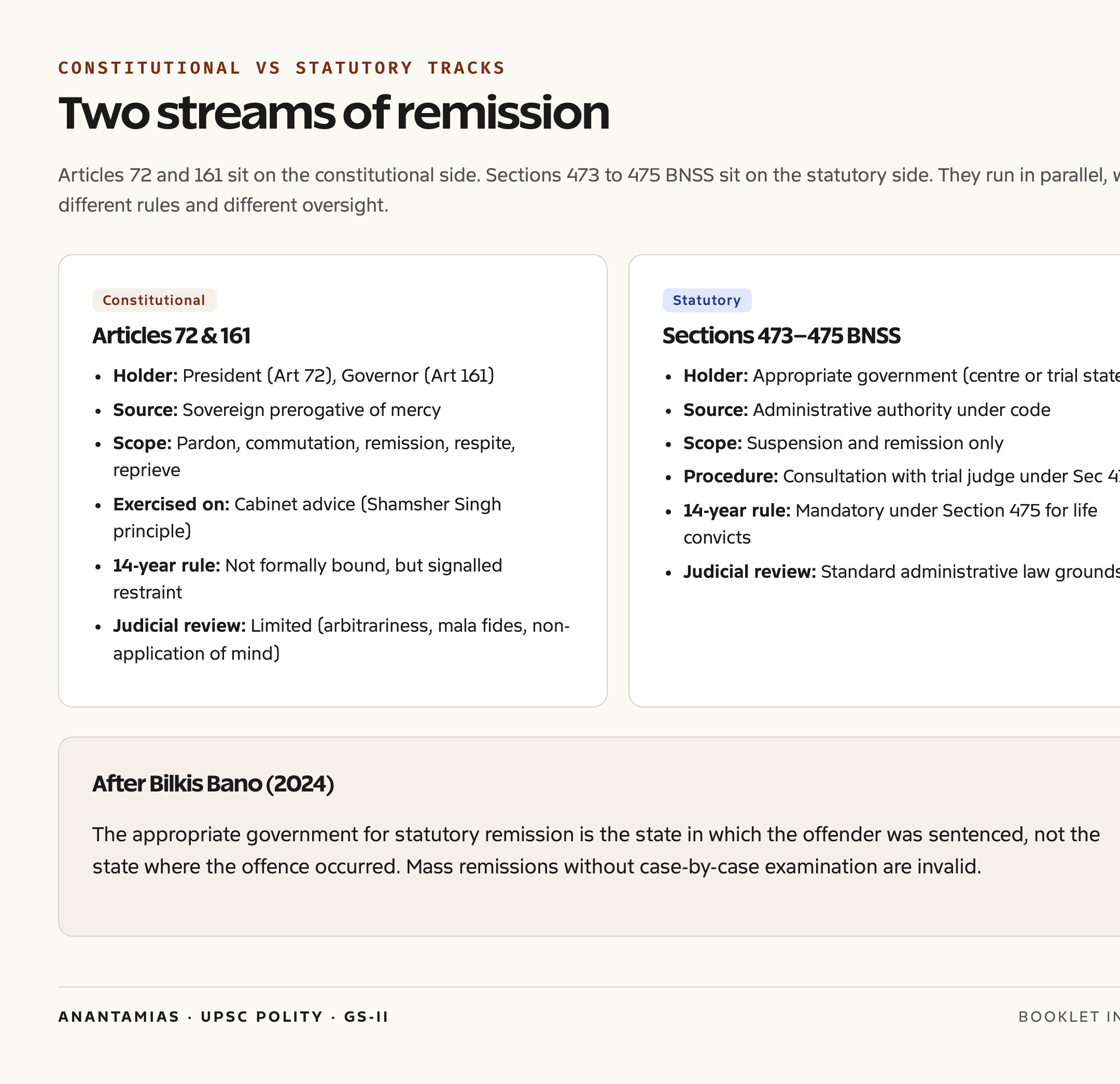
The two tracks differ in source, scope, and supervision.
| Feature | Articles 72 and 161 | Sections 473 to 475 BNSS |
|---|---|---|
| Source | Constitutional, sovereign | Statutory, administrative |
| Holder of power | President or Governor on cabinet advice | Appropriate government (central or state) |
| Scope | All forms of clemency including pardon, commutation, remission, respite, reprieve | Suspension and remission of sentence, conditional remission allowed |
| Death sentence | President can pardon; Governor’s power on this point is contested in practice | Cannot be exercised in death sentence cases |
| 14-year minimum | Not formally bound by Section 475, but Court has signalled restraint | Bound by Section 475 for life convicts in death-eligible offences |
| Consultation duty | No statutory consultation, but cabinet advice reasoned | Consultation with presiding judge required under Section 474 |
| Judicial review | Limited, on grounds of arbitrariness, mala fides, non-application of mind | Available on standard administrative law grounds |
| Frequency | Rare, high-profile cases | Routine, large numbers of cases annually |
The two tracks can overlap. A person serving life imprisonment can apply for remission under the BNSS through the state government, and can simultaneously petition the Governor under Article 161 or the President under Article 72. The doctrines that govern each track remain distinct, and a refusal under one does not preclude a request under the other.
Challenges and Open Questions
Several open questions continue to attract litigation and academic attention.
Application of Section 475 to constitutional power. The Court has held that the constitutional pardoning power is not formally bound by the 14-year minimum, but in practice has signalled that the executive should respect the underlying policy. Whether a President or Governor can remit a life sentence below the 14-year mark is technically open, although it has not been done in any leading case.
Mass remissions on political occasions. State governments occasionally grant blanket remissions on Independence Day, Republic Day, or anniversaries of state formation. The Bilkis Bano ruling tightens the requirement that each case be examined individually. Whether the practice of occasion-based remission can survive in its current form is now uncertain.
Remission policy versus statutory rules. Many states have remission policies dating back several decades, and the question of whether remission is governed by the policy in force at the time of conviction or at the time of consideration has been litigated repeatedly. The Court has generally favoured the policy at conviction in cases where it is more favourable to the convict.
Death-row commutation and the Shatrughan Chauhan principles. The Court in 2014 laid down guidelines on delay, mental illness, and conditions of solitary confinement as grounds for commutation of death sentences. The interaction between these guidelines and the Article 72 mercy power remains a live area of doctrine.
Federal coordination after Bilkis Bano. State governments now need clear protocols for handling remission applications from convicts whose trials were transferred to other states. Inter-state coordination, transfer of records, and timely consultation with the trial judge across state lines all require administrative attention.
Prelims Pointers
A compact list of facts most likely to appear in objective questions.
- Article 72 vests pardoning power in the President; Article 161 in the Governor.
- The five forms of clemency are pardon, commutation, remission, respite, and reprieve.
- Statutory remission is now governed by Sections 473 to 476 of the Bharatiya Nagarik Suraksha Sanhita 2023, replacing Sections 432 to 435 of the older Code of Criminal Procedure.
- Section 475 of the BNSS, like Section 433A of the older Code, imposes a 14-year minimum on life convicts in death-eligible offences.
- The appropriate government for statutory remission is the state in which the offender was sentenced, after Bilkis Bano (2024).
- Section 474 of the BNSS requires consultation with the presiding judge before remission of session-court sentences.
- Gopal Vinayak Godse v State of Maharashtra (1961) clarified that life imprisonment means imprisonment for the rest of the convict’s natural life.
- Maru Ram v Union of India (1980) upheld Section 433A as constitutional.
- Union of India v V Sriharan (2015) clarified the relationship between commutation and life imprisonment.
- Bilkis Bano v Union of India (2024) struck down the Gujarat government’s remission of eleven convicts and ordered their surrender.
- The pardoning power is exercised on the aid and advice of the Council of Ministers under the Shamsher Singh principle.
Mains Practice Questions
These are the kinds of analytical prompts the topic invites.
- Discuss the constitutional and statutory framework of remission of sentence in India. How has the Supreme Court delimited the scope of the appropriate government in light of the Bilkis Bano case?
- Examine the difference between the constitutional pardoning power and the statutory power of remission with reference to the source of authority, scope, and judicial review.
- The 14-year rule under Section 475 of the BNSS often misleads the public into believing that life imprisonment ends at 14 years. Analyse the legal position with reference to Gopal Vinayak Godse and Maru Ram.
- Critically analyse the practice of mass remissions on political and ceremonial occasions in light of recent Supreme Court rulings.
- Discuss the procedural safeguards in statutory remission, particularly the duty of consultation with the trial judge and the requirement of application of mind to individual cases.
Way Forward
Three calibrated steps would strengthen the remission framework without weakening the executive’s mercy function.
Codify a uniform remission policy at the central level. The current patchwork of state-level remission policies, some dating to the 1960s, creates avoidable inconsistency. A model policy framework, perhaps under the BNSS rules, could harmonise core requirements while allowing state-specific calibration on details.
Strengthen consultation with trial judges. Section 474 already requires consultation, but the quality of consultation varies widely. Trial judge opinions sometimes arrive years after retirement, are summary in form, or are ignored when the executive disagrees. A protocol that requires reasoned recording of the judge’s view, reasoned recording of the government’s response, and a public summary of the decision would strengthen rule-of-law credibility.
Embed inter-state coordination after Bilkis Bano. Remission applications for convicts whose trials were transferred to other states will need a working coordination protocol. The home affairs ministry can lead the drafting of such a protocol, drawing on existing inter-state extradition and witness protection frameworks.
The mercy power exists because a humane criminal justice system needs a release valve from rigid rules and unforeseen hardship. The structural reforms suggested here are not about narrowing mercy but about ensuring that when mercy is exercised, it is exercised by the right authority, on a proper record, after due reflection on the individual case. That is what the Bilkis Bano ruling demands, and what the constitutional framework of Articles 72 and 161 always required.
Frequently Asked Questions
What is the difference between pardon, commutation, and remission?
Pardon ends both the conviction and the sentence, treating the offence as if it had never been recorded. Commutation substitutes a milder form of punishment for a harsher one, such as turning a death sentence into life imprisonment. Remission reduces the duration of the sentence without changing its character, so a ten-year sentence with two years remitted becomes an eight-year sentence of the same kind. All three fall within the broader category of clemency, along with respite and reprieve, which delay or temporarily stay execution.
Who is the appropriate government for granting remission?
After the Bilkis Bano ruling of January 2024, the appropriate government for statutory remission is the state in which the offender was sentenced, not the state where the offence was committed. If a trial was transferred from one state to another for fair-trial reasons, only the trial state has jurisdiction to consider remission. For offences against Union law, the central government is the appropriate government. The position now binds all state governments and ends a long-running ambiguity.
Does life imprisonment mean 14 years?
No. The Supreme Court clarified in Gopal Vinayak Godse v State of Maharashtra (1961) that life imprisonment in India means imprisonment for the rest of the convict’s natural life unless remitted by competent authority. The 14-year period under Section 475 of the BNSS is the minimum that must be served before remission can even be considered, not an automatic release date. Life convicts whose remission applications are denied serve the rest of their natural lives.
Can the President or Governor pardon any offence?
The President can pardon offences against Union law, offences punishable by death, and offences tried by courts martial under Article 72. The Governor can pardon offences against state law under Article 161. Both exercise the power on the advice of the Council of Ministers in their respective governments. The Governor’s power technically extends to commuting death sentences, although in practice this has been a contested area, and the President holds the conventional final authority on death sentences.
Is the pardoning power subject to judicial review?
Yes, but only on narrow grounds. The Supreme Court in Maru Ram and subsequent cases held that the pardoning power can be reviewed if the order is shown to be arbitrary, made in bad faith, based on irrelevant considerations, without application of mind, or in violation of constitutional principles. The Court will not substitute its own judgment for the executive’s, but it can quash an order that fails the basic standards of administrative law.
What are Sections 473 to 475 of the BNSS?
Section 473 allows the appropriate government to suspend or remit the whole or part of a sentence with or without conditions. Section 474 requires consultation with the presiding judge of the court that tried the case before remission of session-court or higher sentences. Section 475 imposes a 14-year minimum on life convicts in offences where the death penalty was a permissible alternative. These provisions replace Sections 432, 433, and 433A of the older Code of Criminal Procedure with substantially the same content.
What was the Bilkis Bano remission case?
In 2002, Bilkis Bano was gang-raped and seven of her family members, including her three-year-old daughter, were murdered during the Gujarat communal violence. Eleven men were convicted by a Maharashtra trial court after the Supreme Court transferred the trial out of Gujarat for fair-trial reasons. In August 2022, the Gujarat government granted remission to the eleven convicts under its 1992 remission policy. The Supreme Court quashed those orders in January 2024, ruling that only the Maharashtra government, as the trial state, had jurisdiction to consider remission, and ordered the convicts to surrender.
What is Section 475 of the BNSS and its 14-year rule?
Section 475 says that a person sentenced to life imprisonment for an offence where the death penalty was a possible alternative cannot be released through remission until they have served at least 14 years of actual imprisonment. The same rule applies to persons whose death sentence has been commuted to life imprisonment. Actual imprisonment means time served physically in jail, not adjusted for remissions. The 14-year period is a floor, not a ceiling, and remission after 14 years is discretionary, not automatic.
How is the Article 72 power exercised in practice?
The President receives a mercy petition from a convict, usually after the death sentence has been confirmed by the Supreme Court. The home affairs ministry processes the petition, prepares a file, and sends it to the President with the recommendation of the Council of Ministers. The President, by constitutional convention, acts on the cabinet’s advice. The petition can be accepted, rejected, or returned for reconsideration. The decision is communicated through formal notifications and is subject to limited judicial review.
Can a remission order be revoked once granted?
Yes, in two ways. First, conditional remission can be revoked if the convict breaches the conditions, leading to re-arrest and resumption of the original sentence. Second, an unconditional remission order can be quashed by the courts if the underlying decision-making process is found to be illegal, as happened in the Bilkis Bano case. In both situations, the convict can be required to return to custody and serve the remainder of the original sentence.
Tell Google you want more of this.
Add Anantam IAS as a preferred sourceOne tap, and this site shows up more often in your own Top Stories, AI Overviews and AI Mode. Remove it any time.