
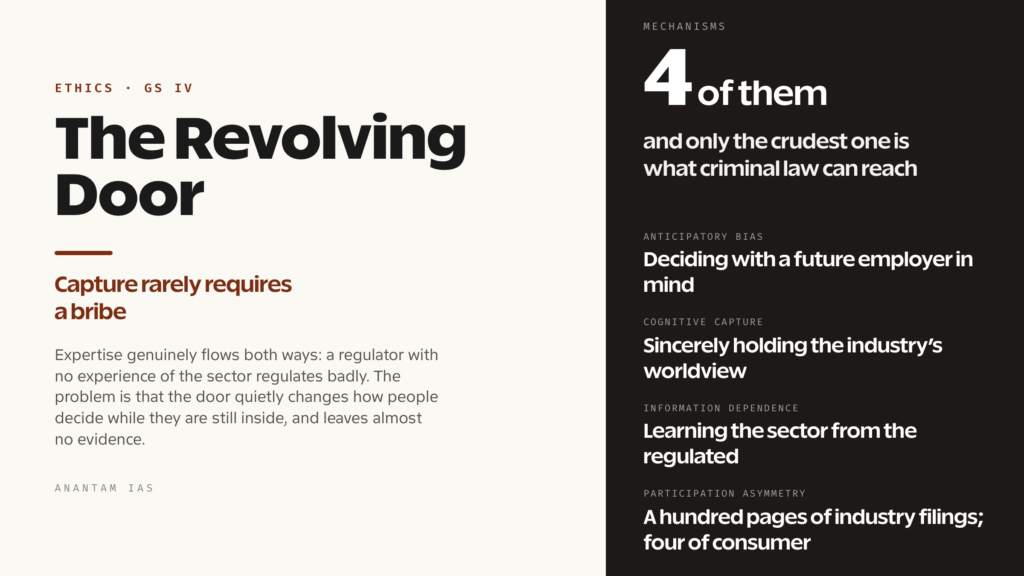
The phrase “revolving door” names movement in both directions, and the two directions raise different problems. An official who leaves a regulator for the industry it supervises carries relationships, unpublished knowledge of how the institution reasons, and the memory of decisions taken. A specialist who joins a regulator from the industry brings expertise nobody else in the building has, along with a professional network and a set of assumptions about what counts as a reasonable rule.
Neither movement is corruption, and treating it as corruption is the standard error in writing about it. Expertise genuinely flows both ways. A securities regulator staffed entirely by people who have never priced a security regulates badly, and a telecom regulator with no engineers writes rules that cannot be complied with. The problem is not that the door exists. It is that the door quietly changes how people decide while they are still inside, and the mechanisms by which it does so leave almost no evidence.
What Capture Means, and Why It Is Rarely a Crime
The economic account of the problem is old. George Stigler’s 1971 paper on the theory of economic regulation argued that regulation tends to be acquired by the industry it governs and operated primarily for that industry’s benefit, because a concentrated group with large per-member stakes will always out-organise a diffuse public with small per-member stakes. Mancur Olson’s earlier work on collective action supplied the reason: the beneficiaries of a rigged tariff are few and know exactly what they stand to gain, while the losers are many and each loses a little.
The strong version of that claim has been contested since it was made. Later work on regulation argues that capture is usually partial rather than total — an industry secures favourable treatment on some questions and loses on others — and that the evidence for wholesale capture is weaker than the theory’s popularity suggests. That correction matters for how the problem is written about. Assuming every regulator is captured is as unhelpful as assuming none is, and it makes the actual analytical task, which is identifying the specific channel of influence in a specific decision, look unnecessary.
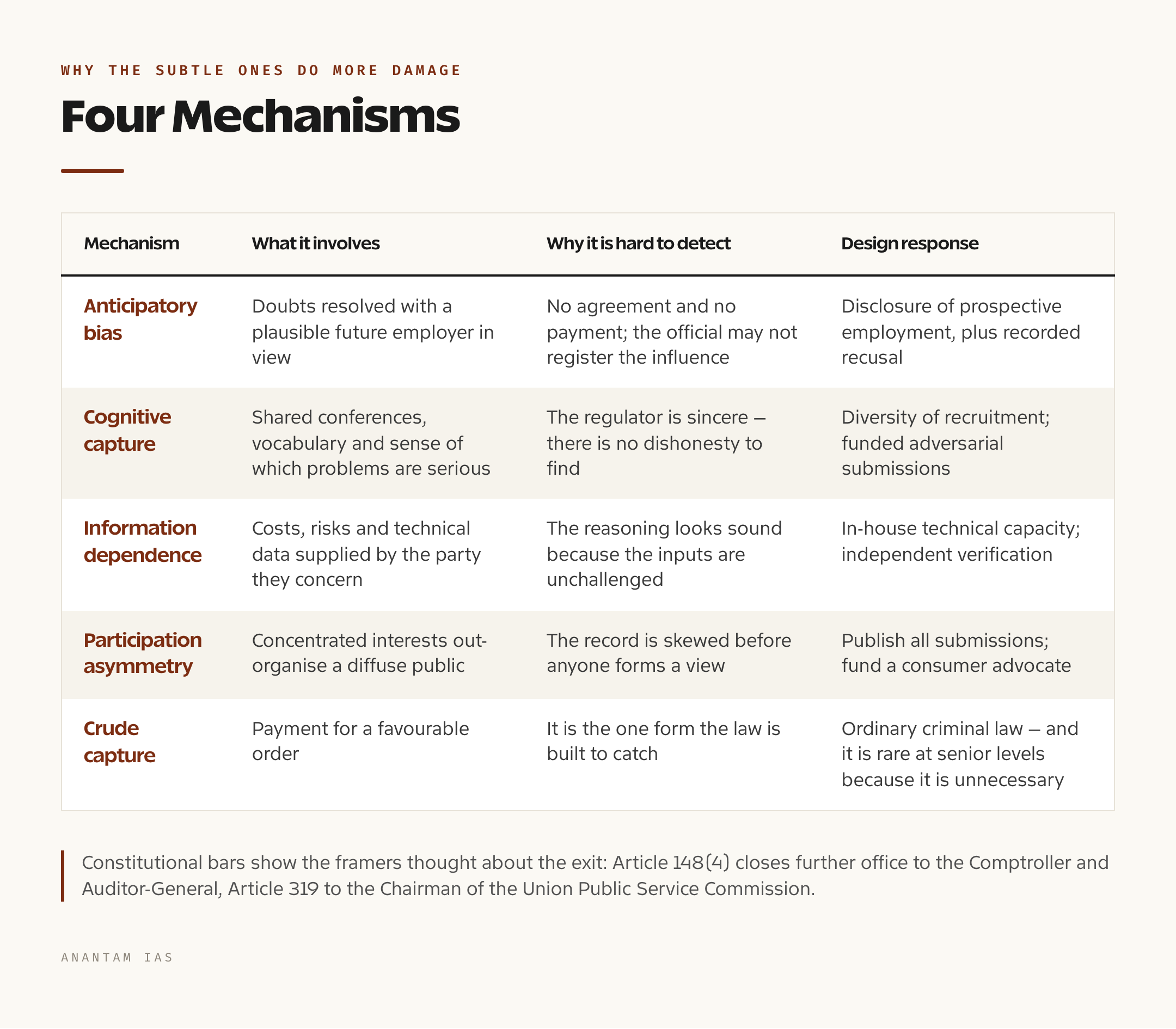
Crude capture — a payment for a favourable order — is the version the criminal law is built for, and the version that almost never occurs at senior levels, because it is unnecessary. The mechanisms that do the work require no agreement, produce no transaction, and are consistent with everyone involved believing they are acting properly.
Four Mechanisms That Leave No Evidence
Anticipatory bias. An official deciding a matter involving a firm that may plausibly employ them in three years does not need to be promised anything. The prospect is enough to shift how doubts are resolved. There is no agreement to detect, no payment to trace, and the official may not consciously register the influence — which makes this both the most common form and the least provable.
Cognitive capture. Regulators and the regulated attend the same conferences, read the same journals, use the same analytical vocabulary and share a view of what problems are serious. Willem Buiter used the term “cognitive regulatory capture” of central banks; others have described it as cultural capture, operating through identity, status and relationships rather than interest. The captured regulator is not dishonest. They sincerely hold the industry’s view of the world, having acquired it in the industry’s company.
Information dependence. A regulator’s central handicap is that the regulated entity knows its own costs, risks and technology and the regulator does not. Tariff filings, cost data, safety records and technical justifications all arrive from the party they concern. Verification requires capacity the regulator usually lacks, and an institution that learns its subject from one source will tend to reason as that source does.
Asymmetry of participation. In a public consultation on a draft regulation, the industry files a hundred pages prepared by counsel and economists. Consumer groups file four pages, or nothing. The regulator, acting entirely in good faith, weighs the submissions in front of it. The record is therefore skewed before anyone forms a view — the structural weakness in the design of Indian regulators traced in independent regulatory bodies.
India’s Rules on Post-Retirement Employment
India regulates the exit door through service rules rather than through a single statute, which produces uneven coverage.
For civil servants, the pension rules require a retired officer of Group ‘A’ to obtain previous sanction of the government before accepting commercial employment within a stated period after retirement — one year under the general rule — and permission may be refused where the proposed employer had official dealings with the officer or where the employment would involve a conflict. The All India Services rules carry an equivalent requirement. Officers of intelligence and security organisations are subject to tighter restrictions, extending to publication as well as employment.
Several regulatory and quasi-judicial statutes attach their own bars, typically preventing a departing chairperson or member from taking employment with a regulated entity, or from further government employment, for a specified period after demitting office. The Constitution itself contains the strictest versions. Article 148(4) makes the Comptroller and Auditor-General ineligible for any further office under the Union or a State after ceasing to hold office. Article 319 bars the Chairman of the Union Public Service Commission from further employment under the Union or a State, and restricts a member to specified Commission appointments. These are absolute bars on office, not permission requirements, and they exist because the functions concerned require the holder to be visibly unpurchasable.
The interesting fact is where these bars are absent. The Election Commission, for instance, has no equivalent constitutional restriction on post-retirement office, an asymmetry with Articles 148(4) and 319 that reform proposals have raised repeatedly.
Tribunals, Commissions and the Pre-Retirement Problem
The most-discussed Indian version of the revolving door does not involve industry at all. It involves the government.
A large number of tribunals, commissions, authorities and ombudsman offices are staffed substantially by retired judges and retired officials, appointed by the executive. That practice has an obvious defence: these are people with directly relevant experience who are available. It also has a specific hazard, and the hazard operates before retirement rather than after it. If desirable post-retirement appointments are in the gift of the government, and the government is the largest litigant appearing before the body making the appointment, then the incentive structure of a serving judge or officer in the years before retirement is not neutral.
The Supreme Court’s tribunal jurisprudence has circled this problem for two decades without naming it in these terms. Its recurring concerns — the length of a member’s term, whether the term is renewable, who sits on the selection committee, and the extent of executive control over service conditions — are all reducible to a single question: does the member’s future depend on the executive whose decisions the member reviews? A short term renewable at the government’s discretion produces dependence regardless of anyone’s integrity, and the Court’s insistence on longer, more secure tenures follows from that rather than from any allegation against individuals.
The judicial version is sharper still. Higher-court judges retire relatively early, and the Constitution restricts what they may do afterwards in a revealing way. Article 124(7) bars a retired judge of the Supreme Court from pleading or acting before any court or authority in India; Article 220 similarly restricts former High Court judges. The framers therefore thought about the exit and chose to close the practice door while leaving the office door open. The Law Commission’s first major report on judicial administration in 1958 objected to retired judges accepting government employment, and the argument has been made in Parliament and in public debate ever since that the prospect of a post-retirement position can colour decisions taken before it. The claim is unprovable in any individual case and unfalsifiable as a general proposition, which is precisely why it corrodes confidence: the appearance is enough to do the damage, whatever the reality — the reason appointments design carries so much weight in judicial appointments and the collegium debate.
The Legislative and Lobbying Version
Legislators occupy a different position, because they are not expected to be disinterested in the way an adjudicator is. They represent constituencies, including economic ones, and a legislature composed entirely of people with no commercial experience would be a poorer institution.
The mechanisms available are therefore about disclosure rather than prohibition. Candidates file declarations of assets and liabilities; members of the Houses declare their interests under rules framed for the purpose, and ethics committees exist in both Houses. The constitutional bar is narrow and specific: Article 102 disqualifies a member who holds an office of profit under the government, with statutory exemptions.
What India does not have is a lobbying framework. Several jurisdictions require paid advocates to register, to disclose clients and expenditure, and to observe post-employment restrictions before lobbying the institutions they served in; India has no statutory register of lobbyists and no disclosure requirement for meetings between officials and interested parties. The consequence is not that lobbying does not occur. It is that it occurs without a record, which removes the only cheap check on it.
Remedies and What Each One Costs
Every proposed fix has a price, and an answer that lists remedies without their costs is not analysis.
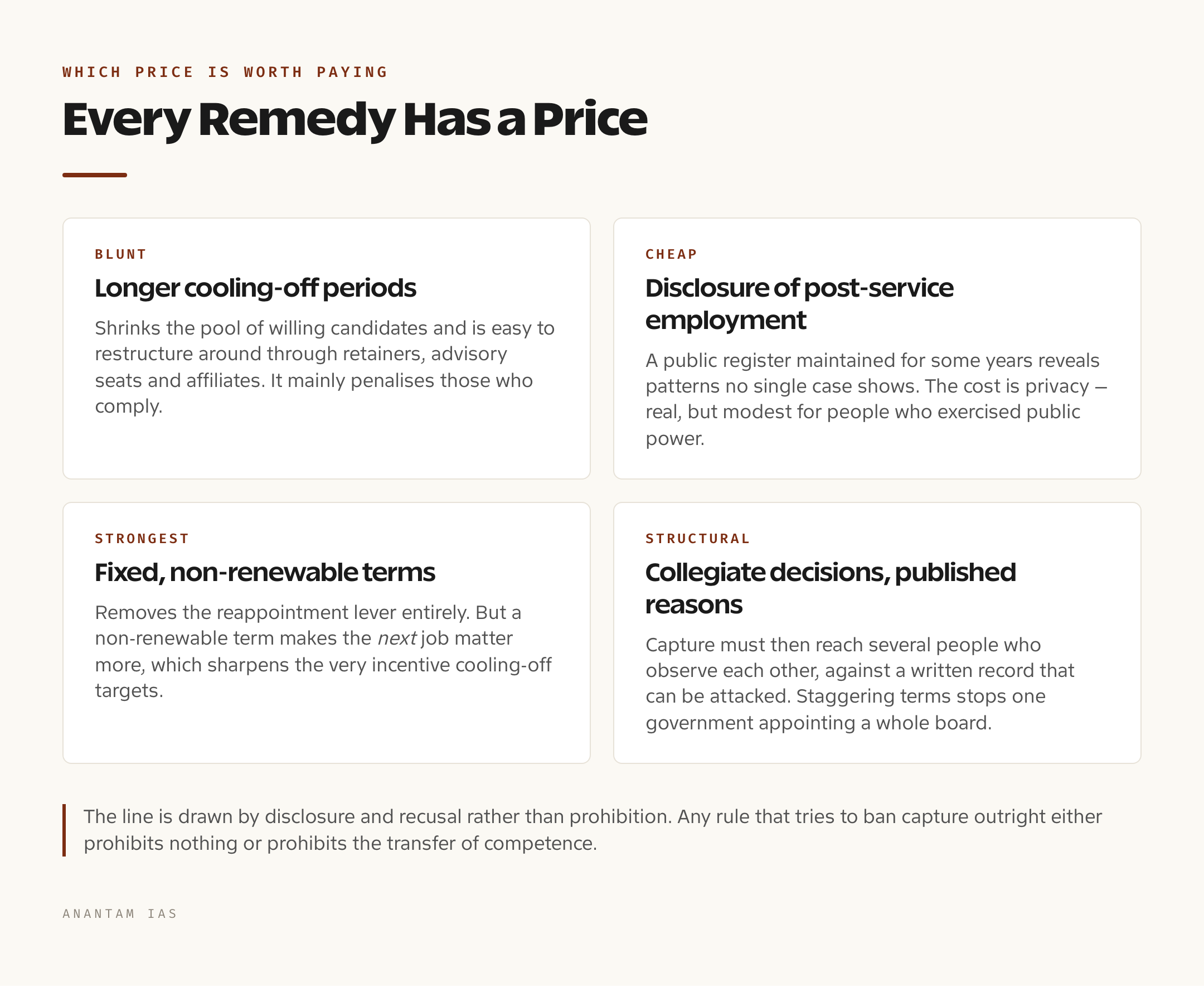
Longer cooling-off periods. The intuitive remedy, and the weakest. Extending the bar reduces the pool of people willing to take regulatory jobs, since a post that ends a career is worth less than one that does not — which selects for candidates with no outside options rather than for the best. It also pushes arrangements out of sight: consultancy retainers, advisory board seats, non-executive directorships in affiliates, or employment by a firm’s law firm rather than by the firm. A rule that is easy to restructure around mainly penalises the people who comply with it.
Mandatory disclosure of post-service employment. Cheap, and more effective than it looks. A public register of where officials go after leaving, maintained for a period of years, allows patterns to be seen that no individual case reveals. The cost is privacy, which is a real cost but a modest one for people who exercised public power.
Recusal rules with a written record. An official who has a prospective interest, a former employer or a family connection in a matter should stand aside, and the recusal should be recorded and published. The cost is capacity: in a specialised field, aggressive recusal can leave nobody qualified to decide, and recusal can also be used tactically to avoid an unwelcome file.
Fixed, non-renewable terms. Structurally the strongest single measure, because it removes the reappointment lever entirely. A regulator who cannot be reappointed has nothing to gain from pleasing whoever would do the reappointing. The cost is the loss of good members at the end of a term, and the fact that a non-renewable term makes the next job more important, which sharpens the industry-employment incentive rather than dulling it. The two remedies work against each other and have to be balanced rather than stacked.
Staggered appointments. Terms arranged so that no single government appoints an entire board. Cheap, undramatic and effective, and it slows the pace at which any one set of preferences can capture an institution.
Transparency of contact. Published logs of meetings with regulated entities, publication of all consultation submissions, and rules against one-sided communication on pending matters. This addresses the asymmetry-of-participation mechanism directly, and does so without restricting anyone’s career.
The Case for Institutional Design Over Career Restriction
The most useful conclusion available is that the revolving door is a symptom, and that the treatment belongs at the level of how decisions are made rather than who is permitted to make them.
Three features do most of the work. Collegiate decisions: a multi-member body deciding by recorded vote requires a capturing interest to capture several people who can observe each other, which is a different order of difficulty from persuading one. Published reasons: an order that must state why it departed from the tariff formula, why it accepted the licensee’s cost figures, or why it deviated from the technical committee’s advice creates a document that can be attacked, and the anticipation of that attack disciplines the reasoning at the drafting stage. Adversarial process: funding a consumer advocate to file in tariff proceedings, or requiring the regulator to publish and respond to submissions, corrects the participation asymmetry that no employment rule touches.
The underlying insight is that capture exploits unaccountable discretion, and that reducing unaccountable discretion is available whether or not anyone’s career is restricted. This is the same conclusion the second ARC reached across its recommendations on probity — that the reliable safeguards are structural rather than personal, described in the Second ARC on ethics in governance. It is also the conclusion corporate governance reached about interested directors: the answer was not to ban them but to require disclosure, abstention from the vote, and a record of both, an approach set out in corporate governance and business ethics.
The Honest Difficulties
Cooling-off is a blunt instrument. It applies to everyone by rank and period rather than by actual conflict, so it catches the officer whose new employer has no connection with their old work and misses the one whose relationship is mediated through a consultancy. Blunt rules are administratively attractive precisely because they need no judgement, which is also why they perform poorly against people willing to restructure around them.
There is a genuine rights question. A person who has completed a career of public service retains the freedom to practise a profession, and a pension is deferred compensation for work done rather than payment for permanent silence. Restrictions on employment after service have to be reasonable in duration and connected to an actual risk, and an open-ended bar imposed for appearances would be difficult to defend as anything other than confiscation of livelihood. That is a serious objection, not a technicality.
The empirical picture is mixed. The intuition that officials who later join an industry were softer on it while in office is not clearly borne out. Studies of enforcement staff have found evidence pointing the other way — that officials who subsequently move to the private sector were, if anything, more aggressive beforehand, consistent with building a demonstrable record rather than trading favours. The literature is contested and the findings are sensitive to how movement is measured, so the safest statement is that the direction of the effect is not established.
And there is no clean line. Expertise transfer and capture are the same movement of the same people carrying the same knowledge; what distinguishes them is a mental state at the moment of decision, which is not observable. Any rule that tries to prohibit capture will either be so narrow that it prohibits nothing or so wide that it prohibits the transfer of competence.
The workable position follows from that. The line is drawn by disclosure and recusal, not by prohibition. Require that interests, prospective employment and prior associations be declared; require that a person with a live interest stand aside and that the fact be recorded; publish the register; and design the institution so that a single captured individual cannot determine an outcome. That accepts the door will keep turning, and makes each turn visible.
FAQ
What is the revolving door in regulation? The movement of personnel between a regulator and the industry it regulates, in both directions — officials leaving for the regulated sector, and industry specialists joining the regulator. It is a conflict-of-interest problem rather than a form of bribery.
Why is the revolving door not simply corruption? Because expertise genuinely needs to flow both ways. A regulator with no experience of the sector regulates badly. The concern is that the prospect of future employment, and a shared professional worldview, can influence decisions without any agreement or payment.
What is cognitive capture? Capture that operates through shared assumptions rather than interest. A regulator who trained in the industry, reads its literature and moves in its professional circles may sincerely hold the industry’s view of what is reasonable, without any dishonesty.
What are India’s rules on commercial employment after retirement? Pension and service rules require a retiring Group ‘A’ officer to obtain previous sanction of the government before accepting commercial employment within a stated period — one year under the general rule — and permission may be refused where there is a connection with the officer’s official dealings.
Why do post-retirement appointments to tribunals raise a concern? Because the incentive operates before retirement. If desirable appointments are in the gift of the executive, and the executive is the principal litigant before the body concerned, the independence of a serving judge or officer in the years before retirement is structurally compromised even where nothing improper occurs.
What is the strongest structural remedy? Removing the reappointment lever through fixed, non-renewable terms, combined with collegiate decisions, published reasons and disclosure of contact with regulated entities. These reduce unaccountable discretion without restricting individual careers.
Practice Questions
Prelims MCQs
- The proposition that regulation is typically acquired by the industry and operated for its benefit is associated with: (a) Mancur Olson (b) George Stigler (c) Amartya Sen (d) Ronald Coase — Answer: (b) Stigler advanced it in his 1971 paper on the theory of economic regulation, building on the collective-action asymmetry Olson had described.
- Article 148(4) of the Constitution provides that the Comptroller and Auditor-General: (a) May be reappointed for a second term (b) Shall not be eligible for further office under the Union or a State (c) May be appointed to a tribunal after retirement (d) Shall require government sanction for commercial employment — Answer: (b) it is an absolute bar on further office rather than a permission requirement.
- Which constitutional provision bars a retired judge of the Supreme Court from pleading or acting before any court or authority in India? (a) Article 121 (b) Article 124(7) (c) Article 217 (d) Article 220 — Answer: (b) Article 220 imposes a comparable but narrower restriction on former judges of High Courts.
- “Cognitive capture” of a regulator refers to: (a) Acceptance of payment for a favourable order (b) Adoption of the regulated industry’s worldview through shared professional formation (c) Failure to disclose a family interest (d) Deliberate delay in deciding a matter — Answer: (b) the captured regulator is sincere, which is what makes the mechanism difficult to address through conflict rules.
- Which remedy most directly removes the executive’s leverage over a serving regulator? (a) A longer cooling-off period after demitting office (b) A public register of post-service employment (c) A fixed, non-renewable term (d) Mandatory recusal on conflicted matters — Answer: (c) a member who cannot be reappointed has nothing to gain from pleasing the appointing authority, though it may sharpen the incentive to look for private employment afterwards.
Mains Practice Questions
- “Capture rarely requires a bribe.” Explain the mechanisms through which a regulator may be captured without any corrupt transaction. (250 words)
- Examine the argument that post-retirement appointments in the gift of the executive compromise independence before retirement rather than after it. (150 words)
- Longer cooling-off periods are the most intuitive remedy for the revolving door and among the least effective. Critically examine. (250 words)
- “The line between legitimate expertise transfer and regulatory capture is drawn by disclosure and recusal, not by prohibition.” Discuss. (250 words)
- Suggest an institutional design for a multi-member regulator that reduces the risk of capture without restricting the careers of its members. (150 words)
Tell Google you want more of this.
Add Anantam IAS as a preferred sourceOne tap, and this site shows up more often in your own Top Stories, AI Overviews and AI Mode. Remove it any time.