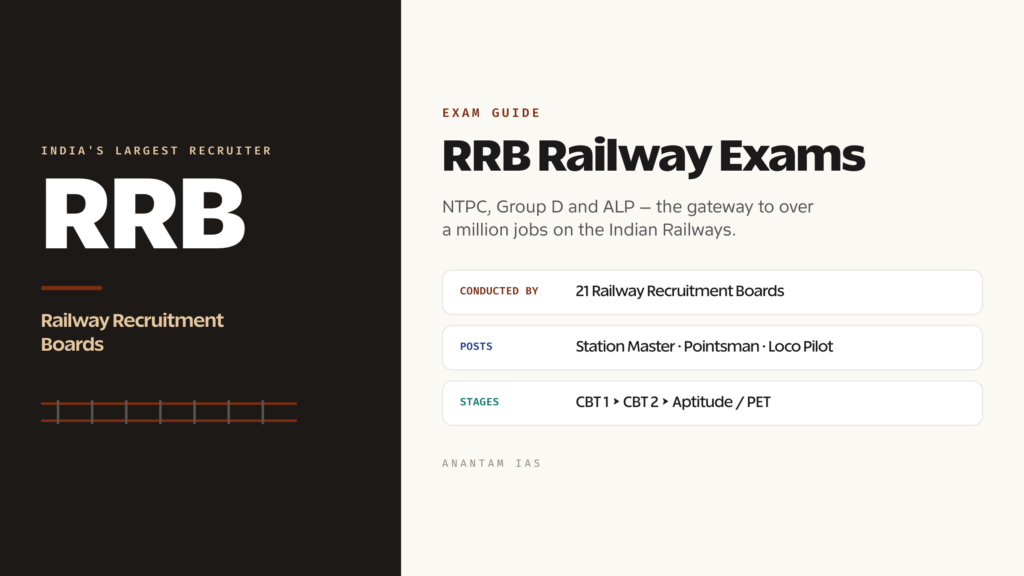
The Railway Recruitment Boards (RRBs) run the hiring machine behind one of the world’s largest employers — the Indian Railways, which carries millions of people every day and keeps over a million staff on its rolls. If you want a stable, pensionable central-government job after Class 10, an ITI, or a degree, the RRB exams are the widest door in the country, and they pull in numbers no other recruiter matches: the last Group D notification alone saw more than one crore candidates sit the test.
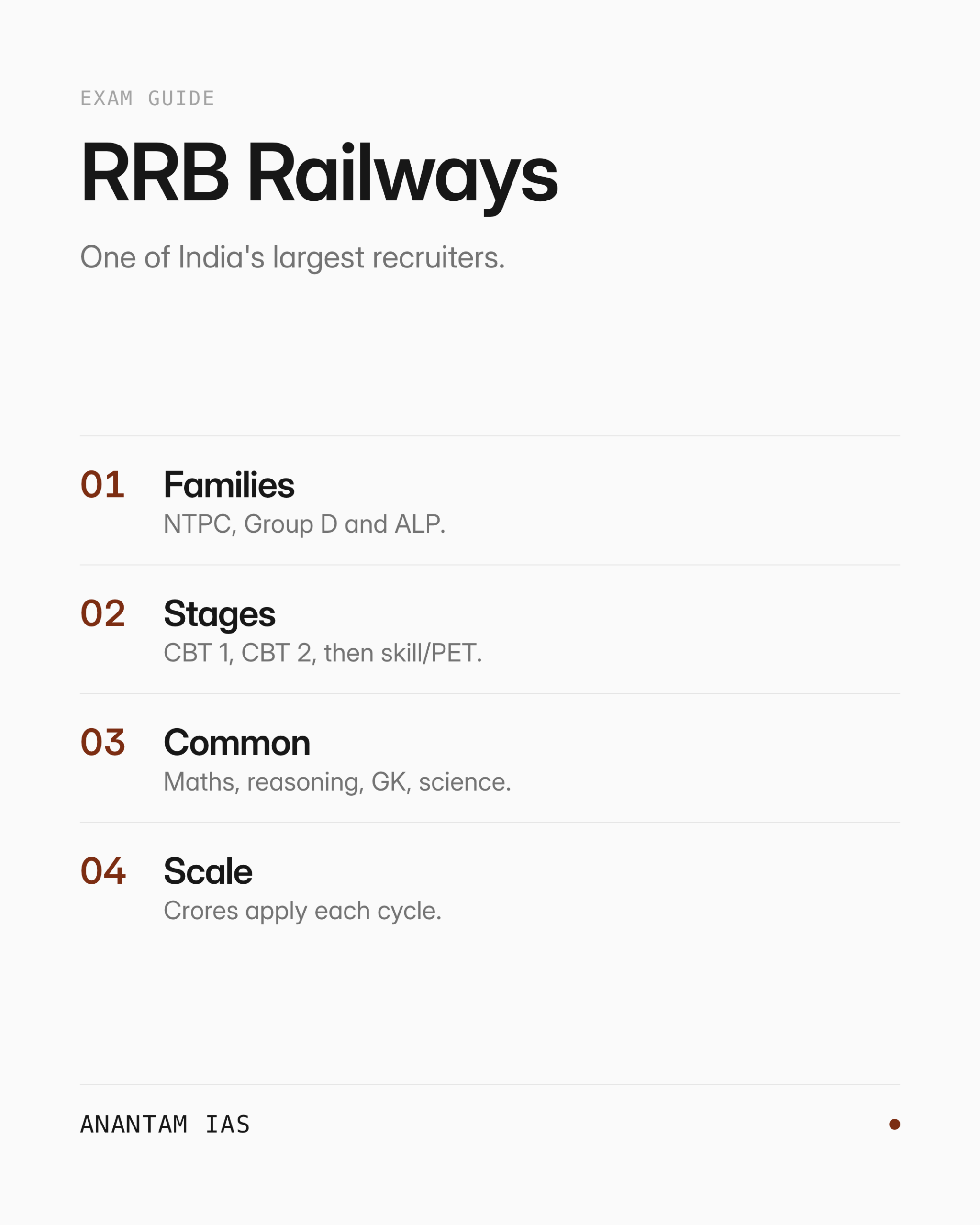
There isn’t one RRB exam but a family of them, sorted by the kind of post. RRB NTPC fills clerical and supervisory roles like Station Master and Goods Train Manager; RRB Group D (Level 1) fills the on-track and depot roles like track maintainer and pointsman; and RRB ALP recruits Assistant Loco Pilots — the people in the engine cab. This guide walks through each one’s pattern, eligibility, the shared syllabus, and a study plan that fits all three.
What Are the RRB Exams?
The Railway Recruitment Boards are 21 regional boards across India, coordinated by the Railway Recruitment Control Board (RRCB) under the Ministry of Railways. They don’t recruit gazetted officers — those Group A posts come through the UPSC and the Engineering Services Examination — but they handle the enormous Group C and Level-1 workforce that runs the trains, stations, depots, and offices. Each board advertises against vacancies in its zone, but the papers and merit logic are set centrally, so an RRB exam is effectively a single national competition split across boards.
The recruitment is organised by post category. The Non-Technical Popular Categories (NTPC) exam covers commercial, clerical, and operational supervisory posts at both undergraduate (Class 12) and graduate levels — Junior Clerk, Trains Clerk, and Commercial cum Ticket Clerk at the lower end, and Goods Train Manager, Junior Account Assistant, Commercial Apprentice, and Station Master at the graduate end. Group D, formally the Level-1 recruitment, fills the safety and maintenance backbone — track maintainer, pointsman, helper, and assistant posts across the mechanical, electrical, and engineering departments. The Assistant Loco Pilot (ALP) recruitment, run alongside Technician posts, picks the technically trained staff who drive and maintain locomotives.
Key Facts
- Conducting authority: 21 Railway Recruitment Boards under the Railway Recruitment Control Board, Ministry of Railways.
- Main exam families: RRB NTPC (graduate & undergraduate posts), RRB Group D / Level 1, and RRB ALP & Technician.
- Stages: Multi-stage Computer-Based Tests (CBT 1 → CBT 2) plus a post-specific extra stage — a Computer-Based Aptitude Test, a Typing Skill Test, or a Physical Efficiency Test — then document verification and a medical exam.
- Scale of competition: The 2024 Group D notification (CEN 08/2024) advertised 32,438 vacancies and drew well over one crore applicants, with more than 1.08 crore candidates appearing for the CBT.
RRB Railway Exam Pattern
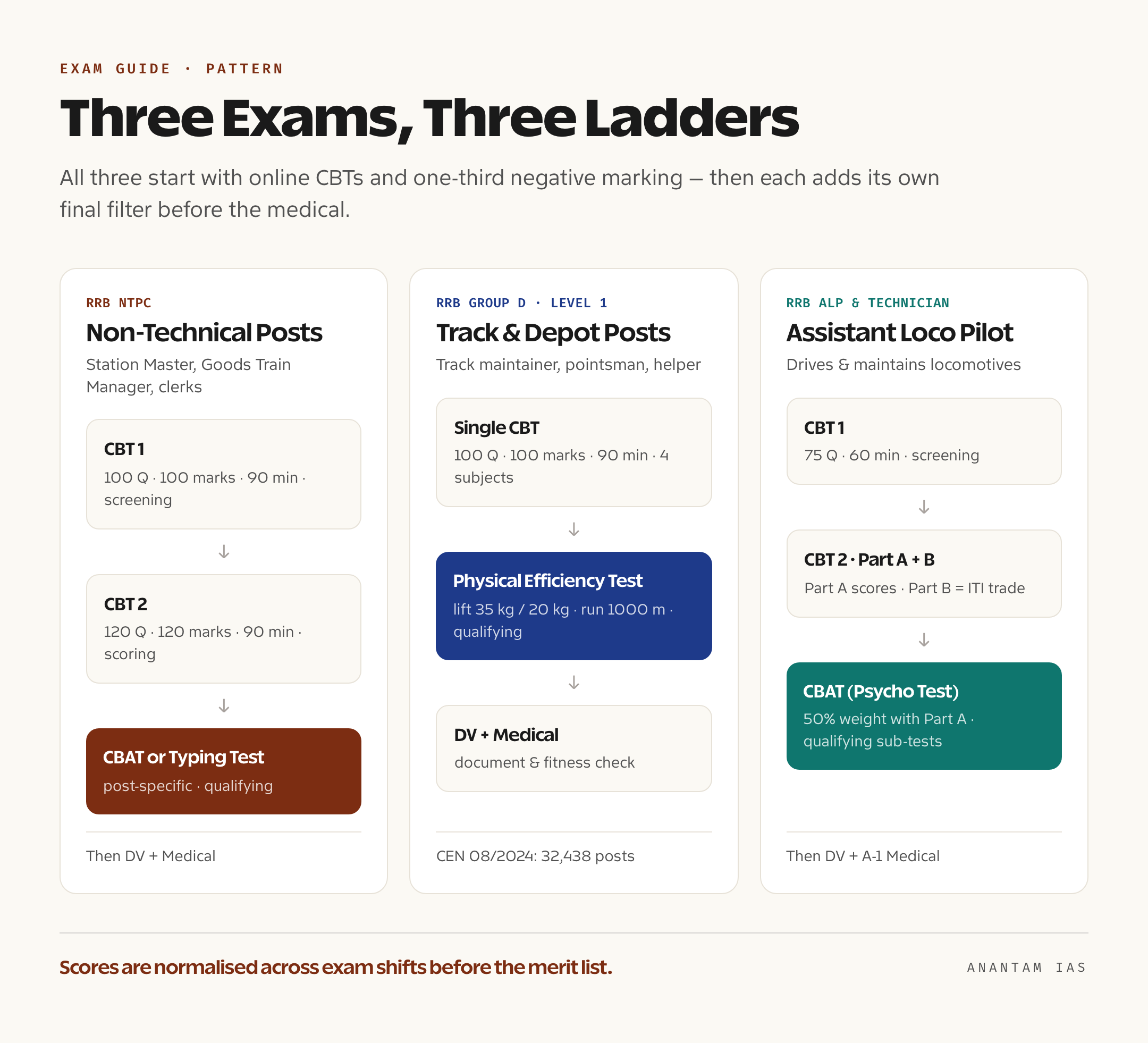
The three exam families share a spine — online Computer-Based Tests with a one-third negative-marking penalty and score normalisation across exam shifts — but each adds its own final filter. Because the CBTs run over many days in multiple shifts, the Railways normalise raw scores statistically so that candidates who got a tougher shift aren’t penalised, and the normalised score, not the raw one, decides the merit list.
RRB NTPC
NTPC runs as a two-stage CBT. CBT 1 is a screening test of 100 questions for 100 marks in 90 minutes, drawn from General Awareness, Mathematics, and General Intelligence & Reasoning, with one-third negative marking. It’s purely a gate — the score doesn’t carry into the final merit, it only shortlists candidates for CBT 2. CBT 2 is the scoring stage: 120 questions for 120 marks in 90 minutes across the same three subjects at a higher difficulty. After CBT 2, the path splits by post — graduate posts like Station Master and Traffic Assistant take a Computer-Based Aptitude Test (CBAT), while clerical and typist posts take a Typing Skill Test, before document verification and the medical.
RRB Group D (Level 1)
Group D is a single CBT followed by a physical test. The CBT has 100 questions for 100 marks in 90 minutes, spread across four subjects — Mathematics, General Intelligence & Reasoning, General Science, and General Awareness & Current Affairs — with the usual one-third negative marking. Candidates who clear the CBT face a Physical Efficiency Test (PET), which is qualifying, not scoring: male candidates must lift and carry 35 kg over 100 metres in two minutes and run 1,000 metres in 4 minutes 15 seconds; female candidates lift 20 kg over 100 metres and run 1,000 metres in 5 minutes 40 seconds. Document verification and a medical fitness test follow.
RRB ALP & Technician
ALP is the most layered of the three. CBT 1 is a 60-minute screening test of 75 questions covering Maths, Reasoning, General Science, and General Awareness. CBT 2 has two parts — Part A (Maths, Reasoning, Basic Science & Engineering) and Part B (the candidate’s specific ITI trade), and only Part A counts toward shortlisting. ALP candidates then sit a Computer-Based Aptitude Test (CBAT), a psychometric battery of memory, perception, concentration, and decision-making tests where you must clear each sub-test. In the current scheme, CBT 2 Part A and the CBAT carry equal 50 per cent weight in the final merit, after which comes document verification and a stringent medical (including the A-1 vision standard, since the job is to drive trains). Compared with the UPSC Civil Services exam, where success rides on descriptive answer-writing and an interview, the RRB exams are fully objective and speed-driven — the cut-offs reward accuracy under a ticking clock.
RRB Railway Exam Eligibility
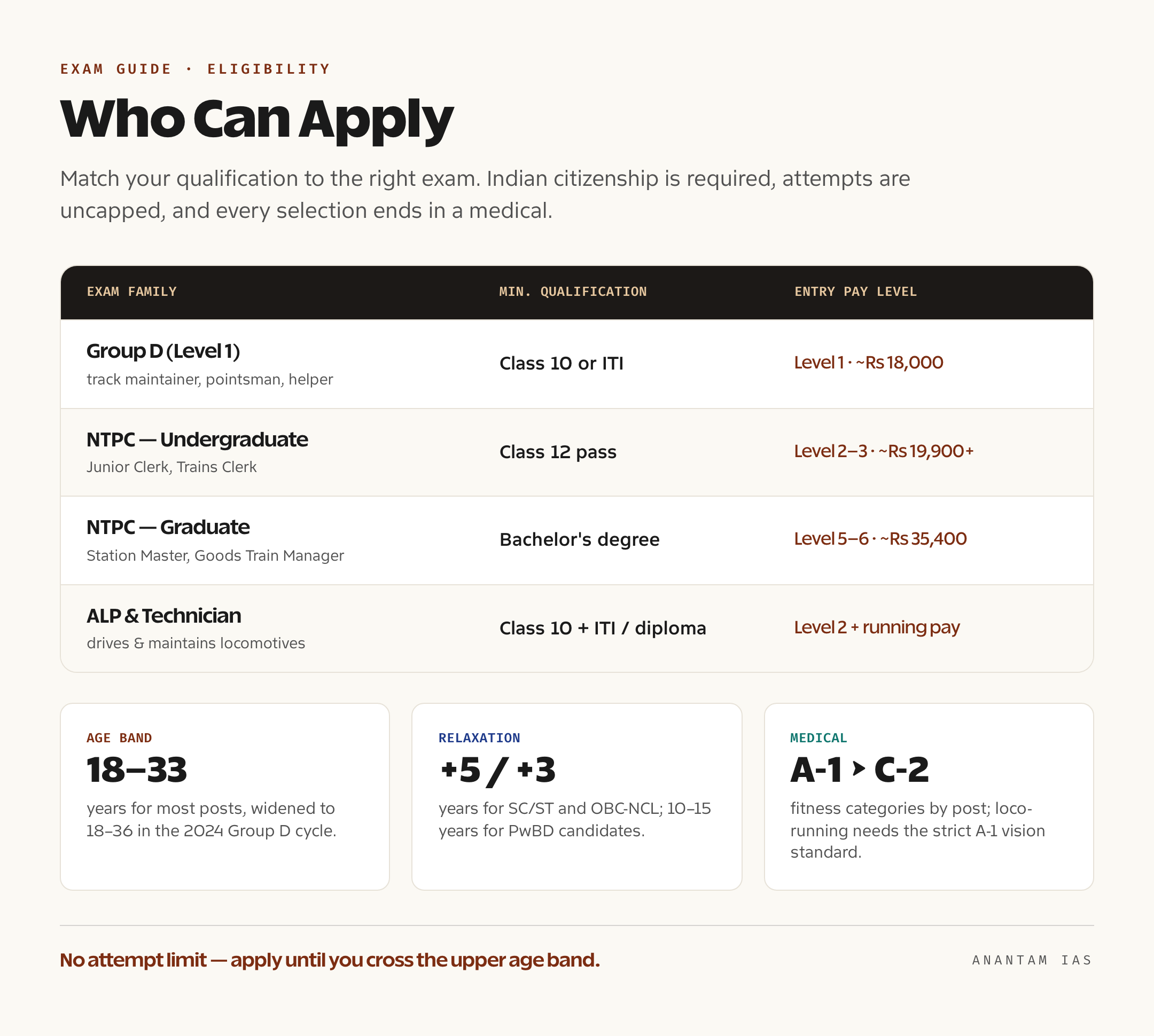
RRB eligibility turns on three things — nationality, age, and your educational qualification — plus a medical fitness category that varies by how safety-critical the post is. The qualification bar is what separates the three exam families, so match your degree or certificate to the right exam before you apply.
You must be an Indian citizen (with a few specified exceptions). The age band is typically 18 to 33 years for most posts, though the Railways have in recent cycles widened it — the 2024 Group D notification ran 18 to 36 to offset the COVID-affected gap years. Reserved categories get the standard relaxation: five years for SC and ST, three years for OBC (non-creamy layer), and ten to fifteen years for persons with benchmark disabilities. On qualification, Group D needs a Class 10 pass or an ITI; the undergraduate NTPC posts need a Class 12 pass; the graduate NTPC posts need a Bachelor’s degree in any discipline; and ALP needs Class 10 plus an ITI in a relevant trade (or an engineering diploma/degree). Every selection ends in a medical, and the Railways grade posts into fitness categories — the standards for an Assistant Loco Pilot or track-side role are far stricter than for a desk clerk, so you can clear the written stage and still be filtered out on medical grounds. Unlike UPSC, the RRBs set no cap on attempts; you can keep applying until you cross the upper age limit.
RRB Railway Syllabus
The good news for anyone targeting more than one RRB exam is that the syllabus overlaps heavily. The same four pillars — Mathematics, General Intelligence & Reasoning, General Awareness & Current Affairs, and General Science — recur across NTPC, Group D, and ALP CBT 1, so one foundation prepares you for all three. What changes is the weighting and, for ALP, the trade paper.
Common CBT Syllabus
Mathematics covers number systems, ratio and proportion, percentages, profit and loss, time and work, time and distance, interest, mensuration, algebra, geometry, and basic trigonometry — school arithmetic done fast and accurately. General Intelligence & Reasoning tests analogies, series, coding-decoding, syllogisms, Venn diagrams, blood relations, and statement-conclusion logic. General Awareness & Current Affairs spans static GK — Indian history, geography, polity, and economy — alongside national and international current events, sports, and awards from the months before the exam. General Science (heavier in Group D and ALP than in NTPC) draws on Class 10-level Physics, Chemistry, and Life Sciences. The split shifts by exam: NTPC leans on General Awareness and Maths, Group D balances all four, and ALP CBT 1 keeps a strong science share.
Post-Specific Layer
ALP adds the part that the others don’t. In CBT 2 Part B, you’re tested on your specific ITI trade — Electrician, Fitter, Mechanic, Electronics, and so on — at the trade-certificate level, and you must qualify it even though only Part A counts for merit. The CBAT then measures aptitude rather than knowledge: memory, following directions, depth perception, concentration, and perceptual speed, each a separate timed test. For NTPC graduate posts, the CBAT works the same way — a qualifying psychometric filter — while clerical posts swap it for a typing test in English or Hindi. There’s no negative marking in these aptitude and skill stages, only a pass-or-fail threshold.
RRB Railway Preparation Strategy
The RRB exams reward a different muscle from the descriptive PSC exams — speed, accuracy, and a wide but shallow general-knowledge net. Here’s the sequence that works across NTPC, Group D, and ALP.
Build One Shared Foundation
Because the four core subjects are common, prepare them once and reuse them. Drill Mathematics from a standard quantitative-aptitude book until the school-level chapters are automatic, and build Reasoning through daily sets of analogies, series, and coding puzzles — these are the most scoring sections because they’re learnable and predictable. If you’re weighing the RRB route against other central jobs, our UPSC vs SSC comparison shows where railway recruitment sits in the wider government-job landscape, and the quant-reasoning base you build here also serves SSC and banking exams.
Layer In Static GK and Current Affairs
General Awareness is where many candidates leak marks, so make it a daily habit. Cover static GK — Indian polity, history, geography, and economy — at the Class 10 level, and read a current-affairs compilation for the six to twelve months before your exam, focusing on national news, sports, awards, and railway-specific updates. A short daily current-affairs note beats a last-month cram.
Don’t Skip General Science
For Group D and ALP especially, General Science carries real weight, so revise Class 9 and 10 NCERT Physics, Chemistry, and Biology. These are fact-dense, high-return chapters — a fortnight of focused NCERT revision can add several marks you’d otherwise concede.
Work Previous Papers and Time Every Mock
The single best preparation is solving previous RRB papers and full-length mock tests under the clock. The exams are won on speed and accuracy, so practise managing 100 questions in 90 minutes, learn when to skip rather than guess into the negative marking, and review every mock to plug weak topics. For ALP aspirants, add CBAT practice sets close to the exam, since the aptitude battery is unlike anything in the CBTs.
For ALP, Prepare the Trade and the Medical Early
If you’re targeting ALP, study your ITI trade syllabus alongside the general subjects — Part B is qualifying but candidates routinely underestimate it. And take the medical seriously from the start: the A-1 vision standard is non-negotiable for loco-running staff, so confirm your eyesight meets it before you invest months in the written prep.
Posts, Salary & Career
The RRB exams open onto a tiered, pensionable career under the 7th Pay Commission, and the pay level tells you exactly where a post sits. Group D / Level 1 posts — track maintainer, pointsman, helper, and assistants — start at Pay Level 1 with a basic pay of around Rs 18,000, the entry rung, with promotion ladders into technician and supervisory grades over time. NTPC undergraduate posts sit at Level 2 (Junior Clerk cum Typist, around Rs 19,900 basic) and Level 3 (Commercial cum Ticket Clerk, around Rs 21,700). NTPC graduate posts climb higher — Level 5 covers Goods Train Manager and Junior Account Assistant at around Rs 29,200 basic, while Level 6 holds the two most sought-after posts, Commercial Apprentice and Station Master, at around Rs 35,400 basic. On top of basic pay come Dearness Allowance, House Rent Allowance, Transport Allowance, and railway perks like travel passes, which lift the in-hand figure substantially.
The Assistant Loco Pilot post sits at Pay Level 2 to begin with, but it carries a strong running-allowance component and a clear promotion path — ALP to Loco Pilot (Goods), then Loco Pilot (Passenger), and on to Loco Pilot (Mail/Express) — which makes it one of the most upwardly mobile technical careers in the Railways. Across all three families, the real draw is the combination of job security, structured promotions, and the prestige of running the national railway network. To see where these railway exams fit among India’s many recruitment tracks, read our overview of the different types of government exams.
Frequently Asked Questions
Which RRB exam is easiest to crack — NTPC, Group D, or ALP?
Group D is generally the most accessible because it needs only a Class 10 pass or ITI and has a single CBT plus a physical test, with no trade paper or aptitude battery. But “easiest” is relative — Group D draws the largest applicant pools (over one crore in the 2024 cycle), so cut-offs stay high. ALP is the most demanding because of its CBT 2 trade paper, the CBAT, and the strict A-1 medical standard.
Is there negative marking in RRB exams?
Yes. All the Computer-Based Tests in NTPC, Group D, and ALP carry a penalty of one-third of a mark for each wrong answer, so reckless guessing costs you. The aptitude and skill stages — the CBAT, the Typing Skill Test, and the Physical Efficiency Test — are qualifying only, with no negative marking, just a pass-or-fail threshold.
Why are RRB scores “normalised”?
Because the CBTs run across many days and shifts, the difficulty of papers varies slightly between sittings. The Railways apply a statistical normalisation formula so that candidates who happened to get a harder shift aren’t disadvantaged, and the final merit list and cut-offs are built on these normalised scores, not the raw marks you see on your response sheet.
Can a graduate apply for RRB Group D?
Yes — Group D only sets a minimum qualification of Class 10 or ITI, so a graduate is eligible and many apply for the job security. The trade-off is that the pay starts at Level 1 (around Rs 18,000 basic), the lowest railway grade, so a graduate is usually better served targeting the graduate-level NTPC posts like Station Master or Goods Train Manager that pay considerably more.
Tell Google you want more of this.
Add Anantam IAS as a preferred sourceOne tap, and this site shows up more often in your own Top Stories, AI Overviews and AI Mode. Remove it any time.