The SAARC Visa Exemption Scheme grants visa-free travel to a set of designated dignitaries and professionals — not ordinary tourists — among the eight SAARC countries. Introduced at the 1992 Dhaka Summit, it issues a special SAARC visa sticker to eligible categories; it is nothing like the Schengen system, since member states keep full control of their borders and there is no common SAARC visa.
The South Asian Association for Regional Cooperation (SAARC) is the primary regional bloc of South Asia, comprising eight member states. While the grouping aspires to economic integration and people-to-people contact, visa regimes across the region remain among the most restrictive in the world. The SAARC Visa Exemption Scheme was conceived to ease travel for specific professional categories, yet its scope and impact remain limited compared to arrangements like the European Schengen system. Understanding the SAARC visa framework is essential for UPSC aspirants studying India’s neighbourhood policy and regional diplomacy.
SAARC — A Quick Overview
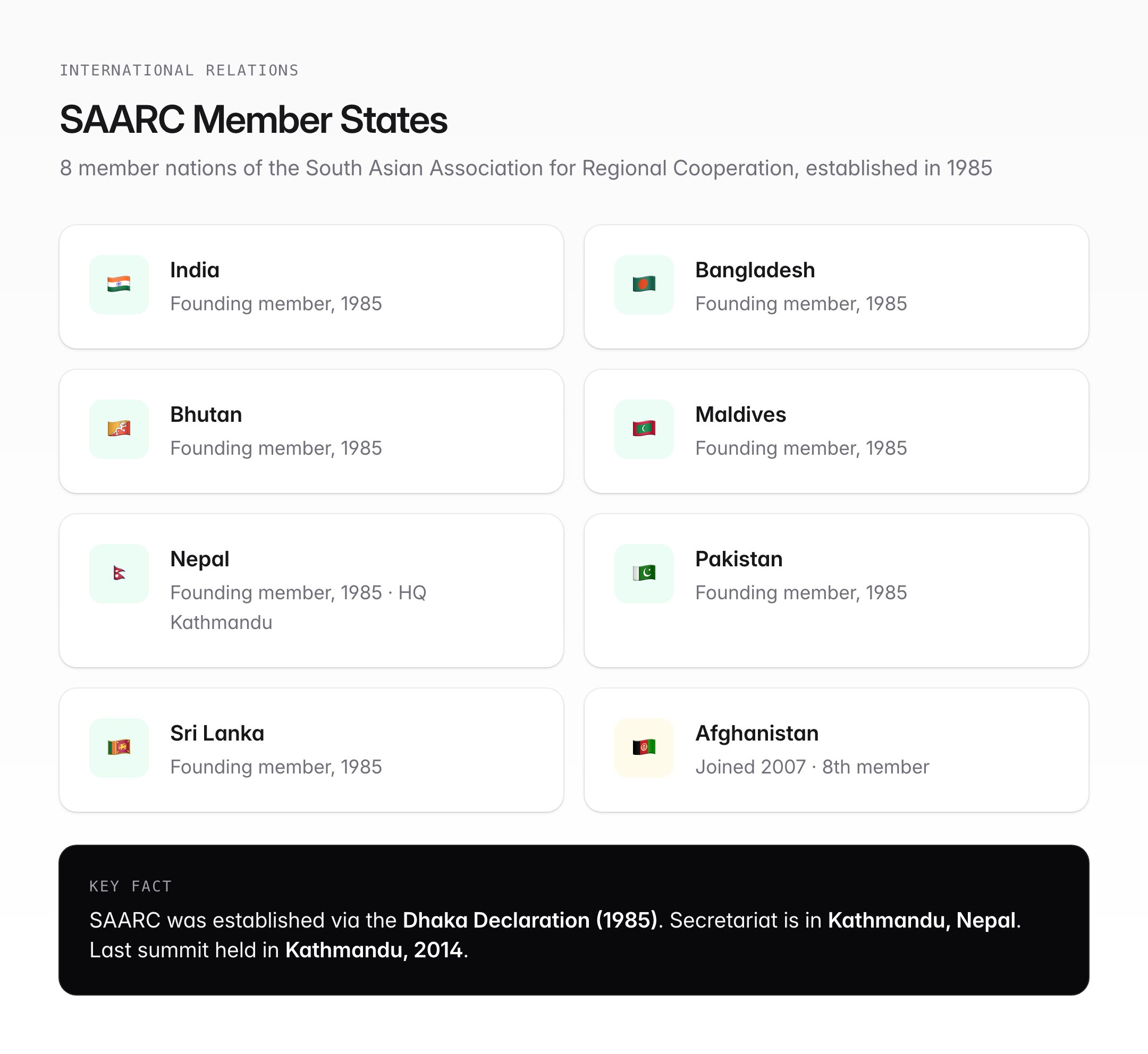
SAARC was established in 1985 through the Dhaka Declaration, with its secretariat located in Kathmandu, Nepal. The eight member states are:
| # | Member State | Year of Joining |
|---|---|---|
| 1 | Bangladesh | 1985 (founding) |
| 2 | Bhutan | 1985 (founding) |
| 3 | India | 1985 (founding) |
| 4 | Maldives | 1985 (founding) |
| 5 | Nepal | 1985 (founding) |
| 6 | Pakistan | 1985 (founding) |
| 7 | Sri Lanka | 1985 (founding) |
| 8 | Afghanistan | 2007 |
SAARC also has nine observer states, including China, the United States, Japan, and the European Union.
The SAARC Visa Exemption Scheme
The SAARC Visa Exemption Scheme was introduced in 1992 at the Dhaka Summit and operationalised subsequently. Unlike a general free-movement arrangement, the scheme provides visa-free or visa-on-arrival travel only to specific categories of travellers among SAARC nations.
Eligible Categories
The scheme originally covered 22 categories of travellers, which include:
- Dignitaries — Heads of state, parliamentarians, judges of superior courts
- Diplomats and officials on duty
- SAARC Secretariat staff and representatives of recognised SAARC bodies
- Journalists accredited by their governments
- Sportspersons participating in SAARC events
- Academics, researchers, and university faculty
- Medical professionals attending conferences
- Business persons attending SAARC Chamber of Commerce events
- Cultural performers and artists participating in SAARC cultural events
The scheme does not cover ordinary tourists or general business travellers. This narrow scope is a key limitation.
How It Works
Eligible travellers receive a special SAARC visa sticker that is affixed to their passport. The sticker allows multiple entries into SAARC countries for a defined period, typically aligned with the duration of the specific event or assignment.
India's Bilateral Visa Regimes with SAARC Neighbours
Given the limitations of the multilateral scheme, India has developed separate bilateral visa arrangements with each neighbour. These vary significantly:
| Country | Visa Regime for Indian Citizens | Key Features |
|---|---|---|
| Nepal | Visa-free | Open border; Indians can enter with any government-issued photo ID |
| Bhutan | Permit-based (no visa) | Indians need a permit obtainable at entry points; no visa fee |
| Sri Lanka | Visa required (ETA available) | Electronic Travel Authorisation (ETA) system; tourist visa on arrival |
| Maldives | Visa on arrival (30 days) | Free tourist visa on arrival for all nationalities |
| Bangladesh | Visa required | Bilateral visa agreement; e-visa facility available |
| Pakistan | Visa required (highly restricted) | Strict bilateral visa regime; limited categories; city-specific endorsements |
| Afghanistan | Visa required | e-Visa introduced; limited consular access due to security situation |
The India-Nepal open border arrangement, rooted in the 1950 Treaty of Peace and Friendship, remains the most liberal bilateral movement regime in South Asia.
Limitations of the SAARC Visa Scheme
Despite its good intentions, the scheme suffers from several structural weaknesses:
- Narrow coverage — Only designated professional categories benefit; ordinary citizens see no change.
- India-Pakistan tensions — Bilateral disputes have repeatedly stalled broader SAARC integration. The last SAARC summit was held in 2014 in Kathmandu; the 2016 Islamabad summit was boycotted by India and five other members after the Uri attack.
- No common visa — Unlike the Schengen zone, there is no single SAARC visa that permits unrestricted movement.
- Implementation gaps — Member states retain full sovereign control over immigration policy; the scheme is advisory, not binding.
- Security concerns — Cross-border terrorism, illegal migration, and trafficking concerns limit political will for liberalisation.
Comparison with the Schengen Visa System
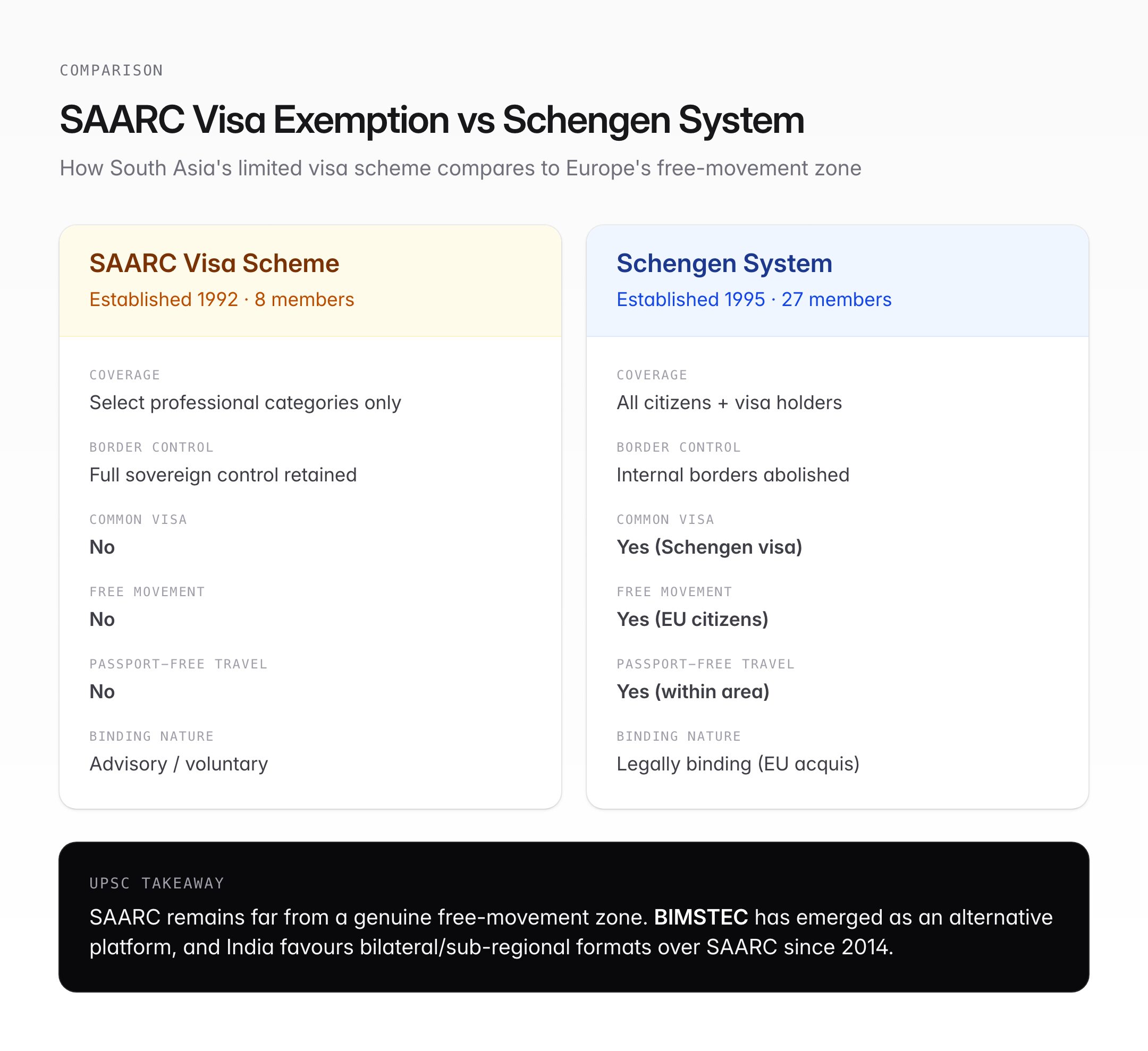
| Feature | SAARC Visa Exemption Scheme | Schengen Visa System |
|---|---|---|
| Established | 1992 | 1995 |
| Member states | 8 | 27 (Schengen Area) |
| Coverage | Select professional categories only | All citizens of member states + visa holders |
| Border control | Full sovereign control retained | Internal borders abolished |
| Common visa | No | Yes (Schengen visa for third-country nationals) |
| Free movement of persons | No | Yes (EU citizens) |
| Binding nature | Advisory/voluntary | Legally binding (EU acquis) |
| Passport-free travel | No | Yes (within Schengen Area) |
The comparison underscores how far SAARC remains from a genuine free-movement zone. The BIMSTEC (Bay of Bengal Initiative for Multi-Sectoral Technical and Economic Cooperation) grouping has emerged as an alternative platform, though it too lacks a visa liberalisation component.
Recent Developments
- SAARC stagnation — Since 2014, no SAARC summit has been held, effectively freezing multilateral progress.
- Sub-regional alternatives — India has increasingly favoured BIMSTEC and bilateral/trilateral formats (India-Bangladesh-Myanmar, India-Nepal-Bhutan) over SAARC.
- Digital visa initiatives — India has expanded its e-Visa facility to citizens of most SAARC nations (except Pakistan), easing procedural hurdles.
- Motor vehicles agreements — The BBIN (Bangladesh, Bhutan, India, Nepal) Motor Vehicles Agreement (2015) aims to facilitate cross-border road transport, a step toward greater connectivity.
UPSC Relevance
GS Paper II — International Relations: India and its neighbourhood; regional groupings; bilateral agreements.
GS Paper II — Governance: Visa and immigration policy; border management.
Prelims key facts:
- SAARC was established in 1985 with its secretariat in Kathmandu.
- Afghanistan joined SAARC in 2007 (8th member).
- The SAARC Visa Exemption Scheme (1992) covers only designated professional categories, not general tourists.
- India has an open border with Nepal under the 1950 Treaty.
- The last SAARC summit was in Kathmandu, 2014.
- The Schengen Area abolishes internal border controls — SAARC does not.
- BIMSTEC is increasingly seen as an alternative to SAARC for regional cooperation.
- The BBIN Motor Vehicles Agreement was signed in 2015 to improve land connectivity among Bangladesh, Bhutan, India, and Nepal.
Tell Google you want more of this.
Add Anantam IAS as a preferred sourceOne tap, and this site shows up more often in your own Top Stories, AI Overviews and AI Mode. Remove it any time.