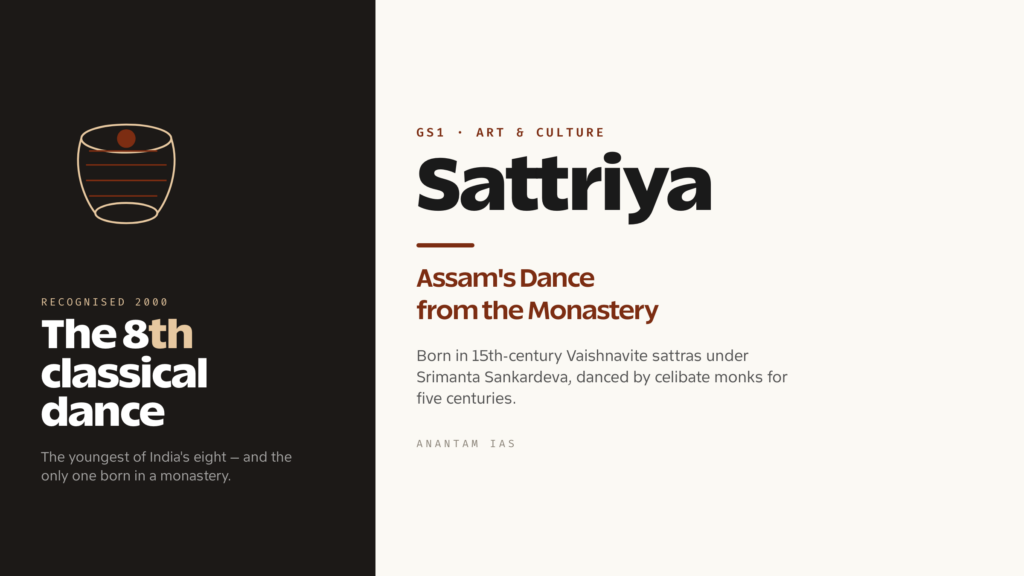
Most of India’s classical dances grew up in temples or royal courts. Sattriya grew up in a monastery — and stayed there, almost in secret, for nearly five hundred years. It is the classical dance of Assam, and the Sangeet Natak Akademi recognised it only in November 2000, which makes it the youngest member of the family by a wide margin. For most of its life it was not performed for an audience at all. It was offered, by celibate monks, as a form of prayer.
That single fact changes how you should read everything else about it. Sattriya is the only Indian classical dance with a fully monastic origin, and the only one that survived not through patronage but through faith. For a UPSC aspirant it sits squarely in GS Paper I — art and culture, the Bhakti movement, and the cultural geography of the Northeast — but its real value is as a case study in how a living tradition can hide in plain sight for centuries and then walk out onto a national stage almost intact.
What Sattriya Dance Is
Sattriya is a devotional dance form that fuses three things the old texts kept separate: pure rhythmic dance, expressive storytelling through the body, and full-blown dance-drama. So a Sattriya performance can be a few minutes of crisp footwork, or it can be a night-long enactment of an episode from Krishna’s life with costumed characters, narration and a live drum ensemble. The name comes from the sattra — the Vaishnavite monastery — because that is where the form lived and was taught.
The subject matter is almost entirely devotional. Sattriya draws on the life of Krishna, episodes from the Bhagavata Purana, the Ramayana and Mahabharata, and above all on the writings of Assam’s own saint-poets. And because it was built to teach religion to ordinary villagers, it leans on direct, legible storytelling rather than abstraction. The dance follows the grammar of Bharata Muni’s Natya Shastra — the ancient Sanskrit treatise on performance — using codified hand gestures, footwork and postures, but it filters all of that through a distinctly Assamese sensibility. The result looks unmistakably classical and yet unlike any other form on the list.
Origins and Evolution
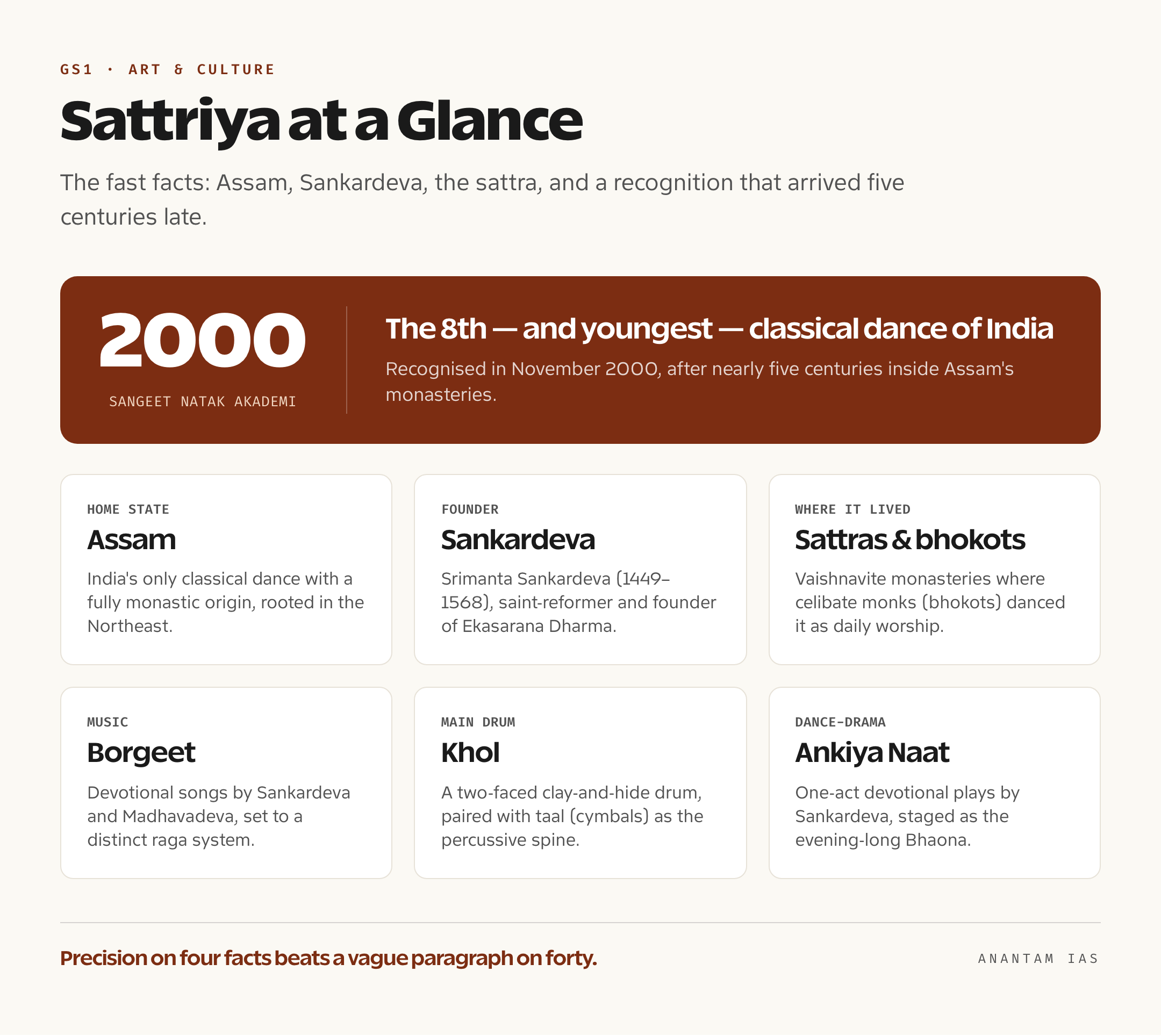
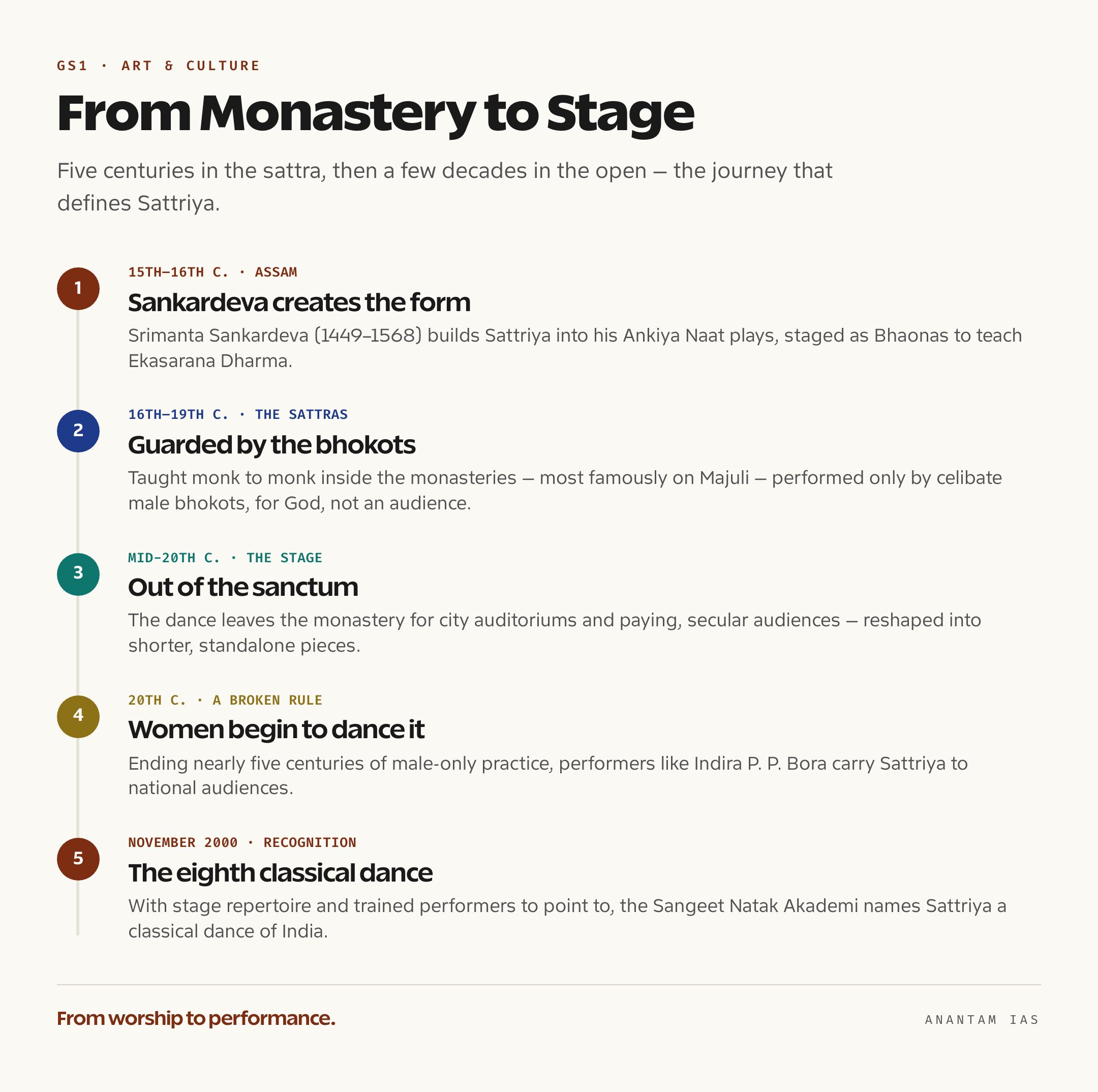
Sattriya was created in the 15th and 16th centuries by Srimanta Sankardeva (1449-1568), the saint-reformer who reshaped Assamese religious and cultural life. Sankardeva was the founder of Ekasarana Dharma — literally “shelter in one” — a monotheistic strand of the wider Bhakti movement that asked devotees to surrender to a single God, Krishna, through chanting his name. He distrusted ritual hierarchy and caste exclusion, and he wanted a way to carry his message to people who could not read Sanskrit. So he turned to performance.
His chief vehicle was the Ankiya Naat — one-act devotional plays he wrote himself, staged as an evening-long event called a Bhaona. Sattriya dance grew up as part of these Bhaonas: the movement, music and gesture that carried the story. Sankardeva’s principal disciple, Madhavadeva, extended the repertoire and co-authored much of the devotional song that still accompanies the dance. From the start, then, this was not court entertainment. It was a sermon you could watch.
The form was nurtured for centuries inside the sattras, the monasteries Sankardeva and his followers established across Assam — most famously on Majuli, the great river island in the Brahmaputra. Inside the sattra, the dance was performed by bhokots, the celibate male monks, as part of daily worship and festival ritual. It was, in the most literal sense, a closed tradition: taught monk to monk, generation to generation, performed for God rather than for ticket-buyers, and for most of its history danced only by men. That insulation is exactly why it survived in such pure form — and also why, until the 20th century, almost no one outside Assam had heard of it.
Distinctive Features
What makes Sattriya recognisable starts in the body. The basic training unit is the mati akhara — literally “floor exercises,” a set of sixty-four foundational movements that a student drills before anything else. These are grouped into named categories such as Ora, Saata, Jhalak, Sitika, Pak, Jap, Lon and Khar, and they build the stance, balance and rhythmic precision the form demands. The posture is upright and squared, the footwork firm and grounded, and the spins and entries follow set patterns. Anyone who has watched Bharatanatyam or Kathak will spot the difference at once: Sattriya’s hand gestures and foot movements are its own, even though they trace back to the same Natya Shastra root.
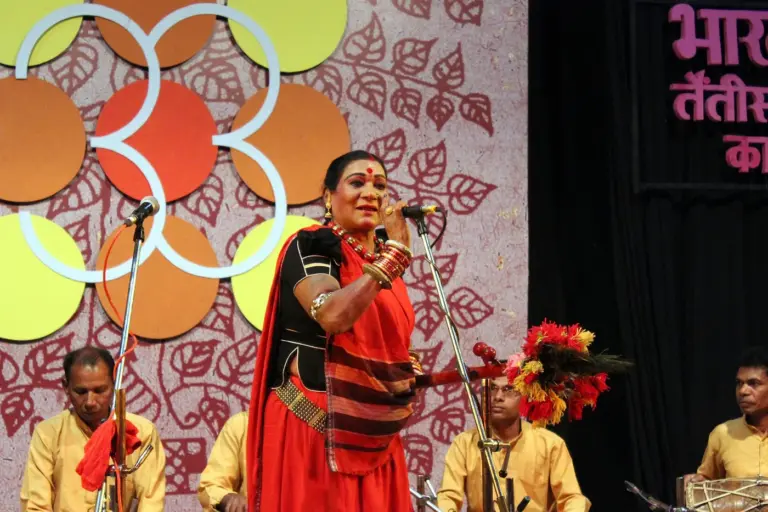
The music is where Sattriya becomes most clearly Assamese. Its core songs are the Borgeet — devotional compositions written by Sankardeva and Madhavadeva, set to a system of ragas that runs parallel to Hindustani classical music but keeps its own distinct character. The rhythm is held by the khol, a two-faced clay-and-hide drum whose two heads produce sharply different pitches, paired with taal (cymbals). The interplay of khol and taal is the percussive spine of the whole form, and an experienced player can shape an entire performance with it. Flute supports the melody; harmonium and violin are later additions from the stage era.
The costume is woven, quite literally, from Assam. Dancers wear the state’s traditional pat silk and muga silk, the golden muga being unique to the region. Women dance in the three-piece set of the mekhela, chadar and ghuri; men wear the dhoti, chadar and a paguri turban. The jewellery — the kopali forehead piece, the gaam kharu and muthi kharu bangles, the dholbiri and lokaparo — follows old Assamese goldsmithing patterns. Put together, the look is restrained and devotional rather than ornate, in keeping with a dance that began as worship.
Repertoire and Exponents
The Sattriya repertoire spans the intimate solo and the epic ensemble. At one end sit the short, named dance numbers — cholis and nritya pieces such as the Chali Nritya, Rajagharia Chali and Apsara Nritya — that a single dancer performs. At the other end is the Bhaona, the full dance-drama in which costumed performers enact an Ankiya Naat from start to finish. Between them lie distinctive ensemble forms: the Gayan-Bayan, a powerful orchestral prelude performed by male singers and drummers, and Ojapali, a choral storytelling tradition that blends song, narration and rhythmic movement. Thematic solos like the Krishna Bhangi and Nadu Bhangi round out what a stage dancer might present today.
The form’s modern face was built by a handful of teachers and performers who carried it out of the sattra. The most decorated is Jatin Goswami (born 1933), founder-director of the Sattriya Akademi in Guwahati, who won the Sangeet Natak Akademi Award in 2004, the Padma Shri in 2008, and — a marker of how far the form has risen — the Padma Bhushan in 2025. Among the women who broke the old male-only rule and pushed Sattriya onto the national stage, Indira P. P. Bora stands out, with a Sangeet Natak Akademi Award in 1996 and the Padma Shri in 2020. Sattras themselves produced master practitioners such as Ghanakanta Bora Barbayan, also a Padma Shri awardee, while a younger generation — Sharodi Saikia, Anita Sharma, Anwesha Mahanta, Mallika Kandali and others — now performs and teaches across India and abroad.
Where Sattriya Stands Today
The defining shift came in the second half of the 20th century, when Sattriya moved from the sanctum of the sattra to the metropolitan stage. Two changes mattered most. First, the dance left the monastery and was performed before paying, secular audiences in city auditoriums — which forced it to be shaped into shorter, standalone pieces a non-devotee could follow. Second, and just as significant, women began to learn and perform it, ending nearly five centuries in which only celibate monks had danced it. That opening up is what made the 2000 recognition possible: by then Sattriya had a body of stage repertoire and a roster of trained performers to point to.
Recognition has brought attention but not safety. The sattras that kept the form alive are concentrated on Majuli, the world’s largest inhabited river island, and Majuli is shrinking — the Brahmaputra erodes its banks every monsoon, and many of the island’s historic sattras have already disappeared or shifted to the mainland. Majuli has sat on the UNESCO World Heritage tentative list since 2004 without final inscription, and the question of how to protect a living monastic culture, not just its buildings, remains open. The wider risks are familiar to any traditional art: ageing gurus, the pull of commercial entertainment, and the gap between a few celebrated stage stars and the under-funded sattras where the tradition is actually transmitted. Sattriya today is recognised, performed internationally through bodies like the ICCR, and taught in dedicated academies — and still, at its source, more fragile than its classical status suggests.
For Your Mains Answer
Sattriya is a clean fit for GS Paper I — “salient aspects of Art Forms… from ancient to modern times” — and doubles as evidence in answers on the Bhakti movement, the cultural integration of the Northeast, and the role of saint-reformers in social change. The smart move is to use Sattriya not as a stand-alone fact-dump but as the concrete example that lets you make a larger argument: how religious reform produced enduring art, or how a regional tradition entered the national canon.
How to Build the Answer
Open with what makes Sattriya distinctive — its monastic, devotional origin under Sankardeva — rather than with a definition. Then move outward: the sattra system and the bhokots, the form’s features (Borgeet, khol, mati akhara), its 20th-century journey to the stage and the entry of women, and finally its 2000 recognition and present-day fragility. That arc — origin, system, features, transformation, status — answers almost any Sattriya question and lets you show range.
Common Mistakes to Avoid
Don’t confuse Sattriya with the folk dances of Assam like Bihu — examiners test exactly this. Don’t date its recognition to the 15th century; the form is old but its classical status came only in 2000. Don’t forget the religious frame: Sattriya without the Ekasarana Dharma and the Bhakti context is just a costume list. And don’t overstate UNESCO — Majuli is on the tentative list, not yet inscribed.
A Compact Answer Spine
Devotional dance of Assam, born in 15th-16th-century sattras → created by Sankardeva as part of Ekasarana Dharma and the Ankiya Naat / Bhaona → preserved by celibate bhokots for centuries → features: Borgeet music, khol and taal, mati akhara, Natya Shastra grammar, muga-silk costume → moved to the secular stage in the 20th century, women admitted → recognised by the Sangeet Natak Akademi in 2000 as the eighth classical dance → today celebrated yet threatened by Majuli’s erosion.
Diagram or Flowchart Idea
Draw a simple two-stage flow: a box marked “Sattra / Monastery (15th-20th c.): bhokots, ritual, men only” with an arrow to a box marked “Secular Stage (20th c. onward): public audiences, women, 2000 recognition.” A single arrow labelled “from worship to performance” captures the form’s whole story and earns marks fast.
A Balanced-Conclusion Line
Close on the tension between status and survival: Sattriya has won its place among India’s classical dances, but its future depends less on that recognition than on protecting the living sattras of Majuli where it is actually passed on.
How to Use Data Without Cramming
You need only a few anchors: the 2000 Sangeet Natak Akademi recognition, Sankardeva’s dates (1449-1568), the eight classical dances, and Majuli’s tentative-list status since 2004. Drop the right name — Sankardeva, Madhavadeva, the Borgeet, the khol — rather than reciting every costume part. Precision on four facts beats a vague paragraph on forty.
FAQ
Why was Sattriya recognised as a classical dance so late? Because it spent nearly five centuries inside Assam’s Vaishnavite monasteries, performed by monks as worship rather than as public entertainment. It only reached city stages and gained a body of trained secular performers in the second half of the 20th century, which is why the Sangeet Natak Akademi recognised it as a classical dance only in November 2000 — the most recent addition to the eight.
Who created Sattriya dance and why? The saint-reformer Srimanta Sankardeva (1449-1568) created it in 15th-16th-century Assam as part of his Ekasarana Dharma, a monotheistic strand of the Bhakti movement. He used dance-dramas called Ankiya Naat, staged as Bhaonas, to teach Krishna devotion to ordinary people who could not read Sanskrit.
What music and instruments does Sattriya use? The core songs are the Borgeet, devotional compositions by Sankardeva and Madhavadeva set to a distinct raga system. Rhythm comes from the khol — a two-faced clay drum — paired with taal (cymbals), with flute, and later harmonium and violin, supporting the melody.
Was Sattriya always performed by women? No. For most of its history it was danced only by celibate male monks (bhokots) inside the sattras. Women began learning and performing it only after the form moved to the secular stage in the 20th century, with figures like Indira P. P. Bora helping bring it to national audiences.
Practice Questions
Prelims MCQs
- With reference to Sattriya dance, consider the following: it is the classical dance of which state and was created by which saint-reformer?
(a) Manipur; Madhavadeva
(b) Assam; Srimanta Sankardeva
(c) Odisha; Chaitanya Mahaprabhu
(d) West Bengal; Ramakrishna.
Answer: (b) Sattriya is Assam’s classical dance, created by Srimanta Sankardeva in the 15th-16th century. - The Sangeet Natak Akademi recognised Sattriya as a classical dance of India in which year?
(a) 1958
(b) 1975
(c) 2000
(d) 2014.
Answer: (c) It was recognised in November 2000, making it the youngest of the eight classical dances. - The “sattras” associated with Sattriya dance are best described as:
(a) royal courts of the Ahom kings
(b) Vaishnavite monasteries of Assam
(c) Buddhist learning centres
(d) Shakta temples.
Answer: (b) Sattras are Vaishnavite monasteries established by Sankardeva and his followers, where the dance was preserved. - The Ankiya Naat, central to the Sattriya tradition, refers to:
(a) a system of hand gestures
(b) one-act devotional plays staged as Bhaona
(c) a type of silk costume
(d) a raga used in Borgeet.
Answer: (b) Ankiya Naat are the one-act plays written by Sankardeva, performed as evening-long Bhaonas. - Which of the following are correctly associated with Sattriya dance? 1. Borgeet 2. Khol 3. Mati akhara. Select the correct answer:
(a) 1 and 2 only
(b) 2 and 3 only
(c) 1 and 3 only
(d) 1, 2 and 3.
Answer: (d) Borgeet (songs), the khol (drum) and the mati akhara (foundational exercises) are all integral to Sattriya.
Mains Practice Questions
- Trace the evolution of Sattriya dance from its monastic origins to its recognition as a classical dance of India, and assess what this journey reveals about the survival of regional art forms. (15 marks, 250 words)
- “Sattriya is the clearest expression of the Bhakti movement in eastern India.” Examine this statement with reference to Srimanta Sankardeva and the Ekasarana Dharma. (15 marks, 250 words)
- Discuss the distinctive features of Sattriya dance and explain how it differs from the other classical dance forms of India. (10 marks, 150 words)
- The sattras of Majuli are central to the transmission of Sattriya, yet they face existential threats. Discuss the challenges to preserving Sattriya and suggest measures for its conservation. (15 marks, 250 words)
- Analyse the role of saint-reformers in shaping India’s regional cultural traditions, using Sattriya dance as a case study. (10 marks, 150 words)
Tell Google you want more of this.
Add Anantam IAS as a preferred sourceOne tap, and this site shows up more often in your own Top Stories, AI Overviews and AI Mode. Remove it any time.