Disclosure: this guide contains Amazon affiliate links. As an Amazon Associate, Anantam IAS earns from qualifying purchases — at no extra cost to you.
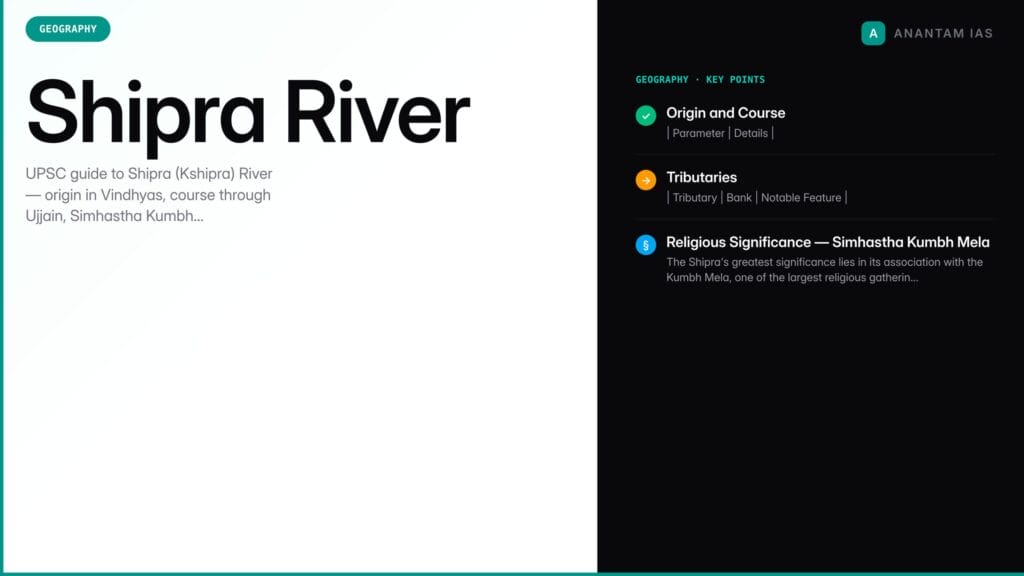
The Shipra River (also spelled Kshipra or Sipra) is a historically and religiously significant river in Madhya Pradesh that rises in the Vindhya Range near Indore and flows northward through the ancient city of Ujjain before joining the Chambal River. Though relatively short (~195 km), the Shipra holds extraordinary cultural importance as one of the four sites of the Kumbh Mela (known as Simhastha when held at Ujjain). The river’s ecological degradation and the ambitious Narmada-Kshipra Link Project make it a relevant topic for UPSC Prelims and GS Paper I (Geography) and GS Paper III (Environment).
Origin and Course
| Parameter | Details |
|---|---|
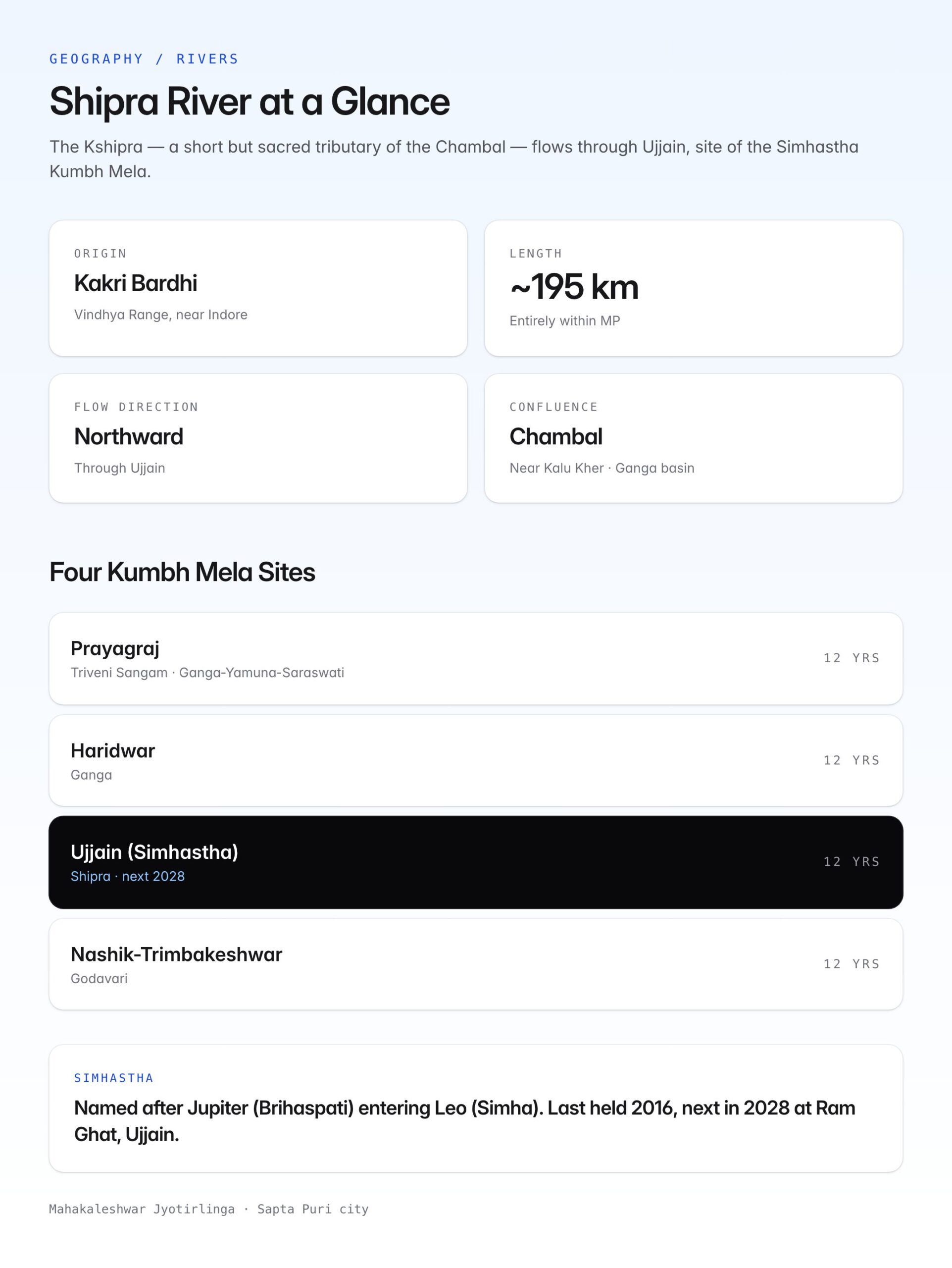
| Origin | Kakri Bardhi hills, near the village of Upper Kakri, Vindhya Range, about 15 km south of Indore, MP |
| Alternative source claim | Some accounts trace the origin to Dhar district near Mhow |
| Length | ~195 km |
| Flow Direction | Generally northward |
| Major City | Ujjain — one of the seven sacred cities (Sapta Puri) of Hinduism |
| Confluence | Joins the Chambal River near Kalu Kher village (Chambal is a tributary of the Yamuna) |
| River Basin | Part of the Chambal sub-basin within the larger Ganga basin |
| States | Flows entirely within Madhya Pradesh |
The Shipra is a right-bank tributary of the Chambal. Its drainage basin covers parts of Indore, Ujjain, Dewas, and Ratlam districts.

Oxford Student Atlas for India — 7th Edition
- 160 pages, Oxford University Press, the current edition
- India-focused thematic maps: physical, political, rivers, climate, soils, vegetation, plus world maps
- Made for UPSC and state PSC map work; slim enough to stay open beside the textbook
Tributaries
| Tributary | Bank | Notable Feature |
|---|---|---|
| Khan River | Left | Flows through Indore city; heavily polluted |
| Gambhir River | Right | Joins near Ujjain |
| Kshepra (Chhoti Shipra) | Right | Small seasonal stream |
The Khan River, a tributary that merges with the Shipra near Ujjain, carries significant urban and industrial effluents from Indore, contributing to the Shipra's pollution load.
Religious Significance — Simhastha Kumbh Mela
The Shipra's greatest significance lies in its association with the Kumbh Mela, one of the largest religious gatherings in the world. The Kumbh Mela is held at four sacred river locations in a 12-year cycle:
| Site | River | Frequency |
|---|---|---|
| Prayagraj (Allahabad) | Triveni Sangam (Ganga-Yamuna-Saraswati) | Every 12 years |
| Haridwar | Ganga | Every 12 years |
| Ujjain | Shipra | Every 12 years |
| Nashik-Trimbakeshwar | Godavari | Every 12 years |
At Ujjain, the Kumbh Mela is called Simhastha because it is held when Jupiter (Brihaspati) is in the zodiac sign of Leo (Simha). The last Simhastha was held in 2016, and the next is expected in 2028.
During the Simhastha, millions of devotees take a sacred dip (snan) in the Shipra at Ram Ghat, the principal bathing ghat in Ujjain. The Simhastha is also a major event for the Naga Sadhus and Akharas of Hinduism.
Ujjain — The City on the Shipra
Ujjain (ancient name: Ujjayini or Avantika) is one of the seven sacred cities (Sapta Puri) and one of the four Dhams in some traditions. Its significance includes:
- Mahakaleshwar Jyotirlinga — one of the twelve Jyotirlingas of Lord Shiva.
- Tropic of Cancer passes near Ujjain; historically, Indian astronomers used Ujjain as the prime meridian for calculations.
- Vikramaditya — the legendary king associated with the Vikram Samvat calendar (started 57 BCE) ruled from Ujjain.
- Ashoka served as governor of Ujjain before becoming emperor of the Mauryan Empire.
- Ujjain was the capital of the Avanti Mahajanapada (one of the sixteen Mahajanapadas).
Pollution Issues
The Shipra has faced severe environmental degradation:
| Issue | Details |
|---|---|
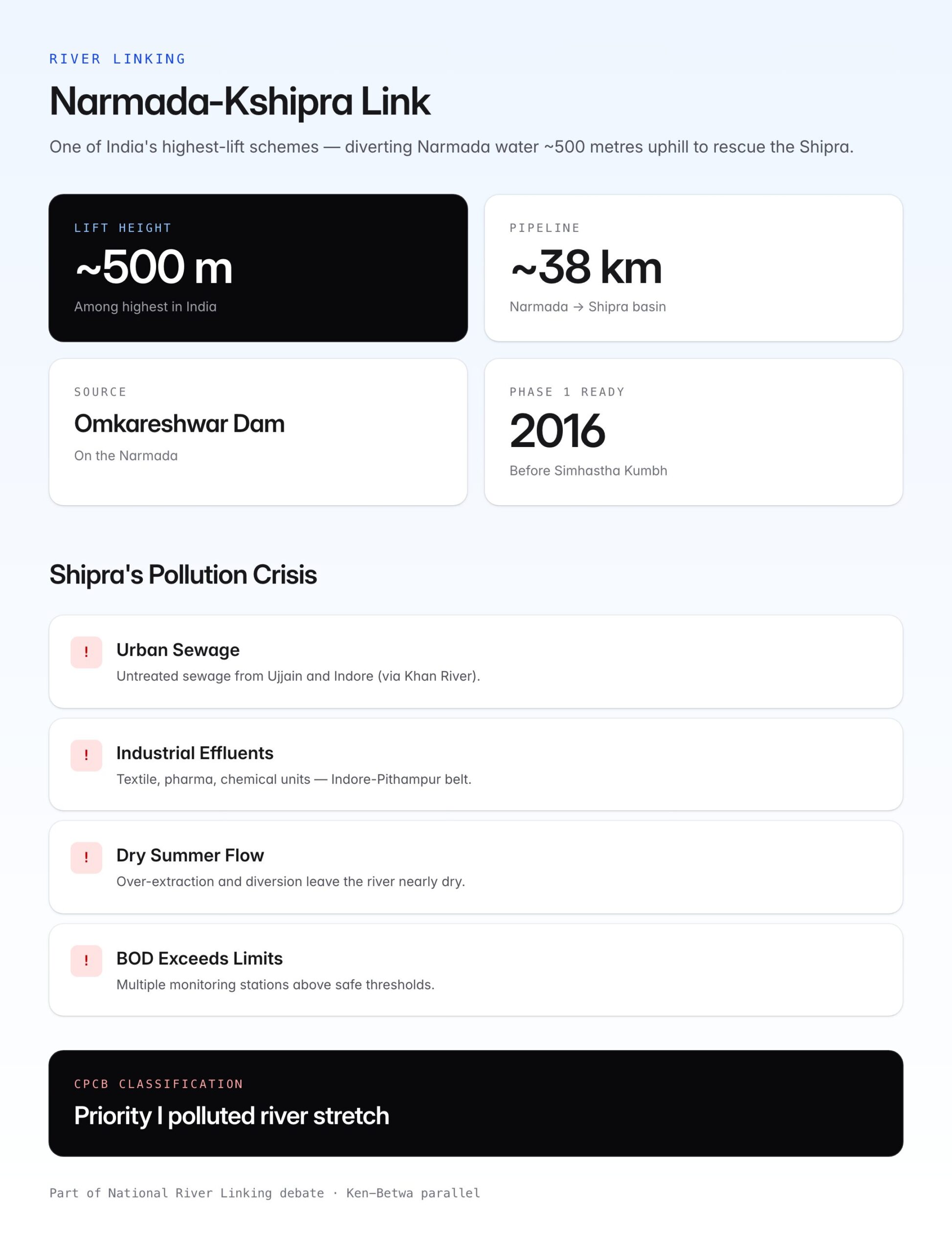
| Urban sewage | Untreated sewage from Ujjain and Indore (via Khan River) |
| Industrial effluents | Textile, pharmaceutical, and chemical industries in the Indore-Pithampur industrial belt |
| Reduced flow | The river runs nearly dry in summer due to over-extraction of groundwater and diversion |
| Biological Oxygen Demand (BOD) | Exceeds safe limits at multiple monitoring stations |
| Religious waste | Immersion of idols, flowers, and ritual materials at ghats |
The Central Pollution Control Board (CPCB) has classified several stretches of the Shipra as "Priority I" polluted river stretches.
Narmada-Kshipra Link Project
To address the Shipra's water crisis — particularly the embarrassment of a nearly dry river during the Simhastha — the Madhya Pradesh government executed the Narmada-Kshipra Link Project:
| Parameter | Details |
|---|---|
| Concept | Lift water from the Narmada River and transfer it to the Shipra via a canal and pipeline system |
| Source | Omkareshwar Dam on the Narmada River |
| Route | ~38 km pipeline from Narmada to the Shipra basin |
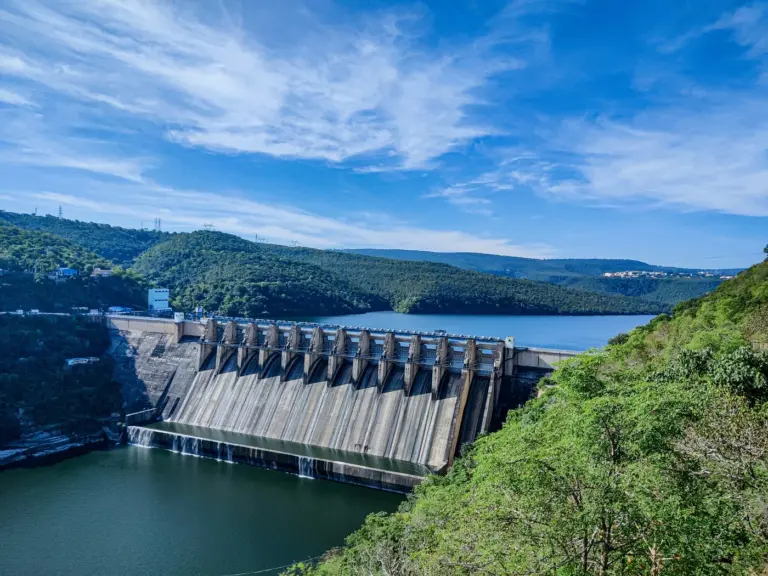
| Lift Height | Water lifted approximately 500 metres — one of the highest lift schemes in India |
| Completion | First phase operational before Simhastha 2016 |
| Purpose | Augment Shipra's flow; recharge groundwater; ensure water for Kumbh |
| Controversy | Environmentalists argued it is an energy-intensive band-aid that does not address root pollution causes |
The project is often cited as an example of interlinking of rivers at the state level — a smaller-scale version of the National River Linking Project (NRLP) proposed by the National Water Development Agency (NWDA).
River Interlinking — Broader Context
The Narmada-Kshipra link is relevant in the context of the larger Interlinking of Rivers (ILR) debate:
| Argument For | Argument Against |
|---|---|
| Addresses regional water scarcity | Ecological disruption of river basins |
| Flood control in surplus basins | Displacement of communities |
| Drought mitigation in deficit basins | High cost and energy consumption |
| Supports agriculture and drinking water | Interstate disputes over water sharing |
The Ken-Betwa River Link Project (India's first under the NRLP, approved 2021) is another important example for UPSC.
Comparison with Other Kumbh Rivers
| Parameter | Ganga (Haridwar) | Shipra (Ujjain) | Godavari (Nashik) |
|---|---|---|---|
| Length | 2,525 km | ~195 km | 1,465 km |
| Origin | Gangotri Glacier | Vindhya Range | Trimbakeshwar (WG) |
| Flow | Perennial (glacial) | Seasonal; augmented by Narmada link | Perennial |
| Pollution | High (Namami Gange programme) | Critical (CPCB Priority I) | Moderate |
UPSC Relevance
GS Paper I: Indian Geography — Drainage Systems; Important Rivers.
GS Paper III: Conservation; Environmental Pollution and Degradation.
GS Paper I (Culture): Kumbh Mela; Ujjain's historical significance.
Prelims key points:
- Shipra (Kshipra) River originates in the Vindhya Range near Indore and flows northward through Ujjain to join the Chambal River.
- The Simhastha Kumbh Mela is held at Ujjain on the banks of the Shipra every 12 years (last: 2016, next: 2028).
- The Narmada-Kshipra Link Project lifts water from the Omkareshwar Dam on the Narmada to the Shipra — one of India's highest lift irrigation schemes.
- Ujjain is one of the Sapta Puri (seven sacred cities) and home to the Mahakaleshwar Jyotirlinga.
- The Shipra is a tributary of the Chambal, which is itself a tributary of the Yamuna (Ganga basin).
- The CPCB has classified the Shipra as a Priority I polluted river stretch.
Tell Google you want more of this.
Add Anantam IAS as a preferred sourceOne tap, and this site shows up more often in your own Top Stories, AI Overviews and AI Mode. Remove it any time.