
Introduction
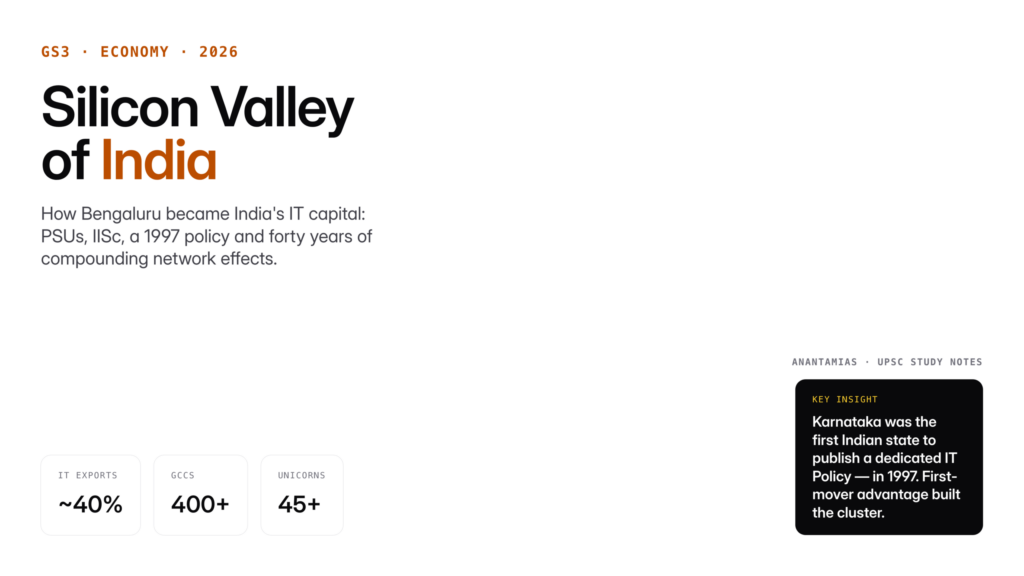
The phrase Silicon Valley of India refers to Bengaluru, the capital of Karnataka, which grew from a pensioners’ paradise and a public sector defence hub into the heart of India’s information technology industry. The label draws an explicit parallel with Silicon Valley in California — the San Francisco Bay Area cluster that birthed Intel, Apple, Google and countless venture-backed startups. Bengaluru earned the tag by the 1990s, and today hosts over 40 per cent of India’s IT exports, 400-plus Global Capability Centres and the densest startup concentration in the country.
For UPSC aspirants, Bengaluru’s rise is a GS Paper 3 case study in industrial policy, science and technology, urbanisation and the Indian economy’s structural transformation. The story also spans GS Paper 1 (urbanisation, migration) and GS Paper 2 (centre-state policy, ease of doing business). This note unpacks how the city earned the title, which factors built its ecosystem, and the challenges it now faces as a global tech hub.

Quick Facts at a Glance
| Attribute | Detail |
|---|---|
| Popular Name | Silicon Valley of India / IT Capital of India |
| Official Name | Bengaluru (renamed from Bangalore in 2014) |
| State | Karnataka |
| Founded | 1537 by Kempe Gowda I |
| IT Exports Share (FY24) | ~38-40% of India’s IT exports (NASSCOM) |
| GCCs Hosted | 400+ (highest in India) |
| Tech Workforce | Approx. 16 lakh IT professionals |
| Unicorn Count | 45+ (highest city share in India) |
| Key Tech Parks | Electronic City, Whitefield, Manyata, ITPL, Embassy Tech Village |
| Major Institutions | IISc, IIM-B, IIIT-B, NCBS, ISRO, HAL, BEL, BEML |
Background and Historical Context
Bengaluru’s technology story begins long before the software boom. The British established the cantonment in 1806, giving the city a colonial infrastructure base. Post-independence, the Nehruvian state placed major public-sector undertakings here: Hindustan Aeronautics Limited (HAL, 1940 origins), Bharat Electronics Limited (BEL, 1954), Indian Telephone Industries (ITI, 1948), Bharat Earth Movers Limited (BEML, 1964) and the Indian Space Research Organisation (ISRO, with headquarters shifted to Bengaluru in 1969). The Indian Institute of Science (IISc), founded in 1909 with JN Tata’s endowment, anchored scientific talent even earlier.
This base of engineering PSUs and premier institutions produced a skilled workforce trained in electronics, aeronautics and telecommunications — the exact skill adjacencies that software companies would later need. The salubrious climate and relatively low cost of living compared to Delhi or Mumbai attracted both retirees and engineers. By the 1970s, Bengaluru was already known as the Garden City and the Science City.
The inflection came in 1978 when Infosys was founded by seven engineers led by N.R. Narayana Murthy, initially in Pune but relocated to Bengaluru in 1983. Wipro, which started as a vegetable oil company in 1945, pivoted to IT under Azim Premji in the 1980s with its headquarters in Bengaluru. In 1985, Texas Instruments became the first multinational to set up an R&D centre in India — in Bengaluru — leveraging a pioneering satellite communication link that allowed real-time code commits to Dallas.
The Karnataka government’s IT Policy of 1997, the first of its kind among Indian states, formalised incentives like stamp duty exemption, subsidised power and priority land allocation in Electronic City. The Software Technology Parks of India (STPI) scheme, launched in 1991 by the Union Ministry of Electronics and Information Technology, provided tax holidays and duty-free import of hardware. By 2000 Bengaluru had overtaken Mumbai as India’s IT export capital.
Key Features
Electronic City and Tech Park Cluster
Electronic City, developed by the Karnataka State Electronics Development Corporation (KEONICS) from 1978 on 335 acres along Hosur Road, was India’s earliest dedicated IT cluster. It now houses over 200 companies including Infosys, Wipro, HCL and Siemens. Parallel clusters emerged at Whitefield (ITPL, Prestige Shantiniketan), Manyata Tech Park in North Bengaluru, Embassy Tech Village on Outer Ring Road and Bagmane Tech Park at CV Raman Nagar. Collectively they host more than 8 million square feet of Grade A office space.
Global Capability Centres
Bengaluru hosts India’s largest concentration of Global Capability Centres (GCCs) — captive offshore units of multinationals. Companies like Goldman Sachs, Target, Walmart, Tesco, SAP, Oracle, Cisco, Microsoft and Google run significant engineering operations from the city. As per NASSCOM 2024 estimates, India had 1,700 GCCs, and over 400 were located in Bengaluru.
Startup Ecosystem
Bengaluru is India’s undisputed startup capital with 45-plus unicorns including Flipkart, Ola, Swiggy, Byju’s, Udaan, Razorpay, Dream11’s ventures and Zerodha. The city attracts roughly 40 per cent of India’s venture capital funding. T-Hub adjacencies, NASSCOM 10000 Startups and Elevation Capital along with Sequoia (now Peak XV) and Accel India have offices on Koramangala and Indiranagar’s startup streets.
Education and Research Anchors
The Indian Institute of Science (IISc) regularly ranks among the top research institutions in Asia. IIM Bangalore supplies management talent; IIIT-Bangalore produces specialised IT graduates; NIMHANS and NCBS anchor life sciences. Engineering colleges affiliated with Visvesvaraya Technological University and autonomous institutions like PESIT, RVCE and BMSCE generate thousands of engineers annually.
Policy Enablers
Karnataka was the first state to publish an IT Policy (1997), followed by a dedicated Biotechnology Policy (2001), Startup Policy (2015) and GCC Policy (2024). The state runs the annual Bengaluru Tech Summit since 1998, South Asia’s largest technology event. Union-level enablers include STPI, SEZ Act 2005, Digital India (2015) and the Production Linked Incentive (PLI) schemes for electronics.
Infrastructure
Kempegowda International Airport (opened 2008) offers 70-plus international destinations. The Bengaluru Metro (Namma Metro) Purple and Green lines connect major tech clusters, with extensions to Electronic City and the airport under construction. The proposed Bengaluru Suburban Rail Project aims to knit together peripheral IT townships.
Significance for UPSC and General Knowledge
- Bengaluru’s rise illustrates how a knowledge-based services economy can accelerate a region’s growth, a core theme in GS Paper 3 on Indian economy.
- It exemplifies the role of state capacity — the Karnataka IT Policy of 1997 is a textbook case of proactive industrial policy.
- The city demonstrates the cluster effect in economic geography: concentration of talent, capital and infrastructure creates self-reinforcing growth.
- Bengaluru’s strain on water, housing and traffic is a live case study in sustainable urbanisation under GS Paper 1.
- The city’s GCC dominance connects to global value chains and India’s positioning in services exports (GS Paper 3).
- ISRO’s presence links Bengaluru to space policy and achievements including Chandrayaan missions.
Detailed Analysis: Why Bengaluru and Not Another City
Several cities including Hyderabad, Pune, Chennai, Gurugram and Noida claim to be India’s tech hubs, yet Bengaluru retains the Silicon Valley title. The reasons are a compounding mix of historical, geographic and policy factors.
Early public-sector base: The concentration of HAL, BEL, ITI and ISRO from the 1940s-70s created engineering talent and a PSU-contractor ecosystem. When private IT firms arrived, the supplier base, skilled technicians and R&D familiarity already existed. No other Indian city had this depth.
IISc and institutional density: IISc’s presence from 1909, combined with IIM-B (1973), created a rare academic-industry interface. Faculty consulted for Texas Instruments and later for Infosys. Bengaluru’s research output in engineering and computer science consistently leads Indian cities.
First-mover policy advantage: Karnataka’s 1997 IT policy preceded similar policies in Andhra Pradesh (1999), Tamil Nadu (1999) and Maharashtra (2003). Electronic City offered plug-and-play infrastructure when rival cities were still running cable. The state’s continuity — despite political changes between JD(S), Congress and BJP — has kept IT policy broadly stable.
Climate and cost: Bengaluru’s 900-metre elevation gives it a mild year-round climate, reducing air-conditioning costs and improving worker retention. Office rents in Whitefield and Electronic City are 40-50 per cent lower than central Mumbai, critical in a margin-sensitive export industry.
Network effects and talent concentration: Once Infosys, Wipro, IBM, Accenture and Google opened campuses, each new company found it easier to hire experienced engineers from rivals. Venture capital followed talent, creating the Koramangala-Indiranagar-HSR Layout startup corridor. Peer networks at events like TechSparks and Unpluggd reinforced serendipity.
Government support for startups: Karnataka’s Startup Cell, ELEVATE grant (₹50 lakh seed equity), and the IDEATHON programme have funded over 10,000 early-stage founders since 2016. The state has its own Venture Capital Fund with a ₹1,000 crore corpus for deep-tech and biotech.
Comparative Perspective
Bengaluru’s position is best understood in comparison with rival Indian IT cities and with Silicon Valley itself. The comparison highlights both its lead and the areas where catch-up is occurring.
| City / Region | IT Workforce | Unicorns | Signature Strength |
|---|---|---|---|
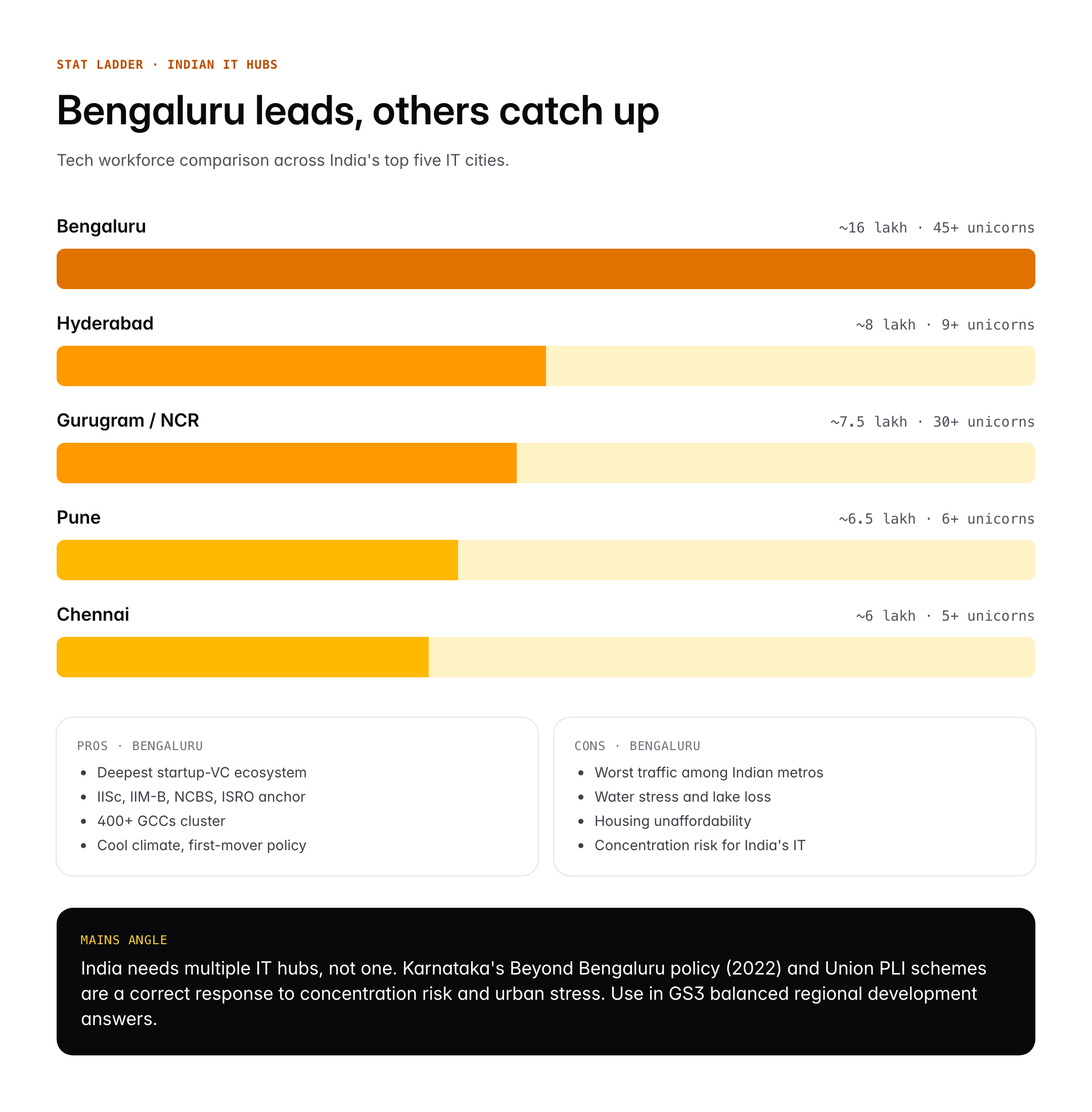
| Bengaluru | ~16 lakh | 45+ | Startups, GCCs, R&D, venture capital |
| Hyderabad | ~8 lakh | 9+ | Pharma + IT, Cyberabad cluster, Google’s largest non-US campus |
| Pune | ~6.5 lakh | 6+ | Automotive software, Hinjewadi cluster, engineering R&D |
| Chennai | ~6 lakh | 5+ | SaaS (Chennai-Chargebee-Zoho belt), auto electronics |
| Gurugram / NCR | ~7.5 lakh | 30+ | Fintech, consumer internet, corporate HQs |
| Silicon Valley, USA | ~15 lakh | 160+ | Platform giants, deep-tech, venture capital depth |
Bengaluru is closing the R&D and deep-tech gap with the US Silicon Valley, but trails in depth of venture capital (about one-tenth) and in university-driven commercialisation. Within India, Hyderabad and Gurugram pose the most credible competition — Hyderabad on GCC cost advantage, Gurugram on fintech and corporate HQs.
Challenges and Criticisms
The Silicon Valley of India tag sits uneasily with the city’s worsening urban crisis. Traffic congestion routinely places Bengaluru among the world’s top ten most-congested cities per the TomTom Traffic Index. Average commute speeds on Outer Ring Road fall below 18 kmph during peak hours. Moving a software engineer from Whitefield to Electronic City takes almost three hours on a bad day.
Water stress peaked in summer 2024 when the city depended on tanker supply after Cauvery inflows dropped. The Bruhat Bengaluru Mahanagara Palike (BBMP) has acknowledged that groundwater has been over-exploited, and many peripheral tech parks rely entirely on tankers. Lake encroachment, documented by the Karnataka Lake Conservation and Development Authority, has halved the number of functional lakes since the 1970s.
Housing affordability has eroded as IT demand pushes rents up 15-20 per cent year on year in prime tech clusters. Tier-2 cities like Mysuru, Hubballi-Dharwad and Mangaluru are being positioned as spillover destinations, supported by the Karnataka Beyond Bengaluru policy launched in 2022.
There are also structural concerns about concentration risk. India’s IT industry is heavily services-led, with a relatively thin domestic product base. Critics argue that despite the Silicon Valley tag, Bengaluru has not produced a global platform company comparable to Google or Apple. The India Stack, UPI and the growing deep-tech base may change this, but the gap remains.
Prelims Pointers
- Bengaluru is the capital of Karnataka; renamed from Bangalore in November 2014.
- Infosys was founded in 1981 in Pune; headquartered in Bengaluru since 1983.
- Texas Instruments set up India’s first MNC R&D centre in Bengaluru in 1985.
- Karnataka was the first Indian state to release an IT Policy (1997).
- Electronic City was developed by KEONICS from 1978.
- IISc was founded in 1909 with JN Tata’s endowment.
- ISRO is headquartered in Bengaluru.
- Bengaluru hosts India’s largest concentration of GCCs (400-plus).
- NASSCOM stands for National Association of Software and Service Companies.
- Kempegowda International Airport (BLR) opened in 2008.
- Bengaluru was renamed after Kempe Gowda I, who founded the city in 1537.
- Karnataka launched the Beyond Bengaluru policy in 2022 to promote Mysuru, Hubballi and Mangaluru as IT hubs.
Mains Practice Questions
- Examine the factors that enabled Bengaluru to emerge as the Silicon Valley of India and assess whether this model is replicable in other Indian cities. (250 words, GS3)
- Identify enablers: PSU base, IISc-IIM ecosystem, early IT policy, climate, network effects.
- Discuss replicability: Hyderabad and Gurugram as partial successes, Mysuru-Mangaluru as spillover plays.
- Conclude with the role of cluster dynamics and sustained state capacity.
- Sustainable urbanisation of India’s tech hubs is as critical as fostering new ones. Critically analyse in the context of Bengaluru. (250 words, GS1/GS3)
- Outline Bengaluru’s urban stress: water, lakes, traffic, housing, air quality.
- Discuss Beyond Bengaluru policy, metro expansion, suburban rail and lake restoration.
- Suggest integrated master planning, demand management and decongestion through tier-2 development.
Conclusion
Bengaluru earned the Silicon Valley of India title through a rare convergence of scientific institutions, public-sector engineering, forward-looking state policy and network effects that compounded over four decades. Its 16-lakh strong IT workforce, 400-plus GCCs and 45-plus unicorns place it at the centre of India’s services-led growth story and its push toward a 7-trillion-dollar economy by 2030.
The challenge ahead is to sustain the cluster without hollowing out the city’s liveability. Traffic gridlock, water stress and housing costs now threaten the very foundations that made Bengaluru attractive. Whether the city can transition from a services powerhouse to a global platform and deep-tech leader — while fixing its urban crisis — will determine if the Silicon Valley tag remains credible in the next decade.
Frequently Asked Questions
What is the Silicon Valley of India?
The Silicon Valley of India is Bengaluru, the capital of Karnataka. The city earned the title in the 1990s due to its concentration of IT companies, research institutions, startups and multinational R&D centres. It now accounts for nearly 40 per cent of India’s IT exports, hosts over 400 Global Capability Centres and leads India in unicorn count.
Why is Bengaluru called the Silicon Valley of India?
Bengaluru is called the Silicon Valley of India because of its unmatched IT ecosystem: Infosys and Wipro’s headquarters, over 400 GCCs, 45-plus unicorns, IISc, IIM-B, IIIT-B, ISRO and the Electronic City-Whitefield-Manyata tech cluster. The phrase draws a deliberate parallel with the San Francisco Bay Area in California.
Why is Bengaluru important for UPSC?
Bengaluru is a GS Paper 3 case study in industrial policy, science and technology, services-led growth, startup ecosystem and urban sustainability. It also links to GS1 (urbanisation, migration), GS2 (centre-state coordination, ease of doing business) and current affairs on ISRO, GCC policy, PLI schemes and AI strategy.
How is Bengaluru related to ISRO and space technology?
ISRO is headquartered in Bengaluru, with critical centres like URSC (U R Rao Satellite Centre), ISTRAC and HQ located within the city. Major missions including Chandrayaan-1, Chandrayaan-3, Mangalyaan and Gaganyaan were planned and operated from Bengaluru. The city’s aerospace ecosystem includes HAL, BEL and private space startups like Skyroot and Pixxel.
When was Bengaluru renamed from Bangalore?
Bengaluru was officially renamed from Bangalore on 1 November 2014 when the Union Ministry of Home Affairs approved Karnataka’s proposal along with renames for 11 other cities including Mysore to Mysuru and Mangalore to Mangaluru. The native Kannada name Bengaluru had been in common use for decades.
Which companies are headquartered in Bengaluru?
Indian tech giants like Infosys, Wipro and Mindtree are headquartered in Bengaluru. Unicorns including Flipkart, Ola, Swiggy, Byju’s, Razorpay, Udaan, Zerodha and CRED are based here. MNCs with large campuses include Google, Microsoft, IBM, Oracle, Cisco, Intel, SAP, Goldman Sachs, Target and Walmart’s global tech centre.
What challenges does Bengaluru face as a tech hub?
Bengaluru’s biggest challenges are traffic congestion (routinely among the world’s worst), water stress (2024 Cauvery crisis), housing unaffordability, lake encroachment and air pollution. The city has lost over half its lakes since the 1970s. Karnataka’s Beyond Bengaluru policy from 2022 aims to redirect IT growth to Mysuru, Hubballi and Mangaluru to ease pressure.
What was the Karnataka IT Policy of 1997?
The Karnataka IT Policy of 1997 was the first dedicated IT policy by any Indian state. It offered stamp duty exemption, subsidised power, priority land allocation in Electronic City, single-window clearances and investment subsidies. This first-mover advantage pulled global MNCs and domestic IT firms to Bengaluru before rival states like Andhra Pradesh, Tamil Nadu and Maharashtra caught up.
Tell Google you want more of this.
Add Anantam IAS as a preferred sourceOne tap, and this site shows up more often in your own Top Stories, AI Overviews and AI Mode. Remove it any time.