
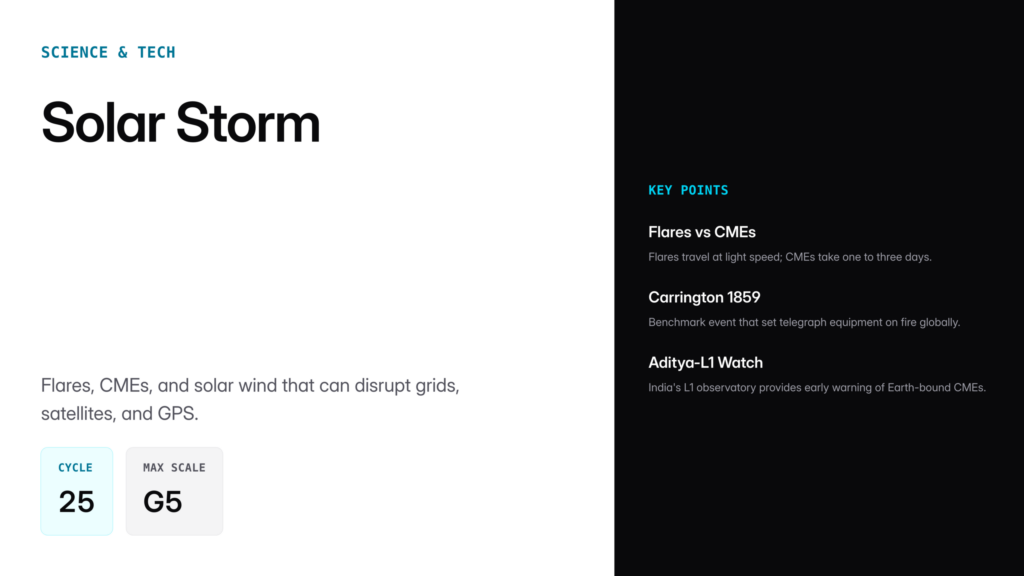
A solar storm is a broad term for energetic disturbances emanating from the Sun — solar flares, coronal mass ejections (CMEs), high-speed solar wind streams, and solar energetic particle events — that disrupt Earth's space environment. When a strong CME strikes Earth's magnetosphere, it can trigger a geomagnetic storm, causing spectacular auroras but also crippling power grids, satellites, GPS, and radio communications. With humanity's growing dependence on space-based infrastructure, solar storms have become a recognised disaster-management concern. India's Aditya-L1 mission, launched in September 2023 and stationed at Lagrange Point L1 from January 2024, is our dedicated solar observatory, placing this topic squarely on the UPSC Science and Technology syllabus.
What Is a Solar Storm
At its core, a solar storm is an outburst of matter, electromagnetic radiation, and charged particles from the Sun. The Sun's activity follows an 11-year solar cycle, driven by the reversal of its magnetic poles. The current cycle, Solar Cycle 25, began in December 2019 and reached its solar maximum in 2024–2025, which is why solar storms have been in the news.
Solar storms manifest in four main forms:
- Solar flares — intense bursts of electromagnetic radiation from the Sun's surface.
- Coronal mass ejections (CMEs) — huge expulsions of magnetised plasma from the Sun's corona.
- Solar Energetic Particles (SEPs) — streams of high-energy protons and electrons.
- High-speed solar wind streams from coronal holes.
The most severe geomagnetic disturbances arise from Earth-directed CMEs combined with strong southward interplanetary magnetic fields.
Solar Flares vs Coronal Mass Ejections
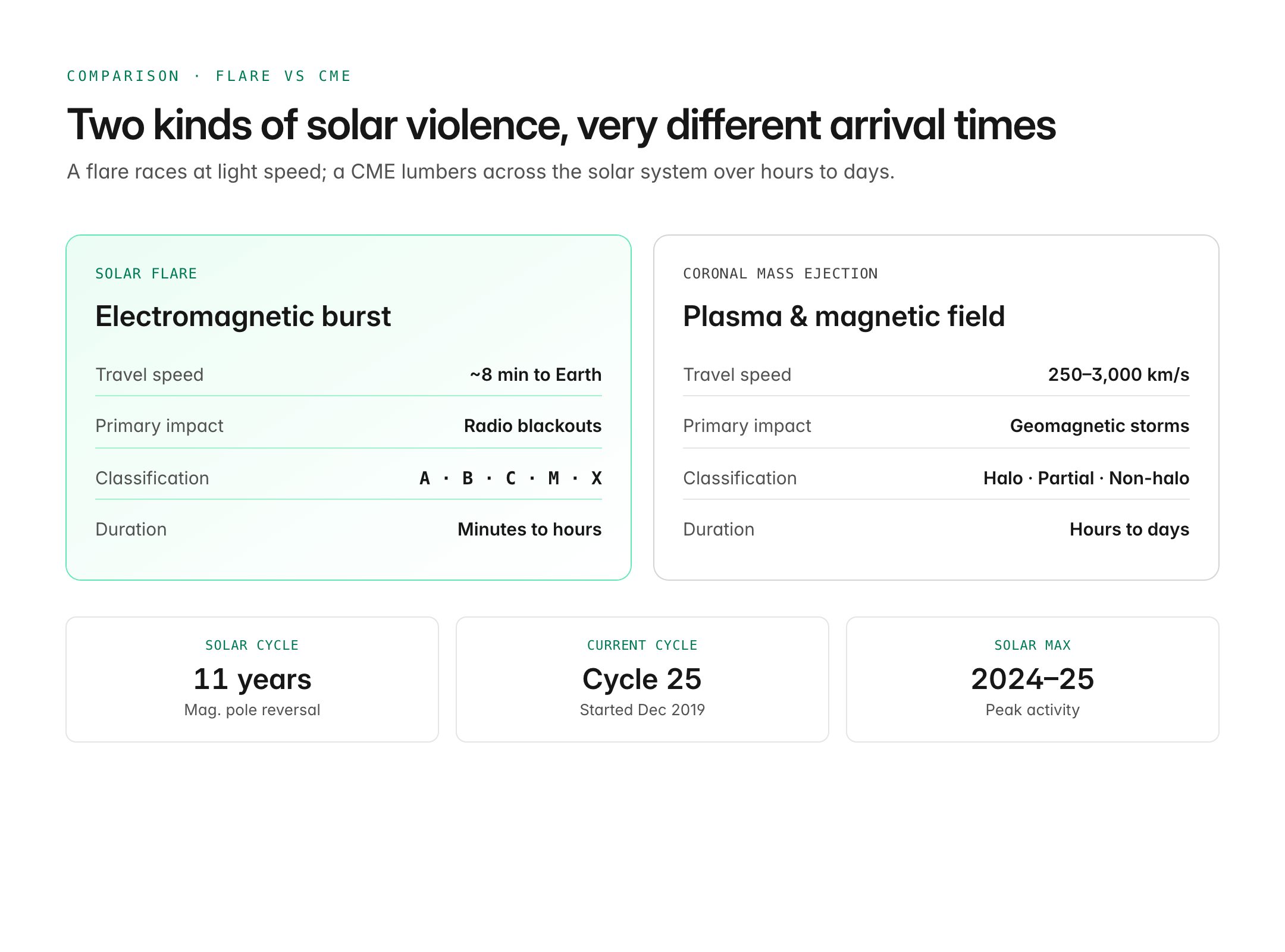
The two terms are often confused but differ significantly.
| Feature | Solar Flare | Coronal Mass Ejection |
|---|---|---|
| Nature | Electromagnetic radiation burst | Plasma + magnetic-field ejection |
| Travel speed | Speed of light (~8 minutes to Earth) | 250–3,000 km/s (1–3 days to Earth) |
| Primary impact | Ionospheric disruption, radio blackouts | Geomagnetic storms, auroras, grid failure |
| Classification | A, B, C, M, X (X = strongest) | Halo, partial halo, non-halo |
| Duration | Minutes to hours | Hours to days |
A flare and a CME can occur together, but not always. X-class flares and fast halo CMEs pose the greatest threat.
How Solar Storms Affect Earth
When a CME reaches Earth (typically 15–72 hours after eruption), it compresses the magnetosphere and injects energy into the ionosphere. The downstream impacts include:
- Power grid failures. Induced currents can overload transformers, as in the 1989 Quebec blackout that left 6 million people without power for 9 hours.
- Satellite damage. High-energy particles can cause single-event upsets, degrade solar panels, and shorten satellite lifespans.
- GPS errors. Ionospheric disturbances can throw navigation accuracy off by tens of metres.
- Radio blackouts. HF radio used by aviation and maritime services can go dark across the sunlit hemisphere.
- Aurora expansion. Auroras normally confined to polar regions can be seen at much lower latitudes.
- Astronaut radiation exposure. ISS crew shelter in shielded modules during strong SEP events.
In May 2024, a severe G5-class geomagnetic storm — the strongest since 2003 — produced auroras visible from parts of Ladakh and northern India.
Space Weather Scales
The US National Oceanic and Atmospheric Administration (NOAA) uses five-level scales:
- G-scale (Geomagnetic): G1 (minor) → G5 (extreme).
- S-scale (Solar radiation/SEP): S1 → S5.
- R-scale (Radio blackout): R1 → R5.
For UPSC purposes, remembering that G5 and X-class flares mark the most severe events, and that the Carrington Event of 1859 is the benchmark "worst-case" historical storm, is useful.
India's Preparedness: Aditya-L1 and Beyond
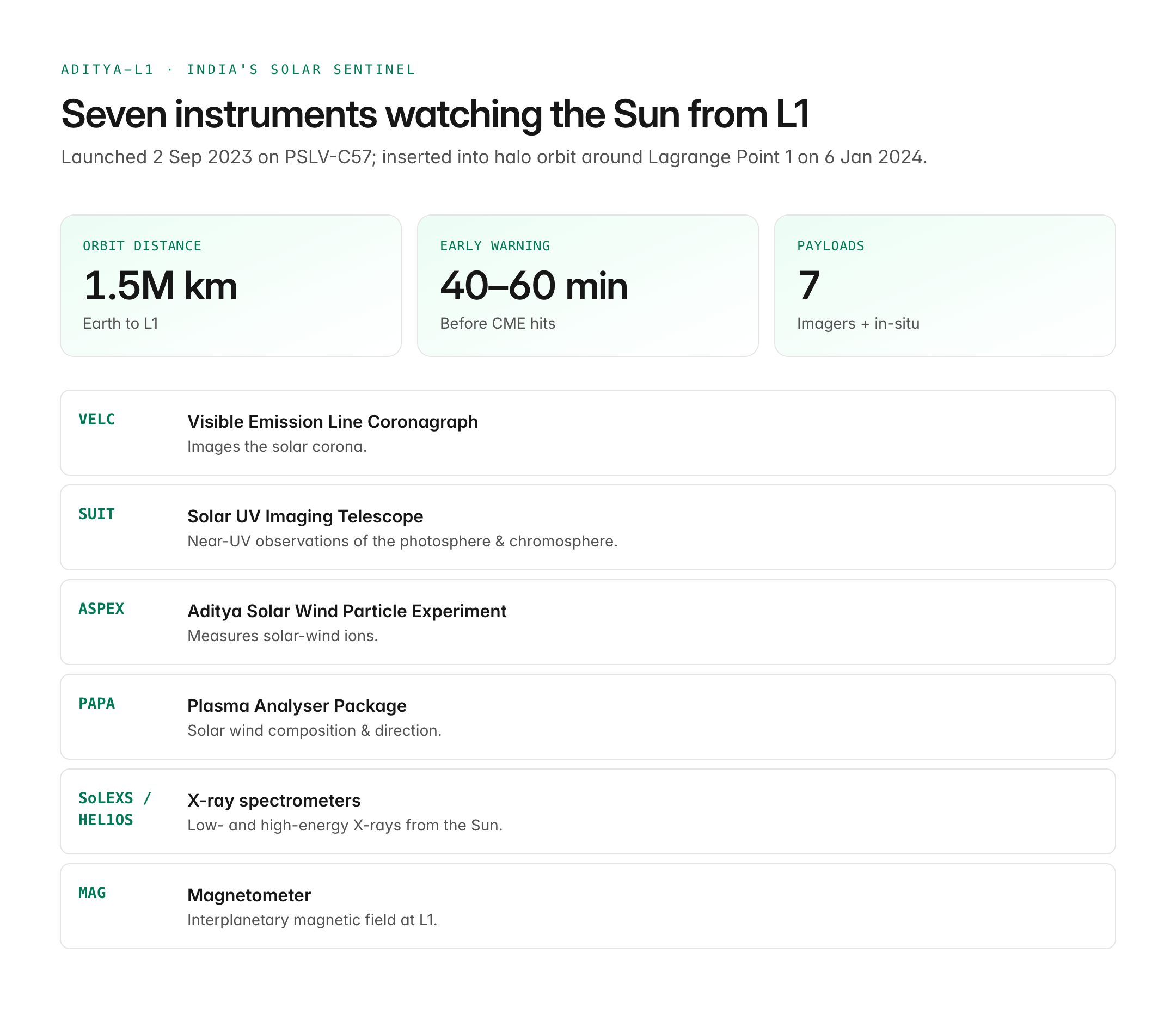
India's dedicated solar mission Aditya-L1 was launched by PSLV-C57 on 2 September 2023 and inserted into a halo orbit around Lagrange Point L1, about 1.5 million km from Earth, on 6 January 2024. Its seven payloads include:
- VELC (Visible Emission Line Coronagraph) — corona imaging.
- SUIT (Solar Ultraviolet Imaging Telescope) — UV observations.
- ASPEX, PAPA, SoLEXS, HEL1OS, MAG — for particle, X-ray, and magnetic-field measurements.
Aditya-L1 gives India continuous solar observation and early warning capability of roughly 40–60 minutes before a CME reaches Earth.
Other Indian initiatives include:
- National Centre for Medium Range Weather Forecasting (NCMRWF) space-weather modelling.
- Indian Institute of Astrophysics (IIA) Kodaikanal Solar Observatory.
- Coordination through the International Space Weather Initiative of the UN.
Historical Benchmark Events
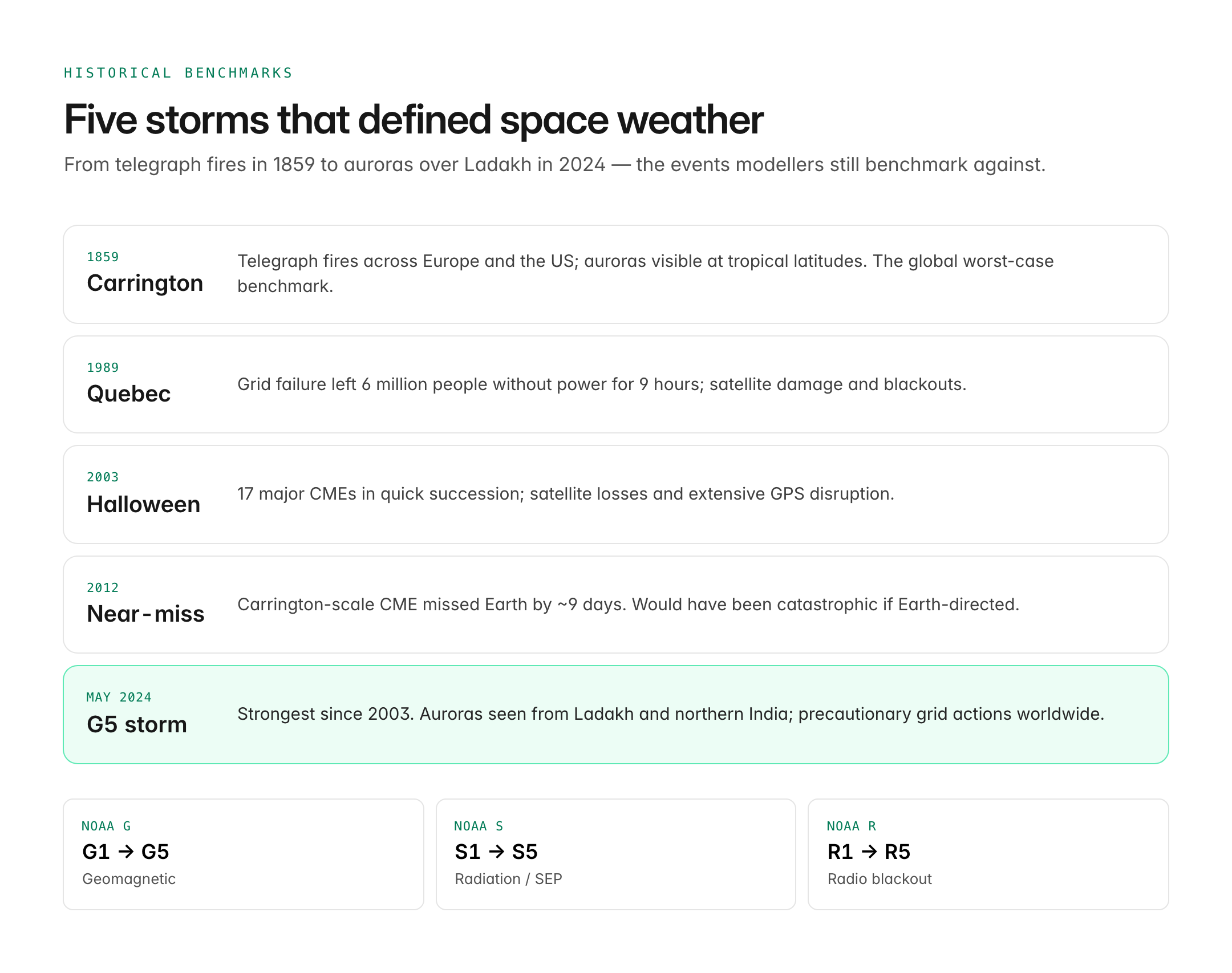
Major recorded solar storms include:
| Event | Year | Impact |
|---|---|---|
| Carrington Event | 1859 | Telegraph fires; auroras at tropical latitudes |
| Quebec blackout | 1989 | 9-hour grid failure; satellite damage |
| Halloween Storms | 2003 | 17 major CMEs; satellite losses |
| Near-miss CME | 2012 | Would have caused Carrington-level damage if Earth-directed |
| May 2024 G5 storm | 2024 | Auroras across much of India; precautionary grid actions |
Modelling studies estimate that a Carrington-level event today could cause trillions of dollars of damage globally.
UPSC Relevance
Prelims focus: difference between flare and CME, 11-year solar cycle, Solar Cycle 25 maximum (2024–25), Aditya-L1 launch date, L1 point and distance (~1.5 million km), key payloads (VELC), Carrington Event (1859), and NOAA G-scale.
Mains GS angle:
- GS III — science and technology, developments in space, disaster management, awareness in space.
- GS III — infrastructure vulnerability: power grids, satellites, and communications.
- Ethics/GS IV angle on scientific foresight and international cooperation in space weather.
Sample PYQ angle: UPSC Prelims has asked about solar flares and their effects, and Mains has touched on space weather. A strong answer defines solar storms, distinguishes flares from CMEs with a clean table, lists impacts on critical infrastructure, and discusses Aditya-L1's role in early warning. Link to disaster management frameworks by arguing for space-weather inclusion in India's National Disaster Management Plan.
Tell Google you want more of this.
Add Anantam IAS as a preferred sourceOne tap, and this site shows up more often in your own Top Stories, AI Overviews and AI Mode. Remove it any time.





