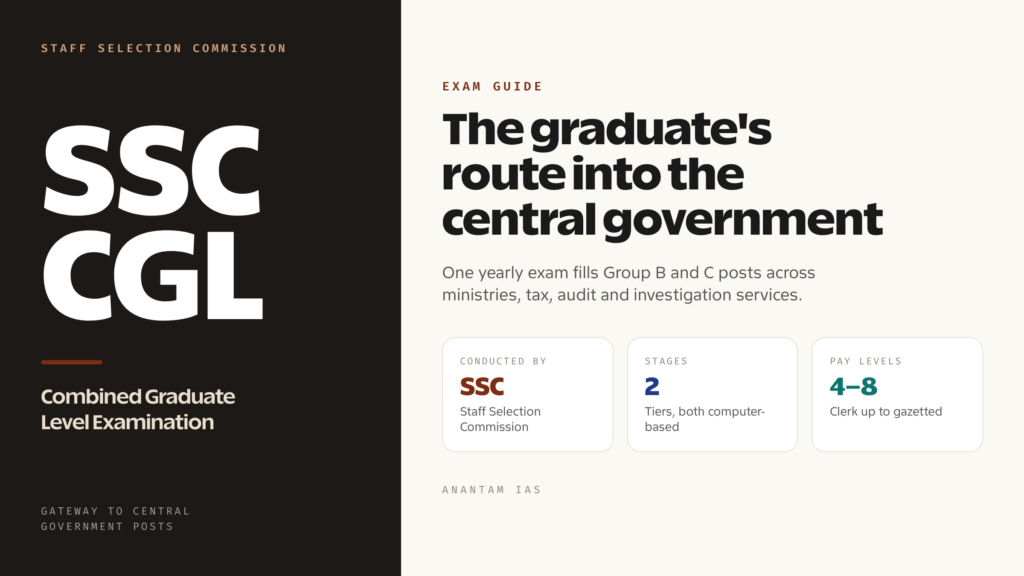
The Combined Graduate Level examination, run by the Staff Selection Commission, is the single biggest gateway into the central government for graduates in India. It fills thousands of Group B and Group C posts every year across ministries, the income tax and customs departments, the CAG, the CBI, and dozens of other organisations — and lakhs of candidates sit for it each cycle.
If you’ve finished a bachelor’s degree and want a stable, pensionable central-government job without the multi-year grind of the civil services, SSC CGL is usually the first exam people point you toward. This guide walks through what it recruits for, how the two tiers work, who can apply, what the syllabus covers, and a preparation plan that’s actually built around speed and accuracy rather than vague “study hard” advice.
What Is SSC CGL?
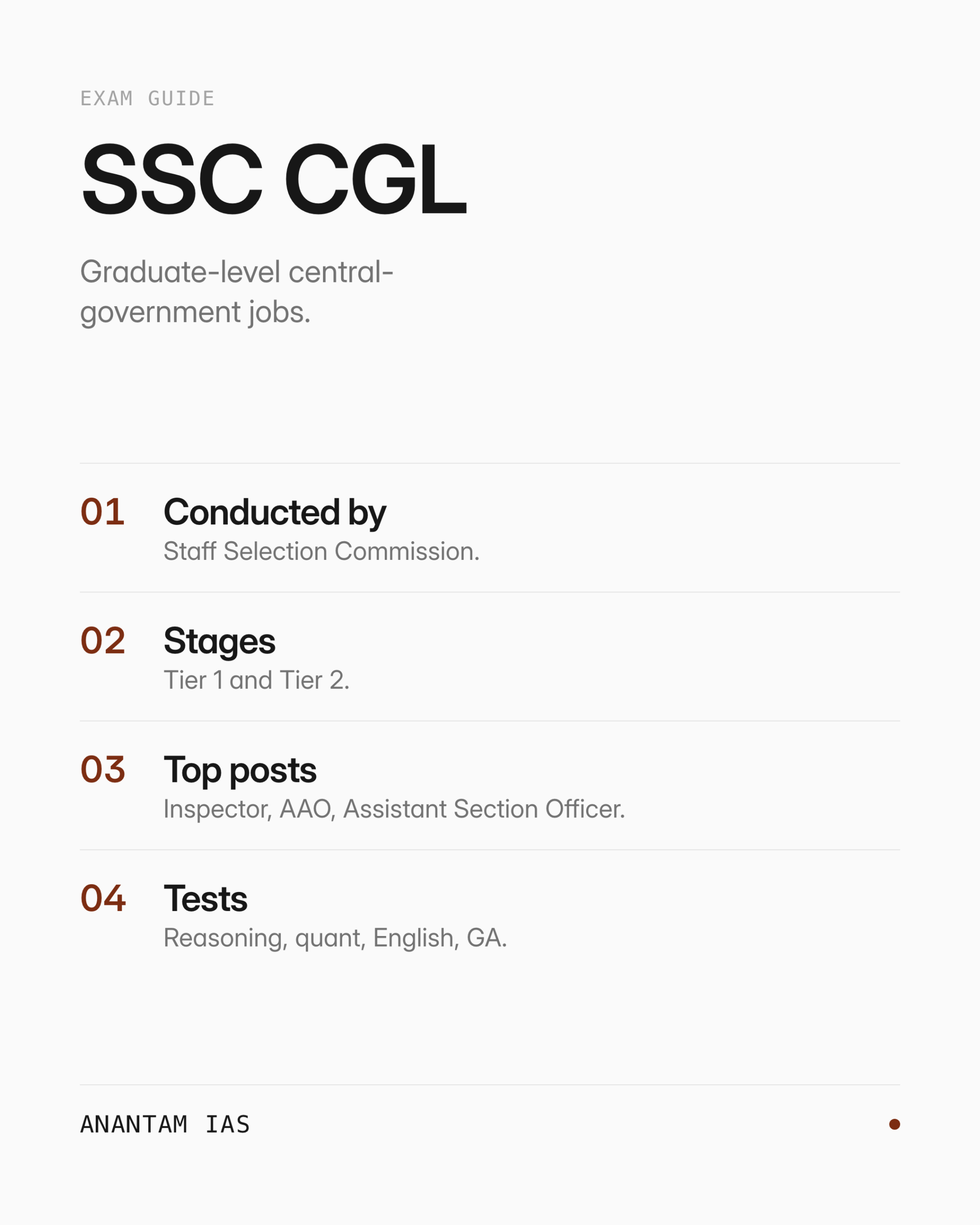
SSC CGL stands for Staff Selection Commission Combined Graduate Level. The Staff Selection Commission is a body under the central government’s Department of Personnel and Training, and it’s the main recruiter for non-gazetted posts in central ministries, departments, and subordinate offices. The CGL exam is its flagship graduate-level recruitment, conducted once a year through a common notification that feeds candidates into a long list of different posts.
What makes CGL attractive is the spread of roles it covers. A single exam can land you as an Income Tax Inspector with the Central Board of Direct Taxes, a Sub-Inspector in the CBI, an Assistant Section Officer drafting policy inside a ministry, or an Assistant Audit Officer in the Comptroller and Auditor General’s office. You don’t apply post by post at the start — you sit one exam, and your rank plus your stated preferences decide where you go.
Key Facts
- Conducting authority: Staff Selection Commission (SSC), under the Department of Personnel and Training.
- Posts filled: Group B and Group C posts across central ministries and departments — Assistant Audit Officer, Income Tax Inspector, Inspector (CGST & Customs), Assistant Section Officer, Sub-Inspector in CBI, Auditor, Accountant, Tax Assistant, and more.
- Frequency: Once a year (the notification typically appears mid-year, with Tier 1 a few months later).
- Stages: Two tiers — both computer-based — followed by document verification and post allocation.
- Scale of competition: Lakhs of applicants chase a few thousand vacancies, so the cut-offs run high and the margin between selection and rejection is often a handful of marks.
SSC CGL Exam Pattern
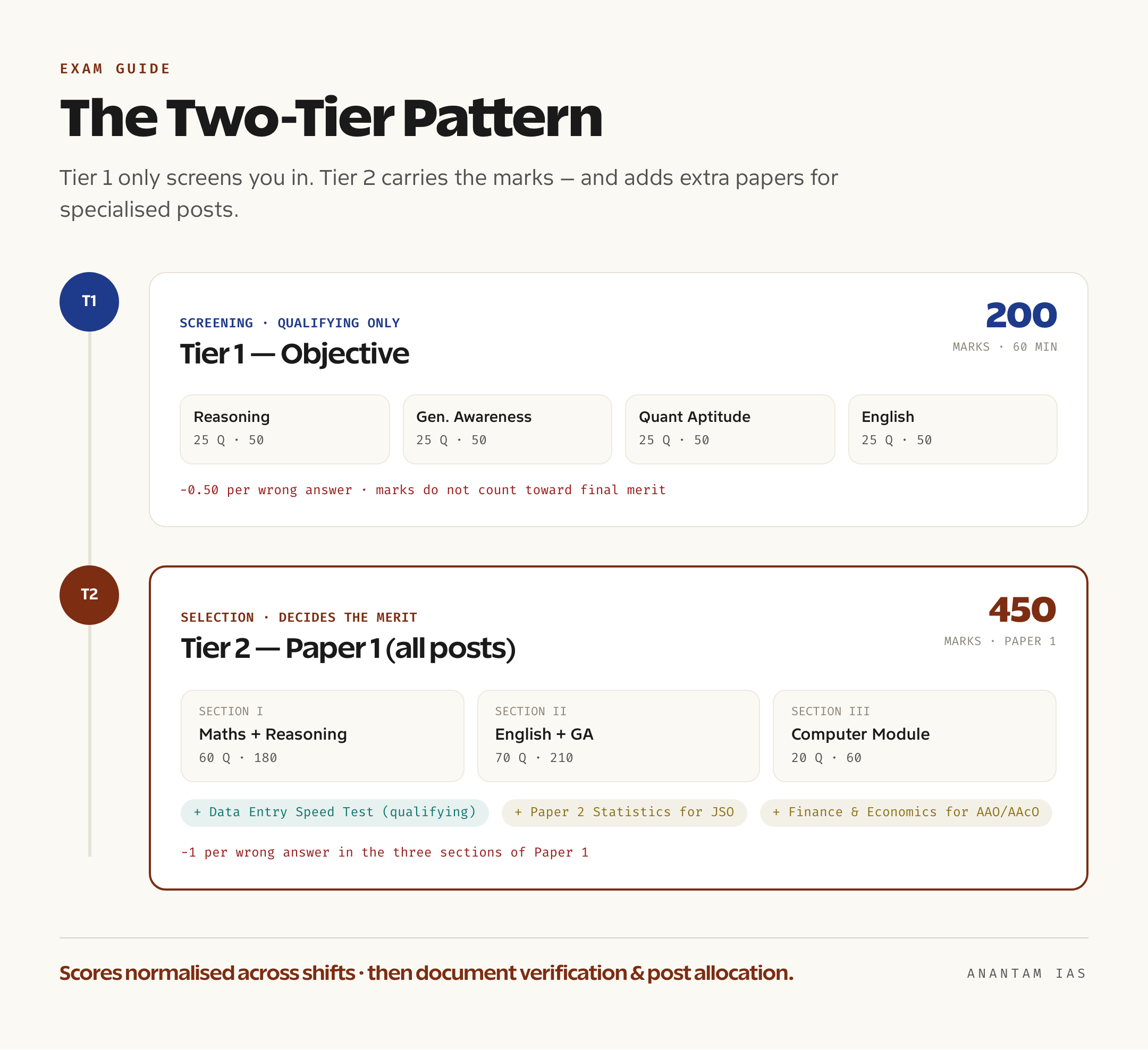
SSC reworked the older four-stage format into a leaner two-tier structure, and that two-tier pattern is what’s current. Tier 1 is a common screening test for everyone; Tier 2 is where the real selection happens, with extra modules layered on for specialised posts. Both tiers are computer-based and objective, and SSC normalises scores across the multiple shifts each tier runs in, so that candidates who sat an easier or harder slot aren’t unfairly advantaged.
Tier 1
Tier 1 is the qualifying screen. It’s a single one-hour paper with 100 questions worth 200 marks, split evenly across four sections of 25 questions (50 marks) each:
| Section | Questions | Marks |
|---|---|---|
| General Intelligence & Reasoning | 25 | 50 |
| General Awareness | 25 | 50 |
| Quantitative Aptitude | 25 | 50 |
| English Comprehension | 25 | 50 |
| Total | 100 | 200 |
Every correct answer earns 2 marks, and there’s a negative marking of 0.50 marks for each wrong answer — so guessing blindly costs you. Tier 1 marks don’t count toward the final merit; clearing the cut-off here just gets you into Tier 2.
Tier 2
Tier 2 is where selection is decided. The core is Paper 1, which is compulsory for every post. It runs across two sessions and three scored sections:
| Section | Modules | Questions | Marks |
|---|---|---|---|
| Section I | Mathematical Abilities + Reasoning & General Intelligence | 30 + 30 | 180 |
| Section II | English Language & Comprehension + General Awareness | 45 + 25 | 210 |
| Section III | Computer Knowledge Module | 20 | 60 |
A Data Entry Speed Test module runs in a separate short session and is qualifying in nature for most posts. Negative marking in Tier 2 is steeper — 1 mark deducted per wrong answer in the three sections of Paper 1 — which is why accuracy matters even more than in Tier 1.
On top of Paper 1, some posts add a specialised paper. Paper 2 is a statistics paper (100 questions, 200 marks) taken only by candidates applying for Junior Statistical Officer in the Ministry of Statistics, and a finance-and-economics paper applies to accounts-related posts such as Assistant Audit Officer and Assistant Accounts Officer. So your exam load depends on the posts you’ve opted for. If you compare this with the descriptive, essay-heavy civil-services Mains, CGL stays fully objective end to end — a different kind of test that rewards calculation speed over long-form writing, as the UPSC vs SSC comparison lays out in more detail.
SSC CGL Eligibility
Eligibility for CGL is broad by design, but the fine print on age and qualification shifts from post to post. Here’s what you need before you apply.
- Nationality: You must be a citizen of India, or fall into one of the specified categories (a subject of Nepal or Bhutan, certain Tibetan refugees, or a person of Indian origin migrated from specified countries with the intention of permanent settlement).
- Educational qualification: A bachelor’s degree in any discipline from a recognised university is the baseline. A few posts add a wrinkle — Assistant Audit Officer and Assistant Accounts Officer prefer or require a degree with desirable qualifications like CA, CS, MBA, or a Master’s in Commerce/Economics, and the Junior Statistical Officer post needs a graduation with a defined level of mathematics or statistics.
- Age limits: These vary by post and typically run between 18 and 32, depending on the role. Many inspector-grade posts (Income Tax Inspector, Assistant Section Officer) sit in the 18-30 band, the CBI Sub-Inspector post usually starts at 20, and clerical roles such as Tax Assistant fall in the lower 18-27 range. Always check the year’s notification, since the cut-off date and exact bands are fixed there.
- Age relaxations: Standard relaxations apply — up to 5 years for SC/ST candidates, 3 years for OBC, and further relaxations for persons with benchmark disabilities, ex-servicemen, and certain other categories, as specified by government rules.
Unlike the civil services, SSC CGL doesn’t cap the number of attempts. As long as you’re within the age limit for a post, you can keep appearing — which is one reason the candidate pool is so large.
SSC CGL Syllabus
The syllabus is consistent in theme across both tiers — reasoning, quantitative aptitude, English, and general awareness — but Tier 2 goes deeper and adds computer and (for some) specialised topics.
Tier 1 Syllabus
- General Intelligence & Reasoning: analogies, classification, coding-decoding, series, syllogisms, blood relations, directions, non-verbal reasoning, and basic puzzles.
- General Awareness: static general knowledge (history, geography, polity, economics, general science) plus current affairs of national and international importance.
- Quantitative Aptitude: number systems, percentages, ratio and proportion, averages, profit and loss, time-speed-distance, time and work, algebra, geometry, mensuration, trigonometry, and data interpretation.
- English Comprehension: grammar, vocabulary, synonyms and antonyms, error spotting, sentence improvement, cloze tests, and reading comprehension.
Tier 2 Syllabus
Tier 2 expands the same four areas with harder and lengthier questions, then adds two modules unique to this stage:
- Computer Knowledge Module: computer basics, hardware and software, operating systems, internet and networking, MS Office, and cyber-security basics.
- Data Entry Speed Test: a typing-speed module that’s qualifying for most posts but a core requirement for data-entry-heavy roles.
- Specialised papers: the statistics paper (Paper 2) covers measures of central tendency, dispersion, probability, sampling, and index numbers; the finance and economics paper covers fundamentals of accounting and core economics for accounts posts.
The general-awareness and quantitative sections carry the heaviest weight overall, so most toppers build their score there while keeping English and reasoning fast and clean.
SSC CGL Preparation Strategy
CGL rewards a very specific skill: solving a large number of straightforward-to-moderate questions quickly and without errors. A plan built around that beats one built around depth for its own sake.
Build the quantitative and reasoning base first
Quant and reasoning are the most learnable and the most scoring. Work through the standard arithmetic and algebra-geometry chapters until the methods are automatic, then drill short tricks for percentages, ratios, and number systems. Reasoning rewards pattern recognition, so the more varied sets you practice, the faster you get.
Make English and general awareness routine
English is high-return for the time it takes — fix grammar rules, build vocabulary in small daily doses, and practice reading comprehension under time pressure. General awareness needs steady, broad coverage of static GK plus a daily current-affairs habit; there’s no shortcut other than consistent revision of a compact set of notes.
Train for speed and accuracy together
This is the difference-maker. The exam isn’t only about knowing answers — it’s about how many you can lock in correctly inside the clock, with negative marking punishing every loose guess. Practice in timed blocks, track your accuracy percentage, not just your attempt count, and learn which questions to skip.
Use PYQs and full-length mocks relentlessly
Previous-year questions show you exactly which chapters repeat and at what difficulty. Pair them with full-length mock tests in the actual computer-based format, then spend as much time analysing each mock as taking it — review every wrong answer, every silly slip, and every question that ate too much time. The candidates who clear CGL are usually the ones who took the most mocks and read their own mistakes honestly.
Revise on a fixed cycle
Quant formulae, GK facts, and English rules all fade without revision. Keep a tight, single set of notes per section and cycle through them on a schedule, tightening it as the exam nears.
Posts, Salary & Career
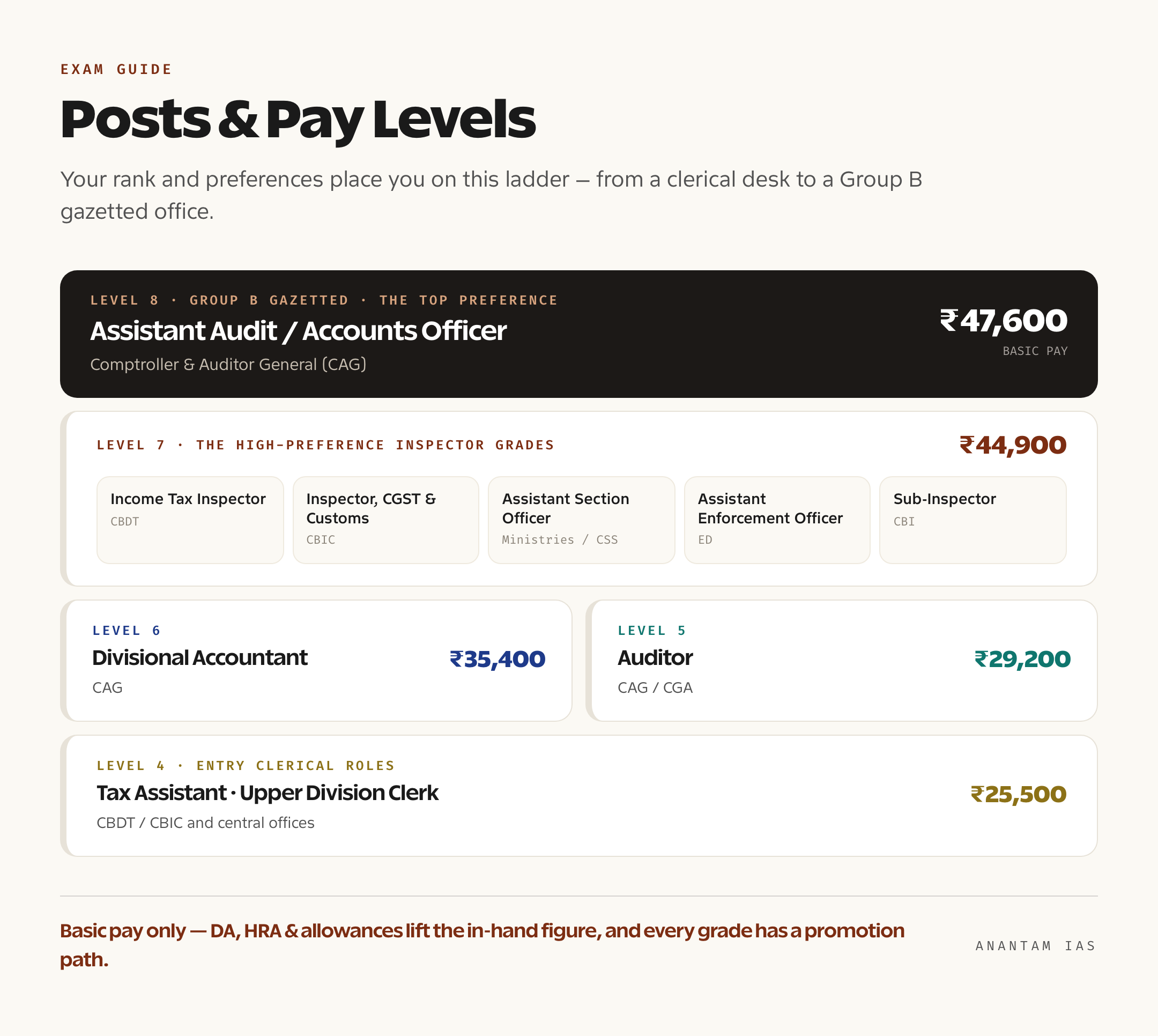
The big draw of CGL is the range of posts and the genuine career ladder behind them. Roles are slotted into pay levels 4 to 8 under the 7th Pay Commission, and where you land depends on your final rank and the preferences you submitted.
| Post | Department | Pay Level | Basic Pay |
|---|---|---|---|
| Assistant Audit / Accounts Officer | CAG | Level 8 | ₹47,600 |
| Income Tax Inspector | CBDT | Level 7 | ₹44,900 |
| Inspector (CGST & Customs) | CBIC | Level 7 | ₹44,900 |
| Assistant Section Officer | Ministries / CSS | Level 7 | ₹44,900 |
| Assistant Enforcement Officer | Enforcement Directorate | Level 7 | ₹44,900 |
| Sub-Inspector | CBI | Level 7 | ₹44,900 |
| Divisional Accountant | CAG | Level 6 | ₹35,400 |
| Auditor | CAG / CGA | Level 5 | ₹29,200 |
| Tax Assistant | CBDT / CBIC | Level 4 | ₹25,500 |
The Assistant Audit Officer post sits at the top as the only Group B gazetted role in the list at Pay Level 8, which is why it’s the most-fought-for preference. Inspector-grade posts in income tax, customs, and the enforcement and investigation agencies cluster at Level 7 and are the bulk of the high-preference choices. Beyond the basic pay, central allowances — dearness allowance, house rent allowance, and transport allowance — push the in-hand figure higher, and the real value is the promotion path: an Income Tax Inspector or ASO can rise through the grades over a career into senior, gazetted positions. For a wider view of where CGL fits among public-sector routes, the guide to different types of government exams maps out the landscape, and the PCS full form explainer is a useful contrast if you’re weighing state services against central posts.
Frequently Asked Questions
Is SSC CGL Tier 1 counted in the final selection?
No. Tier 1 is purely a qualifying screen — you need to clear its cut-off to advance, but its 200 marks don’t carry into the final merit list. Selection is decided on your Tier 2 score, mainly Paper 1’s 450 marks plus any specialised paper for posts that need one.
Which is the best post in SSC CGL?
Most candidates rank Assistant Audit Officer in the CAG highest, since it’s the only Group B gazetted post in the list at Pay Level 8 with a basic pay of ₹47,600. Income Tax Inspector and the Inspector posts in customs and the enforcement agencies at Pay Level 7 are the next most popular for their pay, profile, and growth.
How tough is the competition in SSC CGL?
It’s intense — lakhs of graduates apply against a few thousand vacancies each cycle, so cut-offs run high and the gap between selection and rejection can be a few marks. Because there’s no attempt limit, you’re also competing against repeat candidates who’ve taken the exam before.
Can a final-year student apply for SSC CGL?
Generally you need to hold the bachelor’s degree as on the cut-off date in the notification, so a student must have results in hand by that date. The exact eligibility date is fixed each year in the official SSC notification, so check it before assuming you qualify.
Tell Google you want more of this.
Add Anantam IAS as a preferred sourceOne tap, and this site shows up more often in your own Top Stories, AI Overviews and AI Mode. Remove it any time.