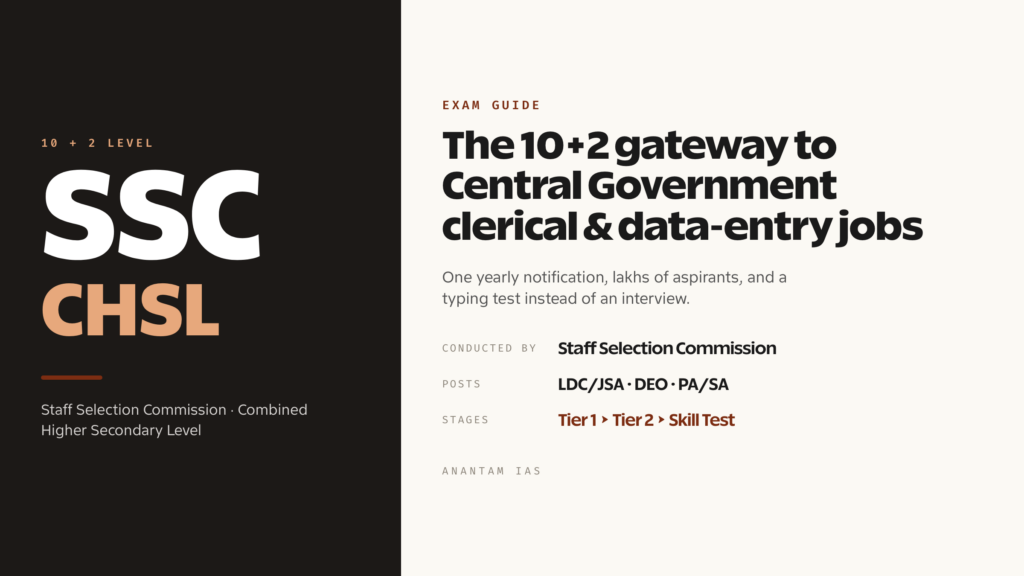
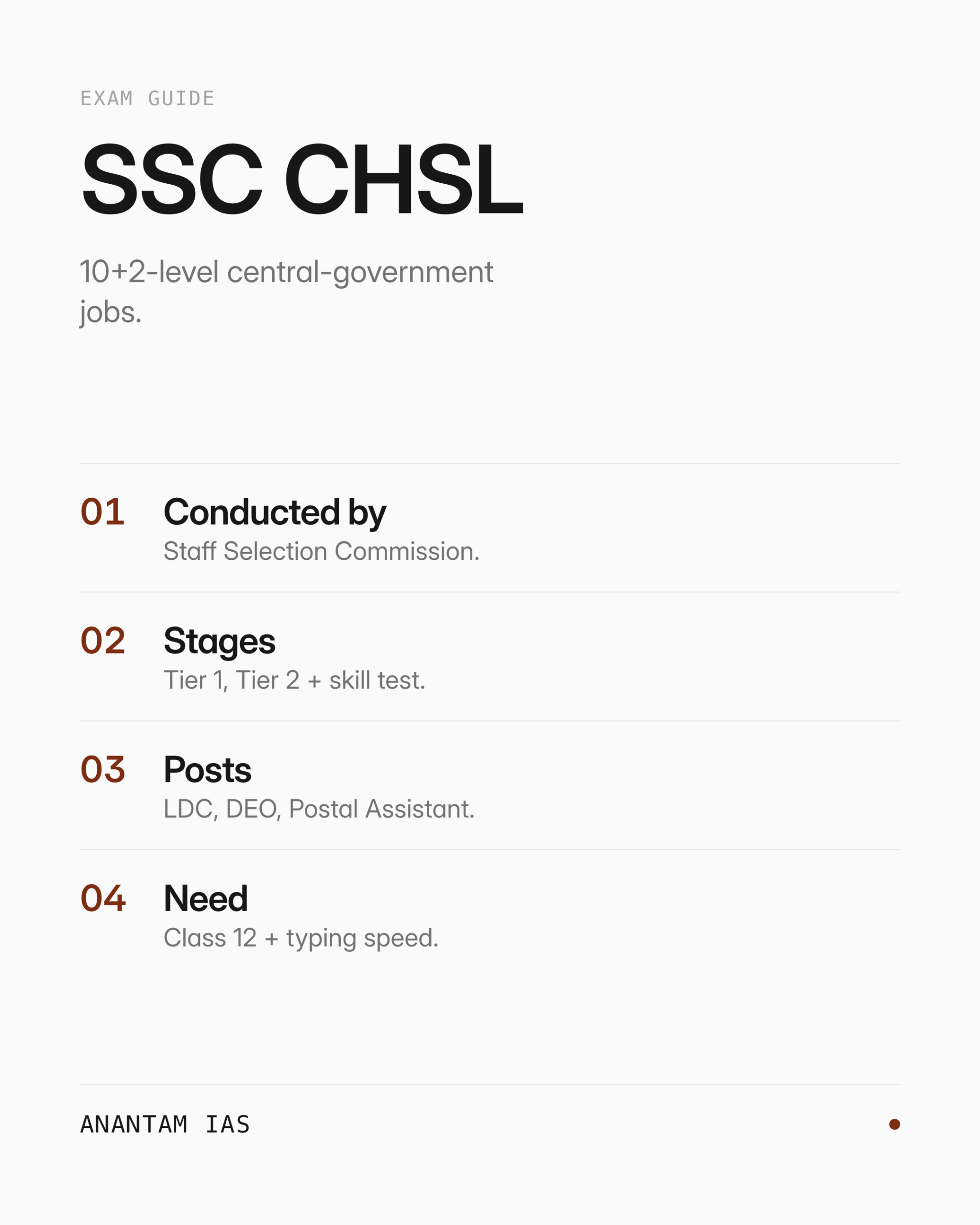
SSC CHSL (Combined Higher Secondary Level) is the Staff Selection Commission’s 10+2-level exam that recruits Lower Division Clerks, Postal/Sorting Assistants, and Data Entry Operators for Central Government offices. It is a two-tier computer-based test followed by a qualifying typing/skill test, with no interview; the minimum eligibility is a Class 12 pass and the age band is 18–27 years.
The SSC CHSL is the Staff Selection Commission’s Combined Higher Secondary Level examination — the main gateway for anyone who has cleared Class 12 and wants a stable Central Government clerical or data-entry job. One notification fills thousands of seats across ministries, departments, and offices spread all over India, which is why it draws huge numbers every year.
If you’ve finished school and don’t want to wait three years for a graduate-level exam, CHSL is the most direct route into government service. It’s a high-volume, speed-and-accuracy test rather than a deep-knowledge one, and that shapes everything about how you should prepare. This guide walks through the pattern, eligibility, syllabus, the all-important typing test, the posts on offer, and a realistic study plan.
What Is SSC CHSL?
SSC CHSL stands for Staff Selection Commission Combined Higher Secondary Level (10+2) Examination. The Staff Selection Commission, an attached office under the Department of Personnel and Training, conducts it once a year to recruit for non-gazetted, non-technical clerical and assistant posts across the Central Government.
The “10+2” in the name is the eligibility marker — you need to have passed the 12th standard. The exam is national in scale: candidates compete across all states for postings in central ministries, the Postal Department, the offices of the Comptroller and Auditor General, and dozens of other organisations.
Key Facts
- Conducting authority: Staff Selection Commission (SSC), under the Department of Personnel and Training.
- Posts recruited: Lower Division Clerk (LDC) / Junior Secretariat Assistant (JSA), Postal Assistant (PA) / Sorting Assistant (SA), and Data Entry Operator (DEO).
- Frequency: Once a year, with the notification usually out in the first half of the year and Tier 1 held mid-year.
- Scale of competition: Lakhs of applicants for a few thousand vacancies — one of the most-attempted government exams in India alongside SSC CGL.
SSC CHSL Exam Pattern
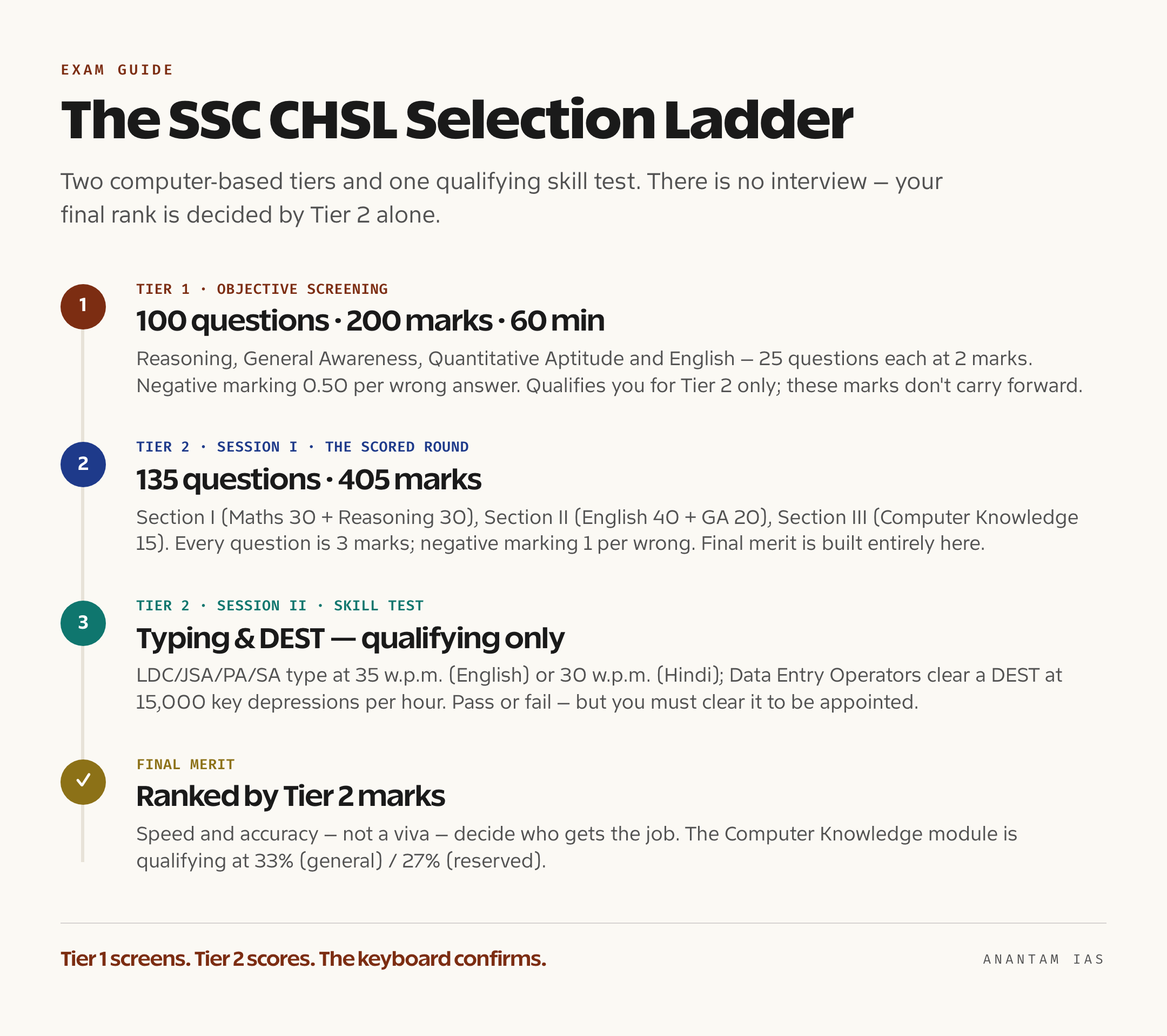
The SSC CHSL is a two-tier exam, and both tiers are computer-based. Tier 1 is purely a screening round, while Tier 2 carries the marks that decide your final selection plus a qualifying skill test. There’s no interview or personality test at any stage — unusual for a government exam, and it means your typing and your test-day accuracy do all the talking.
Tier 1 (Objective Screening)
Tier 1 is a one-hour online test of 100 questions across four sections. Each section has 25 questions worth 2 marks, so the paper totals 200 marks.
| Section | Questions | Marks |
|---|---|---|
| General Intelligence & Reasoning | 25 | 50 |
| General Awareness | 25 | 50 |
| Quantitative Aptitude | 25 | 50 |
| English Language | 25 | 50 |
| Total | 100 | 200 |
Duration is 60 minutes (80 minutes for candidates eligible for a scribe). There’s negative marking of 0.50 marks for every wrong answer. Tier 1 marks are used only to shortlist candidates for Tier 2 — they don’t carry into the final merit list. Because scores cluster tightly at this level, even one or two careless errors can push you below the cut-off.
Tier 2 (Objective, with Modules)
Tier 2 is where selection is actually decided. It runs in two sessions on the same day and is built from three sections, each split into modules. Every question carries 3 marks, and there’s negative marking of 1 mark per wrong answer.
| Section | Modules | Questions | Marks |
|---|---|---|---|
| Section I | Mathematical Abilities (30) + Reasoning & General Intelligence (30) | 60 | 180 |
| Section II | English Language & Comprehension (40) + General Awareness (20) | 60 | 180 |
| Section III | Computer Knowledge Module (15) | 15 | 45 |
| Total (Session I) | 135 | 405 |
Session I covers Sections I and II plus the Computer Knowledge module. Session II is the Skill Test / Typing Test module, held later the same day. The Computer Knowledge module is qualifying — you need to clear it (33% for general candidates, 27% for reserved categories) but its marks aren’t added to the merit total. Final ranking comes from your scored Tier 2 sections.
A quick comparison: where UPSC and most state PSCs run a written Mains plus an interview, CHSL replaces the interview entirely with a typing test. Your speed at the keyboard can make or break an otherwise strong attempt.
SSC CHSL Eligibility
The bar to apply is deliberately low, which is the whole point of a 10+2 exam — it opens government service to school-leavers.
Nationality: You must be a citizen of India, or a subject of Nepal or Bhutan, or fall into the other narrow categories the Staff Selection Commission specifies in its notification.
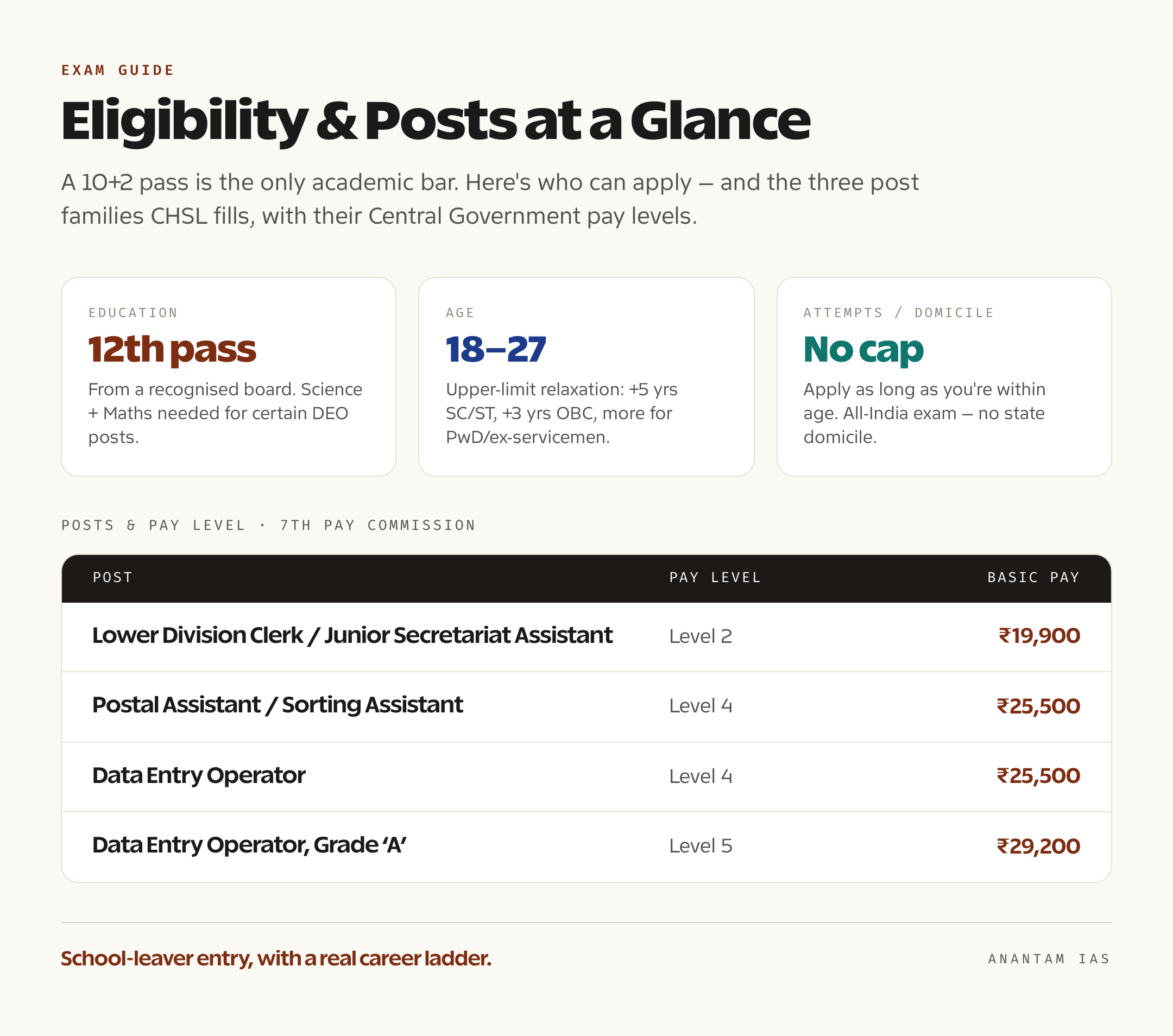
Educational qualification: You need to have passed the 12th standard (or equivalent) from a recognised board. SSC doesn’t look at your marks — a pass is enough for most posts. There’s one exception: for Data Entry Operator posts in certain ministries (such as the office of the Comptroller and Auditor General), you must have passed 10+2 in the Science stream with Mathematics as a subject.
Age limit: The general age band is 18 to 27 years as on the cut-off date in the notification. Age relaxation applies on the upper limit — 5 years for SC/ST candidates, 3 years for OBC, and further relaxations for PwD, ex-servicemen, and other reserved categories as per government rules. There’s no cap on the number of attempts; you can keep applying as long as you’re within the age limit.
Domicile: CHSL is an all-India exam, so there’s no state domicile requirement — anyone eligible can apply, and postings can be anywhere in the country.
SSC CHSL Syllabus
The CHSL syllabus is broad but shallow. It rewards coverage and recall rather than the analytical depth that a graduate-level exam demands. The same four subject areas appear in both tiers, just at greater length in Tier 2.
Prelims Syllabus (Tier 1)
- General Intelligence & Reasoning: Analogies, classification, coding-decoding, series, blood relations, syllogism, non-verbal reasoning (figures, mirror images), and arrangements. This is the most scoring section with practice.
- General Awareness: Static GK (history, geography, polity, economics, general science), plus current affairs of the last six to twelve months. Books, awards, sports, and important dates feature regularly.
- Quantitative Aptitude: Number system, percentages, ratio and proportion, averages, time-speed-distance, profit and loss, simple and compound interest, mensuration, basic algebra, trigonometry, and data interpretation.
- English Language: Spotting errors, fill in the blanks, synonyms and antonyms, spellings, idioms and phrases, one-word substitution, sentence improvement, and reading comprehension.
Mains Syllabus (Tier 2)
Tier 2 expands the same four areas and adds a computer section:
- Mathematical Abilities: A deeper version of Tier 1 quant — arithmetic, algebra, geometry, mensuration, trigonometry, and statistics with more multi-step problems.
- Reasoning & General Intelligence: Harder logical, analytical, and non-verbal reasoning sets.
- English Language & Comprehension: Grammar, vocabulary, and longer comprehension passages, with the largest question count in Section II.
- General Awareness: The same static-plus-current mix, slightly fewer questions.
- Computer Knowledge Module: Basics of computer organisation, MS Office, internet and email, networking fundamentals, and computer security. This module is qualifying only.
The Typing / DEST Skill Test
This is the section that genuinely separates CHSL from CGL, and it’s where many otherwise-strong candidates lose their seat. The skill test is qualifying — pass or fail, not scored — but you must clear it to be appointed.
- Data Entry Operators: A Data Entry Speed Test (DEST) requiring a speed of 15,000 key depressions per hour on a given passage. DEO candidates are tested on raw keyboard output, so accuracy under time pressure is everything.
- LDC / JSA / Postal Assistant / Sorting Assistant: A typing test at 35 words per minute in English or 30 words per minute in Hindi, measured on a 10-minute passage. The English speed corresponds to roughly 10,500 key depressions per hour.
Start daily typing practice the day you decide to attempt CHSL. Speed builds slowly, and you can’t cram it in the final week the way you might revise GK.
SSC CHSL Preparation Strategy
CHSL rewards consistency over intensity. The syllabus isn’t hard; the challenge is doing easy questions fast and right, again and again, under a ticking clock.
Build the Foundation with NCERTs
For General Awareness and the static portions, NCERT textbooks for Classes 6 to 10 cover history, geography, polity, and general science at exactly the right depth for CHSL. There’s no need for thick UPSC standard books at this level — over-reading wastes time you should spend on practice.
Drill Quant and Reasoning Daily
These two sections are the most scoring because answers are objective and improve directly with practice. Master shortcuts for percentages, ratios, and time-speed-distance, and solve reasoning sets daily until pattern recognition becomes automatic. Aim to clear the easy questions in under 40 seconds each so you bank time for the tougher ones.
Make Current Affairs a Daily Habit
Read a current-affairs digest covering roughly the last six to twelve months — national and international events, awards, sports, books, and government schemes. Twenty focused minutes a day beats a panicked month-end binge.
Analyse Previous Year Questions
Solving past CHSL papers tells you which topics repeat and how questions are framed. SSC recycles question types heavily, so PYQ analysis is one of the highest-return activities you can do. Track which areas cost you marks and fix those first.
Take Full-Length Mock Tests
Sit timed, full-length mocks under exam conditions, then review every wrong answer. Mocks train the two things CHSL actually tests: time management and the discipline to skip a question when negative marking makes a guess too risky. Build the habit of moving on rather than getting stuck.
Practise Typing from Day One
Treat typing as a separate, parallel track. Practise on a typing tutor every single day, working on Hindi too if you plan to use it for the test. By exam time you want your speed comfortably above the cut-off, with low error rates — qualifying margins leave no room for a bad day.
Posts, Salary & Career
CHSL fills three families of posts, each mapped to a Central Government pay level under the 7th Pay Commission.
| Post | Pay Level | Approx. Basic Pay |
|---|---|---|
| Lower Division Clerk (LDC) / Junior Secretariat Assistant (JSA) | Level 2 | ₹19,900 |
| Postal Assistant (PA) / Sorting Assistant (SA) | Level 4 | ₹25,500 |
| Data Entry Operator (DEO) | Level 4 | ₹25,500 |
| Data Entry Operator, Grade ‘A’ | Level 5 | ₹29,200 |
On top of basic pay you get Dearness Allowance, House Rent Allowance (which varies by city class), Transport Allowance, and the usual central benefits. In-hand pay for an LDC/JSA typically works out to roughly ₹24,000 to ₹29,000 a month early on, and rises meaningfully with annual increments and DA revisions.
Career growth is steady rather than dramatic. An LDC can move up to Upper Division Clerk and onward through departmental promotions and limited departmental examinations. Postings carry job security, a defined career ladder, and — for many school-leavers — a respected first step that can be combined with a graduate degree and a later attempt at SSC CGL or a state PSC.
Frequently Asked Questions
Is SSC CHSL only for 12th-pass candidates, or can graduates apply too?
Both can apply. The minimum qualification is a Class 12 pass, but there’s no upper educational bar, so a large share of CHSL aspirants are actually graduates competing for a quick, stable government job. Graduates don’t get any extra advantage in scoring — everyone takes the same exam.
How hard is the SSC CHSL typing test, and what speed do I need?
For LDC/JSA and Postal/Sorting Assistant posts you need 35 words per minute in English or 30 in Hindi over a 10-minute passage; for Data Entry Operator you need 15,000 key depressions per hour. It’s qualifying, not scored, but you must clear it — and with daily practice from the start of your preparation, most candidates reach the required speed comfortably.
Does SSC CHSL have an interview?
No. CHSL has no interview or personality test. Selection runs through Tier 1 (screening), Tier 2 (the scored objective exam), and the qualifying skill or typing test. Your final merit is decided entirely by your Tier 2 marks.
What’s the difference between SSC CHSL and SSC CGL?
CHSL is the 10+2 level exam for clerical and data-entry posts and needs only a Class 12 pass. SSC CGL is the graduate-level exam for higher posts like Inspector, Assistant, and Auditor, and requires a bachelor’s degree. CGL roles sit at higher pay levels, but CHSL is the faster entry point straight after school.
Tell Google you want more of this.
Add Anantam IAS as a preferred sourceOne tap, and this site shows up more often in your own Top Stories, AI Overviews and AI Mode. Remove it any time.