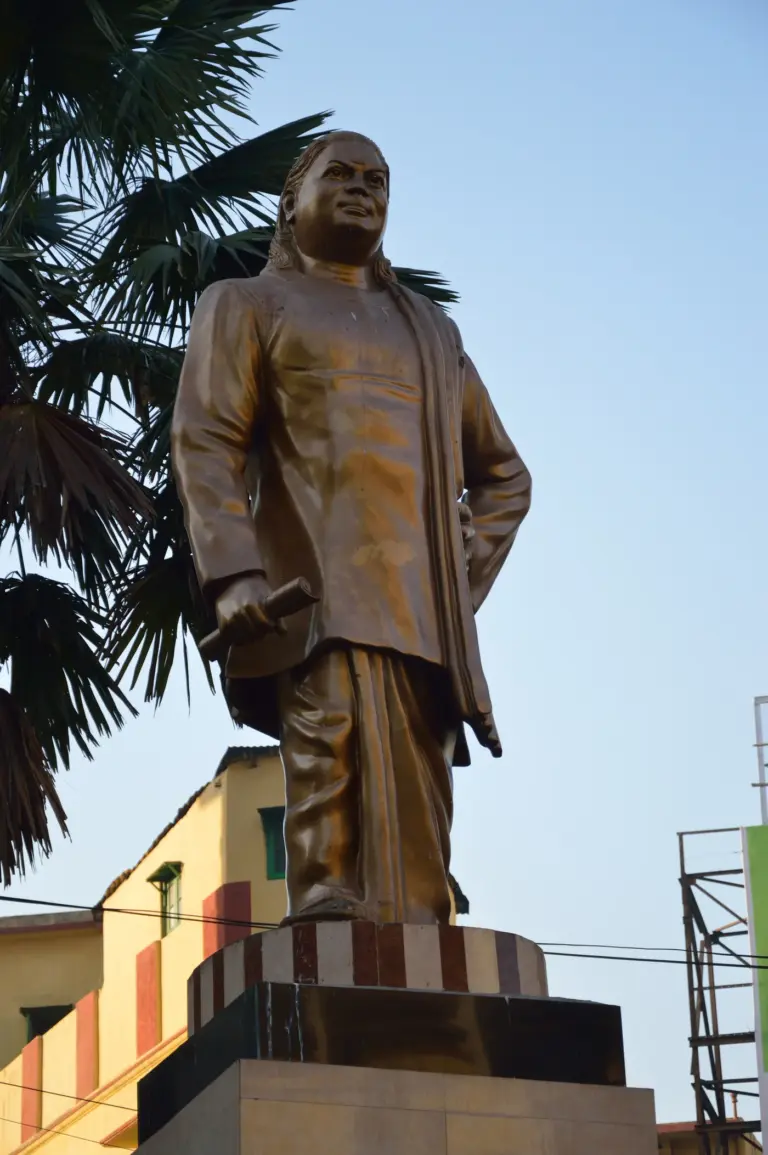
The Swaraj Party, also called the Congress–Khilafat Swarajya Party, was founded on 1 January 1923 in Allahabad by Chittaranjan Das (CR Das) and Motilal Nehru. It emerged from a sharp internal debate in the Indian National Congress over whether to continue boycotting the legislatures created under the Government of India Act of 1919 or to enter them and obstruct the colonial administration from within. The Swarajists, as they came to be known, pioneered a strategy of constitutional obstruction that redefined nationalist politics during the mid-1920s. For UPSC aspirants, the Party is essential for Prelims factual questions and for Mains discussions on the evolution of the national movement between the two Non-Cooperation and Civil Disobedience phases.
Historical Background
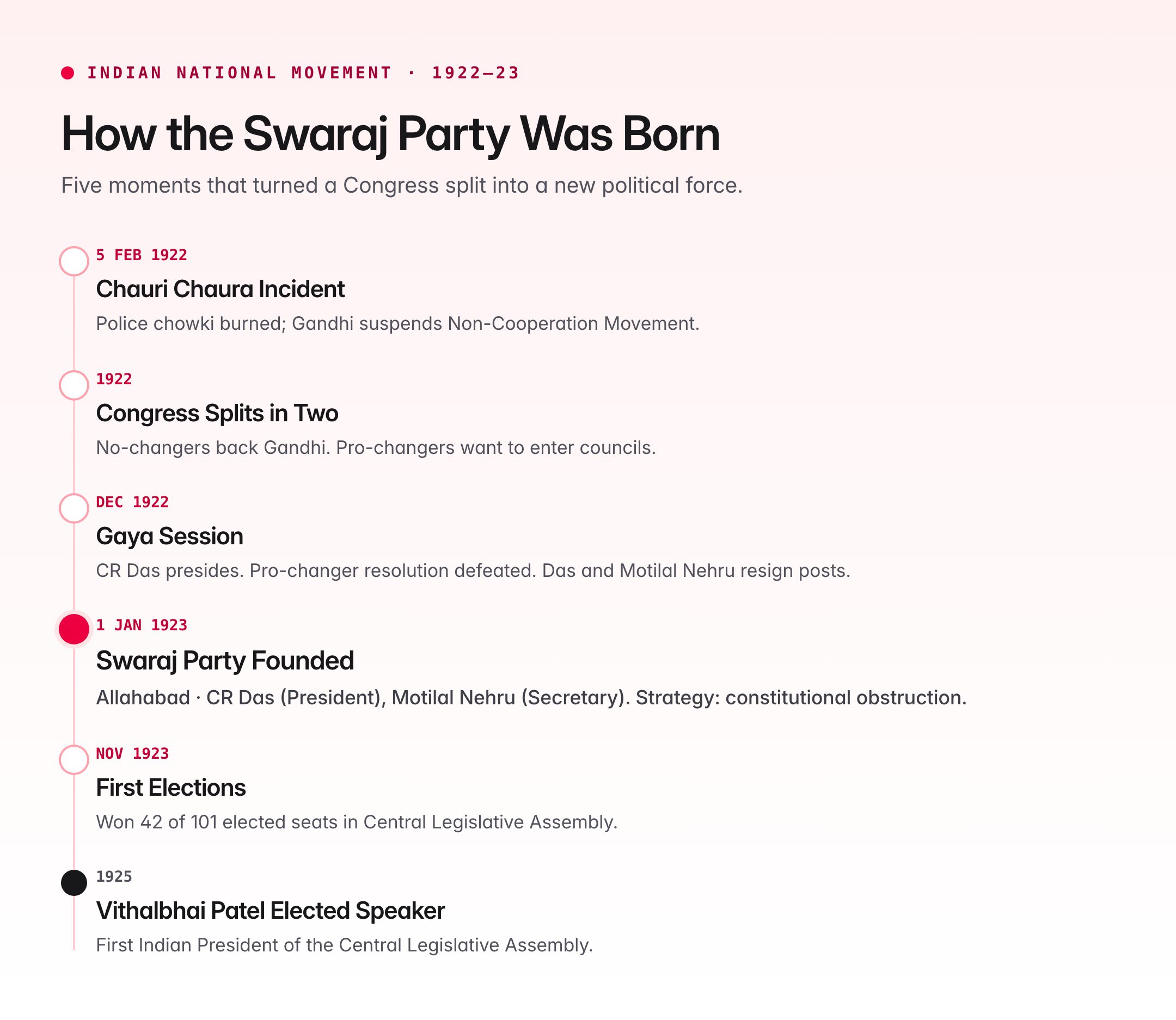
After Gandhi suspended the Non-Cooperation Movement following the Chauri Chaura incident on 5 February 1922, the Congress faced a strategic vacuum. Many leaders felt that sudden withdrawal had demoralised cadres, wasted organisational strength, and left the colonial system to function unchallenged. Simultaneously, the 1919 Montagu–Chelmsford Reforms had created enlarged provincial councils under dyarchy, and elections were due. The question was whether to continue the Congress's boycott of these bodies or to use them as platforms for nationalist struggle.
This produced two factions within the Congress.
| Faction | Position |
|---|---|
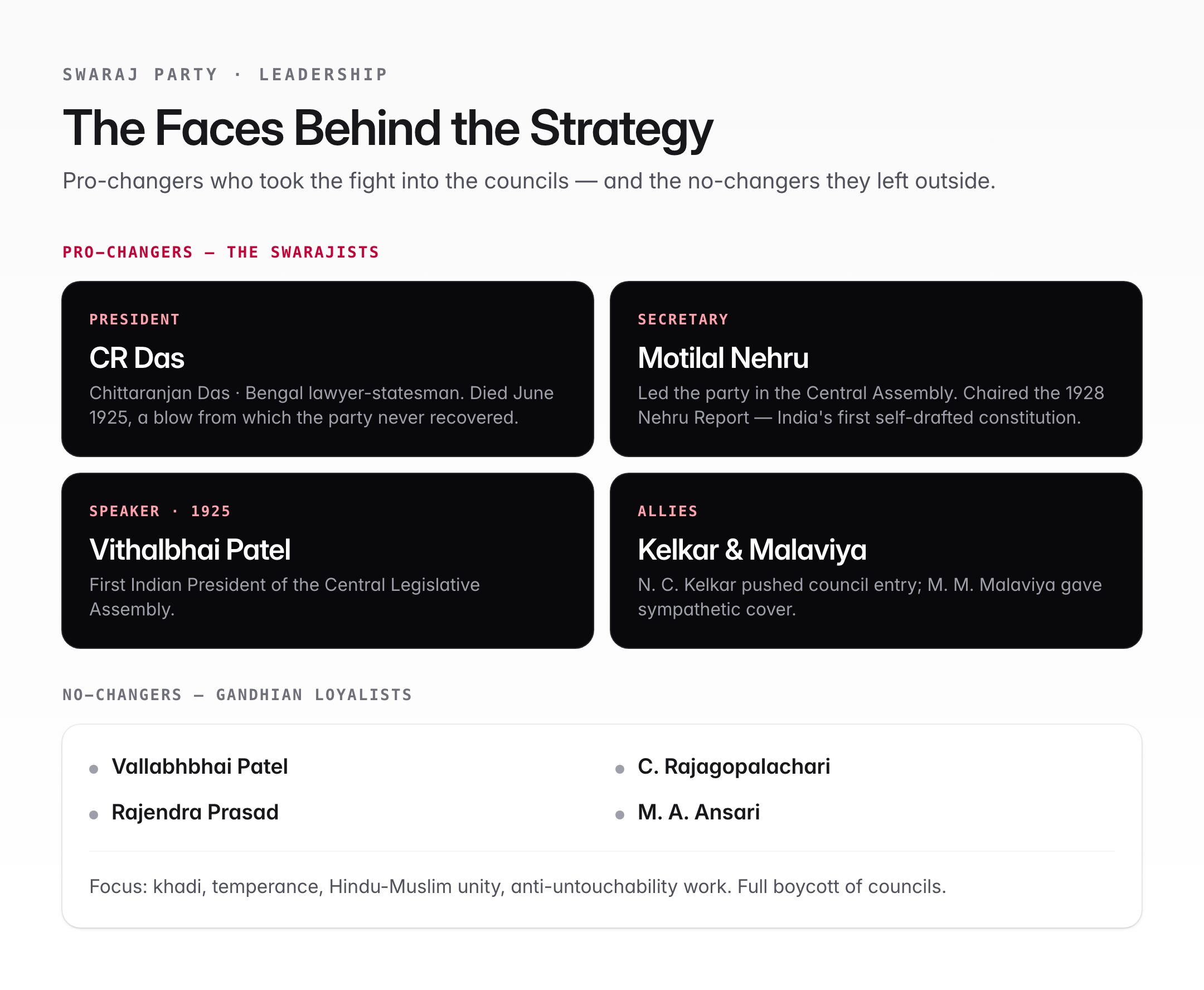
| No-changers | Loyal to Gandhi's constructive programme; opposed council entry; focused on khadi, temperance, Hindu–Muslim unity, and anti-untouchability work. Leaders: Vallabhbhai Patel, C. Rajagopalachari, Rajendra Prasad, M. A. Ansari. |
| Pro-changers | Wanted to enter councils and obstruct government from within. Leaders: CR Das, Motilal Nehru, Vithalbhai Patel, N. C. Kelkar, Madan Mohan Malaviya (sympathetic). |
At the Gaya Session of the Congress (December 1922), presided over by CR Das, the pro-changers' proposal for council entry was defeated. CR Das and Motilal Nehru resigned from their Congress posts and formed the Swaraj Party on 1 January 1923 while remaining inside the Congress.
Formation of the Swaraj Party
- Date: 1 January 1923
- Place: Allahabad
- President: CR Das
- Secretary: Motilal Nehru
- Parent body: Indian National Congress (Swarajists retained Congress membership)
- Formal name: Congress–Khilafat Swarajya Party
Objectives and Programme
The Swaraj Party's manifesto and election programme set out a distinctive strategy.
| Objective | Method |
|---|---|
| Attain Swaraj (self-government) | Through council entry and parliamentary pressure. |
| Obstruct the colonial government from within | Move adjournment motions, reject budgets, block official bills. |
| Expose the hollowness of dyarchy | Use council debates to show that real power remained with the British. |
| Demand constitutional reform | Dominion status, full responsible government, reform of the Government of India Act 1919. |
| Continue Gandhi's constructive programme | Khadi, national education, Hindu–Muslim unity, removal of untouchability — outside the councils. |
| Contest elections | Stand candidates for central and provincial legislatures. |
1923 Council Elections: Entry and Success
The Swaraj Party contested the November 1923 elections held under the Government of India Act 1919 and performed impressively.
- Central Legislative Assembly: Swarajists won 42 of 101 elected seats. With support from Liberals and Independents, they could often defeat government motions.
- Provincial performance: They secured majorities or near-majorities in the Central Provinces and Bengal, and strong representation in Bombay and Uttar Pradesh.
- Central leadership: Motilal Nehru led the party in the Central Legislative Assembly. Vithalbhai Patel was elected President (Speaker) of the Central Legislative Assembly in 1925, the first Indian to hold that chair.
Contributions and Achievements
Despite the short window of influence, the Swaraj Party left a clear record.
- Defeat of the 1924–25 Budget and the Finance Bill — demonstrating that an organised opposition could embarrass the government.
- Rejection of the Public Safety Bill (1928) aimed at deporting communist agitators.
- Exposing dyarchy — the Bengal and Central Provinces councils blocked salaries of ministers, making dyarchy unworkable in those provinces.
- Demand for the Muddiman Committee (1924) to review the working of the 1919 reforms; the Swarajists submitted a strong minority report.
- Nehru Report (1928) — Motilal Nehru chaired the committee that produced India's first attempt at drafting a self-made constitution in response to the Simon Commission.
- Parliamentary apprenticeship — a generation of Congress leaders learned legislative technique, a skill that later shaped the Constituent Assembly.
- Integration of constitutional and extra-constitutional methods — the Swaraj Party kept Congress politically relevant during a phase when mass movement was not feasible.
Decline of the Swaraj Party
The Party's decline set in by 1925–26 for several reasons.
| Cause | Detail |
|---|---|
| Death of CR Das (16 June 1925) | The Party lost its most inspiring and unifying leader. |
| Internal splits | Communal tension rose; the Responsivist faction under Madan Mohan Malaviya, Lala Lajpat Rai, and N. C. Kelkar advocated cooperation with the government on some issues and accepted office. The Non-Responsivists under Motilal Nehru opposed this. |
| Revival of communal politics | Hindu–Muslim riots in the mid-1920s eroded the Party's Hindu–Muslim unity plank. |
| Loss of seats in 1926 elections | Performance slipped except in Madras and Central Provinces. |
| Return to mass politics | The Simon Commission (1927), the Lahore Congress resolution for Purna Swaraj (1929), and the launch of Civil Disobedience (1930) pulled energy back to street-level agitation. |
After 1930, the Swaraj Party effectively dissolved back into the mainstream Congress.
Swarajists vs No-changers: A Quick Comparison
| Aspect | Swarajists (Pro-changers) | No-changers |
|---|---|---|
| Leaders | CR Das, Motilal Nehru | Patel, Rajagopalachari, Rajendra Prasad |
| Strategy | Enter councils, obstruct | Constructive village programme |
| Core method | Legislative obstruction | Khadi, education, unity |
| View on Gandhi | Respectful but tactically independent | Loyal to Gandhian line |
| Attitude to boycott | Partial — boycott outside, obstruct inside | Full boycott of councils |
Significance for the National Movement
The Swaraj Party is important for three lasting reasons.
First, it demonstrated that the Indian national movement was flexible enough to combine mass agitation with constitutional struggle, a dual-track approach that later informed Congress strategy under the Government of India Act 1935 and in 1937 ministries.
Second, it produced the Nehru Report of 1928, the first comprehensive Indian draft constitution, and it trained leaders in legislative craft — skills that proved indispensable in the Constituent Assembly of 1946–50.
Third, it kept the Congress organisationally alive during a lull in mass politics between Non-Cooperation (1920–22) and Civil Disobedience (1930–34), preventing the colonial government from claiming that nationalist sentiment had collapsed.
Quick Revision Table
| Point | Fact |
|---|---|
| Founded | 1 January 1923, Allahabad |
| Founders | CR Das, Motilal Nehru |
| Trigger | Suspension of Non-Cooperation after Chauri Chaura (1922) |
| Congress session that rejected council entry | Gaya, December 1922 |
| Strategy | Council entry and obstruction |
| First major election | 1923 (Central Legislative Assembly) |
| Key milestone | Defeat of the 1924–25 Budget |
| First Indian Speaker of Central Assembly | Vithalbhai Patel, 1925 |
| Blow to party | Death of CR Das, 1925 |
| Notable report | Nehru Report, 1928 (by Motilal Nehru) |
UPSC Relevance
The Swaraj Party is a staple Prelims topic, especially in statement-based and matching questions involving CR Das, Motilal Nehru, Vithalbhai Patel, the Nehru Report, and the 1923 elections. Aspirants must remember the Gaya Session of 1922, the pro-changers versus no-changers split, and that the Swaraj Party never left the Congress. In Mains GS Paper I, it appears in questions on the strategies of the Indian national movement between 1922 and 1930, on the evolution of constitutional politics, and on the bridge between Non-Cooperation and Civil Disobedience. Link it with the Government of India Act 1919, Montagu–Chelmsford Reforms, Simon Commission, and the Nehru Report. In Essay writing, the Swaraj Party is a powerful example of how tactical flexibility and principled disagreement coexisted within a mass movement, a theme that resonates with questions on leadership, pluralism, and democratic politics in modern India.
Tell Google you want more of this.
Add Anantam IAS as a preferred sourceOne tap, and this site shows up more often in your own Top Stories, AI Overviews and AI Mode. Remove it any time.